
Guide
What is spirituality? A plain guide, with or without religion
Updated 25 October 2026 · 8 min read
Spirituality is a sense of connection to something bigger than yourself, along with a search for meaning and purpose. It can be religious or not. Some people find it in faith, others in nature, community, art or their values. There is no single definition, so you can explore it in your own way.
A plain-language reflection guide for readers of any belief or none · Part of self-discovery
You might be wondering whether you are 'spiritual', or whether the word even fits you. Maybe you have a faith. Maybe you have none, and still feel something when you stand by the sea or sit with someone you love.
Whatever you believe, or if you believe nothing in particular, you will not be asked to believe anything here. This is self-help, not therapy. If big questions ever feel heavy or frightening, there is support further down.
What is spirituality?
In plain terms, spirituality is a sense of connection to something bigger than yourself, and the search for meaning and purpose that goes with it. That 'something' could be a god, the natural world, other people, the universe, your ancestors, or simply life itself. It can be religious. It can be completely non-religious.
Definitions vary a lot. Some people use the word for belief and ritual. Some use it for a feeling of awe, peace or belonging. Some use it for how they try to live, in line with what matters to them. None of these is the one correct version, so it is fine if the word fits you loosely, or not at all.
Spirituality is not a skill you pass or fail at, and nobody can rank how spiritual you are. It is a way of asking what you are connected to and what gives your life meaning.
Spirituality and religion: what's the difference?
The two overlap, and people draw the line in different places. One way to put it: religion is a shared system of beliefs, practices and community, with a tradition, texts and set ways to worship. Spirituality is the wider, more personal question of meaning and connection, and it can sit inside a religion or outside one.
- You can be religious and also think of your faith as deeply personal.
- You can be religious and not use the word 'spiritual' at all.
- You can be spiritual without belonging to any religion.
- You can be neither, and still care about meaning, purpose and connection.
All of these are valid. Nothing here asks you to pick a side, adopt a belief or give one up.
Signs of spirituality in everyday life
Spirituality does not have to look like prayer or meditation. You might see it in moments like these. You do not need all of them, and not having them says nothing bad about you.
- You feel awe or wonder at something large, such as a night sky, a mountain or a newborn baby.
- You ask big questions: why am I here, what matters, what happens next.
- You feel connected to other people, to a place or to nature.
- You feel a pull towards something you would call meaningful, even if you cannot explain it.
- You have a ritual or habit that steadies you, such as a quiet morning cup of tea, a walk or lighting a candle.
- You try to act in line with your values, even when it is inconvenient.
- You feel moved by music, art, poetry or a story.
- You find comfort in stillness, or in being part of something shared.
Ways to explore your spirituality
There is no required route. These steps are ideas to try. Pick the ones that appeal and leave the rest.
- 1Notice what moves you. For a week, jot down moments when you felt awe, peace, wonder or deep care. Look for patterns in where you were and who you were with.
- 2Make a little quiet time. Even five minutes of sitting without your phone gives questions room to surface. You can sit, walk slowly or simply look out of a window.
- 3Spend time in nature. A park, a garden or the sky will do. Pay attention to what you see, hear and feel, without needing to get anything from it.
- 4Name your values. Your values are the things you care about most. They often point to what feels meaningful. The core values worksheet helps you pick them out.
- 5Find community, if you want it. That could be a faith group, a volunteering project, a book club or a circle of friends who talk about big things. Being with others who share your questions can help, but you are free to explore alone too.
- 6Write it down. Journaling lets you ask questions without needing answers. Try the prompts below, or start with the who am I? worksheet.
- 7Read widely and stay curious. Reading about different traditions, philosophies and viewpoints, from religious texts to nature writing, can show you ideas you had not met. You can take what resonates and leave what does not.
Spiritual journaling prompts
Take one prompt at a time and write for a few minutes. Honest and messy is better than polished. If a prompt does not suit you, skip it. For more ideas on getting started, see how to start journaling. You can also use the ikigai worksheet or the mindfulness journal prompts.
- What does the word 'spiritual' mean to me? Does it fit, and why or why not?
- When have I felt connected to something bigger than myself?
- What do I turn to when life feels hard or uncertain?
- What gives my days meaning, even on ordinary days?
- Which places, people or activities leave me feeling most like myself?
- What did I believe as a child about the world, and what do I think now?
- What am I grateful for that I rarely stop to notice?
- What do I want to be remembered for by the people close to me?
- What questions am I carrying that I do not have answers to yet?
- How do I want to treat other people and the world around me?
- What would a quiet, unhurried hour look like for me this week?
When spiritual questions feel heavy
Big questions can sometimes stop feeling curious and start feeling heavy, frightening or empty. If you feel lost, numb or stuck on whether anything matters, the existential crisis guide looks at that experience in more depth. If the heaviness has lasted a while, or is affecting your sleep, appetite, work or relationships, please talk to a GP. You do not have to work it out alone.
If a faith group, teacher or community is causing you harm, or you feel pressured, controlled, shamed or afraid, you are allowed to step back. You can take time away, talk to someone outside the group, and get support. Questioning, doubting or leaving is your choice to make.
If you have thoughts of not wanting to be alive, call Samaritans free on 116 123 (UK and Ireland), call or text 988 (US), or find a line at findahelpline.com.
When to get more support
A spiritual leader, a chaplain, a counsellor or a trusted friend can all be good people to talk to, and you can choose whichever feels right. A GP or counsellor can help if low mood, anxiety or loss of interest is getting in the way of daily life.
If you ever feel unsafe or have thoughts of harming yourself, call Samaritans on 116 123 (UK and Ireland), 988 (US), or find a line at findahelpline.com. If you are in immediate danger, call 999 (UK) or 911 (US).
Sources and further reading
This is an educational self-reflection resource, not therapy or medical advice.
Your questions, answered
- What does it mean to be spiritual?
- It means different things to different people. Put simply, it is having a sense of connection to something bigger than yourself and a wish to understand what gives life meaning. That can involve religion, nature, community, art, your values, or none of these.
- What is the difference between spirituality and religion?
- Religion is a shared set of beliefs, practices and community. Spirituality is the broader, more personal search for meaning and connection. The two overlap, and people draw the line in different places. You can have one, both or neither.
- Can you be spiritual without being religious?
- Yes. Some people feel spiritual through nature, creativity, relationships or their values, without any religious belief. Others are religious and spiritual at once. The word can mean what it honestly means to you.
- What are some examples of spirituality?
- Examples include prayer, meditation, time in nature, feeling awe at a view, music or art, helping others, keeping a quiet ritual, journaling about meaning, and joining a faith or community group. None of them is required.
- How do I start exploring my spirituality?
- Start small. Notice what moves you, make a few minutes of quiet time, spend time outdoors, write down your values, and try some journaling prompts. Read widely, talk to others if you like, and keep what feels true for you.
- Is there a free spirituality worksheet or PDF?
- There are free worksheets that fit well, such as the core values worksheet and the who am I worksheet. Each has a Download PDF button and a Print option, with no payment and no email needed. You can fill them in on screen, and your answers save in your browser.
- Is this a substitute for therapy or religious guidance?
- No. This is a self-help guide, not therapy, medical advice or religious guidance. If low mood or worry is getting in the way, speak to a GP. If you ever feel unsafe or have thoughts of harming yourself, call Samaritans on 116 123 (UK and Ireland), 988 (US), or find a line at findahelpline.com.
Worksheets to do the work
Free to fill in online or print. No email needed.
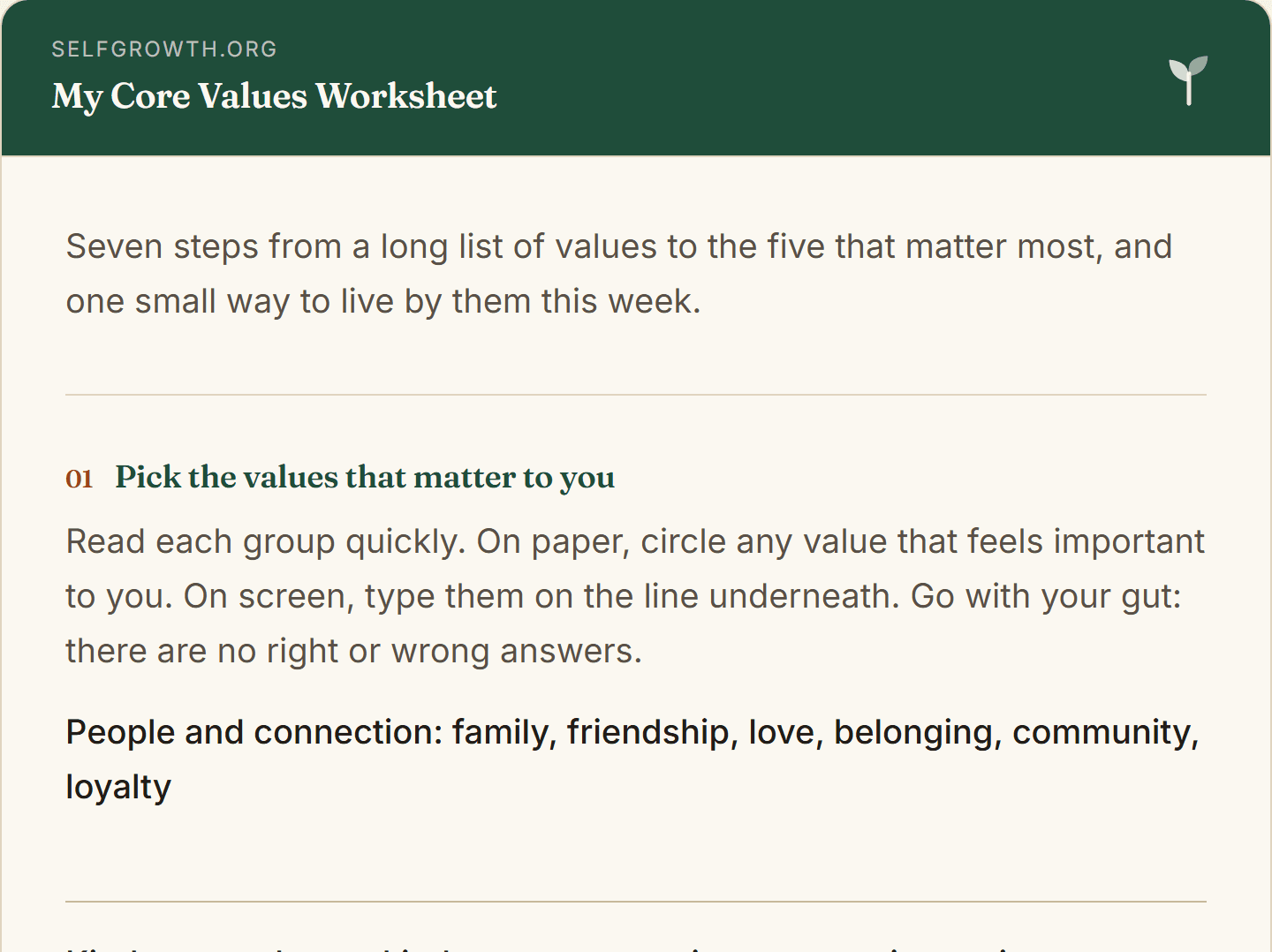
Core Values Worksheet
A free, printable core values worksheet: pick values from a list, narrow them to your top five, put them in your own words and plan one step to live by them.
Open worksheet
Who Am I? Worksheet
A free, printable 'Who am I?' worksheet to explore your identity and values, with the classic twenty-statements exercise and guided prompts.
Open worksheet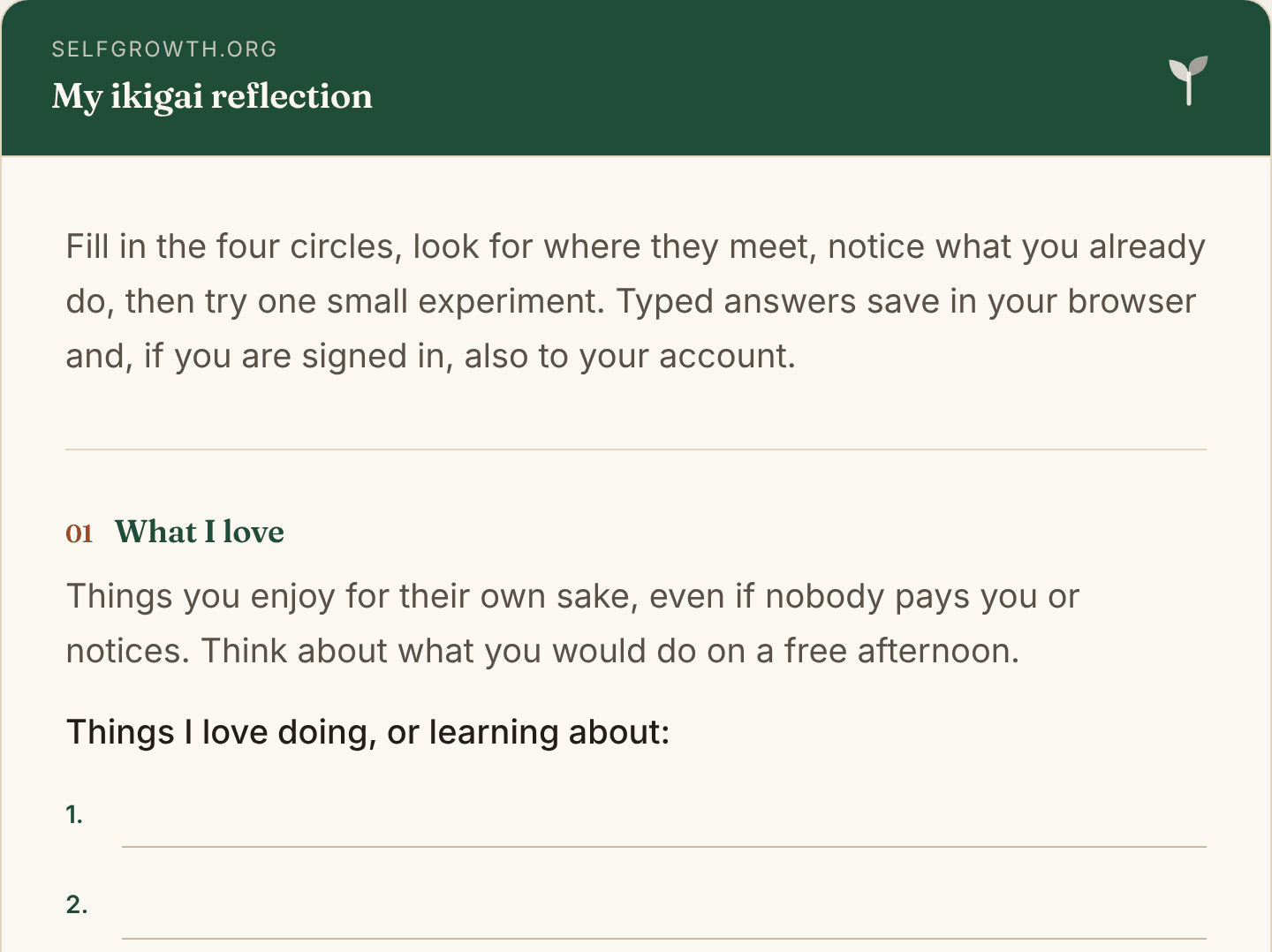
Ikigai Worksheet
A free printable ikigai worksheet: list what you love, do well, the world needs and you can be paid for, then try one small experiment this week.
Open worksheet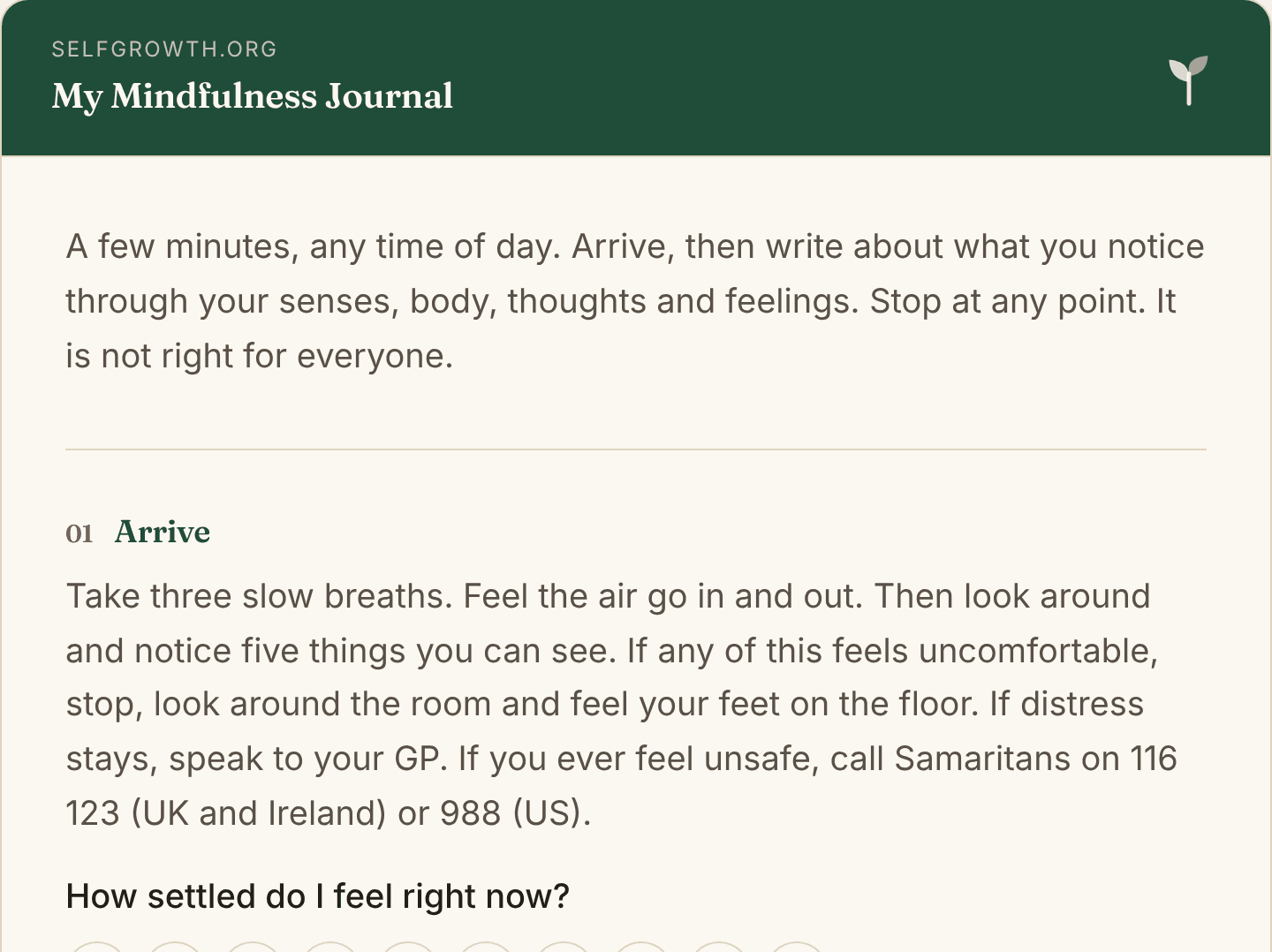
Mindfulness Journal Prompts
A free printable mindfulness journal: a three-breath start, six sets of prompts for senses, body, thoughts and feelings, and a 7-day log. A few minutes a day.
Open worksheetRelated guides
New worksheets, straight to your inbox
An occasional new worksheet or tool, sent only when there's something genuinely worth your time. No spam, no pressure, unsubscribe any time.