
Guide
How to find your purpose
Updated 23 October 2026 · 9 min read
Finding your purpose is less about a single destiny and more about a direction you can test. Notice what absorbs you, what you would regret skipping and who you want to help, then try small experiments. If the search comes with hopelessness or thoughts of not wanting to be alive, get support now.
Drawn from cognitive behavioural therapy & self-compassion research · Part of self-discovery
Questions like 'what am I here for?' and 'what should I do with my life?' can feel enormous, especially when everyone else seems to know where they are going.
Purpose does not have to be one grand answer that you find or fail to find. It can be a direction you try out, adjust and grow into. It is self-help, not therapy, and one thing comes first: if the search for meaning comes with hopelessness or thoughts of not wanting to be alive, please reach out now. Samaritans are on 116 123 (UK and Ireland), 988 is the US line, findahelpline.com lists lines elsewhere, and selfgrowth.org/help has more.
What is purpose, and is it one big answer?
Purpose is a sense of direction: a reason that makes some choices feel worth the effort. It can be about work, but it can just as well be about people, creativity, care, learning or how you want to live. It can be small. It can change as your life changes.
Thinking of purpose as a destiny waiting to be discovered can leave you stuck, because you are searching for something that may not exist as a single fixed thing. Thinking of it as a direction lets you act now: you pick something that seems worthwhile, try it, and learn from what happens.
The idea has a long history. Viktor Frankl, a psychiatrist, wrote about the search for meaning in Man's Search for Meaning, which draws on his time in the Nazi concentration camps and his theory of how people find meaning, which he called logotherapy. It is a memoir and a philosophy, not a method that has been tested the way some therapies have, but it is a thoughtful place to begin.
Researchers have also studied purpose. In a 2014 study in Psychological Science, Patrick Hill and Nicholas Turiano followed a national sample of adults in the United States, aged 20 to 75 at the start, for about 14 years. People who scored higher on purpose in life were less likely to have died during that time, even allowing for things like relationships and mood. This was an observational study, so it shows an association. It does not show that purpose causes anything, and it is not a reason to feel worse if purpose feels out of reach right now.
What questions help me explore my purpose?
You do not need to answer these in one sitting. Pick one, write whatever comes, and come back to it. The self-reflection worksheet gives you space for this.
- What absorbs you? When do you lose track of time, and what are you doing?
- What would you regret not having tried or said? Picture yourself looking back on your life: what would you want to have made room for?
- Who do you want to help or be there for? Think of a person, a group or a cause that pulls at you.
- What do you care about, even when it is inconvenient? Your values are a compass. The core values worksheet helps you name them, and the guide to finding your core values explains how.
- What are you good at, or getting good at? The strengths list worksheet helps you notice what you already bring.
- What did you love as a child or a teenager that you set aside?
- Who are you, apart from your roles and your job? The who am I worksheet is a place to start.
Look for patterns across your answers rather than one perfect sentence. A theme that shows up more than once is worth testing.
How do I find my purpose, step by step?
Purpose can become clearer through doing, not only thinking. These small experiments let you test a direction without having to commit to it.
- 1Write down two or three themes from your answers, such as helping, making things, teaching or being outdoors.
- 2Pick one theme and choose a small experiment you can do within a week: an hour of volunteering, a short course, a conversation with someone who does the work, a small project of your own.
- 3Do the experiment, then note how it felt. Did you feel energised, bored, proud, drained? Write down what you noticed, not what you think you should feel.
- 4Adjust. Keep what worked, drop what did not, and choose the next experiment. Each one gives you information.
- 5Link it to your values. Ask whether what you tried fits what you care about. If it does, think about making a little more room for it each week.
- 6Turn a direction into a goal. When a theme keeps holding up, give it a concrete next step. The goal setting worksheet helps, as does the guide to setting goals.
Remember that an experiment that does not fit is not a failure. Finding out what is not for you is part of getting closer to what is.
Open the Core Values WorksheetWhy does finding my purpose feel stuck?
Feeling stuck has reasons, and they are worth looking at.
- Waiting for certainty. Purpose may not announce itself. Acting on a best guess teaches you more than waiting.
- Looking for one answer. If you believe there is a single right purpose, every option feels like it might be the wrong one.
- Comparing. Other people's lives can look more settled from the outside than they are.
- Being worn out. When you are exhausted or stressed, little feels meaningful. Rest and support may come before direction.
- Low mood. Feeling flat or empty can drain the sense that anything matters. That is a health question, not a failure to find your passion.
If the questions are heavy and keep coming back, the guide to existential crisis looks at that experience in more depth.
When to get more support
Searching for meaning is not the same as being in danger, but sometimes it comes with hopelessness, a feeling that there is no point in carrying on, or thoughts of not wanting to be alive. Thoughts like these are serious, and you deserve support from a real person. In the UK and Ireland, call Samaritans free on 116 123, any time. In the US, call or text 988. Elsewhere, findahelpline.com lists free, confidential lines by country, and selfgrowth.org/help has more routes. If you might act on a thought or are in immediate danger, call 999 (UK) or 911 (US) or your local emergency number.
If you have felt low, empty or without interest for two weeks or more, or this is affecting your sleep, work or relationships, speak to a GP. A counsellor or therapist can also help you explore meaning at your own pace. This guide is self-help and is not a substitute for that.
Sources and further reading
This is an educational self-reflection resource, not therapy or medical advice.
If you want to go deeper
- Hill, P. L. & Turiano, N. A. (2014). Purpose in life as a predictor of mortality across adulthood. Psychological Science, 25(7), 1482-1486.
- Frankl, V. E. Man's Search for Meaning. Beacon Press. First published 1946. An account of the author's time in the Nazi concentration camps and his theory of logotherapy.
Your questions, answered
- How do I find my purpose in life?
- Treat purpose as a direction to test, not a single answer to discover. Notice what absorbs you, what you would regret skipping and who you want to help, name your values, then try small experiments and see how they feel. Adjust as you learn.
- Does everyone have a purpose?
- That is a question people have thought about for a long time, and there is no single agreed answer. A practical way to hold it is that you can choose a direction that feels worthwhile and build meaning through what you do. You do not have to find one fixed purpose to live a meaningful life.
- What if I don't know what I'm passionate about?
- You do not need a passion to begin. Start with curiosity. Try small things, notice what holds your attention and what you care about, and let interest grow from there. The core values worksheet and strengths list worksheet are good starting points.
- Is purpose the same as a career?
- No. A career can be part of your purpose, but purpose can also come from relationships, caring for others, creativity, community or the way you choose to live. Different kinds of life can be purposeful.
- Can purpose change over time?
- Yes. As your life, values and circumstances change, what feels worthwhile can change too. Returning to the same questions from time to time is a reasonable way to check your direction.
- Is there a free worksheet for finding my purpose?
- Yes. The core values worksheet, strengths list worksheet, who am I worksheet and self-reflection worksheet are all free, with a Download PDF button and no email needed. Typed answers save in your browser and, if you are signed in, also to your account.
- Is this guide a substitute for therapy?
- No. It is an educational self-help guide, not therapy or medical advice. If you are struggling, a GP or counsellor can help. If you are thinking about harming yourself or ending your life, that is serious: call Samaritans on 116 123 (UK and Ireland), call or text 988 (US), or find a line at findahelpline.com. More routes: selfgrowth.org/help. For chest pain, trouble breathing or fainting, call 999 (UK) or 911 (US) or your local emergency number; use NHS 111 if you are unsure.
Worksheets to do the work
Free to fill in online or print. No email needed.
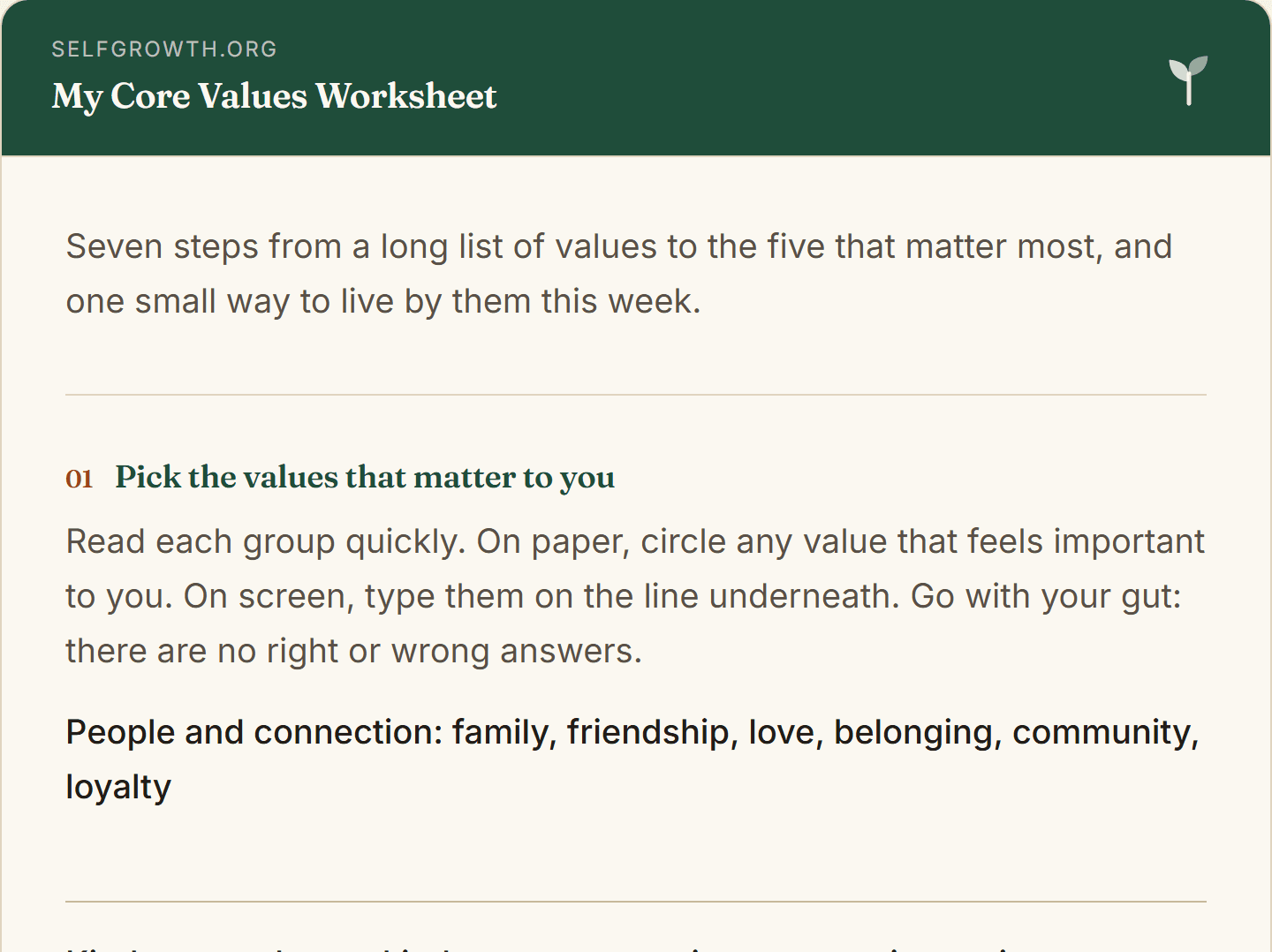
Core Values Worksheet
A free, printable core values worksheet: pick values from a list, narrow them to your top five, put them in your own words and plan one step to live by them.
Open worksheet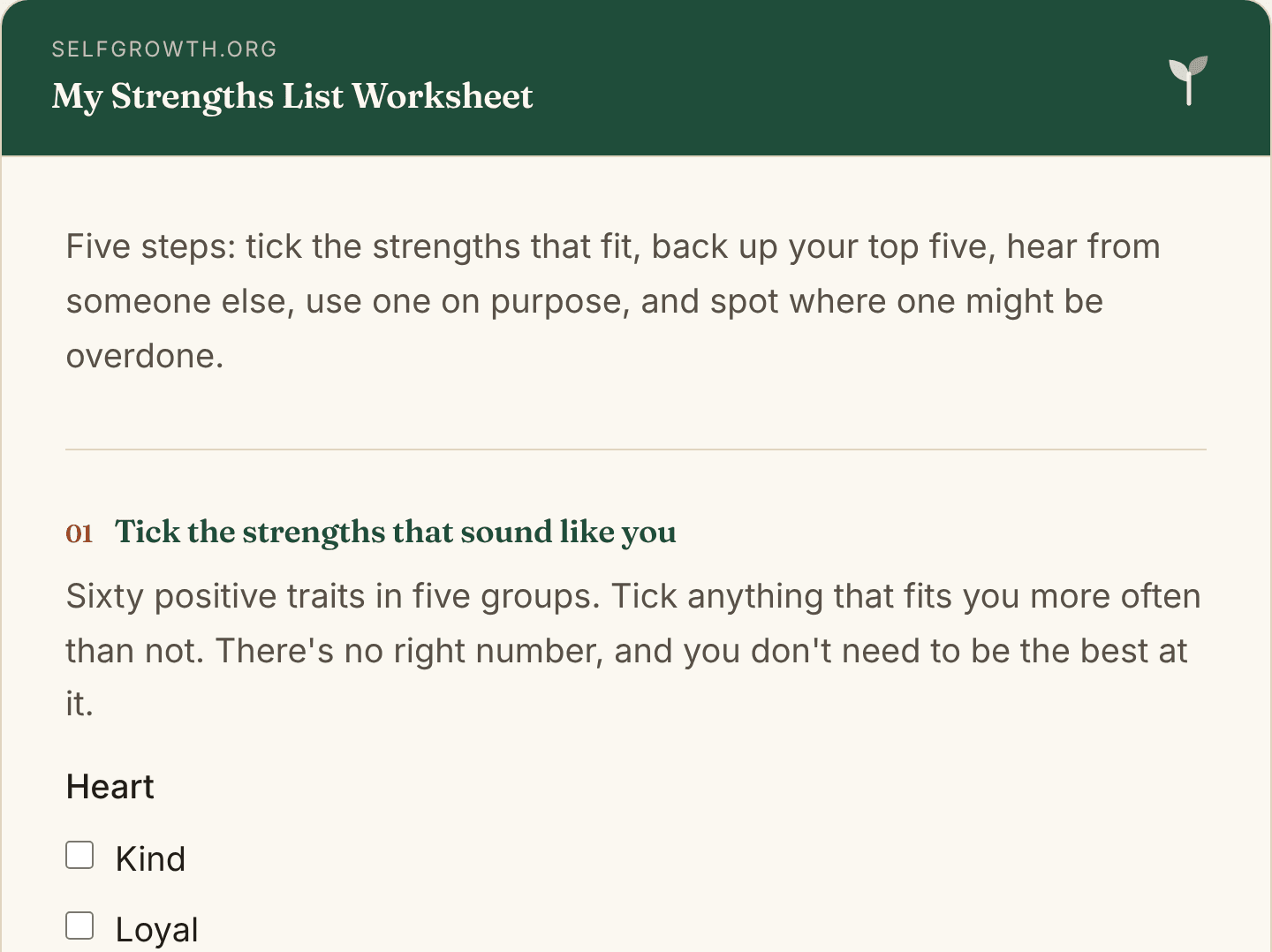
Strengths List Worksheet
A free list of 60 positive character traits and strengths to tick, with space for evidence, what others see in you and one strength to use on purpose this week.
Open worksheet
Who Am I? Worksheet
A free, printable 'Who am I?' worksheet to explore your identity and values, with the classic twenty-statements exercise and guided prompts.
Open worksheet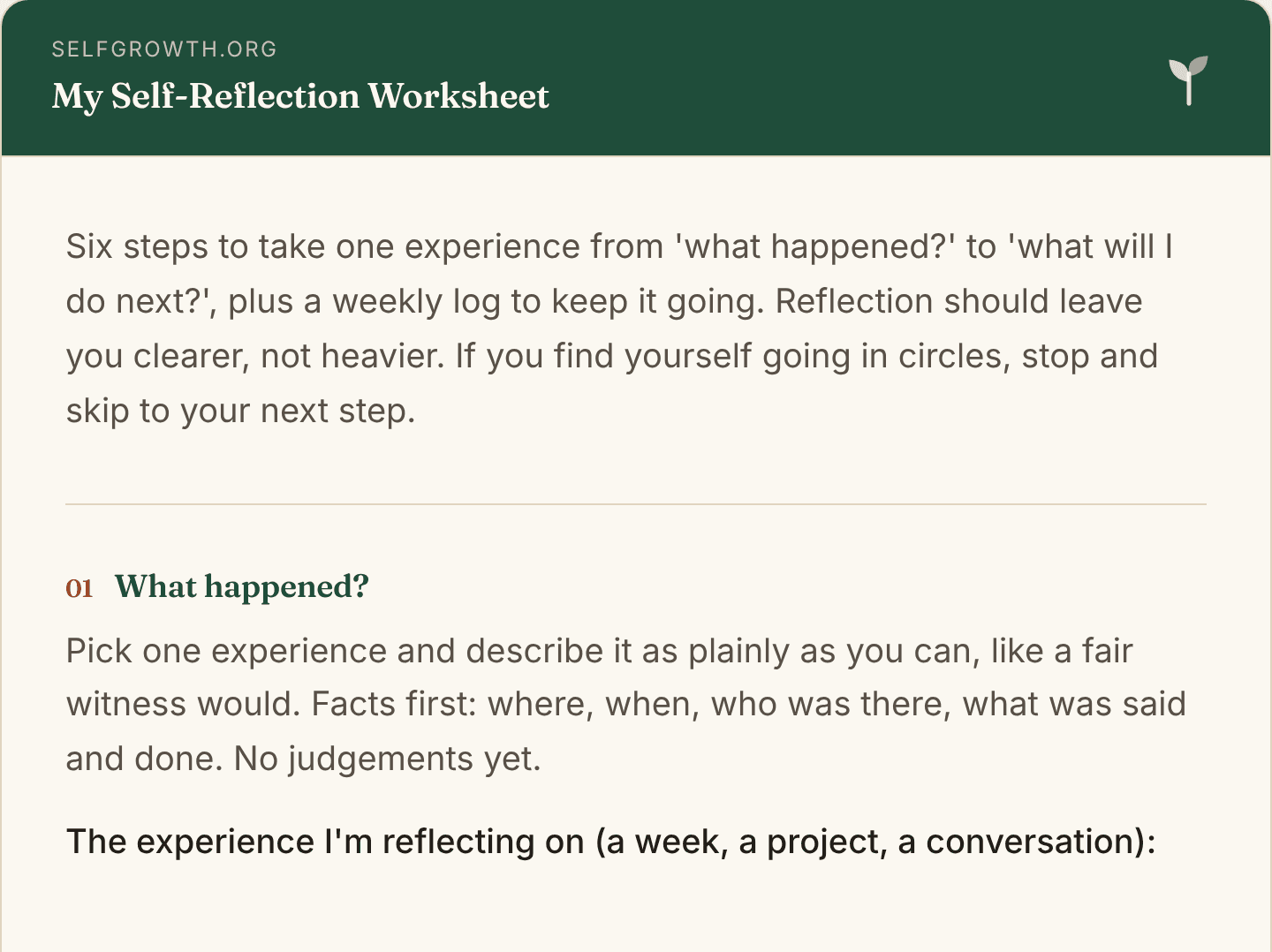
Self-Reflection Worksheet
A free, printable self-reflection worksheet: take one experience through Gibbs' reflective cycle, find your next step and keep a 10-minute weekly log.
Open worksheet
Goal-Setting Worksheet
A free, printable goal-setting worksheet that turns a vague wish into a specific goal, a when-and-where plan, and a first step you'll actually take this week.
Open worksheetRelated guides
New worksheets, straight to your inbox
An occasional new worksheet or tool, sent only when there's something genuinely worth your time. No spam, no pressure, unsubscribe any time.