
Self-confidence
Self-confidence worksheets: build confidence from evidence you already have
Updated 11 October 2026 · 6 min read · Free to print
A self-confidence worksheet builds confidence the way it actually grows: from evidence and action, not affirmations alone. This free, printable worksheet helps you list your real strengths and past wins and answer the self-doubt that talks over them. Then you pick one small, doable action, because confidence follows doing far more than positive thinking.
Drawn from self-efficacy research and action-based (ACT) approaches · Part of self-esteem and confidence
Fill it in here (it saves in this browser, but not in a private window), print it, or download the PDF. Free, no sign-up.
Temperament plays a part, but much of confidence is the trust that you can handle things, and that trust is built. It grows mostly from evidence (proof you've coped before) and from action (small reps of doing the scary thing). Affirmations can help a little, but telling yourself you're amazing rarely sticks if part of you doesn't believe it.
You don't have to feel confident to start. You'll gather the evidence you already have, name the self-doubt that drowns it out, and pick one small action, because doing the thing, even badly, can help you see you're capable.
How to use this worksheet
- 1Give it about 15–20 minutes. Fill it in online or print it and write by hand.
- 2When you list strengths and wins, count the small and ordinary ones, they're real evidence too.
- 3Pick an action small enough that you're fairly sure you'll actually do it. Tiny and done beats ambitious and skipped.
- 4Come back after you've taken the action and note what happened, that's where confidence compounds.
The worksheet
selfgrowth.org
My Self-Confidence Worksheet
Five exercises to build confidence from what's real: your strengths, your track record, and one small step.
01Where do I want more confidence?
Name the specific situation, not 'be more confident' in general.
The situation or area where I want more confidence:
How confident do I feel about it right now?
02My strengths inventory
List things you're genuinely good at, or qualities people rely on you for. Include the small and unglamorous ones too, such as 'patient', 'a good listener' or 'I finish what I start'.
- 1.
- 2.
- 3.
- 4.
- 5.
- 6.
03Evidence I've handled hard things before
Write past moments when you coped, learned, recovered, or did something that scared you. This is your track record, proof you can handle more than your doubt admits.
- 1.
- 2.
- 3.
- 4.
- 5.
04The doubt vs. the evidence
Write the self-doubt thought on the left. On the right, answer it with a specific fact from your strengths or track record above.
Entry 1
Entry 2
Entry 3
Entry 4
05One small action
Confidence follows action. Choose one small step towards your situation, small enough that you'll almost certainly do it this week.
The one small action I'll take:
When and where I'll do it:
What's the smallest first move that makes it easy to start?
When you're done, a moment to reflect
- If you fully trusted your own track record, what would you stop avoiding?
- Whose voice is the self-doubt in, is it even yours?
- What would 'confident enough' look like, not fearless, just willing to act?
Done for now?
Save today's answers as a dated entry. You can come back, fill it in again and compare the two side by side.
What is self-confidence?
Self-confidence is trust in your own ability to handle a situation. It is not a fixed trait or a feeling you wait for, and it can be strong in one area and shaky in another. It is built from what you have done before and what you do next, which is why this worksheet works on one situation at a time. Albert Bandura's research on self-efficacy found that the strongest source of confidence is a track record of small successes, what he called mastery experiences. That's why you start here by gathering real proof of what you've handled before, then add to it with one small action, rather than leading with affirmations.
If your doubt covers your whole opinion of yourself rather than one situation, the self-esteem worksheets for adults are a closer fit, and self-worth vs self-esteem explains the difference.
It also borrows from acceptance and commitment approaches, where the move is to act alongside the nerves rather than waiting for them to disappear, because confidence usually follows action, not the other way round.
These are educational self-reflection tools, not therapy.
If you want to go deeper
- Albert Bandura — Self-Efficacy: The Exercise of Control (W. H. Freeman, 1997): the foundational research on building confidence from mastery experiences.
- Wood, J. V., Perunovic, W. Q. & Lee, J. W. (2009). Positive self-statements: Power for some, peril for others. Psychological Science, 20(7), 860-866.
- Russ Harris — The Confidence Gap (Robinson, 2011): the ACT-based case for action before confidence.
- Melanie Fennell — Overcoming Low Self-Esteem (Robinson, 1999): the CBT model behind examining and rebalancing self-doubt.
Your questions, answered
- What are the signs of low self-confidence?
- Common signs include avoiding things you'd like to do because you expect to get them wrong, waiting to feel ready before you start, putting your successes down to luck, checking with someone else before small decisions, and saying 'I can't' before you've tried. Most are about avoiding or discounting, and both are habits you can change one small action at a time.
- What is the difference between self-confidence and self-esteem?
- Self-confidence is belief in your ability to do something specific, such as speak up in a meeting. Self-esteem is your overall opinion of yourself as a person. You can have one without the other: you might be confident at work and still feel you are not good enough. This worksheet works on confidence in one situation; the self-esteem worksheets look at the bigger picture.
- What causes low self-confidence?
- Albert Bandura's self-efficacy research describes four sources of belief in your ability. The first is your own track record. The second is seeing others manage it. The third is encouragement or criticism from other people. The fourth is how you read your nerves. For example, you can feel sure of yourself at work and shaky on a first date. Setbacks, harsh feedback and comparison can chip away at it, and avoiding the thing removes the practice that would rebuild it.
- How do I stop doubting myself?
- You probably can't switch self-doubt off, but you can stop letting it make the decisions. Write down what the doubt is saying, then answer it with a specific fact from your own track record, as the 'doubt vs. the evidence' step on this worksheet does. Then take one small action anyway, because each time you act and cope, the doubt has less to go on.
- Do affirmations work for confidence?
- A little, and mainly when they're believable. In a 2009 study by Joanne Wood and colleagues, people with low self-esteem who repeated 'I'm a lovable person' felt worse afterwards, not better. That's why this worksheet leads with evidence and action rather than affirmations: confidence built on proof and practice may hold up better under pressure than confidence built on hype.
- What if I can't think of any strengths or wins?
- That's common when confidence is low, because low confidence makes small wins easy to overlook. Lower the bar: think of an ordinary day you got through, a time someone thanked you, a small thing you finished. They count. If you're truly stuck, ask one person who knows you what they'd put on the list.
- Are these confidence worksheets suitable for adults and teens?
- Yes. The exercises work at any age, because they're built around one situation you choose, whether that's a job interview, speaking up in class or a hard conversation. If your whole opinion of yourself feels low, rather than one situation, the self-esteem worksheets for adults or for teens on this site are a closer fit. Both are listed further down this page.
- How often should I do this worksheet?
- There's no proven schedule. A useful rhythm is to fill it in before something you're nervous about, take your small action, then come back and note what happened. Each time you do, your list of evidence grows, and that growing track record is what confidence is made of.
- Is there a self-confidence worksheet PDF I can print?
- Yes. Use the Download PDF button near the top of this page for a clean, printable copy to fill in by hand, or Print for a paper version. It's free, with no payment, email or sign-up. You can also fill it in on screen, where your answers save in this browser.
- Is this a substitute for therapy?
- No. This is an educational self-reflection tool, not therapy or medical advice. If low confidence is tied to anxiety, depression or past experiences that still weigh on you, please talk to your GP or a qualified professional. For social anxiety, the small-action habit here can help alongside treatment, and CBT has been studied for social anxiety. If you're having thoughts of harming yourself, contact a crisis line now: Samaritans on 116 123 in the UK and Ireland, 988 in the US, or findahelpline.com elsewhere.
Not quite the right worksheet?
These seven overlap, and more than one may fit you. Here is what each one is for.
Self-esteemYour overall opinion of yourself feels low or harsh, and you want to answer the inner critic.
Self-worthYou feel you only matter when you achieve, please people or get things right.
Self-confidence You're hereYou doubt you can handle one particular thing, like speaking up, a new job or a hard conversation.
Self-loveYou keep putting your own needs last and want to treat yourself with more care, day to day.
Self-esteem for adultsWork, money, parenting or comparison with other adults is wearing your self-esteem down.
Self-esteem for teensYou're a teenager, or you're helping one, and want plain activities about comparison and the mean inner voice.
Self-esteem for kidsYou're a parent, carer or teacher helping a child of about 7 to 12 see what they're good at and talk to themselves more kindly.
Not sure which is wobbling? Read self-worth vs self-esteem.
Keep going, related worksheets
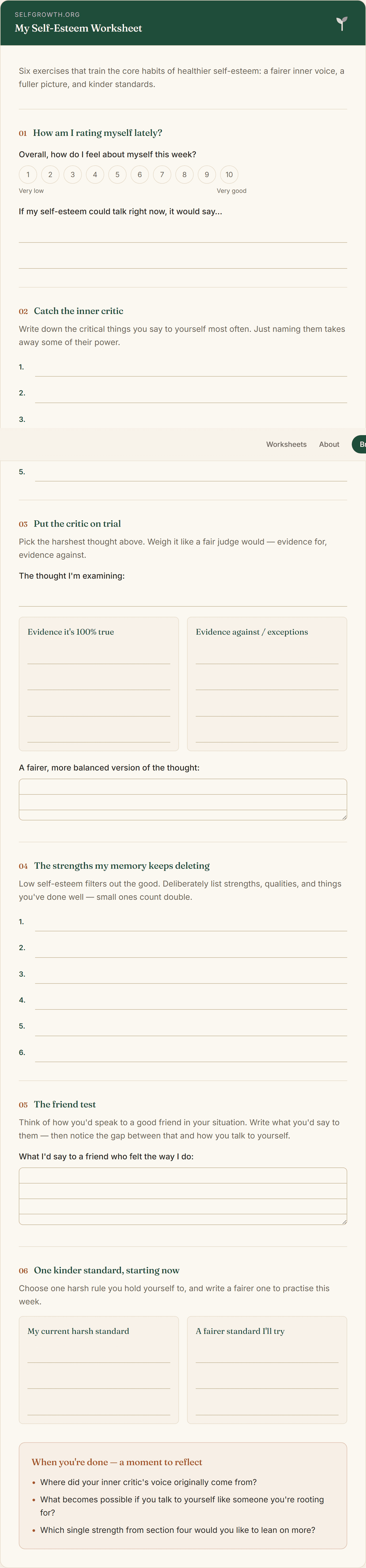
Self-Esteem Worksheet
Free printable self-esteem worksheets (PDF) for adults and older teens: catch your inner critic, test it against evidence, and list the strengths you overlook.
Open worksheet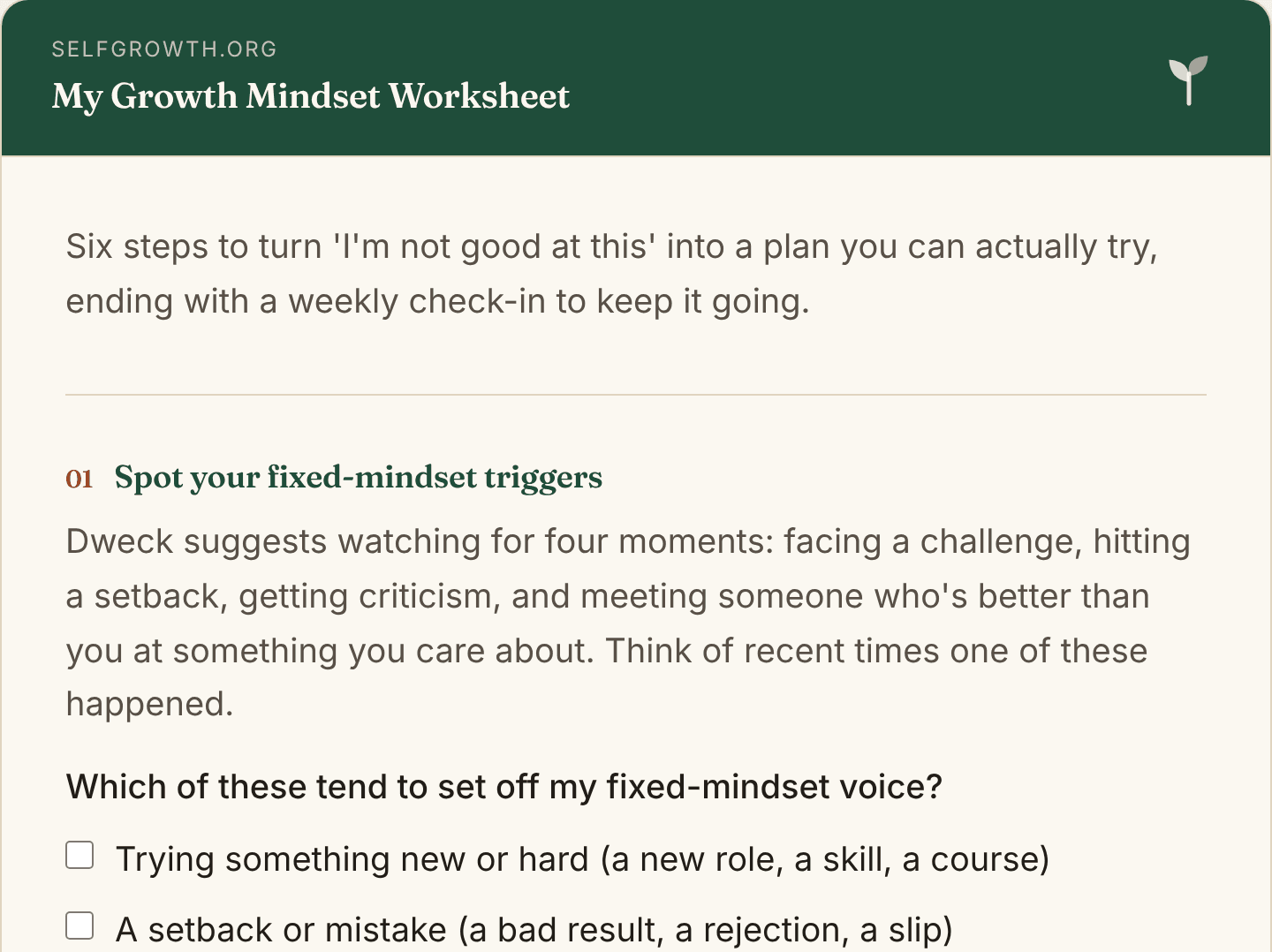
Growth Mindset Worksheet
A free, printable growth mindset worksheet for adults: spot your fixed-mindset triggers, rewrite them, plan practice, review a setback and use the power of yet.
Open worksheet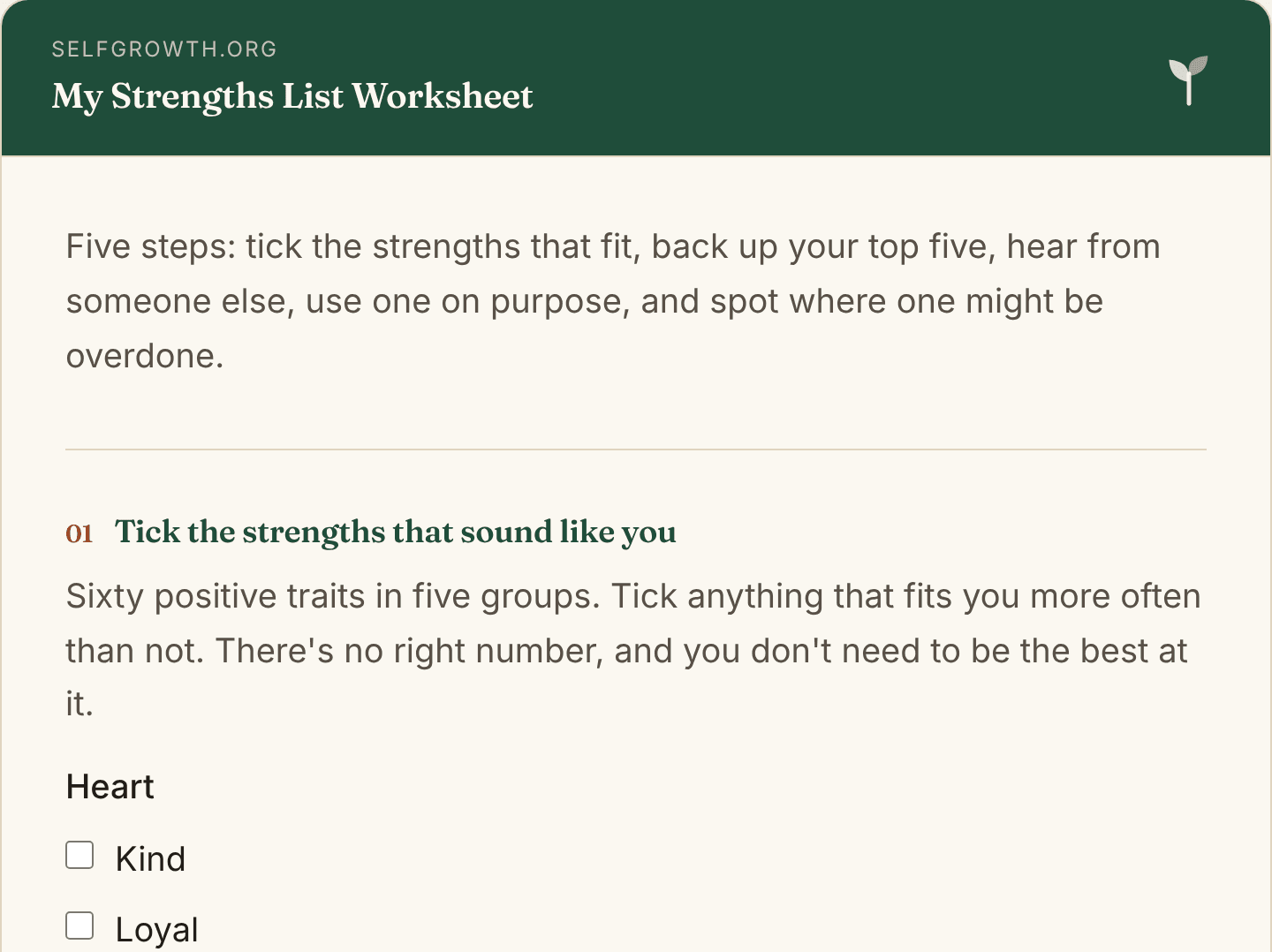
Strengths List Worksheet
A free list of 60 positive character traits and strengths to tick, with space for evidence, what others see in you and one strength to use on purpose this week.
Open worksheetNew worksheets, straight to your inbox
An occasional new worksheet or tool, sent only when there's something genuinely worth your time. No spam, no pressure, unsubscribe any time.