
Self-worth
Self-worth worksheet: steady your sense of your own value
Updated 26 October 2026 · 6 min read · Free to print
A self-worth worksheet helps you separate your value as a person from your achievements, mistakes, and what other people think. This free, printable worksheet walks you through six short exercises: naming the conditions you've quietly attached to your worth, questioning where they came from, seeing how your worth has shifted over time, and writing a steadier definition you actually believe.
Drawn from self-compassion research and unconditional self-acceptance · Part of self-esteem and confidence
Fill it in here (it saves in this browser, but not in a private window), print it, or download the PDF. Free, no sign-up.
Self-worth is the quiet sense that you matter, that you have value simply as a person, not because of what you produce, how you look, or whether you're getting everything right. When it's steady, criticism stings but doesn't capsize you. When it's shaky, a single bad day can feel like proof you're not enough.
You may have learned, without ever deciding to, that your worth is conditional: worthy if I achieve, worthy if I'm useful, worthy if people approve. Psychologists Jennifer Crocker and Connie Wolfe called these 'contingencies of self-worth', meaning the things you lean on to feel you matter, and their work suggests that the more your worth hangs on one of them, the harder you're knocked when it goes wrong. This worksheet helps you find those hidden conditions and gently take them apart, so your sense of value rests on something steadier than your last win or loss.
It's worth reaching for when you notice you only feel you matter while you're performing, after criticism that landed harder than it should have, or before a hard conversation where you want to go in steadier. For the difference between worth and self-esteem, see self-worth vs self-esteem.
There are no right answers here, and nobody else needs to see it. The point isn't to feel great in twenty minutes, it's to notice the story you've been telling about your own value, and start writing a truer one.
How to use this worksheet
- 1Set aside about 20 quiet minutes. Fill it in on screen, or print it and write by hand, handwriting tends to slow your thinking down in a useful way.
- 2Answer honestly, not impressively. The harsh stuff is exactly what this is for.
- 3If a question feels heavy, write one sentence and move on. You can come back.
- 4Keep what you write. Come back to it in a few weeks and notice what has shifted.
The worksheet
selfgrowth.org
My Self-Worth Worksheet
Six short exercises to notice where your worth is hanging, and to set it down somewhere steadier.
01Where is my worth hanging right now?
Finish each line honestly. There's no wrong ending, you're just mapping what's currently true.
I tend to feel worthy when…
I tend to feel worthless or 'not enough' when…
02The conditions I've attached to my worth
Look at your answers above. What conditions have you quietly set, and where might each one have come from (a parent, a school, a job, a culture)?
Entry 1
Entry 2
Entry 3
Entry 4
03How my sense of worth has changed over time
Your sense of your own value is not fixed. Look back at a few points in your life that feel OK to look at, and notice what it rested on then. You don't have to go back to painful times here: if one comes up, write one line and move on, or skip this. Then pick one condition from above and ask whether it is a fact or a belief you were handed.
Entry 1
Entry 2
Entry 3
One condition from above: is it a fact, or a belief I was handed? What makes me think so?
04Evidence I matter beyond those conditions
List moments, relationships, or small things that suggest you have value even when you're not achieving anything, times you were kind, present, honest, or simply there.
- 1.
- 2.
- 3.
- 4.
- 5.
05Talking back to the harsh voice
Write the thing the harsh inner voice says on the left. On the right, write the reply you'd give a friend who said the same thing about themselves.
Entry 1
Entry 2
Entry 3
Entry 4
06My own definition of worth
In your own words, finish this: 'My worth as a person comes from…' Write the version you'd want a younger version of you to grow up believing.
07A quick check-in
How steady does your sense of worth feel today?
When you're done, a moment to reflect
- Which condition would change the most about your life if you let it go?
- What would you do differently this week if your worth wasn't up for debate?
- Who in your life already sees your worth the way you wrote it in section six?
Done for now?
Save today's answers as a dated entry. You can come back, fill it in again and compare the two side by side.
What is a self-worth worksheet, and why does it help?
Self-worth is the quiet belief that you matter as a person, not as a performance. That makes it different from self-esteem, which often rises and falls with how well you're doing. This worksheet works on the deeper layer: the hidden conditions you've attached to your own worth (when I'm productive, when I'm liked, when I don't mess up), and the practice of letting them go. It draws on Albert Ellis's idea of unconditional self-acceptance, that your value as a person isn't something you have to keep earning.
The second thread is self-compassion. Kristin Neff's research links self-compassion with a more stable sense of worth than approval or achievement tend to give. That is why the worksheet asks you to speak to yourself the way you would to someone you love.
These are educational self-reflection tools, not therapy.
If you want to go deeper
- Kristin Neff — Self-Compassion: The Proven Power of Being Kind to Yourself (William Morrow, 2011).
- Brené Brown — The Gifts of Imperfection (Hazelden, 2010): on worthiness that isn't conditional on achievement.
- Albert Ellis — The Myth of Self-Esteem (Prometheus, 2005): the case for unconditional self-acceptance over earned self-esteem.
- Crocker, J. & Wolfe, C. T. (2001). Contingencies of self-worth. Psychological Review, 108(3), 593-623.
Your questions, answered
- What is self-worth?
- Self-worth is your sense that you have value as a person, simply for being you, not because of what you achieve, how you look or whether people approve of you. When it's steady, mistakes and criticism hurt without making you feel worthless. When it's shaky, your value seems to rise and fall with every win, loss or reaction from someone else.
- What are the signs of low self-worth?
- Low self-worth often shows up as feeling you have to earn the right to take up space: over-apologising, struggling to say no, brushing off praise, and a sense that you're only as good as your last achievement. Criticism can feel devastating rather than just uncomfortable, you may second-guess small decisions, and you may quietly believe that if people really knew you, they'd think less of you. If several of these ring true, the exercises here are built for exactly that.
- What causes low self-worth?
- You may have absorbed, without ever deciding to, the idea that your worth is conditional: worthy if you achieve, if you're useful, if people approve. That can start with early messages from family, school or culture about when we 'counted', and later criticism, rejection or comparison can reinforce it. A belief can be examined, and it may shift with practice, which is what this worksheet is for.
- What's the difference between self-worth and self-esteem?
- Self-esteem is your overall opinion of yourself, and it often moves with how well you're doing. Self-worth is deeper and steadier: the sense that you have value as a person regardless of how well you're doing. You can rate yourself highly in one area and still feel you only matter when you perform, which is why this worksheet focuses on value rather than ability. If your harsh inner critic is the bigger problem, the self-esteem worksheet on this site is a closer fit.
- What does self-respect mean?
- Self-respect means treating yourself as someone whose needs, limits and values count. It shows up more in what you do than in how you feel: keeping promises to yourself, saying no to things that go against your values, and not accepting treatment you'd object to if it happened to a friend. Self-worth is the sense that you matter; self-respect is acting as though you do.
- How can I improve my self-worth?
- Start by noticing what your worth currently hangs on, then question whether those conditions are fair or even yours, and look at how they have shifted over time. Collect evidence that you matter beyond them, answer the harsh voice the way you'd answer a friend, and write your own definition of worth to come back to. That's the order of the exercises here. It's gradual: you're rewriting beliefs you've held for years, and repeating the work over weeks and months is what shifts the baseline.
- Are these self-worth worksheets suitable for adults and teens?
- Yes. The exercises are written for adults but work for older teens too, because the conditions we attach to our worth often start forming early. If school, friends or social media are the main pressure, the self-esteem worksheets for teens on this site use plainer language. If work, money or parenting is what's wearing you down, try the self-esteem worksheets for adults. Both are listed further down this page.
- Is there a self-worth worksheet PDF I can print?
- Yes. Use the Download PDF button near the top of this page for a clean, printable copy to fill in by hand, or Print for a paper version. It's free, with no payment, email or sign-up. You can also fill it in on screen, where your answers save in this browser.
- How has my self-worth changed over time?
- A good way to find out is to look at three points: how you saw your value as a child, how you saw it a few years ago, and how you see it now. Notice which conditions were there at each point (achievement, being useful, approval) and which have loosened. Then ask of each belief: is this a fact about me, or a view I picked up from someone else? Writing your answers down now gives you something to compare with later.
- How often should I do this worksheet?
- There's no set schedule that research backs, so go by what's useful. Once is a good start; coming back to it every few weeks, or after a knock that shakes you, is better. Your answers will change as your circumstances do, and comparing an old sheet with a new one is one of the clearest ways to see that your sense of worth is actually moving.
- Is this the same as therapy?
- No. This is an educational self-reflection tool, not therapy or medical advice. It can sit alongside therapy nicely, but if low self-worth is tied to depression or trauma, or it's affecting your daily life, talk to your GP or a qualified therapist. If you're having thoughts of harming yourself, contact a crisis line now: Samaritans on 116 123 in the UK and Ireland, 988 in the US, or findahelpline.com elsewhere.
Not quite the right worksheet?
These seven overlap, and more than one may fit you. Here is what each one is for.
Self-esteemYour overall opinion of yourself feels low or harsh, and you want to answer the inner critic.
Self-worth You're hereYou feel you only matter when you achieve, please people or get things right.
Self-confidenceYou doubt you can handle one particular thing, like speaking up, a new job or a hard conversation.
Self-loveYou keep putting your own needs last and want to treat yourself with more care, day to day.
Self-esteem for adultsWork, money, parenting or comparison with other adults is wearing your self-esteem down.
Self-esteem for teensYou're a teenager, or you're helping one, and want plain activities about comparison and the mean inner voice.
Self-esteem for kidsYou're a parent, carer or teacher helping a child of about 7 to 12 see what they're good at and talk to themselves more kindly.
Not sure which is wobbling? Read self-worth vs self-esteem.
Keep going, related worksheets
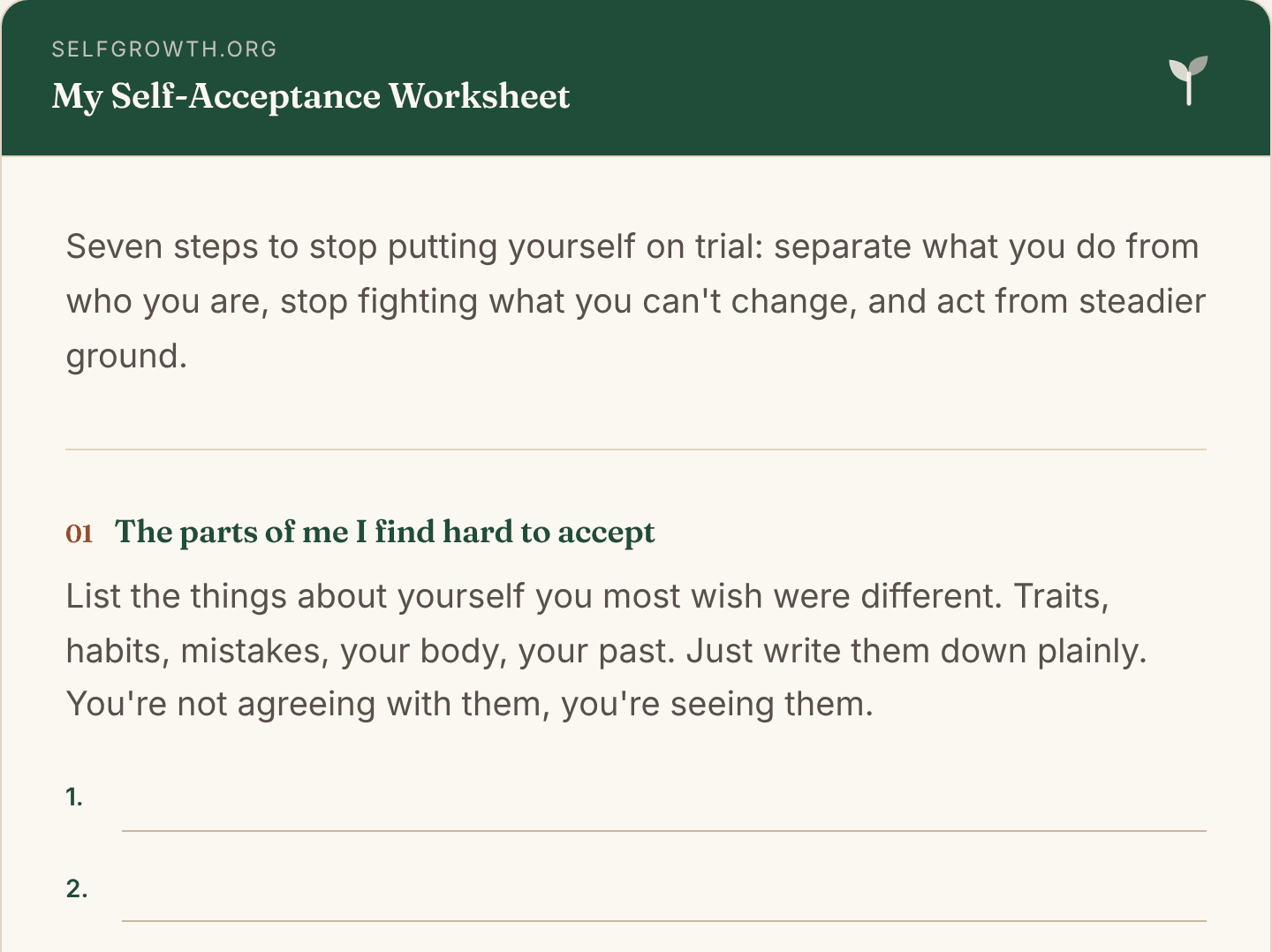
Self-Acceptance Worksheet
A free, printable self-acceptance worksheet: separate what you did from who you are, sort what you can change from what you can't, and stop fighting yourself.
Open worksheet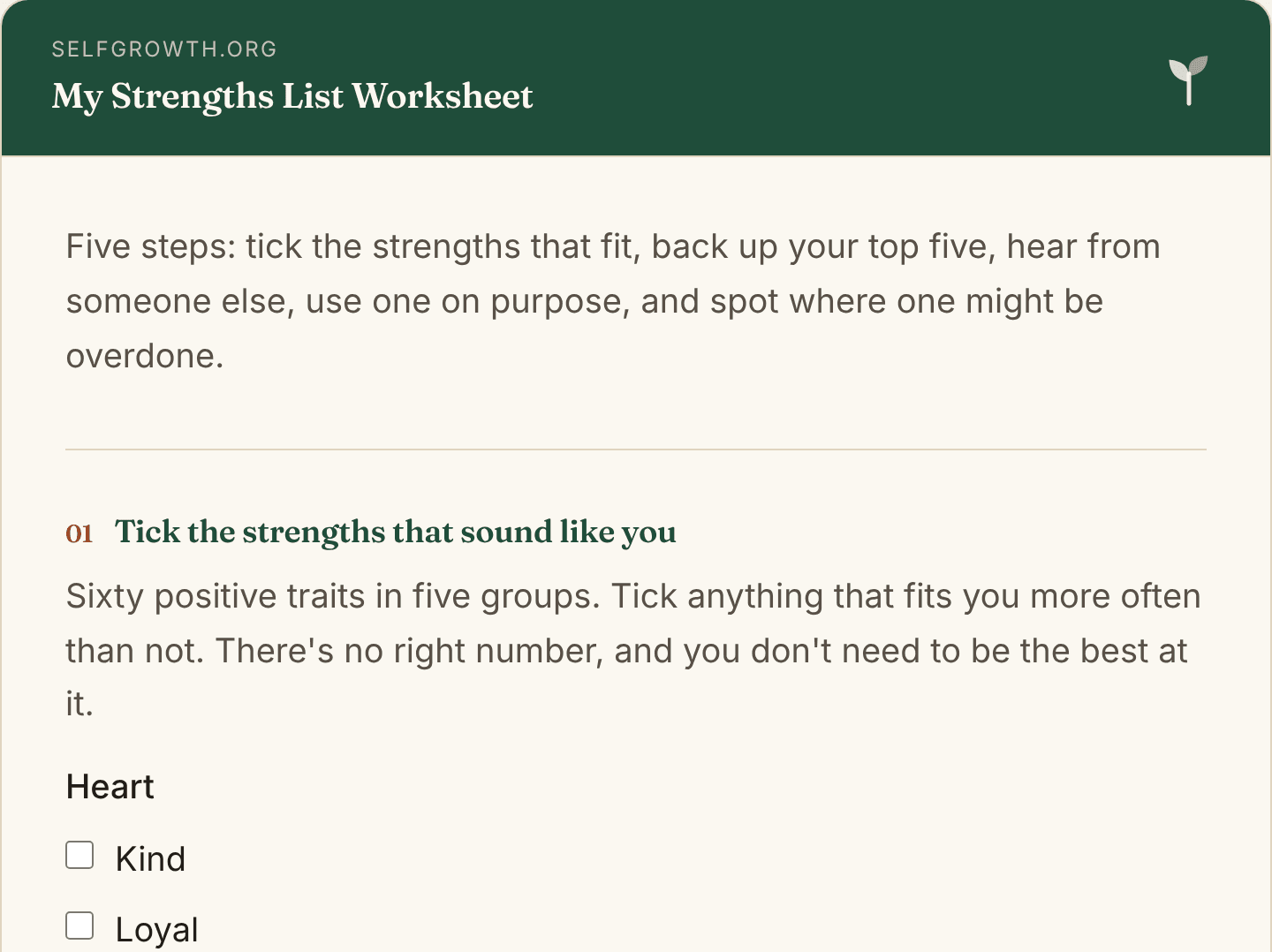
Strengths List Worksheet
A free list of 60 positive character traits and strengths to tick, with space for evidence, what others see in you and one strength to use on purpose this week.
Open worksheet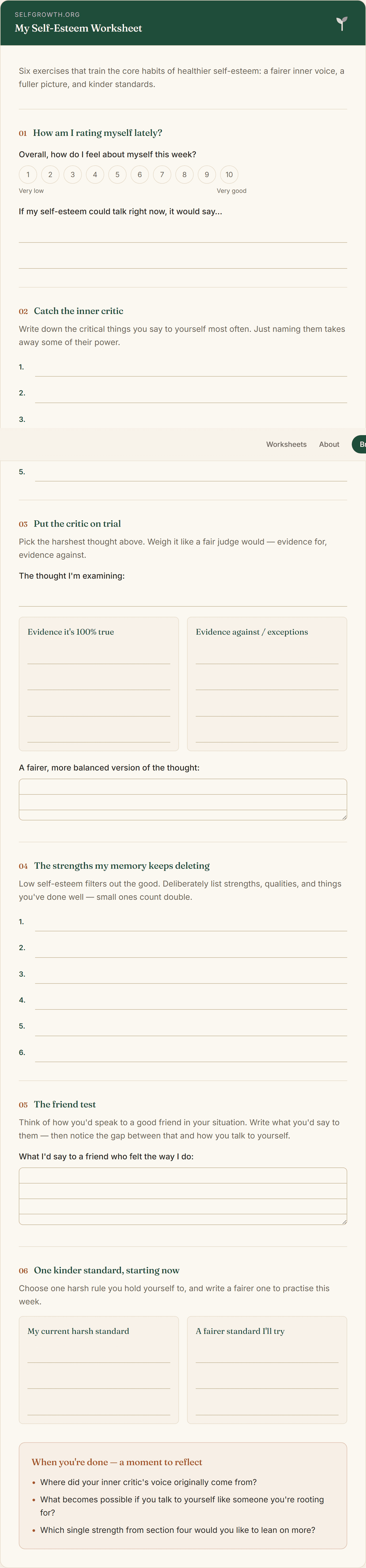
Self-Esteem Worksheet
Free printable self-esteem worksheets (PDF) for adults and older teens: catch your inner critic, test it against evidence, and list the strengths you overlook.
Open worksheetNew worksheets, straight to your inbox
An occasional new worksheet or tool, sent only when there's something genuinely worth your time. No spam, no pressure, unsubscribe any time.