
Self-love
Self-love worksheets: turn self-love into things you actually do
Updated 11 October 2026 · 6 min read · Free to print
A self-love worksheet turns 'love yourself' from a slogan into something concrete. This free, printable worksheet helps you audit how you currently treat yourself, name the needs you keep ignoring, meet a hard moment with kindness, set one caring boundary, and choose small acts of self-love you'll actually do this week.
Drawn from self-compassion research and mindfulness practice · Part of self-esteem and confidence
Fill it in here (it saves in this browser, but not in a private window), print it, or download the PDF. Free, no sign-up.
Self-love gets a bad rap as bubble baths and slogans, but at its core it's simple and unglamorous: treating yourself with the same care, honesty, and patience you'd offer someone you love. That shows up less in how you feel about yourself and more in how you treat yourself, what you allow, what you tolerate, and whether your own needs make the list.
This worksheet skips the platitudes. You'll look honestly at how you currently treat yourself, find the needs you routinely override, and practise self-compassion in a structured way. Then you'll turn it into action.
If you want more to go with it, self-love affirmations and the self-compassion worksheet cover the same ground from different angles, and the self-esteem worksheets look at how you see yourself rather than how you act.
Be gentle with yourself as you do this. If it's hard to be kind to yourself on paper, that's not a failure, it's exactly the muscle this is here to build.
How to use this worksheet
- 1Set aside about 15–20 minutes somewhere you won't be interrupted.
- 2Be honest in the audit section, noticing how you treat yourself is the whole starting point.
- 3Pick acts of self-love that are small and realistic, not a self-improvement project.
- 4Keep the letter you write at the end and reread it on a hard day.
The worksheet
selfgrowth.org
My Self-Love Worksheet
Six exercises to move self-love out of your head and into how you actually treat yourself.
01How do I treat myself right now?
If a friend treated me the way I treat myself, how kind would that be?
One way I'm hard on myself that I'd never be with a friend:
02The needs I tend to ignore
Tick the ones you regularly override, then add your own.
Other needs I keep putting last:
03A kinder reply in a hard moment
Bring to mind something you're struggling with, then write through these three steps, the heart of self-compassion practice.
1. This is hard right now. Name what's difficult:
2. I'm not the only one. How is this part of being human, something others feel too?
3. What do I need to hear right now? Say it to yourself, kindly:
04Where I need a caring boundary
Self-love includes protecting your time and energy. Name a situation and the boundary that would honour you in it.
Entry 1
Entry 2
Entry 3
05Small acts of self-love this week
Concrete, doable, no project required. What will you actually do?
- 1.
- 2.
- 3.
- 4.
- 5.
06A short letter to myself
Write a few lines to yourself the way someone who loves you would. Start with 'Dear me,'.
When you're done, a moment to reflect
- Which ignored need, if you met it consistently, would change your week the most?
- What's one thing you tolerate that someone who loved you wouldn't want you to?
- Did the letter feel awkward to write? What does that tell you?
Done for now?
Save today's answers as a dated entry. You can come back, fill it in again and compare the two side by side.
What is self-love, and how do you start?
Self-love here doesn't mean grand gestures or thinking you're better than anyone. It means self-compassion: treating yourself with the same ordinary kindness you'd offer a friend who was struggling. The worksheet is built around Kristin Neff's three parts of self-compassion. The first is being kind to yourself instead of harshly self-critical. The second is remembering that imperfection is part of being human. The third is mindful awareness, which means noticing hard feelings without being swept away.
From there it turns kindness into something concrete: noticing your own needs, setting a boundary, and changing how you speak to yourself, because self-love is mostly a set of small practices, not a mood you have to summon. The boundary exercise pairs with the boundaries worksheet, and the self-care worksheet helps you plan the rest and sleep you keep skipping. These are educational self-reflection tools, not therapy.
These are educational self-reflection tools, not therapy.
If you want to go deeper
- Kristin Neff — Self-Compassion: The Proven Power of Being Kind to Yourself (William Morrow, 2011).
- Christopher Germer — The Mindful Path to Self-Compassion (Guilford Press, 2009).
- Tara Brach — Radical Acceptance: Embracing Your Life With the Heart of a Buddha (Bantam, 2003).
Your questions, answered
- What is a self-love worksheet actually for?
- It makes self-love practical. 'Love yourself' is easy to say and hard to act on, so this worksheet breaks it into concrete moves: noticing how you treat yourself, meeting needs you usually ignore, practising self-compassion, and setting caring boundaries. The goal is changed behaviour, not just a nicer feeling.
- How do I start practising self-love every day?
- Start small and concrete. Pick one need you keep overriding (rest, help, saying no) and meet it today, notice one harsh thing you say to yourself and answer it as you would a friend, and do one of the small acts you chose for the week. A few minutes each day may suit you better than one big effort. Kristin Neff's research on self-compassion breaks kindness into three parts. The first is being kind rather than harsh. The second is remembering you're not the only one. The third is noticing hard feelings without being swept away.
- What are the signs of a lack of self-love?
- It shows up more in what you do than in what you feel: running on too little rest, saying yes when you mean no, putting everyone else's needs ahead of your own, tolerating treatment you'd never accept for a friend, and talking to yourself harshly when things go wrong. If several sound familiar, the audit and needs sections here are the place to start.
- Why is it so hard to love myself?
- You may have made self-criticism your default for years, so being kind to yourself feels unfamiliar or even undeserved. That isn't a character flaw, it's a habit, and habits can change with practice. The audit and self-compassion exercises here are built to make it feel less foreign one step at a time.
- Is self-love the same as being selfish?
- No. Selfishness is meeting your needs at others' expense; self-love is meeting your needs so you're not running on empty, which usually makes you more available to others, not less. Boundaries and rest aren't taking from anyone; they're what let you show up well.
- What if being kind to myself feels fake or uncomfortable?
- That's very common, especially if self-criticism has been your default. Discomfort isn't a sign it's wrong, it's a sign it's new. Start small, keep going, It tends to ease with practice.
- How often should I do a self-love worksheet?
- There's no set schedule that research backs, so go by what helps. A simple rhythm is to fill in the whole sheet once, then pick new small acts of self-love each week and reread the letter you wrote to yourself on a hard day. A fresh copy after a few weeks shows you what has changed in how you treat yourself.
- Is there a free self-love worksheet PDF?
- Yes. Use the Download PDF button near the top of this page for a clean, printable copy to fill in by hand, or Print for a paper version. It's free, with no payment, email or sign-up. It suits adults and older teens alike, and you can also fill it in on screen, where your answers save in this browser.
- Is this therapy?
- No, it's an educational self-reflection tool, not therapy or medical advice. It pairs well with therapy, but if you're dealing with depression or trauma, please talk to your GP or a qualified professional. If you're having thoughts of harming yourself, contact a crisis line now: Samaritans on 116 123 in the UK and Ireland, 988 in the US, or findahelpline.com elsewhere.
Not quite the right worksheet?
These seven overlap, and more than one may fit you. Here is what each one is for.
Self-esteemYour overall opinion of yourself feels low or harsh, and you want to answer the inner critic.
Self-worthYou feel you only matter when you achieve, please people or get things right.
Self-confidenceYou doubt you can handle one particular thing, like speaking up, a new job or a hard conversation.
Self-love You're hereYou keep putting your own needs last and want to treat yourself with more care, day to day.
Self-esteem for adultsWork, money, parenting or comparison with other adults is wearing your self-esteem down.
Self-esteem for teensYou're a teenager, or you're helping one, and want plain activities about comparison and the mean inner voice.
Self-esteem for kidsYou're a parent, carer or teacher helping a child of about 7 to 12 see what they're good at and talk to themselves more kindly.
Not sure which is wobbling? Read self-worth vs self-esteem.
Keep going, related worksheets
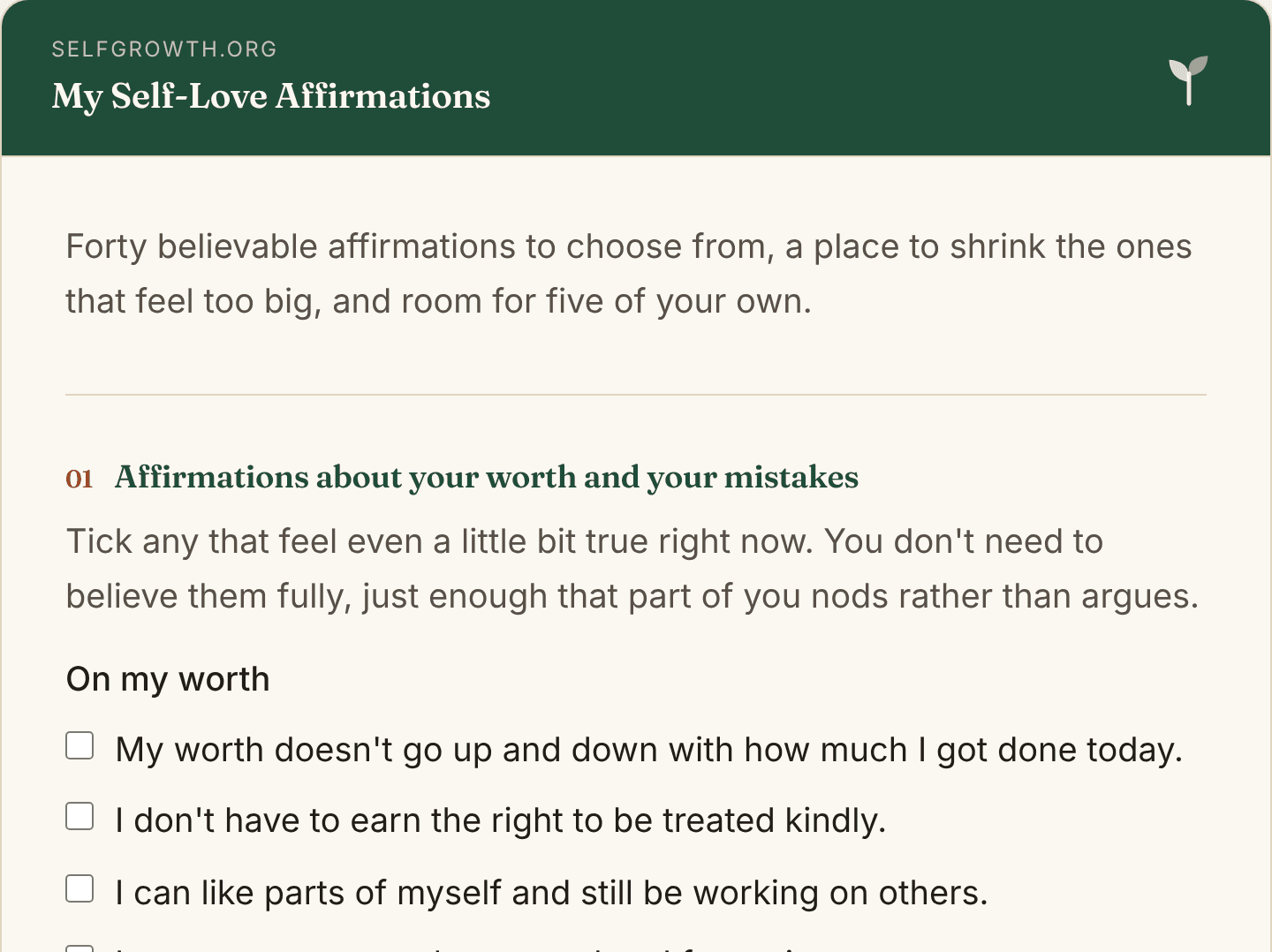
Self-Love Affirmations
40 free, printable self-love affirmations you can actually believe, grouped by theme. Tick the ones that ring true, shrink the big ones, choose your own five.
Open worksheet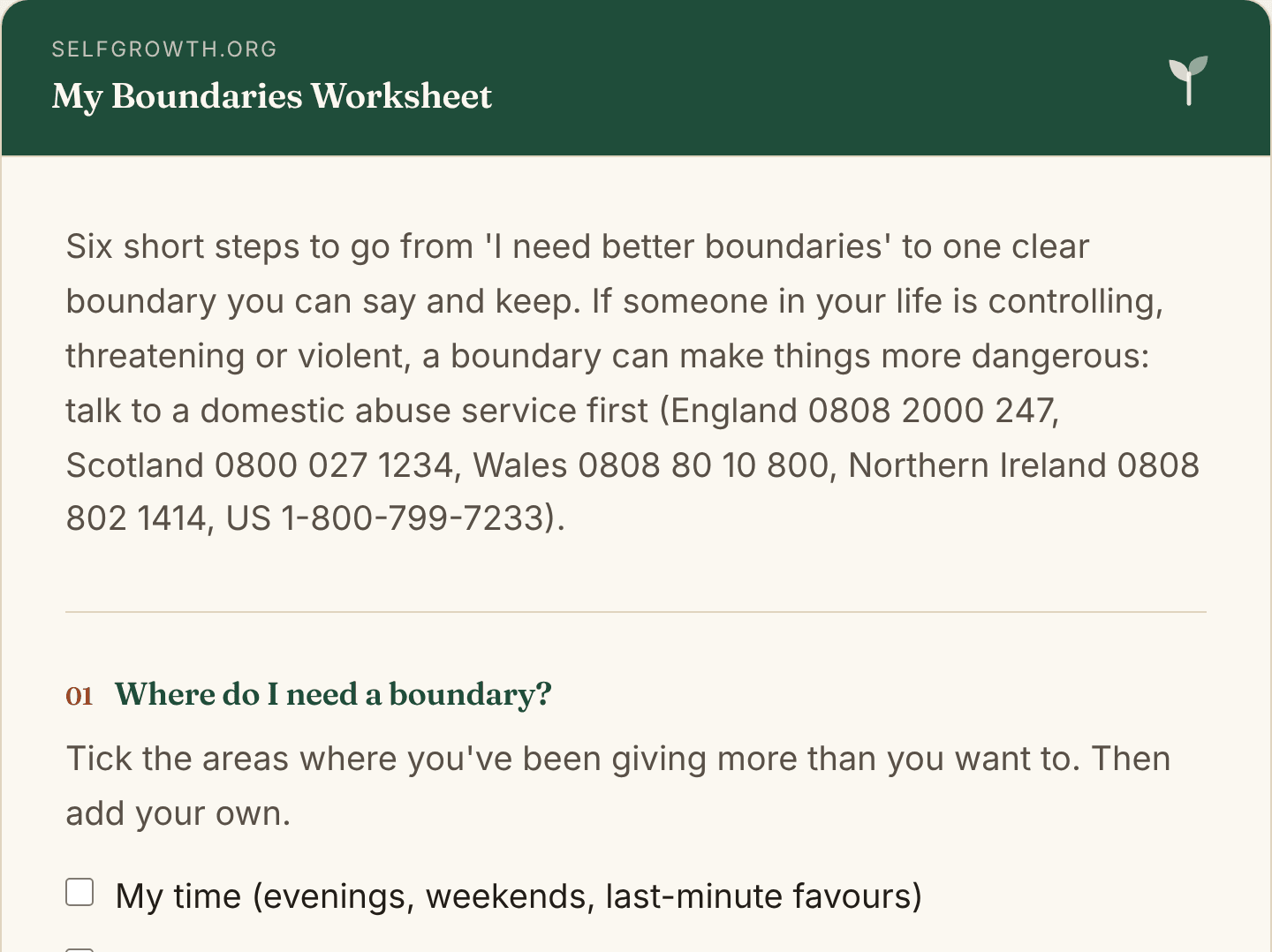
Boundaries Worksheet
A free, printable boundaries worksheet: spot where you need a limit, write it as something you'll do, plan the exact words, and decide what you'll do if it's crossed.
Open worksheet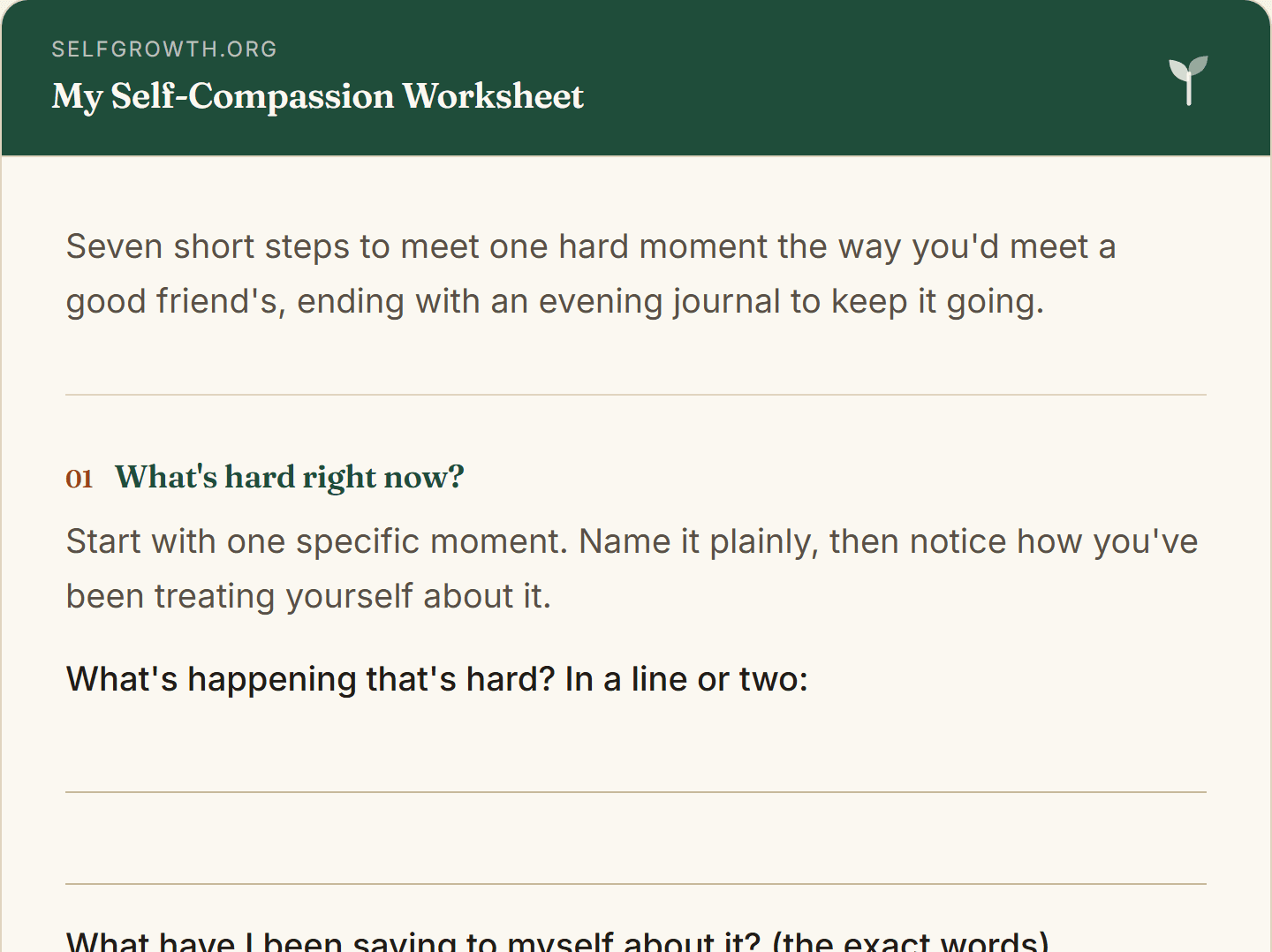
Self-Compassion Worksheet
A free, printable self-compassion worksheet: the self-compassion break, the friend test, a kind letter and journal prompts, based on Kristin Neff's research.
Open worksheetNew worksheets, straight to your inbox
An occasional new worksheet or tool, sent only when there's something genuinely worth your time. No spam, no pressure, unsubscribe any time.