
Self-esteem
Self-esteem worksheets for adults: free printable PDF exercises
Updated 11 October 2026 · 7 min read · Free to print
Self-esteem worksheets for adults help you see yourself fairly under the pressures of adult life: work, money, parenting, ageing and comparison. This free, printable worksheet helps you name what is wearing you down, question the 'shoulds' and comparisons you judge yourself by, credit the load you carry that nobody sees, and come back to your values.
Drawn from cognitive behavioural therapy and self-compassion research · Part of self-esteem and confidence
Fill it in here (it saves in this browser, but not in a private window), print it, or download the PDF. Free, no sign-up.
Adult self-esteem gets squeezed from angles teenagers don't face: performance reviews, finances, parenting, ageing, and a quiet running comparison with everyone else's careers and lives. It's easy to tie your worth to how productive, successful, or 'together' you appear, and then feel like you're failing whenever life is hard.
Healthy adult self-esteem isn't bravado. It's seeing yourself fairly: owning real strengths, accepting flaws without contempt, and resting your sense of self on what you value rather than on constant approval or achievement. That's steadier, and it survives a bad quarter or a hard season.
This worksheet is built for that. It looks at the standards you measure yourself against as an adult, the 'shoulds' and the people you feel behind, and the work you do that nobody thanks you for. If the harsh inner voice is the bigger problem, the general self-esteem worksheet is the better place to start.
How to use this worksheet
- 1Give it around 20–25 minutes. Fill it in here or print it, whichever you'd rather.
- 2Be concrete. 'A good parent would never…' is more useful than 'I'm a bad parent'.
- 3You can do one section per sitting; this isn't a race.
- 4Come back to it before a stressful stretch, or whenever you notice the 'behind' feeling building.
The worksheet
selfgrowth.org
Self-Esteem Worksheet, for Adults
Six exercises for the pressures of adult life: what's wearing you down, the standards you judge yourself by, and what you carry.
01Self-esteem check-in
How fairly am I judging myself as an adult this week?
02What's chipping at my self-esteem?
Tick what's been getting to you lately, then add detail.
The one that's loudest right now, and what it tells me about myself:
03The 'shoulds' I judge myself by
Write the rules you measure yourself against as an adult, in your own words. 'By now I should…', 'A good parent would…', 'Someone my age ought to…'. These are rules to question, not targets to hit.
- 1.
- 2.
- 3.
- 4.
- 5.
04Behind compared with whom?
Pick the 'should' that stings most, often the sense of being behind. Comparison usually runs against the parts of other people's lives you get to see, so put what you see next to what is probably also true.
The 'should' that stings most:
Who or what I compare myself with
The version of their life I see: posts, news, the school gate, the office
What's probably also true for them
The costs, help, luck or struggles I don't see
What 'on track' means for my actual life:
05What I carry that nobody sees
The work that keeps things going and rarely gets credit: bills paid, people looked after, hard days got through, things held together. Name them plainly.
- 1.
- 2.
- 3.
- 4.
- 5.
- 6.
06Values over approval
When approval and performance can't hold you up, values can. Name what actually matters to you, then one way to live it this week regardless of how 'successful' you feel.
What matters most to me (not what should):
One small way I'll live a value this week:
When you're done, a moment to reflect
- If your worth didn't depend on output, what would you let yourself ease up on?
- Whose approval are you still chasing, and what would change if you stopped?
- Which value, lived more fully, would make the comparison noise quieter?
Done for now?
Save today's answers as a dated entry. You can come back, fill it in again and compare the two side by side.
The approach behind this worksheet
By adulthood, low self-esteem often gets tangled up with work, money, parenting and the background comparison of other people's lives. Jennifer Crocker and Connie Wolfe's research on 'contingencies of self-worth' describes how self-esteem rises and falls with events in the areas people stake it on, which is why the worksheet asks you to name those areas early on. The 'shoulds' exercise comes from cognitive behavioural therapy: David Burns lists 'should statements' among the common thinking traps in Feeling Good, and Melanie Fennell's CBT model of low self-esteem describes the rules people live by as part of what keeps it going.
Alongside that sits self-compassion, because adults are often far harder on themselves than they would ever be on a friend in the same situation. Kristin Neff's research suggests treating yourself fairly does more for lasting self-worth than chasing achievement or comparison. These are educational self-reflection tools, not therapy.
These are educational self-reflection tools, not therapy.
If you want to go deeper
- Melanie Fennell — Overcoming Low Self-Esteem (Robinson, 1999): the CBT model of low self-esteem, including the rules for living that the 'shoulds' exercise works on.
- Crocker, J. & Wolfe, C. T. (2001). Contingencies of self-worth. Psychological Review, 108(3), 593–623.
- David D. Burns — Feeling Good: The New Mood Therapy (1980): the CBT self-help classic that names 'should statements'.
- Kristin Neff — Self-Compassion: The Proven Power of Being Kind to Yourself (William Morrow, 2011).
Your questions, answered
- What are the signs of low self-esteem in adults?
- In adults it often hides behind competence, so the signs are more internal: a relentless inner critic, difficulty accepting praise, tying your mood to your latest performance, over-apologising or people-pleasing, and a quiet sense of being 'behind' or not enough however much you do. Comparison and perfectionism are common too. Recognising a few of these is the cue to look hard at the standards you judge yourself by, which is what this worksheet walks you through.
- What causes low self-esteem in adults?
- It's usually a mix: early experiences and self-talk habits, plus ongoing adult pressures like work performance, money, parenting, health, and constant comparison. Often the root issue is tying your worth to achievement or approval, so esteem rises and falls with circumstances. This worksheet works on both: the standards you judge yourself by, and what you base your worth on.
- What's the best worksheet exercise for adult self-esteem?
- For adults, a useful one is questioning the 'shoulds' you judge yourself by: write the rule, ask where it came from, and set a standard that fits your real life. The other is anchoring yourself in your values rather than in approval or output, so a hard season doesn't take your sense of self with it. If the harsh inner voice is the main problem, the general self-esteem worksheet works on that directly.
- Can self-esteem improve in adulthood?
- Yes. Self-esteem isn't fixed at any age. It rests on habits of thinking and on what you base your worth on, and adults can deliberately change both. Progress is usually gradual, so practising regularly and coming back to your worksheets matters more than any single session.
- How long does it take to rebuild self-esteem?
- There's no reliable timeline, and anyone who gives you one is guessing. Self-esteem rests on habits of thinking built up over years, so it tends to change gradually with practice rather than in one sitting. Coming back to the worksheet when the pressure builds is more useful than doing it once.
- Is this free and is it therapy?
- It's completely free to fill in or print, no payment, no email. It is not therapy or medical advice, though; it's an educational self-reflection tool. If low self-esteem is bound up with depression, anxiety, or thoughts of self-harm, please speak with a qualified professional or a local support line.
Not quite the right worksheet?
These seven overlap, and more than one may fit you. Here is what each one is for.
Self-esteemYour overall opinion of yourself feels low or harsh, and you want to answer the inner critic.
Self-worthYou feel you only matter when you achieve, please people or get things right.
Self-confidenceYou doubt you can handle one particular thing, like speaking up, a new job or a hard conversation.
Self-loveYou keep putting your own needs last and want to treat yourself with more care, day to day.
Self-esteem for adults You're hereWork, money, parenting or comparison with other adults is wearing your self-esteem down.
Self-esteem for teensYou're a teenager, or you're helping one, and want plain activities about comparison and the mean inner voice.
Self-esteem for kidsYou're a parent, carer or teacher helping a child of about 7 to 12 see what they're good at and talk to themselves more kindly.
Not sure which is wobbling? Read self-worth vs self-esteem.
Keep going, related worksheets
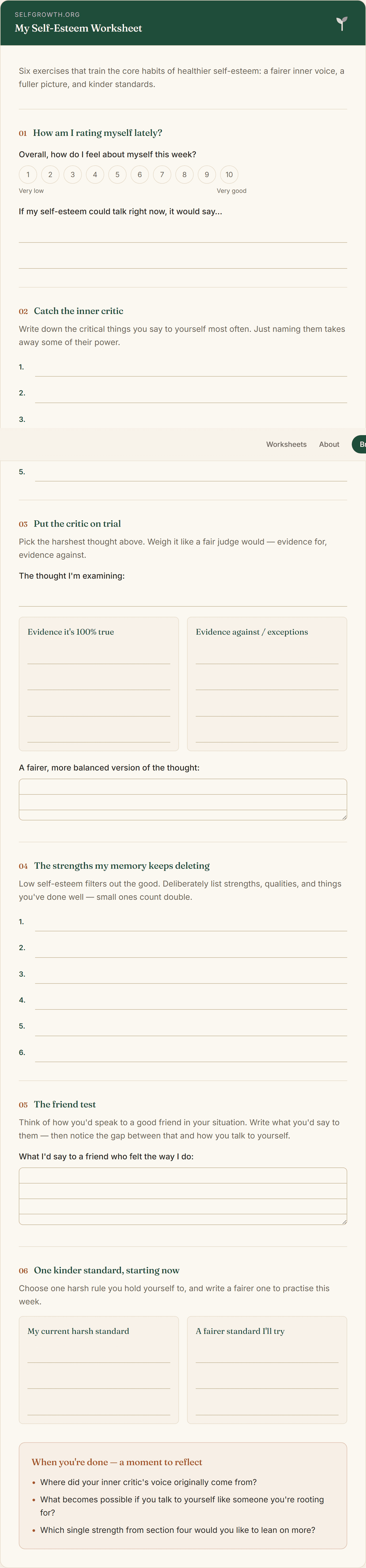
Self-Esteem Worksheet
Free printable self-esteem worksheets (PDF) for adults and older teens: catch your inner critic, test it against evidence, and list the strengths you overlook.
Open worksheet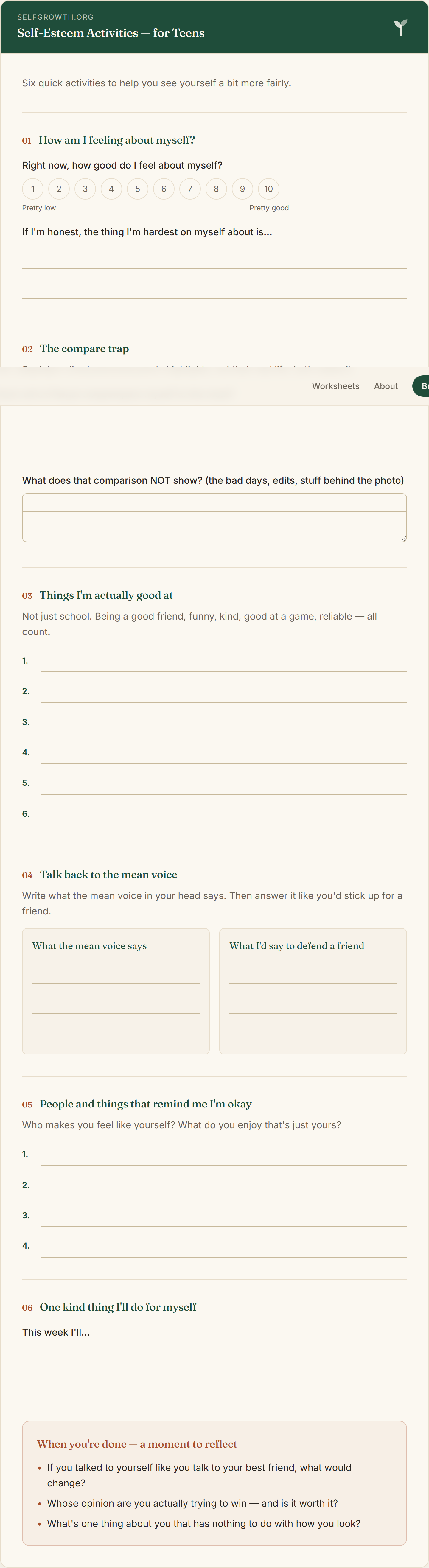
Self-Esteem (Teens)
Free, printable self-esteem worksheets and activities for teens: beat the compare trap, spot real strengths, and quiet the mean inner voice. No jargon.
Open worksheet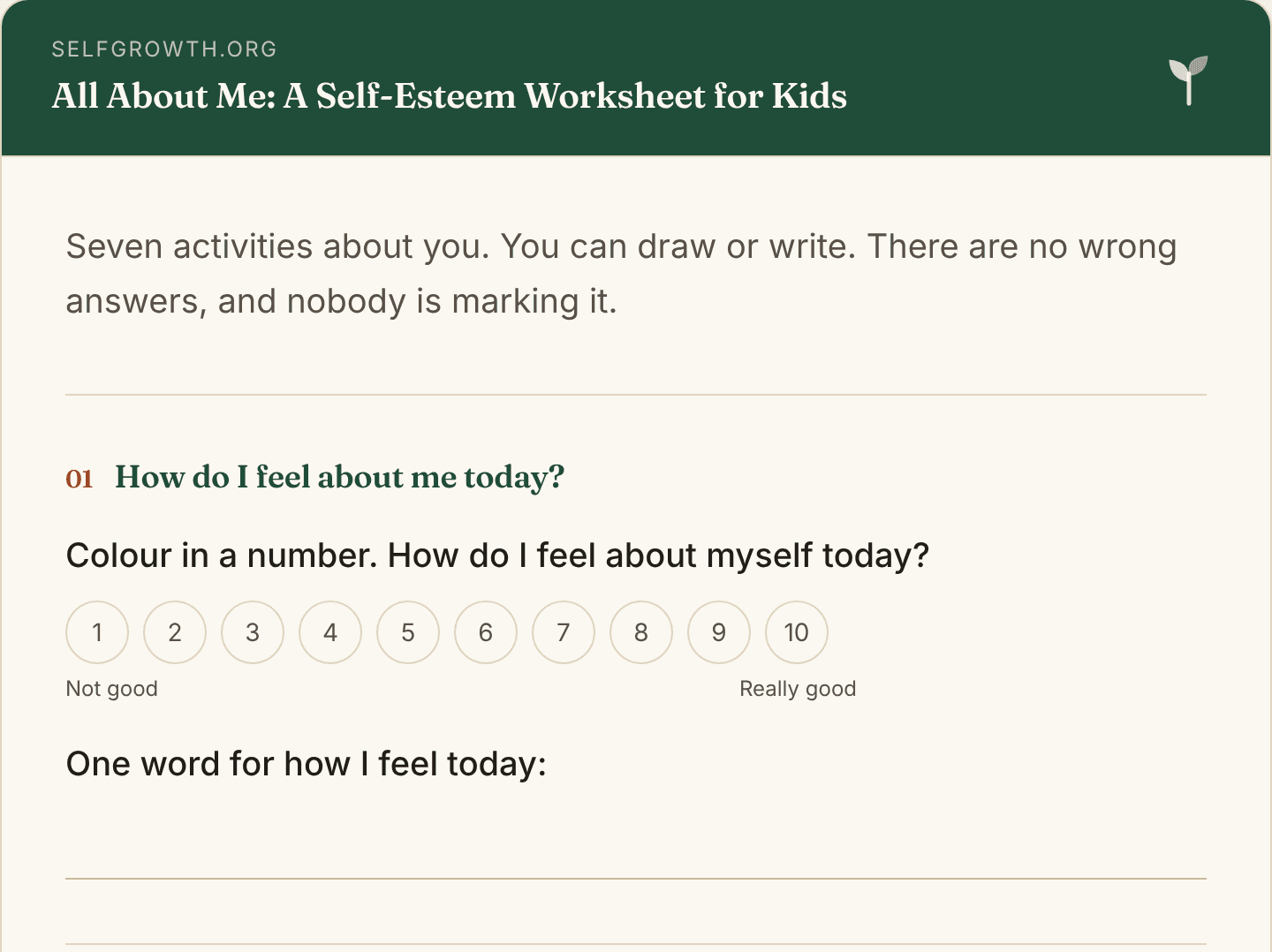
Self-Esteem (Kids)
Free printable self-esteem worksheet for kids aged 7 to 12: draw or write about strengths, kind self-talk and people who help, with tips for parents.
Open worksheetNew worksheets, straight to your inbox
An occasional new worksheet or tool, sent only when there's something genuinely worth your time. No spam, no pressure, unsubscribe any time.