
Guide
How to meditate: a simple guide for beginners
Updated 25 October 2026 · 9 min read
To meditate, sit comfortably, set a short timer and pay attention to your breathing. When your mind wanders, which it will, notice it and bring your attention back to the next breath. That return is the practice. Start with a few minutes and keep it regular. Meditation is self-help, not a treatment.
Simple breath-focused mindfulness meditation · Part of feelings and calm
You do not need a cushion, incense or a quiet mind. You need a few minutes, somewhere to sit and a willingness to notice where your attention goes.
Your mind will wander, and that is what you are practising with. It is self-help, not therapy.
What is meditation?
Meditation is the practice of training your attention. There are different kinds. Some focus on the breath, some on the body, some on repeating kind wishes. The NHS describes mindfulness meditation as sitting silently and paying attention to thoughts, sounds, the sensations of breathing or parts of your body, bringing your attention back whenever the mind starts to wander.
Here you will use the simplest version: paying attention to your breathing. It is not about emptying your mind or feeling calm. The NHS puts it this way: it is not about making thoughts go away, but about seeing them as mental events that come and go.
How to meditate: step by step
- 1Choose a time. Pick a moment you can repeat, such as after you wake up or when you get home. Tying it to something you already do makes it easier to remember.
- 2Sit comfortably. A chair is fine. Put your feet on the floor and let your hands rest in your lap. You can close your eyes or rest your gaze on a spot on the floor. Lying down is fine too, though you may fall asleep.
- 3Set a short timer. Start with a few minutes, so you are not watching the clock. A gentle alarm sound is kinder than a loud one.
- 4Notice your breath. Find where you feel it most, perhaps at your nose, chest or belly. Let it move on its own. You are watching it, not steering it.
- 5When your mind wanders, notice and come back. It will drift to plans, worries or sounds. That is not failing. Quietly say 'wandering' to yourself, then return to the next breath. Do this as often as you need to.
- 6End gently. When the timer goes, let go of the breath and notice the room around you. Take one slower breath, open your eyes and stretch before you get up.
- 7Note how it went. Write one line about what you noticed, not whether it was good. A sentence is enough, and it shows you how the practice is going over time.
A guided script can make this easier. The guided meditation script gives you words to read aloud or record, so you do not have to remember the steps.
Open the Mindfulness WorksheetWhere to sit, and what to do about noise
A quiet corner of a room is enough. If you cannot find quiet, pick the least busy spot you have and let the noise be part of what you notice.
- Seat: a sofa corner, a cushion or the edge of your bed all work too. Sit with your back fairly upright but not stiff.
- Phone: set it to silent and use its timer, so one gentle alarm ends the sitting.
If your mind drifts to how you look or whether you are sitting properly, that is one more thing to notice and let go of.
How long should I meditate as a beginner?
There is no single right answer, and nobody can tell you the exact right length for you. A sensible way to choose is to pick a length you will actually do, even on a bad day. Start with a few minutes.
Regular matters more than long. A short session you repeat is easier to keep up than a long one you skip. You can make it longer later if you want to, or leave it as it is. Both are fine.
How to make meditation a habit
Coming back tomorrow is the harder part. A few small choices help.
- Keep the same place. If your chair or corner is where you always sit, the spot itself becomes a reminder.
- Make the first sitting small enough that skipping it feels silly. A few minutes is plenty.
- Let a missed day go. Sit again at the next usual time, without trying to make up for it.
The mindfulness worksheet gives you a place to write those notes.
Common problems for beginners
Each of these is a normal part of learning. None of them means you are doing it wrong.
- My mind will not stop. It is not meant to. The practice is noticing that it has wandered and coming back. The NHS says watching thoughts can be very hard at first, but that gentle persistence makes it possible.
- I fall asleep. Sit up in a chair rather than lying down, keep your eyes slightly open, or try a time earlier in the day.
- I cannot sit still. Shift position if you need to, and notice the urge to move before you act on it. The NHS says some people find an over-busy mind easier to cope with while doing gentle yoga or walking, so a moving practice is a fair place to start.
- I am bored. Boredom is something to notice too. What does it feel like in your body? Shorten the session if it helps.
- I think I am doing it wrong. If you sat down and tried to pay attention to your breath, you did it. There is no good or bad session, only what you noticed.
Meditation for beginners: other simple practices
If breath focus does not suit you, other practices use the same skill of noticing and returning.
To move your attention slowly through your body, try the body scan script.
To practise kind wishes for yourself and other people, try the loving-kindness meditation script.
For short practices to fit into an ordinary day, such as walking, eating or tuning in to your senses, see the mindfulness exercises guide.
Open the Body Scan ScriptDoes meditation work?
The research is about structured programmes that run over weeks, not about a few minutes of breathing on your own. A 2014 review by Goyal and colleagues pooled 47 trials of meditation courses for adults with a health condition, with 3,515 participants. It found moderate evidence that mindfulness meditation programmes improved anxiety, depression and pain. It found low evidence of improved stress and distress, and low evidence of no effect, or too little evidence to tell, for outcomes such as positive mood, attention, sleep and weight.
The same review found no evidence that the programmes were better than any active treatment, such as drugs, exercise or other behavioural therapies. Its authors said stronger study designs are needed to test effects on positive mental health and stress-related behaviour. The NHS says studies show mindfulness can help with stress, anxiety and depression, and that it is not right for everyone.
This is not a treatment for any condition, and a few minutes of breathing makes no promise about how you will feel. Try it, see what you notice, and decide for yourself.
If meditation feels upsetting
The NHS says mindfulness is not right for everyone, and that some people find it can make them feel worse. If meditating ever brings up something upsetting, stop. Open your eyes, press your feet into the floor, look around the room and name what you can see. You do not have to finish the timer.
The 5-4-3-2-1 grounding worksheet walks you through that. If it keeps happening, speak to a GP before you carry on. Eyes-open, moving practices such as a slow walk can be a gentler place to start.
When to get more support
Meditation is a tool, not treatment. If low mood, anxiety or stress is getting in the way of your sleep, work or relationships, please talk to a GP. They can talk through options such as talking therapies.
If you ever feel unsafe or have thoughts of harming yourself, call Samaritans on 116 123 (UK and Ireland), 988 (US), or find a line at findahelpline.com. If you are in immediate danger, call 999 (UK) or 911 (US).
Sources and further reading
This is an educational self-reflection resource, not therapy or medical advice.
If you want to go deeper
- NHS (n.d.). Mindfulness. nhs.uk, Mental health: self-help.
- Goyal, M. et al. (2014). Meditation programs for psychological stress and well-being: A systematic review and meta-analysis. JAMA Internal Medicine, 174(3), 357-368.
Your questions, answered
- How do I meditate for beginners?
- Sit comfortably, set a short timer and pay attention to your breathing, noticing where you feel it most. When your mind wanders, notice it and come back to the next breath. Do that until the timer goes, then open your eyes slowly. Start with a few minutes and repeat it at a regular time.
- How long should a beginner meditate?
- There is no single right length. Start with a few minutes, a length you will actually do, and keep it regular. A short session you repeat is easier to keep up than a long one you skip. You can lengthen it later if you want to.
- Can I meditate in a chair, and what do I do with my eyes and hands?
- Yes. A chair with your feet on the floor works well. Lying down is fine too, but you may fall asleep. There is no need to sit cross-legged. Close your eyes, or leave them open with your gaze resting on one spot on the floor. Let your hands rest on your thighs or in your lap. Choose what is comfortable, because there is no correct shape.
- What is the difference between meditation and mindfulness?
- Mindfulness is paying attention to the present moment on purpose. Meditation is a formal practice of training that attention, such as sitting and following your breath. The NHS describes mindfulness meditation as sitting silently and paying attention to thoughts, sounds, the sensations of breathing or parts of your body.
- Does meditation really work?
- The evidence is modest. A 2014 review of 47 randomised trials found moderate evidence that mindfulness meditation programmes improved anxiety, depression and pain, and low evidence for stress and distress. These were structured programmes, not short sessions at home, and there was no evidence they beat other active treatments.
- Can meditation make things worse?
- For some people, yes. The NHS says mindfulness is not right for everyone and can make some people feel worse. If meditating brings up something upsetting, stop, open your eyes and ground yourself, then speak to a GP if it keeps happening.
- Is there a free meditation script to print?
- Yes. The guided meditation script is free to print, with no payment and no email needed. You can print it or fill it in on screen.
- Is meditation a substitute for therapy?
- No. Meditation is a self-help tool, not therapy or medical advice. If you ever feel unsafe or have thoughts of harming yourself, call Samaritans on 116 123 (UK and Ireland), 988 (US), or find a line at findahelpline.com.
Worksheets to do the work
Free to fill in online or print. No email needed.
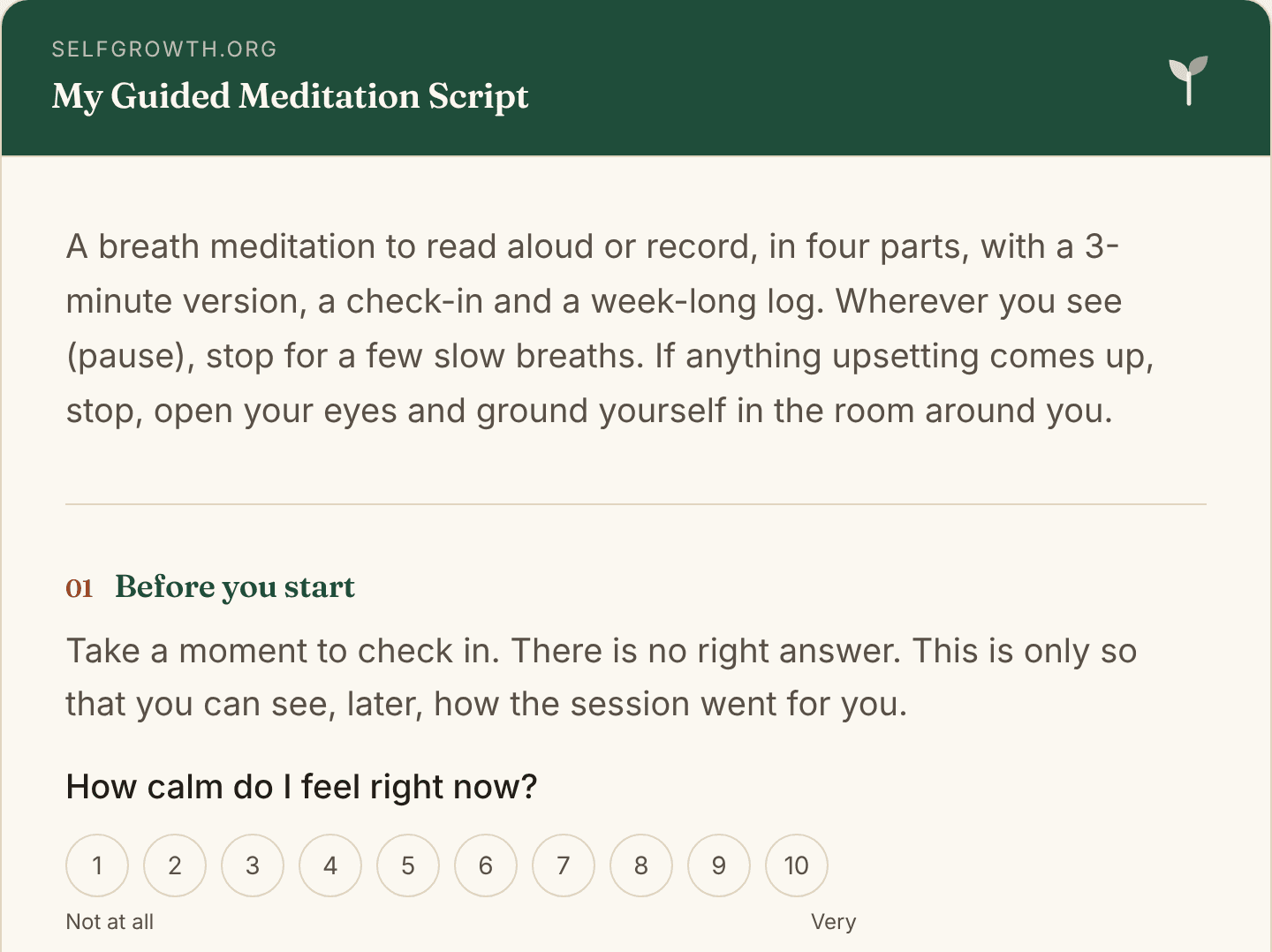
Guided Meditation Script
A free guided meditation script to read aloud or record: a 5 to 10 minute breath meditation, a 3-minute version, a before-and-after check-in and a 7-day log.
Open worksheet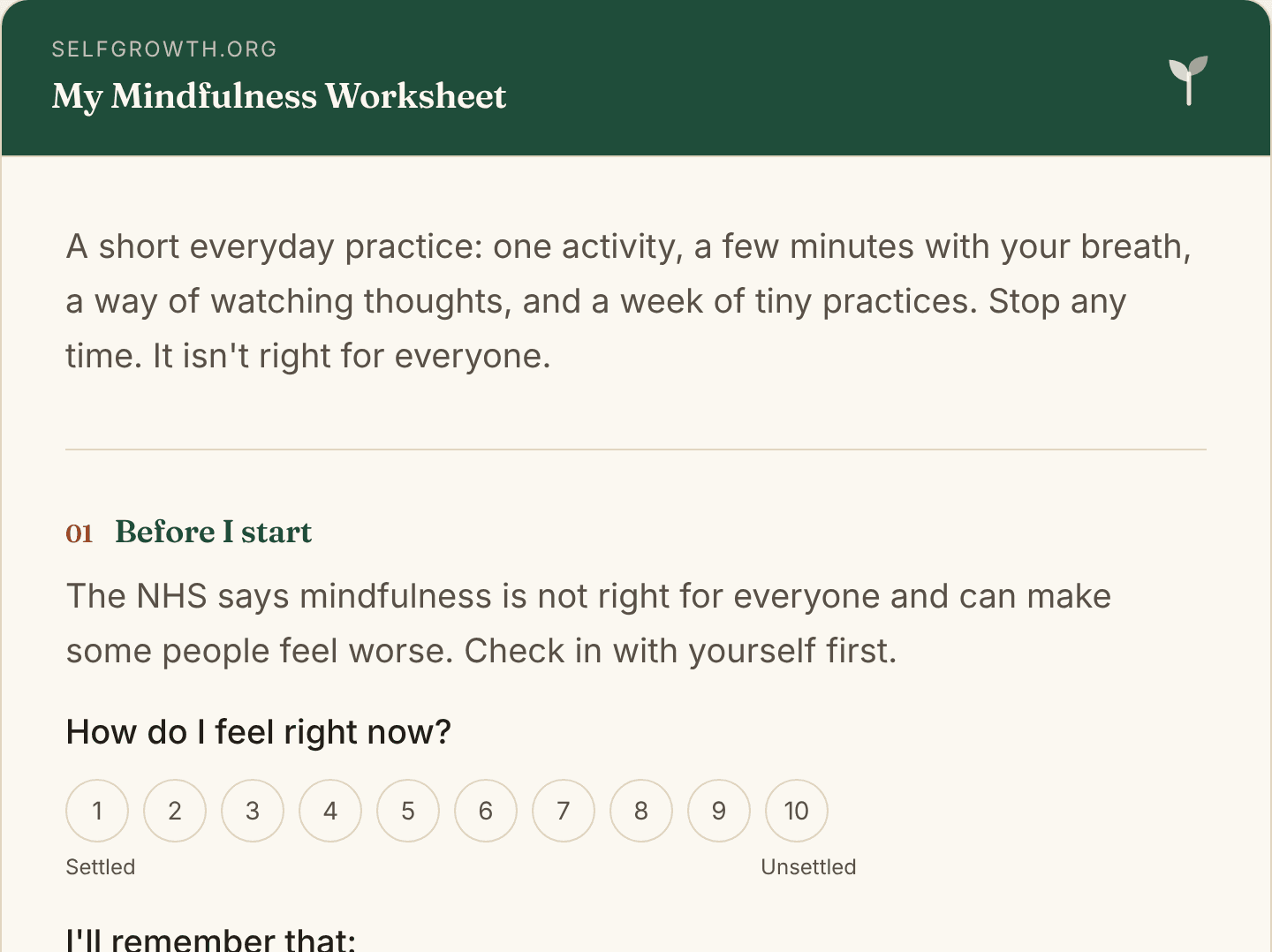
Mindfulness Worksheet
A free mindfulness worksheet: one everyday activity, a few minutes with your breath, a way to watch thoughts and a week of tiny practices. Not for everyone.
Open worksheet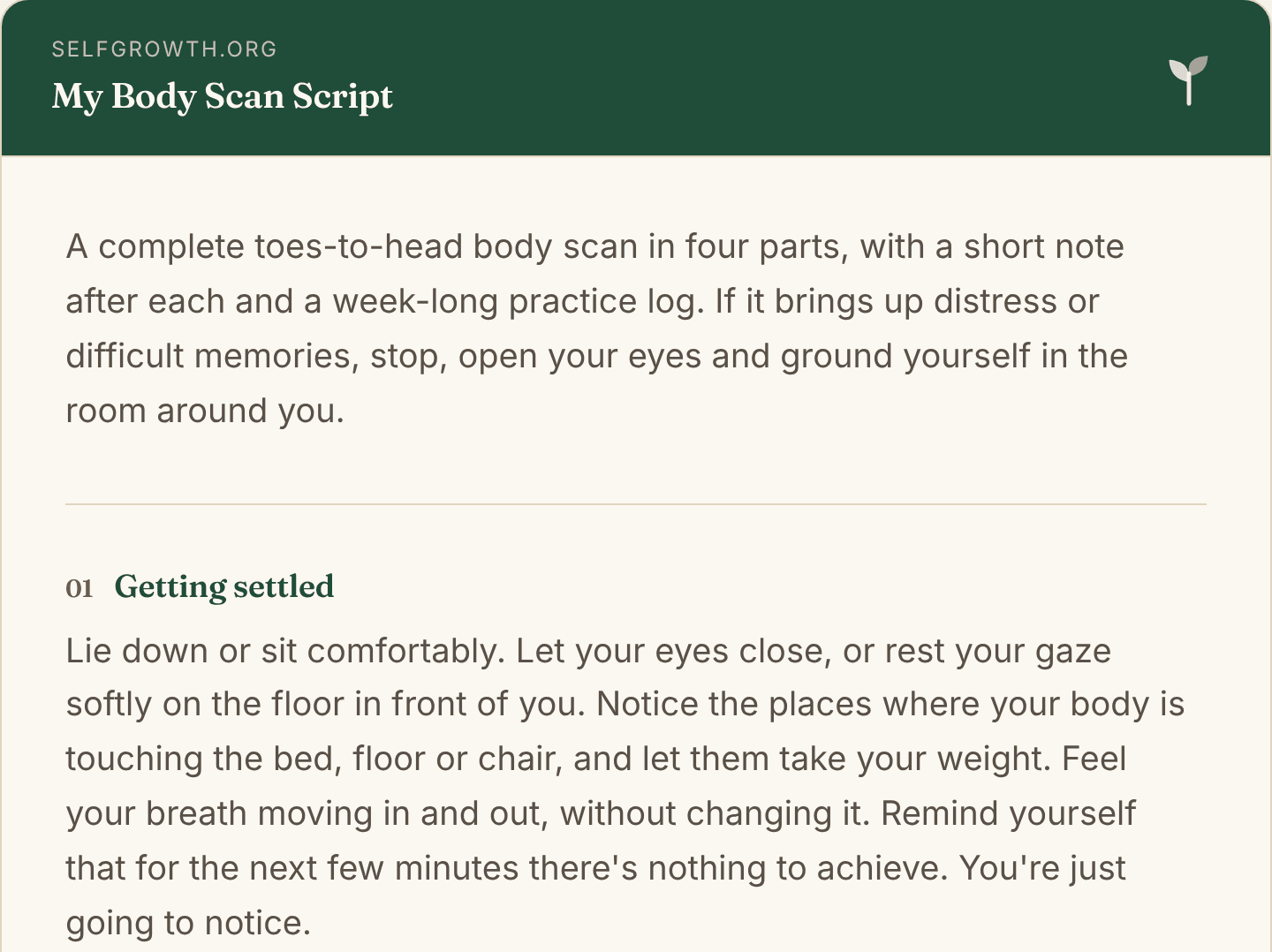
Body Scan Script
A free body scan meditation script in plain English: move your attention slowly from toes to head, noticing without changing, with reflection prompts and a log.
Open worksheet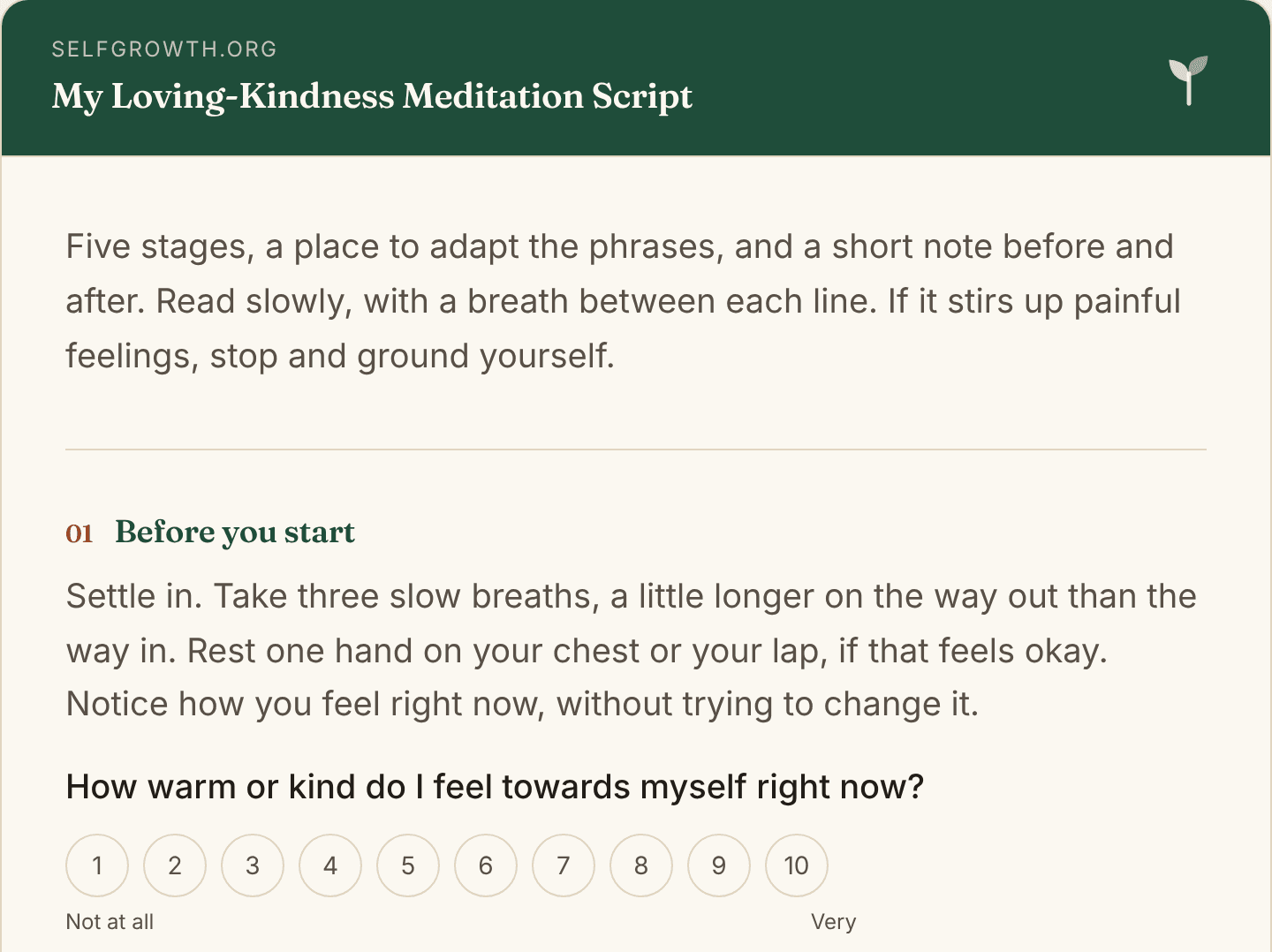
Loving-Kindness Meditation Script
A free loving-kindness (metta) meditation script in plain English: kind wishes for you, someone you love, a neutral person, someone difficult, everyone.
Open worksheet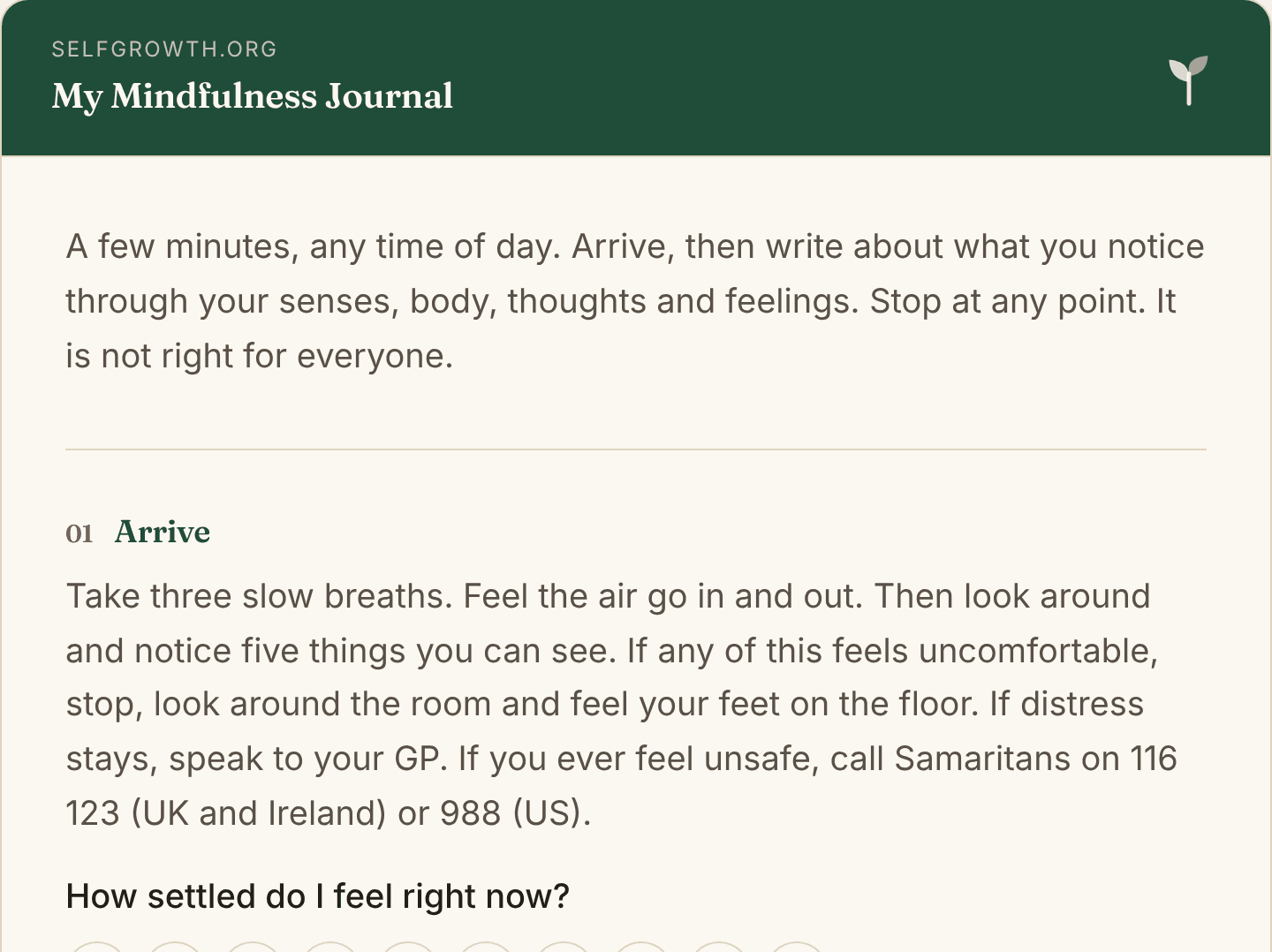
Mindfulness Journal Prompts
A free printable mindfulness journal: a three-breath start, six sets of prompts for senses, body, thoughts and feelings, and a 7-day log. A few minutes a day.
Open worksheetRelated guides
New worksheets, straight to your inbox
An occasional new worksheet or tool, sent only when there's something genuinely worth your time. No spam, no pressure, unsubscribe any time.