
Guide
How to relax your mind and body
Updated 23 October 2026 · 9 min read
To relax, give your body a signal that it is safe to slow down. Breathe out for longer than you breathe in, loosen your muscles from your feet to your face, or take a short walk. Cut back on screens and noise for a while. Pick one method and practise it before you need it.
Drawn from relaxation training and slow-breathing research · Part of rest and self-care
You are exhausted, and you still cannot switch off. Your shoulders are up by your ears, your mind is running through tomorrow, and being told to 'just relax' only makes it worse.
This is a self-help guide, not treatment. If tension, poor sleep or worry are with you all the time, the last section says when to talk to someone.
What does it mean to relax?
Relaxing is not the same as doing nothing, and it is not a feeling you can order up. It is the body and mind slowing down from a state of alert. Your heartbeat settles, your muscles let go, your breathing deepens and your thoughts stop sprinting.
It is also not a performance. If you lie there trying hard to feel calm, the trying can keep you wound up. You are not aiming for perfect stillness. A small drop in tension is a real result.
You cannot force yourself to relax, but you can set up the conditions for it.
Everyone relaxes differently. A long bath calms one person and bores another. Treat what follows as a menu to sample, and keep what works for you.
Why is it so hard to relax when you are stressed?
Stress prepares your body to deal with a threat. Your muscles tighten, your breathing gets quicker and shallower, and your attention narrows onto whatever is worrying you. That response is useful in a short emergency. It is not much use when the pressure is a full inbox at 10pm.
Phones and news keep your mind busy, feeding it new things to react to, so it may not get a clear gap to settle. Trying to stop a worry by force may also keep it in view. If your mind keeps looping, how to stop overthinking goes into that pattern.
One way in is through your body and your surroundings rather than through argument with your thoughts. Slow your breathing, soften your muscles, and reduce what is coming in. See whether your thoughts settle after that.
Ways to relax your mind and body
Try one or two of these when you are already fairly calm, so they feel familiar when you need them. You only need one that works. Stop if an exercise brings back memories, panic or a feeling of unreality: ground yourself, and talk to a GP or therapist about it. Chest pain or trouble breathing means call 999 (UK) or 911 (US), or NHS 111 if you're unsure.
- 1Slow your breathing. Sit or lie somewhere comfortable. The NHS suggests breathing in through your nose and out through your mouth, slowly and steadily, for at least five minutes. A longer out-breath than in-breath is fine if that feels natural. Do not force big breaths.
- 2Release your muscles one group at a time. Starting with your feet, tense a muscle group for a few seconds, then let go and notice the difference. Move up through your legs, stomach, hands, arms, shoulders and face.
- 3Do a body scan. Lie down and move your attention slowly from your toes to your head, noticing each area without trying to change it. Where your mind wanders, bring it back gently.
- 4Take a short walk. Go outside if you can, at an easy pace, and look at what is around you rather than at your phone. Even a few minutes away from your desk counts.
- 5Have a warm shower or bath. Warmth on your skin gives your attention something simple to rest on. Keep your phone out of the room.
- 6Build a wind-down routine for sleep. Choose a regular time, dim the lights, and do something quiet and the same each evening: a stretch, a book, a warm drink without caffeine. A routine tells your body that the day is ending.
- 7Reduce what is coming in. For a set time, turn off notifications, close the tabs, mute the news and lower the noise and light around you. Give your mind a clear gap with nothing new to react to.
If you feel dizzy or light-headed while breathing slowly, stop and breathe normally. The same goes for the body scan or any other exercise here: stop if it brings back memories, panic or a feeling of unreality, ground yourself, and talk to a GP or therapist. Chest pain or trouble breathing means call 999 (UK) or 911 (US), or NHS 111 if you're unsure. If you have a medical condition that affects your breathing, heart or muscles, or you are pregnant, check with your GP before trying breathing or muscle exercises that feel uncomfortable.
Which method suits which moment?
These are starting points, not rules. A free worksheet or script goes with several of them.
- Tense, with tight shoulders or jaw: slow breathing, then the progressive muscle relaxation script, which talks you through each muscle group.
- Lying awake, body restless: the body scan script, or a wind-down routine. If sleep is the main problem, a sleep diary shows you what is helping and what is not.
- Racing thoughts: the mindfulness worksheet, or noticing your senses with the 5-4-3-2-1 grounding worksheet.
- Run down, with no time for yourself: a short walk, a warm shower and some quiet time, planned on the self-care worksheet.
- Overloaded by everything arriving at once: reduce what is coming in, then pick one method from above.
If you want other quick ways to come back to the present when you feel overwhelmed, see grounding techniques.
Common mistakes when trying to relax
- Waiting until you are at breaking point. Practise when you are only mildly tense so the method is familiar.
- Trying too hard. Effort is the opposite of what you want. Let your attention drift and gently bring it back.
- Judging it after one go. Some methods feel strange or even uncomfortable at first. Give each a few tries, unless it makes you panicky or brings back memories: stop and try another.
- Reaching for a screen as your only wind-down. Scrolling can feel restful but keeps your mind taking things in.
- Using relaxation to avoid a problem. Settling yourself helps you think, but the cause may still need dealing with afterwards.
Does relaxation actually work?
Some of it has research behind it, and some is simply sensible. A 2018 systematic review (a study that gathers and assesses all the research on a question) by Andrea Zaccaro and colleagues looked at slow breathing in healthy adults, meaning fewer than 10 breaths a minute. It linked slow breathing with feeling more relaxed and comfortable, and with less anxiety and reduced arousal (less arousal means the body is in a lower state of high alert). Those were healthy people, not people with an anxiety disorder.
For relaxation training more widely, a 2008 meta-analysis (a study that combines the results of many studies) by Gian Mauro Manzoni and colleagues looked at relaxation training for anxiety, including progressive muscle relaxation. It found a reduction in anxiety. But it combined trials of different quality, and some studies had nothing to compare against, so it cannot say how much of the change came from relaxation itself.
No study tests a warm shower, a walk or a wind-down routine on its own as a way to relax. There is less evidence for them. They are offered because they are low-risk to try, and your own experience is the test.
When to get more support
Relaxation is a skill for ordinary stress. See your GP if tension, sleeplessness or worry are with you most days, if you cannot relax however much you try, or if they are getting in the way of work, relationships or looking after yourself. Chest pain or trouble breathing means call 999 (UK) or 911 (US), or NHS 111 if you're unsure. Constant tension can be a sign of anxiety, burnout or another problem that deserves proper help, and there are treatments that work. Signs of burnout can help you tell whether that is what you are dealing with.
Thoughts like these are serious: wanting to harm yourself, or feeling that others would be better off without you. If you are having them, please put safety first and reach out now. Call Samaritans free on 116 123 (UK and Ireland), call or text 988 (US), or find a line in your country at findahelpline.com. The page at selfgrowth.org/help lists more. If you are in immediate danger, call 999 (UK) or 911 (US), or NHS 111 if you are unsure.
Sources and further reading
This is an educational self-reflection resource, not therapy or medical advice.
If you want to go deeper
- Zaccaro, A., Piarulli, A., Laurino, M., Garbella, E., Menicucci, D., Neri, B. & Gemignani, A. (2018). How breath-control can change your life: A systematic review on psycho-physiological correlates of slow breathing. Frontiers in Human Neuroscience, 12, 353.
- Manzoni, G. M., Pagnini, F., Castelnuovo, G. & Molinari, E. (2008). Relaxation training for anxiety: a ten-years systematic review with meta-analysis. BMC Psychiatry, 8, 41.
- NHS. Breathing exercises for stress. https://www.nhs.uk/mental-health/self-help/guides-tools-and-activities/breathing-exercises-for-stress/
Your questions, answered
- How can I relax my mind and body quickly?
- Breathe in slowly through your nose and out slowly through your mouth for a few minutes, and let your shoulders, jaw and hands drop. Then step away from screens for a short while. Neither is a cure for stress, but both give your body a signal to slow down.
- How do I relax when I can't stop thinking?
- Start with your body rather than your thoughts. Slow your breathing, tense and release your muscles, or put your attention on what you can see and hear around you. Trying to push thoughts away may keep them in view, so let them be there while you do something else.
- What are some relaxation tips for stress?
- Slow breathing, progressive muscle relaxation, a body scan, a short walk, a warm shower, a regular wind-down routine and cutting back on screens and noise are all things to try. Pick one or two and practise before you are very tense.
- What is progressive muscle relaxation?
- It is a way of relaxing by tensing a muscle group for a few seconds, letting go, and noticing the difference, working through the body in turn. The free progressive muscle relaxation script on this site talks you through it. A meta-analysis of relaxation training for anxiety, which included this approach, found lower anxiety, though the studies varied in quality.
- Does slow breathing really help you relax?
- A systematic review of studies in healthy adults linked slow breathing with feeling more relaxed and comfortable, and with less anxiety. It does not show that breathing treats an anxiety disorder, so treat it as a practical skill. Stop if you feel dizzy.
- Why can't I relax even when I have free time?
- A body that has been tense for a while does not drop straight into calm when the work stops. Your mind may also use the quiet to catch up on worries. Give yourself a gentle bridge, such as a short walk or a breathing exercise, and if you still cannot settle, speak to your GP.
- Is this free, and is it a substitute for treatment?
- It is free, with no payment and no email needed. This guide is self-help, not therapy or medical advice. If tension, sleeplessness or worry are constant, please see your GP. If you ever feel unsafe, call Samaritans on 116 123 (UK and Ireland), 988 (US), or find a line at findahelpline.com.
Worksheets to do the work
Free to fill in online or print. No email needed.
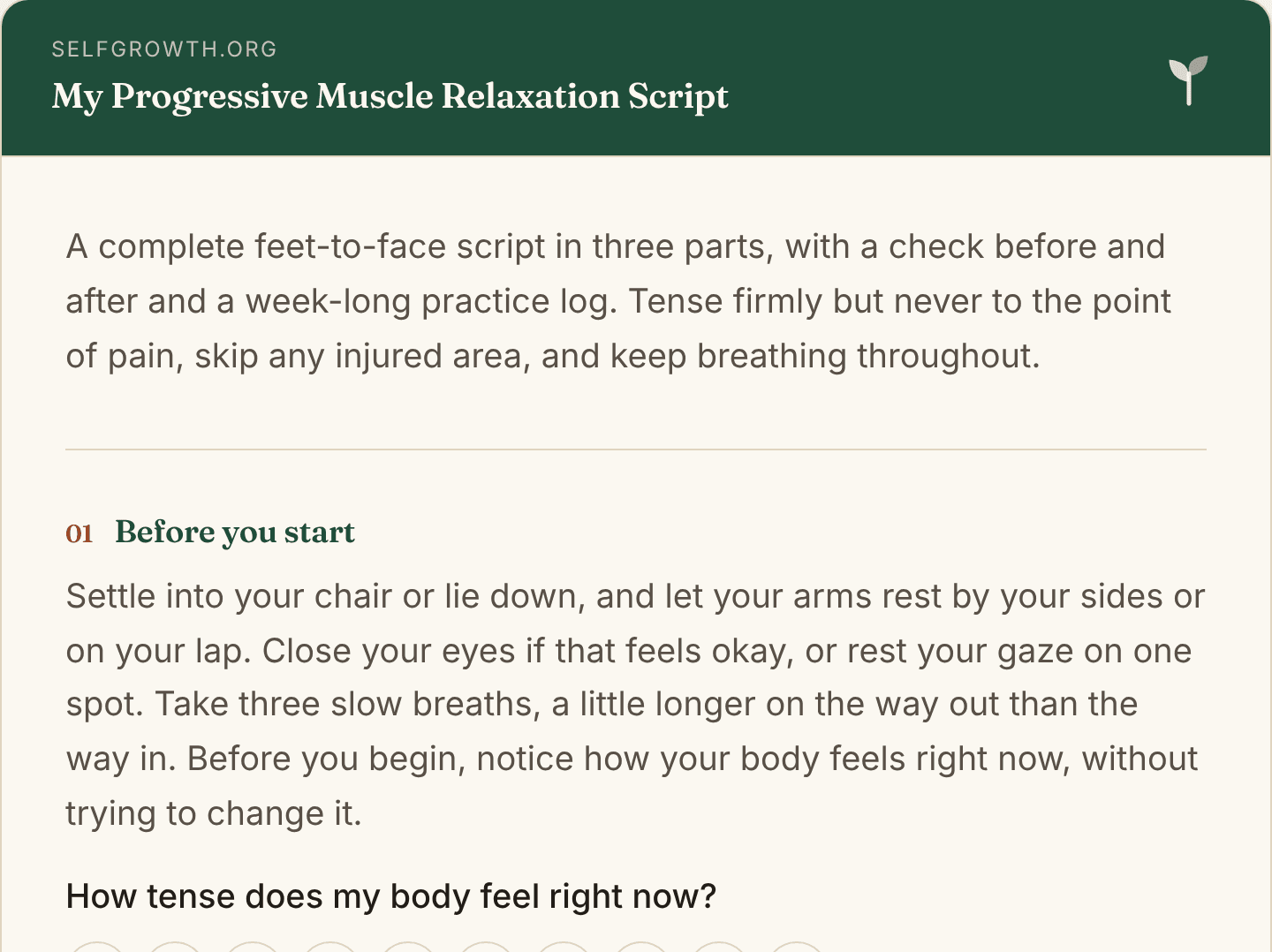
Progressive Muscle Relaxation Script
A free progressive muscle relaxation script in plain English: tense and release 13 muscle groups from feet to face, with a before-and-after check and 7-day log.
Open worksheet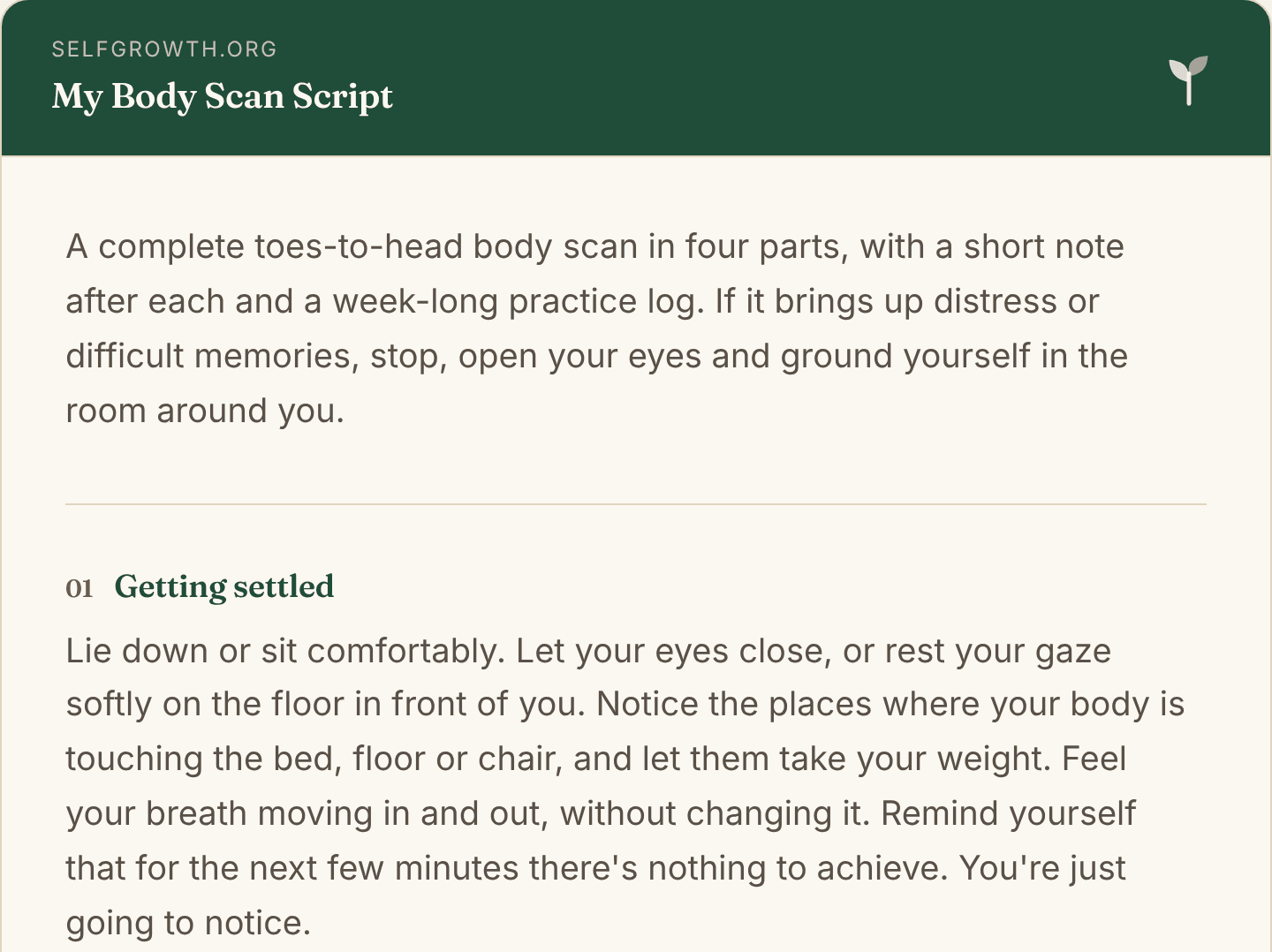
Body Scan Script
A free body scan meditation script in plain English: move your attention slowly from toes to head, noticing without changing, with reflection prompts and a log.
Open worksheet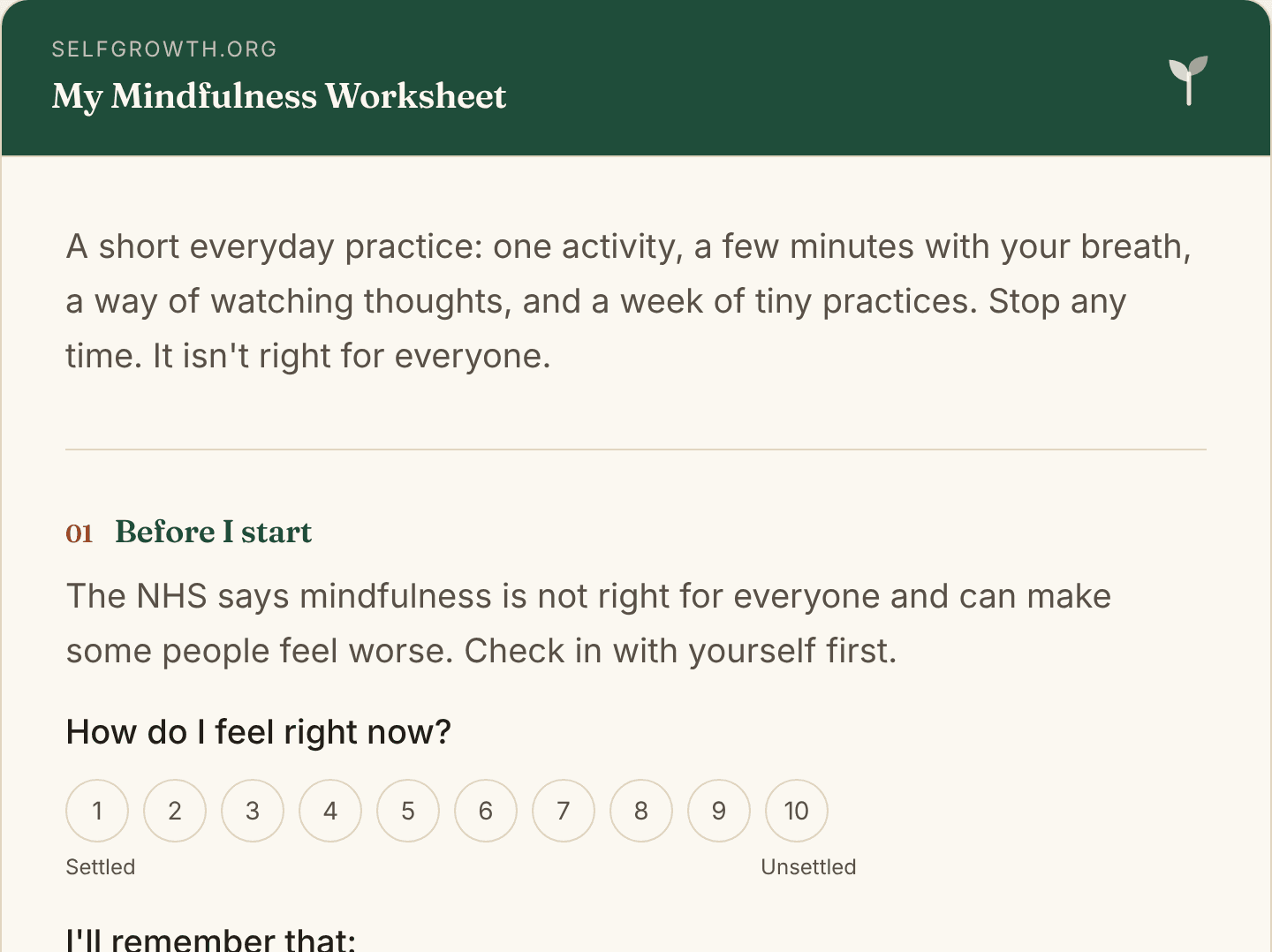
Mindfulness Worksheet
A free mindfulness worksheet: one everyday activity, a few minutes with your breath, a way to watch thoughts and a week of tiny practices. Not for everyone.
Open worksheet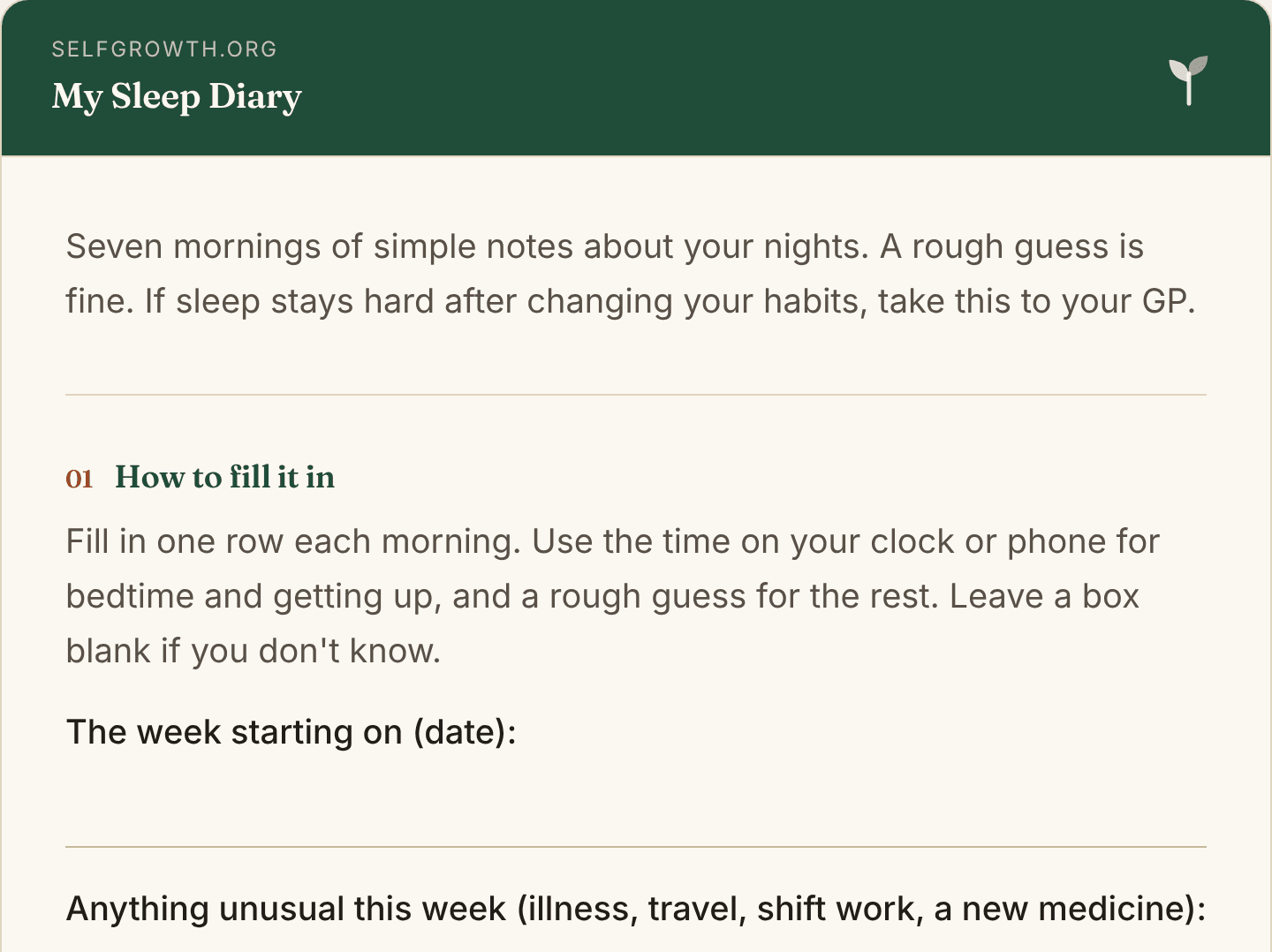
Sleep Diary
A free printable 7-day sleep diary: bedtime, wake time, how rested you felt, caffeine and notes, plus a page to bring to your GP if sleep stays hard.
Open worksheet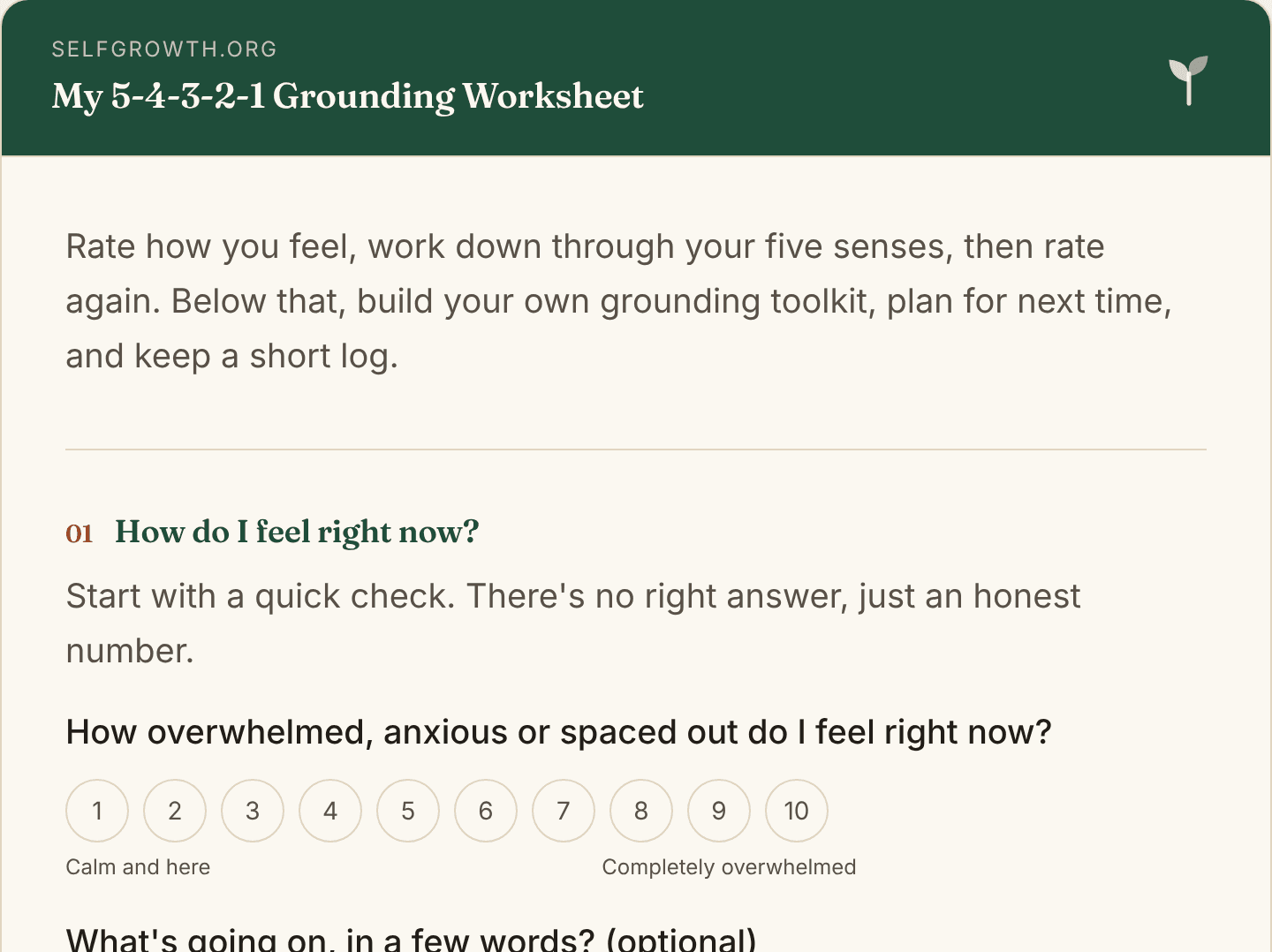
5-4-3-2-1 Grounding Worksheet
A free, printable 5-4-3-2-1 grounding worksheet: rate how you feel, work through your five senses, re-rate, then build your own toolkit and plan for next time.
Open worksheet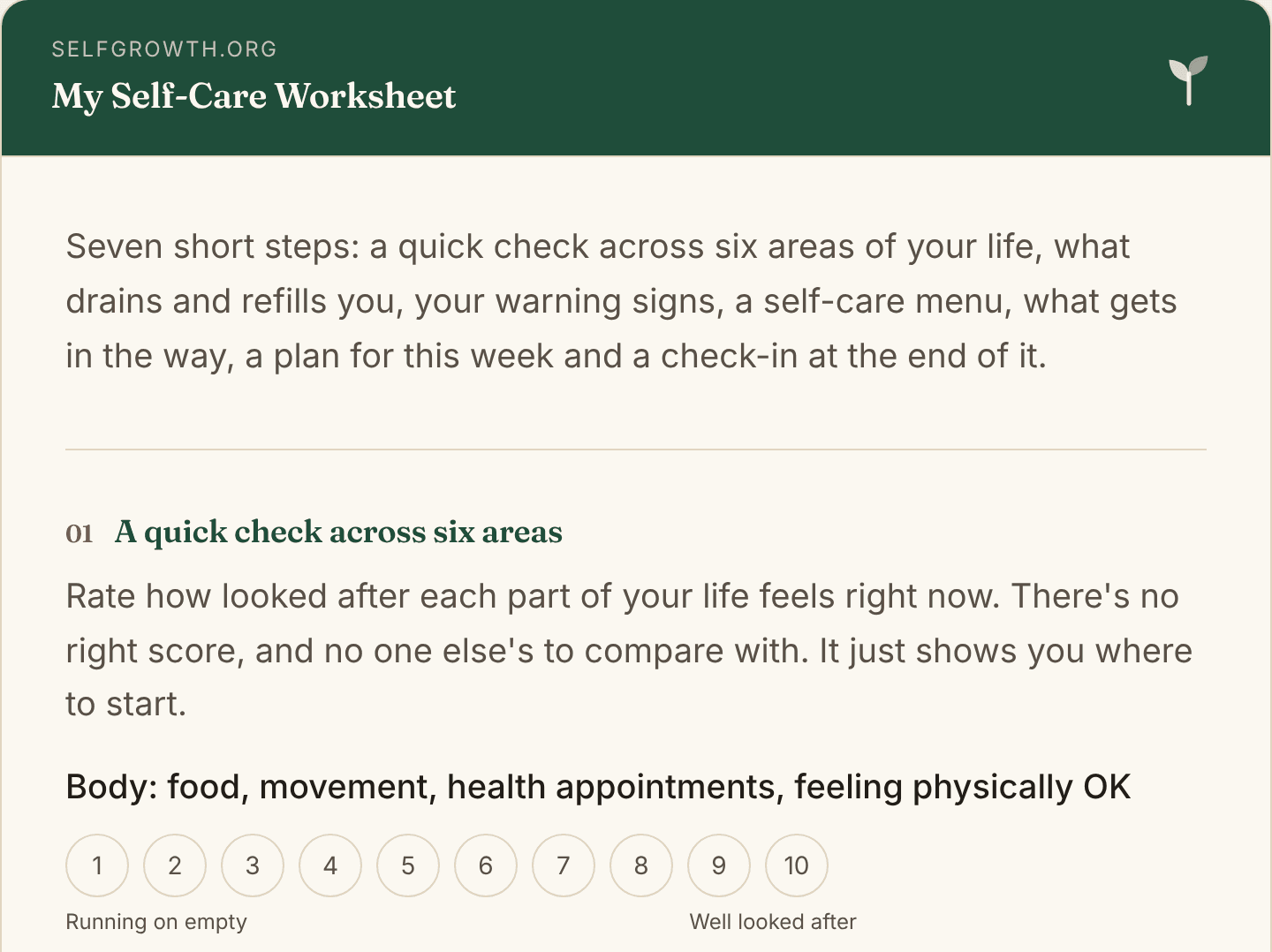
Self-Care Worksheet
A free, printable self-care worksheet for adults: check six areas of your life, see what drains and refills you, and make a self-care plan that costs nothing.
Open worksheet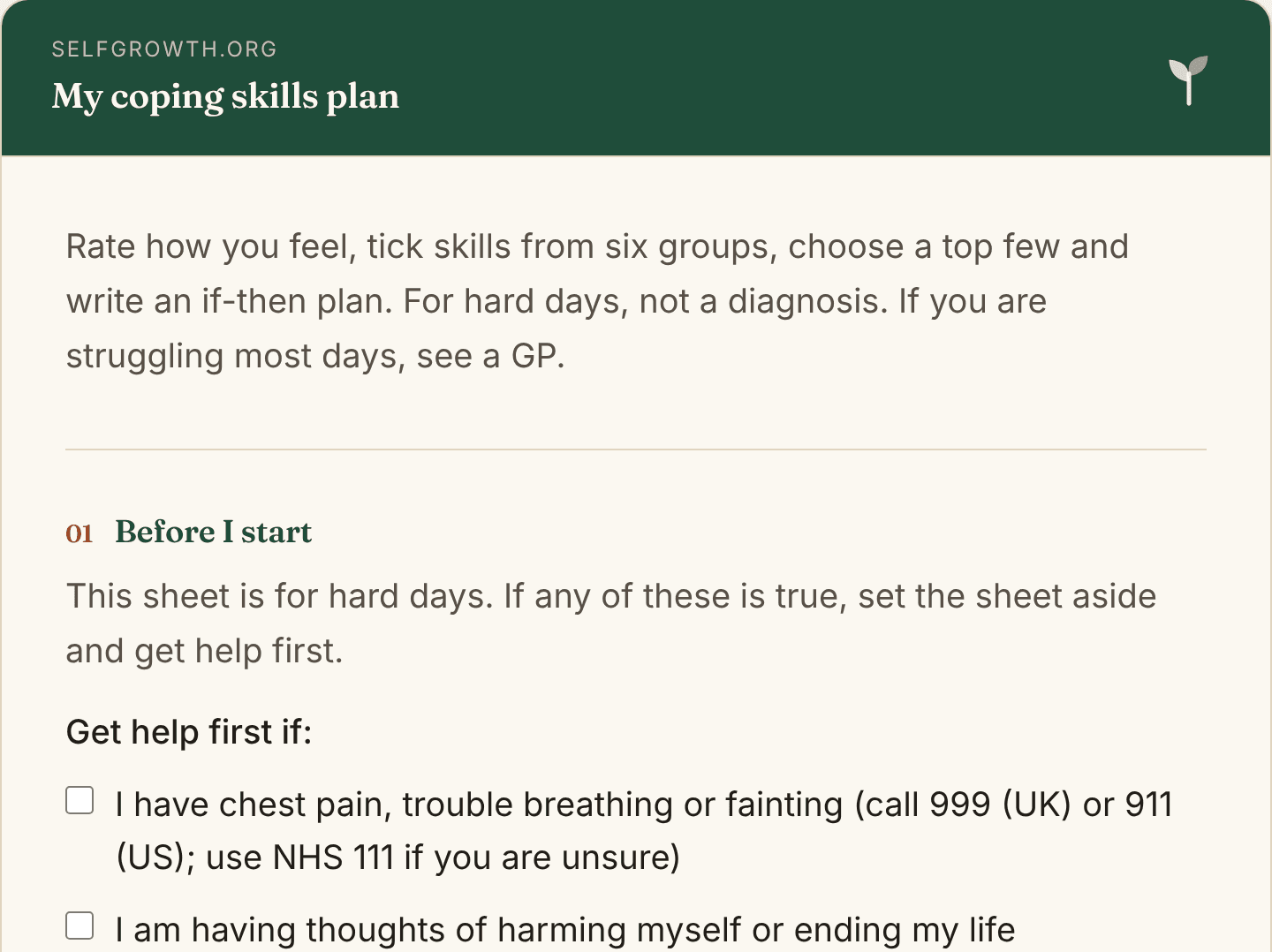
Coping Skills Worksheet
Free printable coping skills worksheet: sort skills into calm, distract, connect, move, basics and problem-solving, then build an if-then plan.
Open worksheet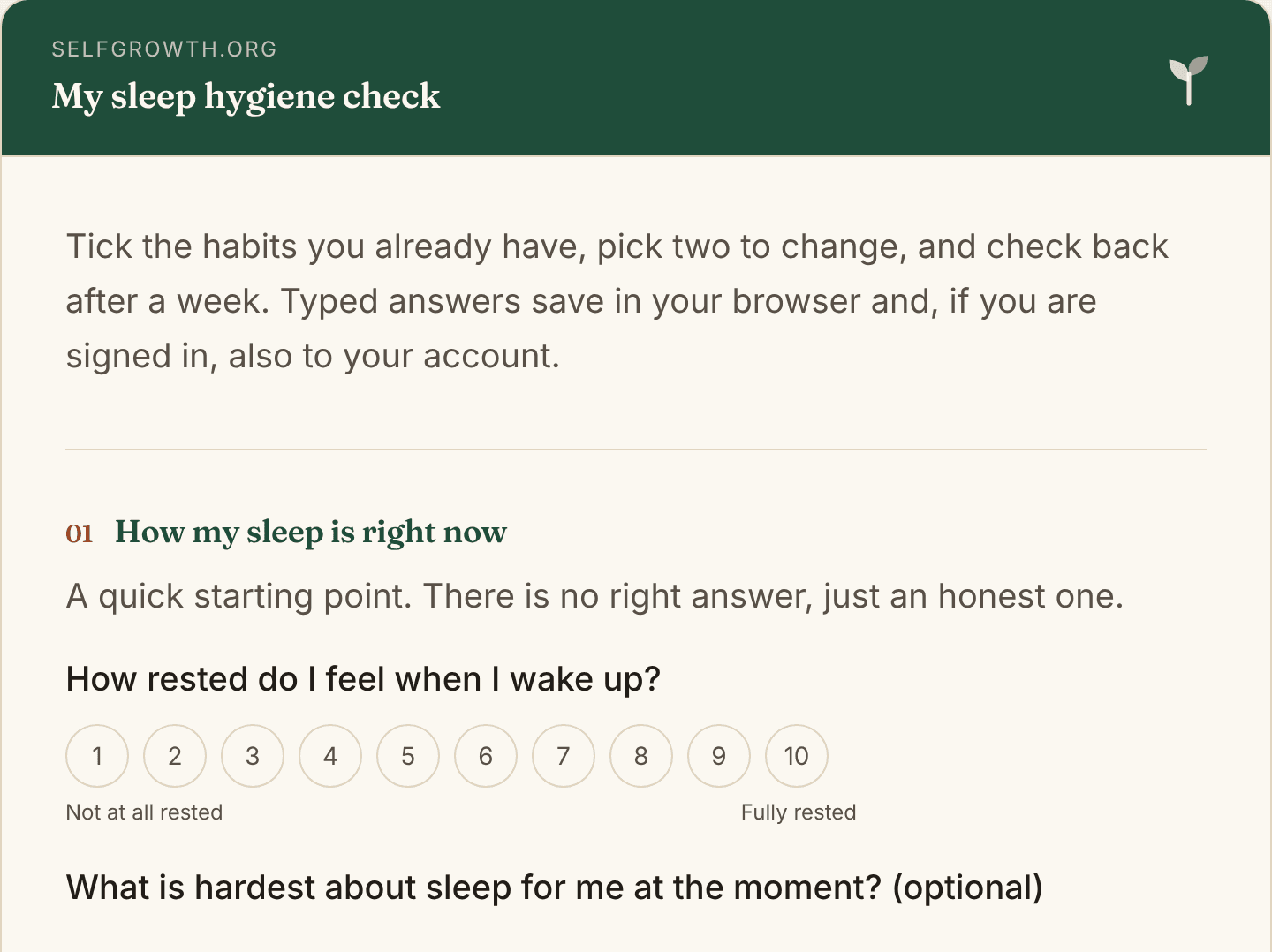
Sleep Hygiene Worksheet
A free printable sleep hygiene worksheet: tick the habits you already have, pick two to change, check back after a week, and know when to see a doctor.
Open worksheetRelated guides
New worksheets, straight to your inbox
An occasional new worksheet or tool, sent only when there's something genuinely worth your time. No spam, no pressure, unsubscribe any time.