
Values
Ikigai worksheet: a free reflection sheet for what you love, do well, and need
Updated 23 October 2026 · 7 min read · Free to print
The popular ikigai exercise uses four circles: what you love, what you are good at, what the world needs and what you can be paid for. This free worksheet gives you space to fill in each one, spot where they overlap and try one small experiment this week. It is a prompt for reflection, not a career test.
Drawn from cognitive behavioural therapy & self-compassion research · Part of self-discovery
Fill it in here (it saves in this browser, but not in a private window), print it, or download the PDF. Free, no sign-up.
You may have wondered what you are meant to be doing. The four-circle ikigai exercise gives that question a shape. You list what you love, what you are good at, what the world needs and what you could be paid for, then look at where the lists meet.
Treat the result as something to think about, not an answer. Your circles will change as your life does, and some may be hard to fill in right now. That is fine. Leave a gap and come back.
The sheet also asks what you are already doing that feels a bit like this, because meaning may turn up in ordinary parts of your week before it turns up in a big plan. It ends with one small experiment, so the thinking becomes something you can try.
This is a self-reflection tool, not career advice, a test or therapy. If doing it brings up a sense that nothing is worth doing or that life is not worth living, pause and talk to a GP or someone you trust. If you are thinking about harming yourself or ending your life, call Samaritans on 116 123 (UK and Ireland) or 988 (US), find a line at findahelpline.com, or see selfgrowth.org/help.
How to use this worksheet
- 1Write quickly and do not edit yourself. Short phrases are enough, and you can fill in the circles in any order.
- 2Include small things. A hobby, a way you help a friend or a task you lose track of time doing all count.
- 3Do not worry if the circles do not seem to overlap. Move on to the step about what you already do.
- 4Choose one small experiment you can try within a week, then come back and note what happened.
The worksheet
selfgrowth.org
My ikigai reflection
Fill in the four circles, look for where they meet, notice what you already do, then try one small experiment. Typed answers save in your browser and, if you are signed in, also to your account.
01What I love
Things you enjoy for their own sake, even if nobody pays you or notices. Think about what you would do on a free afternoon.
Things I love doing, or learning about:
- 1.
- 2.
- 3.
- 4.
- 5.
- 6.
02What I am good at
Skills, strengths and things you do well, from practical to personal. If you struggle to name them, think of what other people ask your help with.
Things I am good at:
- 1.
- 2.
- 3.
- 4.
- 5.
- 6.
03What the world needs
The world can mean your household, your street, your workplace or a wider cause. What would be missed if it were not done? What problem do you care about?
Needs I notice and care about:
- 1.
- 2.
- 3.
- 4.
- 5.
- 6.
04What I can be paid for
Work or skills that someone could pay for, now or later. Include ideas you have not tried. This one can be shaped by money and circumstances, so be practical and kind to yourself.
Things I could be paid for, or could learn to be:
- 1.
- 2.
- 3.
- 4.
- 5.
- 6.
05Where the circles meet
Look back at your lists. Where do two or more circles touch? Write down any pairing, however rough. Not every circle has to meet.
Love and good at
Something from both lists
Good at and needed
Something from both lists
Needed and paid for
Something from both lists
Paid for and love
Something from both lists
Anything that appears on three or four lists? Or a pattern I notice?
06What I am already doing that feels like this
You may not need to start something new. Look through your ordinary week for moments that feel absorbing, useful or meaningful.
Moments in my week when time passes easily, or I feel useful:
Small things count: cooking, helping, tidying, making, explaining.
Which of these could I do a little more of?
07One small experiment this week
Pick one small thing that is easy to try, takes a few hours at most, and can be undone. Examples: spend an hour on something from your love list, ask someone what they notice you do well, or help with something in your needs list. When to get more support: if you have felt low or without purpose for weeks, talk to your GP. If you are thinking about harming yourself or ending your life, call Samaritans on 116 123 (UK and Ireland), call or text 988 (US), or find a line at findahelpline.com. More routes: selfgrowth.org/help.
My experiment, and when I will do it:
Before: how meaningful does my week feel right now?
After: how did the experiment feel?
What did I notice? What do I want to repeat, change or drop?
When you're done, a moment to reflect
- Which circle was easiest to fill in, and which was hardest? What does that tell you?
- Did anything on your lists surprise you?
- Is there something on your lists you have put off because it does not look like a proper job or goal?
- What would a small, gentle step towards one of your overlaps look like?
- Is there a part of this you would like to talk through with a friend, a coach or a counsellor?
Done for now?
Save today's answers as a dated entry. You can come back, fill it in again and compare the two side by side.
Where does the ikigai diagram come from?
The four-circle diagram is a modern popular version, not an ancient Japanese model. In 2014 Marc Winn published a blog post called What's your ikigai?, in which he adapted a 2011 diagram about purpose by the author Andres Zuzunaga, replacing the word purpose with ikigai. A later book, Ikigai: The Japanese Secret to a Long and Happy Life by Hector Garcia and Francesc Miralles, helped spread it.
The Japanese idea is wider. A usual starting point is the psychiatrist Mieko Kamiya, whose 1966 book Ikigai ni tsuite (translated as On the Meaning of Life) wrote about what makes life feel worth living. In everyday use, ikigai can come from relationships, hobbies and daily routines as much as from work.
Treat it as a way to think, not a proven method. Use whatever helps and leave the rest.
These are educational self-reflection tools, not therapy.
If you want to go deeper
- Winn, M. (2014). What's your ikigai? The View Inside Me (blog), 14 May 2014.
- García, H. & Miralles, F. (2016). Ikigai: Los secretos de Japón para una vida larga y feliz. Ediciones Urano. English edition: Ikigai: The Japanese Secret to a Long and Happy Life (2017), Penguin.
- Kamiya, M. (1966). Ikigai ni tsuite [On the Meaning of Life].
Your questions, answered
- What is ikigai?
- Ikigai is a Japanese word for something that gives your life meaning or a reason to get up in the morning. It is often used as a broader, everyday idea that can include family, friends, hobbies and work. The four-circle diagram you may have seen is a later popular version, covered in the section below.
- How do I find my ikigai?
- There is no formula. A practical start is to write down what you love, what you are good at, what the world needs and what you could be paid for, then look for overlaps. Notice what you already do that feels meaningful, and try one small experiment. The worksheet above walks you through each step.
- Is the ikigai diagram really Japanese?
- No. The four-circle diagram is a Western adaptation. Marc Winn posted it in a blog post in 2014, adapting an earlier diagram about purpose by Andres Zuzunaga by changing one word. The Japanese idea of ikigai is wider and less focused on a career.
- What if my circles do not overlap?
- That is fine, and nothing is wrong with you. Your circles can be small, change over time or be hard to fill in when life is busy or low. Move to the step about what you already do, and keep the experiment small.
- Is ikigai a career test?
- No. It is a prompt for reflection. The worksheet does not score you or tell you what job to take. Use it to notice patterns and try small things, and treat any decision about work as your own, ideally with real information and people you trust.
- Is there an ikigai worksheet PDF?
- Yes. Use the Download PDF button for a clean, print-ready copy, or Print to print straight from the page. It is free, with no payment and no email needed. You can also fill it in on screen, and your answers save in your browser.
- Is this worksheet a substitute for therapy?
- No. It is a self-help reflection tool, not therapy, career advice or medical advice. If you feel low, stuck or without purpose for a long time, a GP can point you towards support. If you are thinking about harming yourself or ending your life, that is serious: call Samaritans on 116 123 (UK and Ireland), call or text 988 (US), or find a line at findahelpline.com. More routes: selfgrowth.org/help.
Keep going, related worksheets
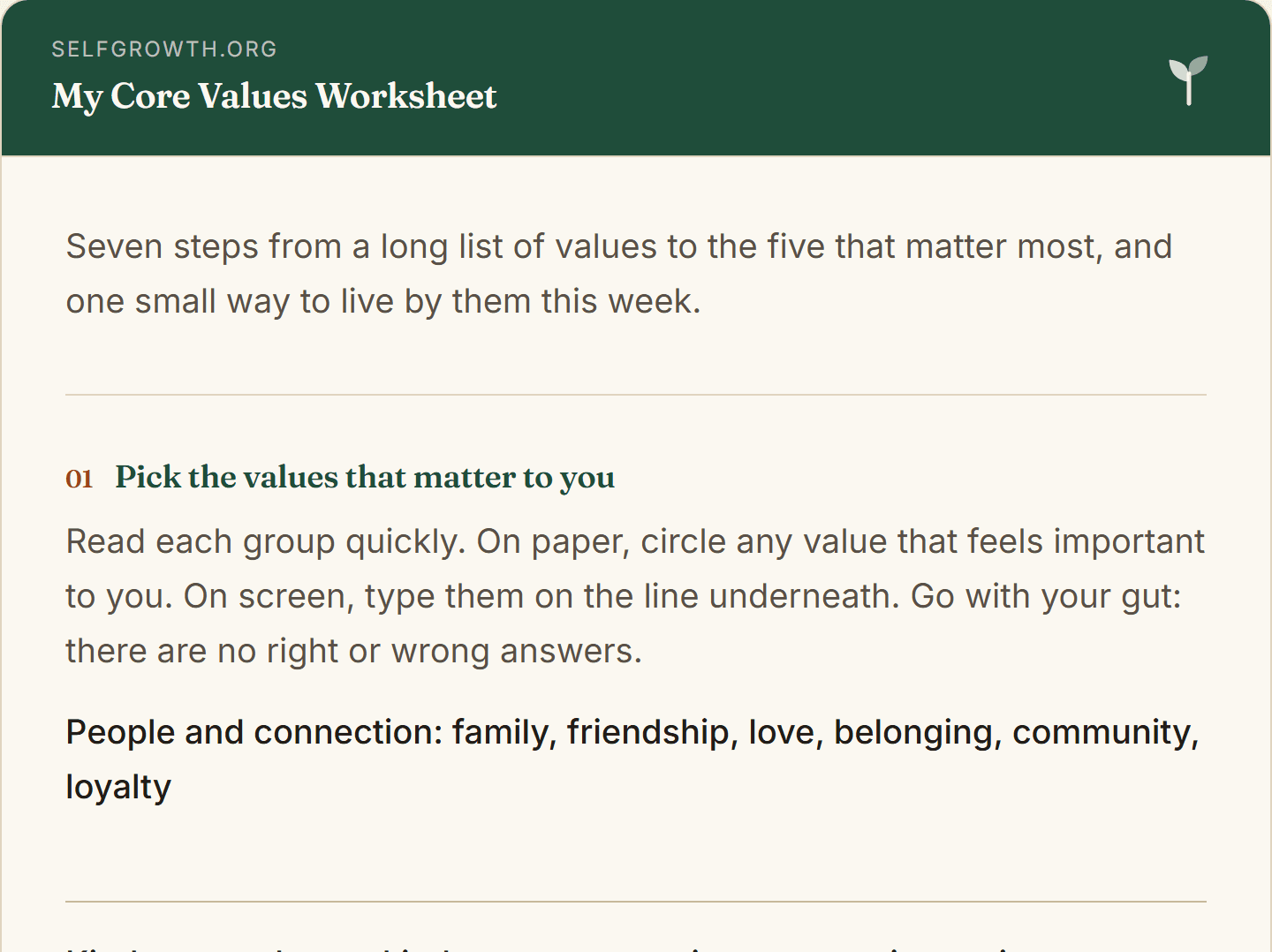
Core Values Worksheet
A free, printable core values worksheet: pick values from a list, narrow them to your top five, put them in your own words and plan one step to live by them.
Open worksheet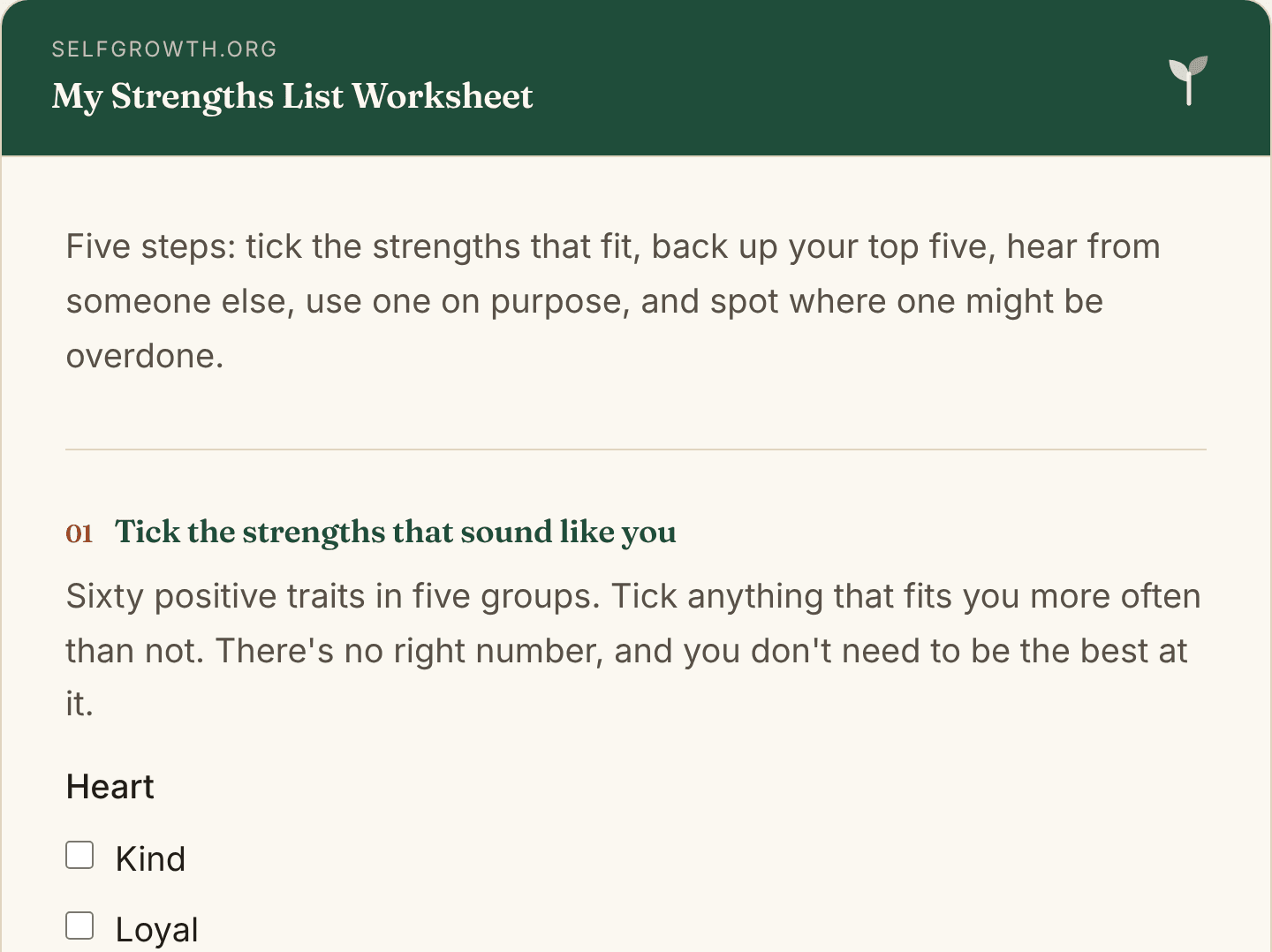
Strengths List Worksheet
A free list of 60 positive character traits and strengths to tick, with space for evidence, what others see in you and one strength to use on purpose this week.
Open worksheet
Who Am I? Worksheet
A free, printable 'Who am I?' worksheet to explore your identity and values, with the classic twenty-statements exercise and guided prompts.
Open worksheetNew worksheets, straight to your inbox
An occasional new worksheet or tool, sent only when there's something genuinely worth your time. No spam, no pressure, unsubscribe any time.