
Anxious moments
Distress tolerance worksheet: a free, printable plan for getting through a hard moment
Updated 23 October 2026 · 6 min read · Free to print
Distress tolerance means getting through a painful moment without doing something that makes it worse. This free, printable worksheet draws on ideas from DBT: you rate how bad it feels, pick from a menu of ways to cope, weigh up any urge to act, and build a plan and log for next time.
Drawn from ideas in DBT distress tolerance · Part of feelings and calm
Fill it in here (it saves in this browser, but not in a private window), print it, or download the PDF. Free, no sign-up.
Some moments are too big to fix or think through. A row, bad news, a wave of shame, a night you can't switch off. In those moments the aim is not to solve anything. It is to get across the next hour without adding a second problem on top of the first.
This sheet helps you do that. You rate how bad it feels, choose a few ways to ride it out from a menu you write in your own words, look honestly at any urge to do something you may regret, and rate again afterwards. On a calmer day you build a plan, and a short log shows you what really helps.
It draws on ideas from the distress tolerance part of dialectical behaviour therapy (DBT), but it is not DBT and it is not therapy. It won't fix what is underneath the feeling. Getting through the moment still counts.
A note on safety. If you think you might hurt yourself (thoughts like these are serious), or you are not safe, put this sheet down and call Samaritans on 116 123 (UK and Ireland), 988 (US), or find a line at findahelpline.com. If the urge you are weighing involves alcohol or drugs, stopping suddenly after regular heavy use can be medically dangerous, so please see a doctor. If another person is the reason you feel unsafe, this sheet is not for that. See the helplines page (selfgrowth.org/help).
How to use this worksheet
- 1Fill in the menu and plan on a calmer day. In a hard moment you won't want to write much, so keep it short.
- 2In the moment, start at section 1 and rate how bad it is. Then pick one or two things from your menu, not all of them.
- 3Choose skills that do not cause harm to you or anyone else. If you notice you are reaching for something risky, go to the pros and cons section first.
- 4Rate again when you are done. A small drop is a real result. If nothing changes, that is information too, so try a different skill.
The worksheet
selfgrowth.org
My distress tolerance worksheet
Rate the moment, choose from your menu, weigh any urge, then rate again. Below that, build your plan and keep a short log.
011. How bad is it right now?
A quick, honest number. You are not trying to talk yourself out of how you feel.
How much distress am I in right now?
What happened, in a few words?
What am I feeling most? (for example panic, shame, anger, grief, emptiness)
022. My skills menu
Tick the ones that suit you and add your own. The aim is to give your mind or body something else to do while the peak passes. None of these removes the problem, and they are not meant to.
Take my mind elsewhere for a while
Soothe myself through the five senses
Change what my body is doing
My own skills, in my own words:
The one or two I will try now:
033. If I have an urge to act
Distress can come with a pull to do something: send the message, quit, drink, shout, spend, disappear. Slow it down by looking at both sides. Do not write about methods of harming yourself here. If that is the urge, stop and use the numbers above.
The urge is to...
Entry 1
Entry 2
Entry 3
Entry 4
Which choice fits the person I want to be next week?
044. Accepting what I can't change right now
Arguing with a fact you can't change can leave you stuck. Accepting it does not mean you approve of it or that it is fair. It means you stop spending energy arguing with what has already happened.
The fact I am struggling to accept:
A sentence I can say in my own words (for example 'This has happened, and I don't have to like it'):
One small thing within my control in the next hour:
055. How bad is it now?
Re-rate it. It does not need to reach zero.
How much distress am I in now?
What helped, and what didn't?
066. My plan and log
Fill in the plan when you are calm. Use the log to see what works for you over time.
Entry 1
Entry 2
Entry 3
Someone I can contact if skills aren't enough:
Entry 1
Entry 2
Entry 3
Entry 4
Entry 5
When you're done, a moment to reflect
- What usually sets off your hardest moments, and how early can you spot the first sign?
- Which skill on your menu changed how you felt, even a little?
- What do you do now that makes a hard moment worse, and what could you do instead?
- What would you say to a friend sitting through the same moment?
- Once you are steadier, is there something underneath this that is worth talking to someone about?
Done for now?
Save today's answers as a dated entry. You can come back, fill it in again and compare the two side by side.
Where do these ideas come from, and do they work?
Dialectical behaviour therapy (DBT) was developed by the psychologist Marsha Linehan, and her 1993 book Cognitive-Behavioral Treatment of Borderline Personality Disorder, from Guilford Press, set out the approach. DBT teaches four groups of skills, including distress tolerance, as part of a full therapy with trained clinicians. This worksheet is a plain-English, self-help use of a few of those ideas. It is not DBT and not therapy.
For DBT as a whole therapy, there is research. A 2010 meta-analysis by Kliem, Kroger and Kosfelder looked at DBT for borderline personality disorder. Effects were moderate, and they held when borderline-specific treatments with randomised designs were considered. About half the studies were not randomised, and the gains faded slightly at follow-up. That is for the full therapy in borderline personality disorder, so it tells us little about a single worksheet.
Single distress tolerance skills used alone, as a self-help page, have not been well tested. The before and after ratings and the log are here so you can see in your own life what helps.
These are educational self-reflection tools, not therapy.
If you want to go deeper
- Linehan, M. M. (1993). Cognitive-Behavioral Treatment of Borderline Personality Disorder. Guilford Press.
- Linehan, M. M. DBT Skills Training Manual. Guilford Press. (Includes the distress tolerance module.)
- Kliem, S., Kroger, C. & Kosfelder, J. (2010). Dialectical behavior therapy for borderline personality disorder: A meta-analysis using mixed-effects modeling. Journal of Consulting and Clinical Psychology, 78(6), 936-951.
Your questions, answered
- What is distress tolerance?
- It is the ability to get through a painful moment without making it worse. That does not mean liking the feeling or pretending it is fine. It means having a few things you can do while the peak passes, so you are less likely to act on an urge you will regret.
- What are distress tolerance skills?
- They are short, practical ways to cope when you are overwhelmed: taking your mind elsewhere, soothing yourself through the senses, changing what your body is doing, weighing up an urge before acting, and accepting a fact you can't change right now. Section 2 of this worksheet lets you build your own menu.
- Is this DBT?
- No. Dialectical behaviour therapy (DBT) is a full therapy developed by the psychologist Marsha Linehan and delivered by trained clinicians, and distress tolerance is one of its four skill areas. This worksheet is a plain, self-help use of a few of those ideas. It is not DBT and not a replacement for it.
- Does distress tolerance work?
- There is research on DBT as a whole therapy. A 2010 meta-analysis by Kliem and colleagues, covering studies of people with borderline personality disorder, found moderate effects that held when borderline-specific treatments with randomised designs were considered. About half the studies were not randomised, and the gains faded slightly at follow-up. That is for the full therapy in borderline personality disorder, so it tells us little about a single worksheet. Single skills used alone from a worksheet like this one have not been well tested. The before and after ratings let you judge what helps you.
- Distress tolerance vs emotion regulation: what is the difference?
- In DBT, distress tolerance is about getting through a moment you can't change without making it worse. Emotion regulation is about changing how often and how strongly feelings show up over time. This sheet is about the first: surviving the moment, not reshaping your feelings.
- Is there a distress tolerance worksheet PDF?
- Yes. Use the Download PDF button for a clean, print-ready copy, or Print to print straight from the page. It is completely free, with no payment and no email needed. You can also fill it in on screen, and your answers save in your browser.
- Is this worksheet a substitute for therapy?
- No. It is a self-help tool for getting through hard moments, not therapy or medical advice. If hard moments are frequent or intense, a GP can point you to talking therapies. If you ever feel unsafe or have thoughts of harming yourself, call Samaritans on 116 123 (UK and Ireland), 988 (US), or find a line at findahelpline.com.
Keep going, related worksheets
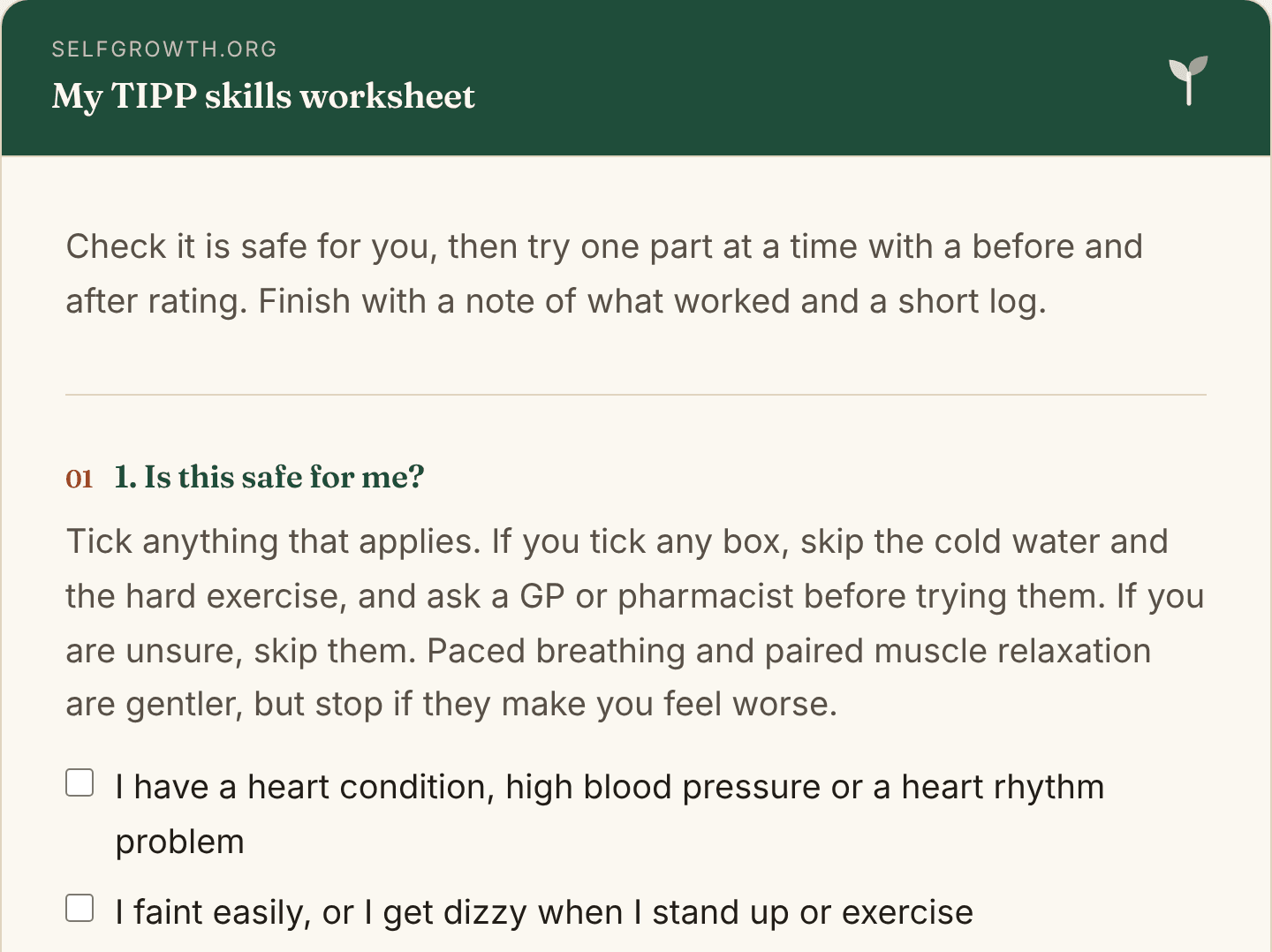
TIPP Skills Worksheet
A free, printable TIPP skills worksheet: check it is safe for you, then try temperature, intense exercise, paced breathing and paired muscle relaxation.
Open worksheet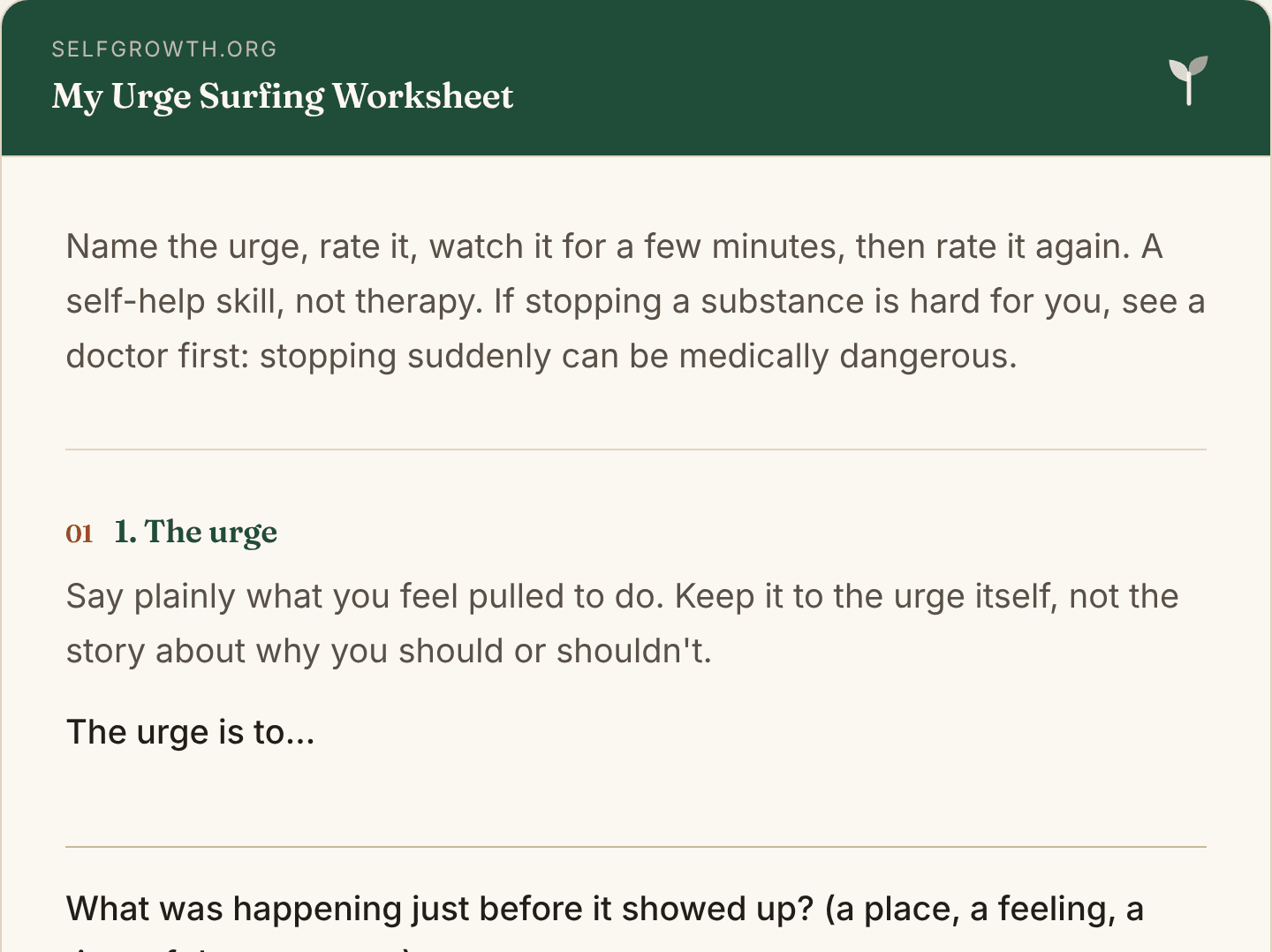
Urge Surfing Worksheet
A free, printable urge surfing worksheet: name the urge, rate it, watch it rise and ease, and plan for next time. Self-help, not therapy. No email needed.
Open worksheet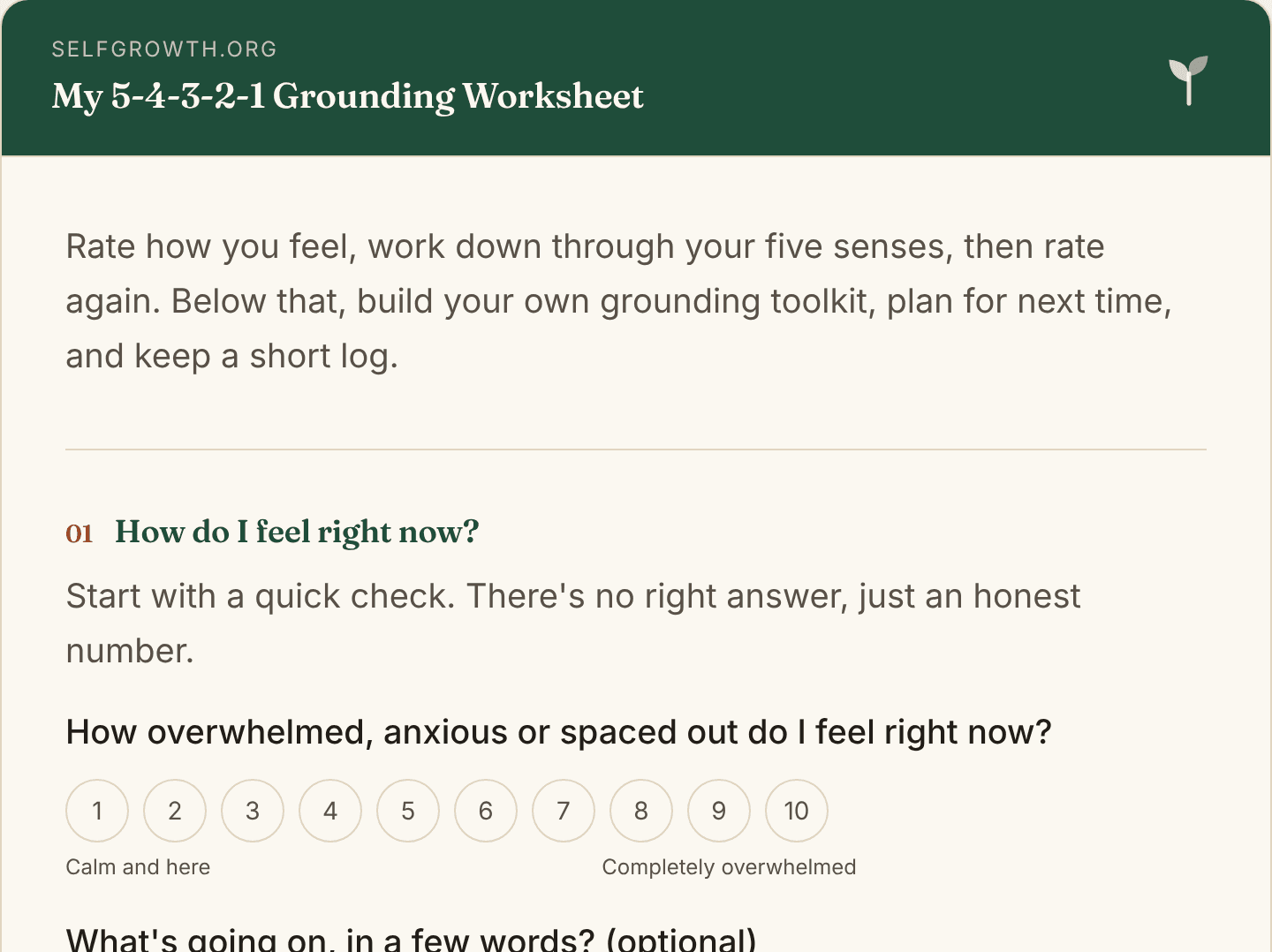
5-4-3-2-1 Grounding Worksheet
A free, printable 5-4-3-2-1 grounding worksheet: rate how you feel, work through your five senses, re-rate, then build your own toolkit and plan for next time.
Open worksheetNew worksheets, straight to your inbox
An occasional new worksheet or tool, sent only when there's something genuinely worth your time. No spam, no pressure, unsubscribe any time.