
Anxious moments
Urge surfing worksheet: a free, printable way to ride out a craving
Updated 23 October 2026 · 6 min read · Free to print
Urge surfing is a way of getting through a craving or impulse without acting on it: you notice the urge, watch it rise and fall like a wave, and stay with it until it eases. This free, printable worksheet walks you through one urge, with a before and after rating and a log.
Drawn from Alan Marlatt's relapse prevention work · Part of feelings and calm
Fill it in here (it saves in this browser, but not in a private window), print it, or download the PDF. Free, no sign-up.
An urge can feel like an order: have the drink, send the message, open the app, buy the thing, eat the rest. Urge surfing is a small experiment in not obeying straight away. You don't fight the urge and you don't feed it. You pay attention to it, the way you might watch a wave, and notice what it does.
This sheet works for everyday urges: to snap at someone, scroll, eat when you aren't hungry, buy something, check your phone or send a message you may regret. You write down the urge, rate it, spend a few minutes watching it, then rate it again. A short log lets you see for yourself what happens over time.
It's a self-help skill, not therapy, and it won't fix whatever sits underneath an urge. If the urge is about alcohol, drugs or another habit that feels out of your control, please read the safety note below.
A note on safety. If stopping a substance or a habit is hard for you, speak to a GP or a local drugs and alcohol service. Stopping suddenly after heavy or regular use of alcohol, or of some other substances, can be medically dangerous, so please get medical advice before you cut down or stop. And if an urge is about harming yourself, that thought can be serious, so put the sheet down and call Samaritans on 116 123 (UK and Ireland), 988 (US), or find a line at findahelpline.com.
How to use this worksheet
- 1Use it while an urge is happening if you can. If not, fill it in straight afterwards, while you remember it.
- 2Pick an everyday urge to practise on first, not the strongest one you have.
- 3You are not trying to make the urge go away. You are watching it and choosing what to do next.
- 4Give it a set time, such as 10 minutes, and write the time down. You can stop sooner if you need to.
- 5If it gets too much, stop and use something that settles you, or reach out to someone. That's not failing.
The worksheet
selfgrowth.org
My Urge Surfing Worksheet
Name the urge, rate it, watch it for a few minutes, then rate it again. A self-help skill, not therapy. If stopping a substance is hard for you, see a doctor first: stopping suddenly can be medically dangerous.
011. The urge
Say plainly what you feel pulled to do. Keep it to the urge itself, not the story about why you should or shouldn't.
The urge is to...
What was happening just before it showed up? (a place, a feeling, a time of day, a person)
How strong is the urge right now?
022. Notice it in your body
Close your eyes or soften your gaze and scan slowly from your head to your feet. Where do you feel the urge? Tick what fits, and add your own.
The place the urge is strongest, and what it feels like there (size, shape, heat, movement):
033. Watch it for a few minutes
Breathe slowly and keep your attention on that place. Say to yourself, 'this is an urge'. Notice whether it grows, stays the same, shifts or fades. It may rise, dip and rise again. You don't need to do anything about it. If your mind wanders to the story ('I need this'), note it and come back to the feeling.
How long I watched it for:
What I noticed as I watched (did it grow, change, move, stay the same?):
Thoughts that showed up (for example 'just this once'):
044. After watching
Re-rate it. It doesn't need to drop. Some urges stay strong, and the skill is in noticing them without being run by them.
How strong is the urge now?
What I chose to do next, and how I feel about that choice:
Something that helped, or got in the way:
055. A plan for next time
Decide now, while you're calm. Write it as 'If I notice..., then I will...'. Pick something small enough to do.
Entry 1
Entry 2
Entry 3
Someone I can message or call if an urge is too strong to sit with alone:
Tick if true for me:
066. My urge log
A short log lets you see your own pattern. Rate the urge from 1 to 10 before and after you watch it.
Entry 1
Entry 2
Entry 3
Entry 4
Entry 5
When you're done, a moment to reflect
- What tends to be going on in the hour before an urge shows up: tiredness, stress, boredom, a certain place or person?
- What did the urge feel like in your body, and did that change as you watched it?
- What do you tell yourself in the moment that makes giving in feel easy, and is it true?
- What would you want to do instead, and what small thing makes that more likely?
- Is there a habit here that you'd like support with, and who could you talk to about it?
Done for now?
Save today's answers as a dated entry. You can come back, fill it in again and compare the two side by side.
Does urge surfing work?
Urge surfing is linked with the psychologist Alan Marlatt, who worked on relapse prevention for people with addictions. In 2009 Sarah Bowen and Marlatt tested a short urge surfing instruction, a few minutes of mindfulness aimed at watching an urge instead of acting on it. This sheet is our own everyday version, not their instructions.
Their study had 123 undergraduate smokers who weren't in a quit programme. The group given the instruction didn't report weaker urges than a comparison group who got no instruction, but over the next 7 days they smoked fewer cigarettes. The authors suggested the skill may change how you respond to urges, not how strong the urges are, and called the work preliminary. We haven't found evidence on this worksheet itself, or on urge surfing for urges other than smoking.
That's why the sheet has a before and after rating and a log. They let you judge, in your own life, whether watching an urge helps you act on what you value.
These are educational self-reflection tools, not therapy.
If you want to go deeper
- Bowen, S. & Marlatt, A. (2009). Surfing the urge: Brief mindfulness-based intervention for college student smokers. Psychology of Addictive Behaviors, 23(4), 666-671. doi:10.1037/a0017127
Your questions, answered
- What is urge surfing?
- Urge surfing is a mindfulness-based way of handling cravings and impulses. Instead of giving in or fighting the urge, you pay attention to it, notice where you feel it and how it changes, and let it rise and ease while you choose what to do. The technique is associated with the psychologist Alan Marlatt's work on addiction.
- How do you do urge surfing?
- Notice the urge and name it. Find where you feel it in your body. Breathe slowly and keep your attention there for a set time, such as 10 minutes, noticing whether it grows, shifts or fades. If your mind wanders to the story ('I need this'), note it and come back. Steps 1 to 4 of this worksheet take you through it in writing.
- Does urge surfing work?
- The evidence is early. In one small study of 123 undergraduate smokers who weren't trying to quit, a brief urge surfing instruction didn't lower how strong their urges were, but the group smoked fewer cigarettes over the following week (Bowen & Marlatt, 2009). The authors called the work preliminary. That is one short study of one group of people and one habit, so treat urge surfing as a skill to try, not a proven fix.
- Can I use urge surfing for things other than addiction?
- The same idea can be tried on everyday urges, such as snapping at someone, scrolling, eating when you aren't hungry or buying things. The research above was about smoking, so we can't say how well it works for other urges. Try it, and use the before and after ratings and the log to judge for yourself.
- What's the difference between urge surfing and distraction?
- Distraction takes your attention away from the urge. Urge surfing turns your attention towards it, so you watch it instead of avoiding it. Neither is right for everyone. Distraction can be sensible when an urge is very strong or you feel unsafe, and a mix of both is fine.
- Is there an urge surfing worksheet PDF?
- Yes. Use the Download PDF button for a clean, print-ready copy, or Print to print straight from the page. It's completely free, with no payment and no email needed. You can also fill it in on screen, and your answers save in your browser.
- Is this worksheet a substitute for therapy?
- No. It's a self-help tool, not therapy or medical advice. If an urge involves alcohol, drugs or another habit you can't control, a GP or local drugs and alcohol service can help, and stopping suddenly can be medically dangerous. If you ever feel unsafe or have thoughts of harming yourself, call Samaritans on 116 123 (UK and Ireland), 988 (US), or find a line at findahelpline.com.
Keep going, related worksheets
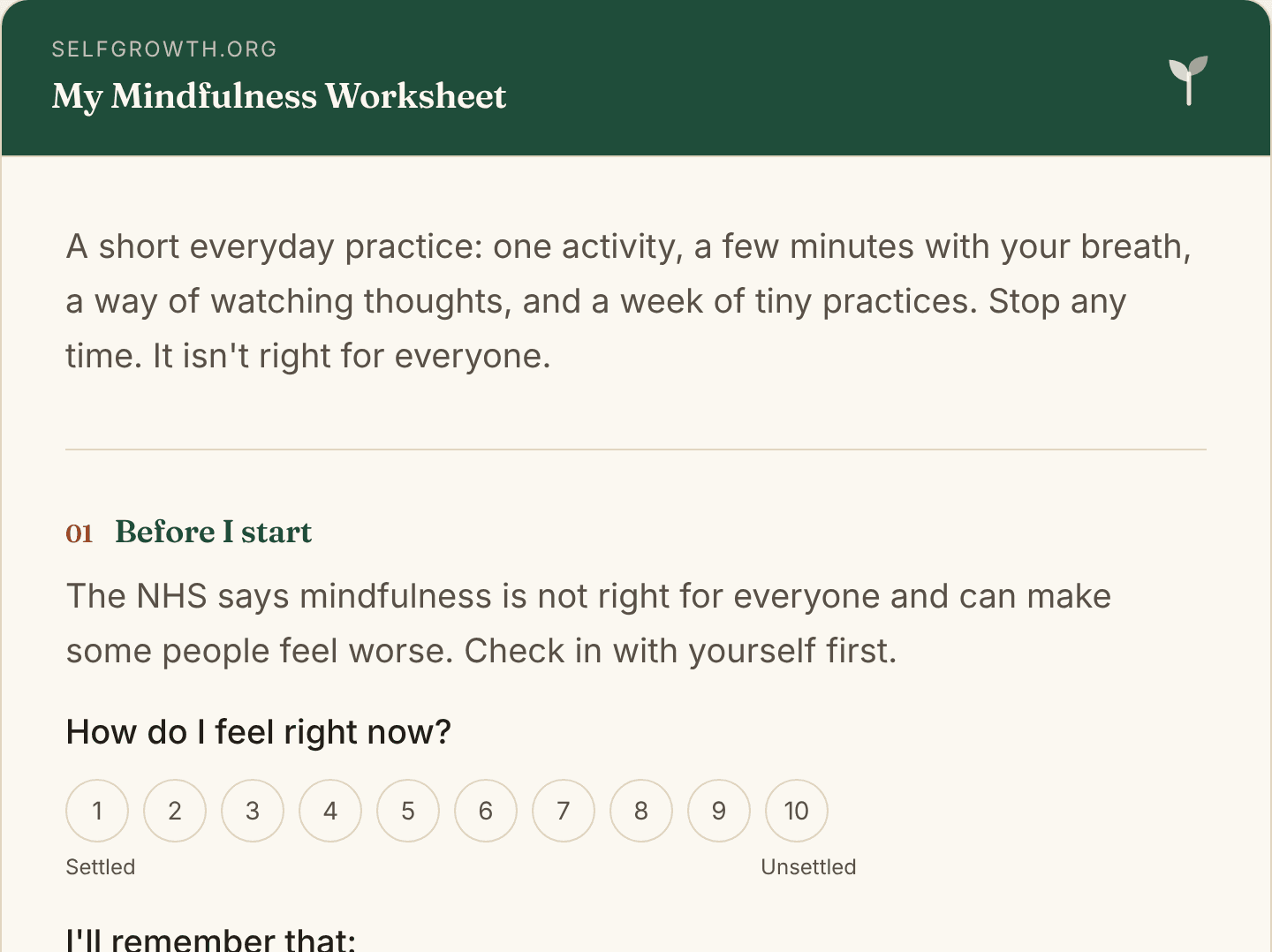
Mindfulness Worksheet
A free mindfulness worksheet: one everyday activity, a few minutes with your breath, a way to watch thoughts and a week of tiny practices. Not for everyone.
Open worksheet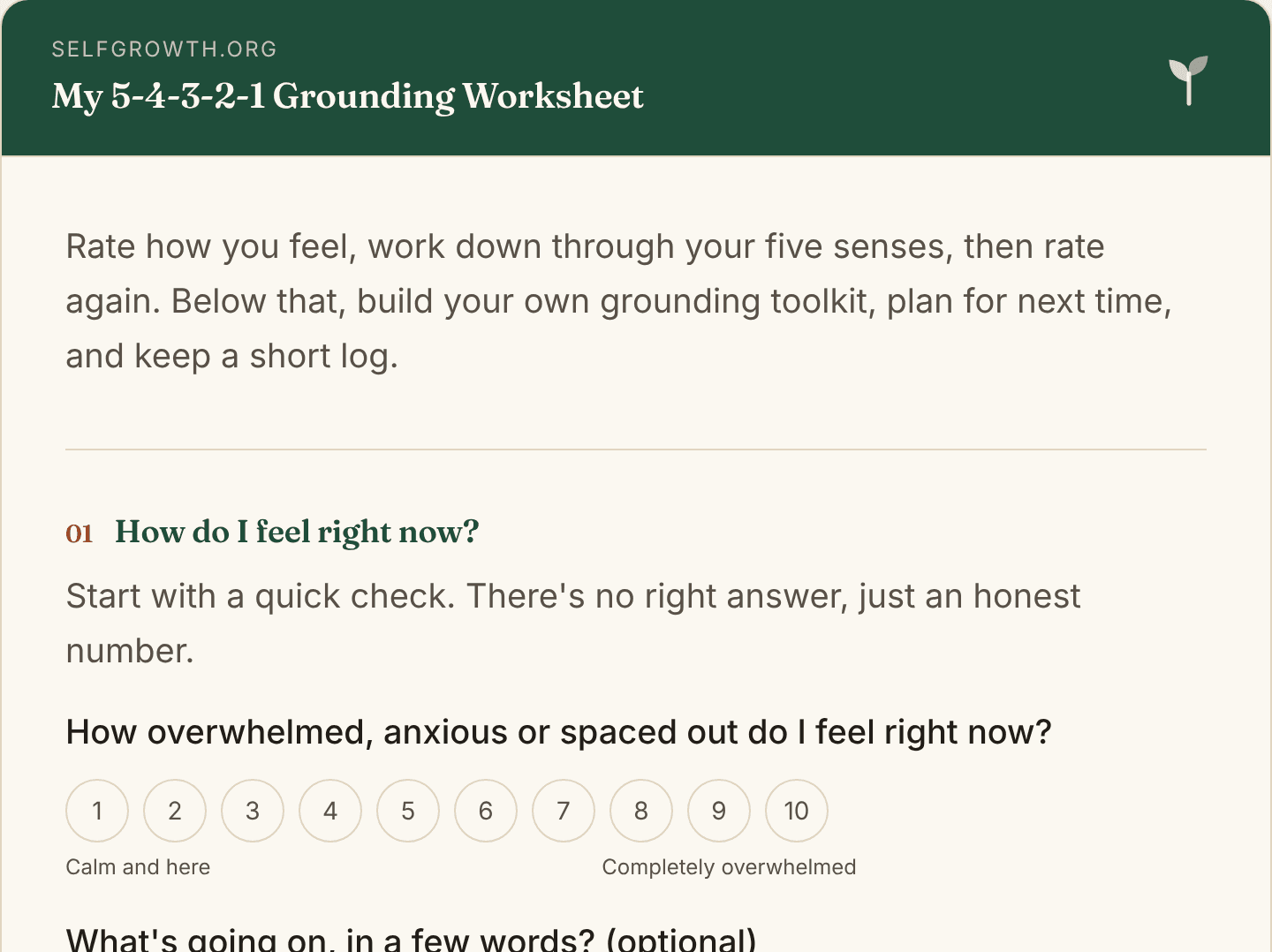
5-4-3-2-1 Grounding Worksheet
A free, printable 5-4-3-2-1 grounding worksheet: rate how you feel, work through your five senses, re-rate, then build your own toolkit and plan for next time.
Open worksheet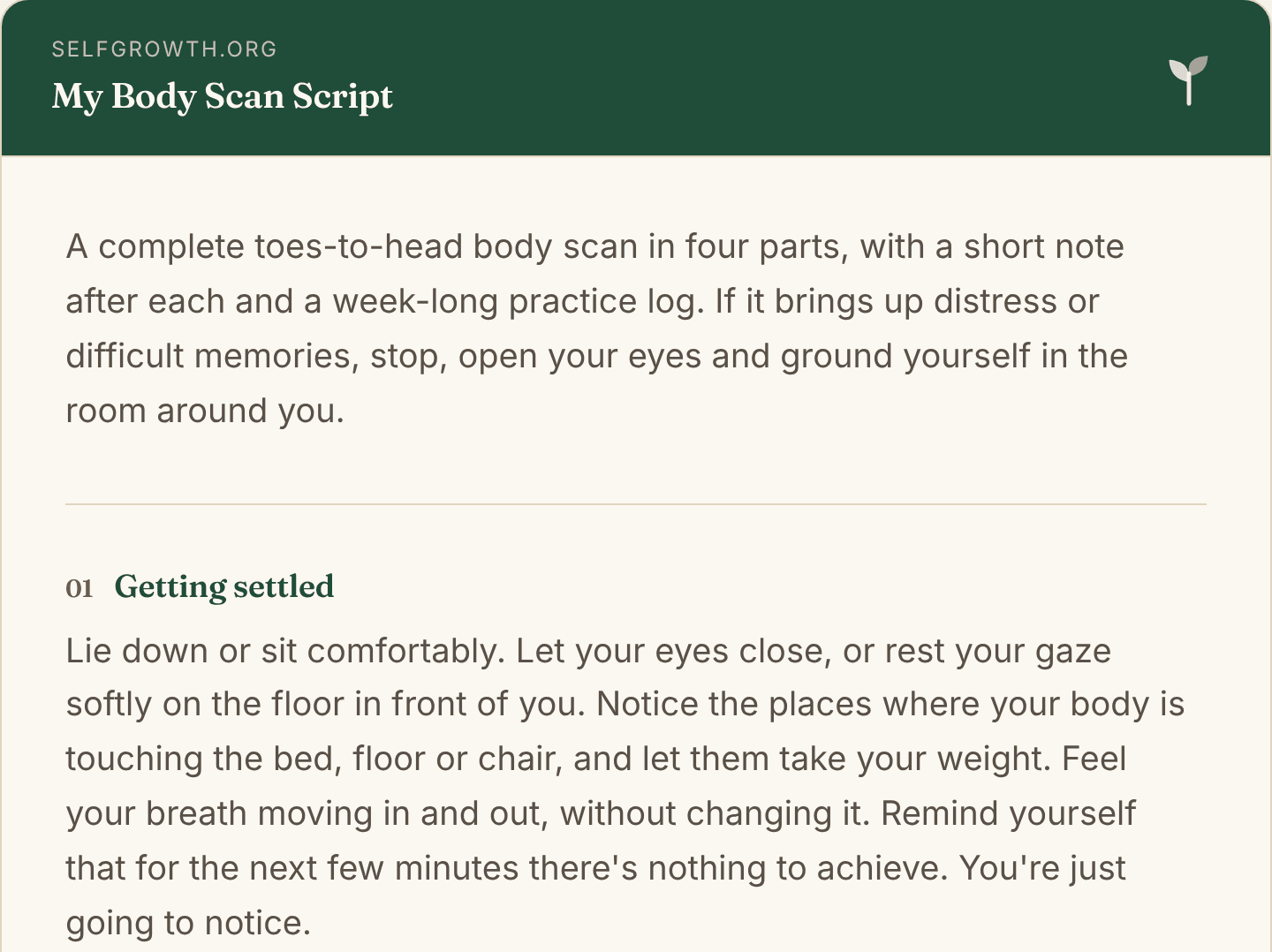
Body Scan Script
A free body scan meditation script in plain English: move your attention slowly from toes to head, noticing without changing, with reflection prompts and a log.
Open worksheetNew worksheets, straight to your inbox
An occasional new worksheet or tool, sent only when there's something genuinely worth your time. No spam, no pressure, unsubscribe any time.