
Anxious moments
TIPP skills worksheet: a free, printable guide to four fast body-based skills
Updated 23 October 2026 · 6 min read · Free to print
TIPP is a set of four fast, body-based skills for when emotions run too high to think: Temperature, Intense exercise, Paced breathing and Paired muscle relaxation. This free, printable worksheet starts with a safety checklist, then has a before and after rating for each part and a short log.
Drawn from DBT distress tolerance skills · Part of feelings and calm
Fill it in here (it saves in this browser, but not in a private window), print it, or download the PDF. Free, no sign-up.
When you are flooded with panic, anger or distress, your body is doing a lot of the work. Your heart pounds, your chest is tight, your muscles are tense. TIPP skills go at the body first, because it can be easier to change what you are doing than what you are thinking.
This sheet starts by asking whether these skills are safe for you, because two of the four (cold water and hard exercise) are not suitable for everyone. Then you try one part at a time, rating how you feel before and after, so you can see which one works for you.
TIPP is taught as a distress tolerance skill in DBT-based programmes. DBT is a full therapy; this page is a plain, self-help version, not DBT and not therapy. Use it to get through a peak, not to fix what is underneath.
A note on safety. If you think you might hurt yourself (thoughts like these are serious), or you are not safe, put this sheet down and call Samaritans on 116 123 (UK and Ireland), 988 (US), or find a line at findahelpline.com. Do not use these skills as a way of hurting yourself. If another person is the reason you feel unsafe, this sheet is not for that. See the helplines page (selfgrowth.org/help).
How to use this worksheet
- 1Do the safety checklist first, on a calm day if you can. If any box gives you doubt, skip that part and check with a GP.
- 2In a hard moment, rate how you feel, try one part for the time suggested, then rate again.
- 3You don't need all four. Pick the one or two that suit your body and your situation.
- 4Stop any part straight away if you feel dizzy, faint, unwell or in pain.
The worksheet
selfgrowth.org
My TIPP skills worksheet
Check it is safe for you, then try one part at a time with a before and after rating. Finish with a note of what worked and a short log.
011. Is this safe for me?
Tick anything that applies. If you tick any box, skip the cold water and the hard exercise, and ask a GP or pharmacist before trying them. If you are unsure, skip them. Paced breathing and paired muscle relaxation are gentler, but stop if they make you feel worse.
Parts I will skip for now:
022. How strong is it right now?
How intense are my emotions or body sensations right now?
What is going on, in a few words?
033. T: temperature
Cold on the face or hands is a quick jolt that gives you something strong to feel. Only if you ticked nothing in section 1: hold a cold, wet cloth or a cool pack against your cheeks and around your eyes for about 30 seconds, or hold cold water in your hands. Do not use ice-cold water on your face for long, and stop if you feel faint or unwell. If you skipped this, try a cool drink or cool air from an open window instead.
Before: how intense is it?
After: how intense is it?
What I noticed:
044. I: intense exercise
A short, hard burst of movement can use up the energy that distress brings. Only if you ticked nothing in section 1: do one or two minutes of something brisk, such as fast stair climbing, jumping jacks or running on the spot, at a level that feels hard but safe. Stop if you feel dizzy, short of breath, or in pain. This is a skill for calming down, never a way to punish yourself, and if it ever feels like that, skip it.
Before: how intense is it?
After: how intense is it?
What I did, and for how long:
055. P: paced breathing
Slow your breathing and make the out-breath longer than the in-breath. For example, breathe in through your nose for 4 and out through your mouth for 6, for a couple of minutes. If counting makes you tense, drop the numbers and just breathe out slowly. Stop if you feel dizzy or tingly.
Before: how intense is it?
After: how intense is it?
The count that felt best for me:
066. P: paired muscle relaxation
Pair a muscle squeeze with your breathing. Breathe in and gently tighten one area for a few seconds, such as fists, shoulders or jaw, then breathe out and let it go completely. Move through a few areas. Tighten only to firm, never to pain or cramp, and skip any area that is injured.
Before: how intense is it?
After: how intense is it?
Where I held the most tension:
077. What worked for me, and a log
TIPP is for getting through a peak. Once you are calmer, think about what to do next.
The part that helped me most, and when I will use it:
Someone I can contact if these skills aren't enough:
Entry 1
Entry 2
Entry 3
Entry 4
Entry 5
When you're done, a moment to reflect
- Which part of TIPP changed how you felt, even by a point or two?
- Which parts did you skip, and was that the right call for your body?
- Where could you do paced breathing or a muscle squeeze without anyone noticing?
- What was happening in the hours before your feelings peaked?
- Once you are steadier, is there something underneath this that is worth talking to someone about?
Done for now?
Save today's answers as a dated entry. You can come back, fill it in again and compare the two side by side.
Where does TIPP come from, and does it work?
Dialectical behaviour therapy (DBT) was developed by the psychologist Marsha Linehan, and the DBT Skills Training Manual from Guilford Press includes a distress tolerance module among its four skill areas. TIPP is taught as one of the distress tolerance skills in DBT-based programmes. This page is a plain, self-help version of the idea. It is not DBT and not therapy.
For DBT as a whole therapy there is research. A 2010 meta-analysis by Kliem, Kroger and Kosfelder looked at DBT for borderline personality disorder. Effects were moderate, and they held when borderline-specific treatments with randomised designs were considered. About half the studies were not randomised, and the gains faded slightly at follow-up. That is for the full therapy in borderline personality disorder, so it tells us little about a single worksheet.
TIPP used alone has not been well tested, so no one can say how or why each part works. The safety checklist is there because cold water and hard exercise are not right for everyone. The ratings and log let you judge what helps you.
These are educational self-reflection tools, not therapy.
If you want to go deeper
- Linehan, M. M. (1993). Cognitive-Behavioral Treatment of Borderline Personality Disorder. Guilford Press.
- Linehan, M. M. DBT Skills Training Manual. Guilford Press. (Includes the distress tolerance module.)
- Kliem, S., Kroger, C. & Kosfelder, J. (2010). Dialectical behavior therapy for borderline personality disorder: A meta-analysis using mixed-effects modeling. Journal of Consulting and Clinical Psychology, 78(6), 936-951.
Your questions, answered
- What is the TIPP skill?
- TIPP is a set of four quick, body-based skills for when emotions are running very high: Temperature, Intense exercise, Paced breathing and Paired muscle relaxation. It is taught as a distress tolerance skill in DBT-based programmes. The idea is to change what your body is doing first, so you can think more clearly afterwards.
- How do you do TIPP skills?
- First check it is safe for you (section 1 of this worksheet). Then rate how you feel and try one part at a time: cold on the face or hands, a short burst of hard exercise, slow breathing with a longer out-breath, or tightening and releasing muscles with your breath. Rate again after each, and stop if you feel unwell.
- Is TIPP safe for everyone?
- No. Cold water on the face and intense exercise are not suitable for everyone, including if you have a heart condition, faint easily, have or have had an eating disorder, are pregnant, or take medication that affects your heart or blood pressure. If you are unsure, skip those two and ask a GP. Paced breathing and muscle relaxation are gentler.
- Does TIPP work?
- DBT as a full therapy has research behind it. A 2010 meta-analysis by Kliem and colleagues, covering studies of people with borderline personality disorder, found moderate effects that held when borderline-specific treatments with randomised designs were considered. About half the studies were not randomised, and the gains faded slightly at follow-up. That is for the full therapy in borderline personality disorder, so it tells us little about a single worksheet. TIPP used alone as a self-help worksheet has not been well tested. Use the before and after ratings to judge whether it helps you.
- TIPP skills vs distress tolerance: what is the difference?
- Distress tolerance is the wider idea of getting through a painful moment without making it worse, and it includes distraction, self-soothing, weighing up urges and acceptance. TIPP is one fast, body-based set of skills within it. Our distress tolerance worksheet is the menu and plan. This one is the quick body-based part.
- Is there a TIPP skills worksheet PDF?
- Yes. Use the Download PDF button for a clean, print-ready copy, or Print to print straight from the page. It is completely free, with no payment and no email needed. You can also fill it in on screen, and your answers save in your browser.
- Is this worksheet a substitute for therapy?
- No. It is a self-help tool for getting through hard moments, not therapy or medical advice. If hard moments are frequent or intense, a GP can point you to talking therapies. If you ever feel unsafe or have thoughts of harming yourself, call Samaritans on 116 123 (UK and Ireland), 988 (US), or find a line at findahelpline.com.
Keep going, related worksheets
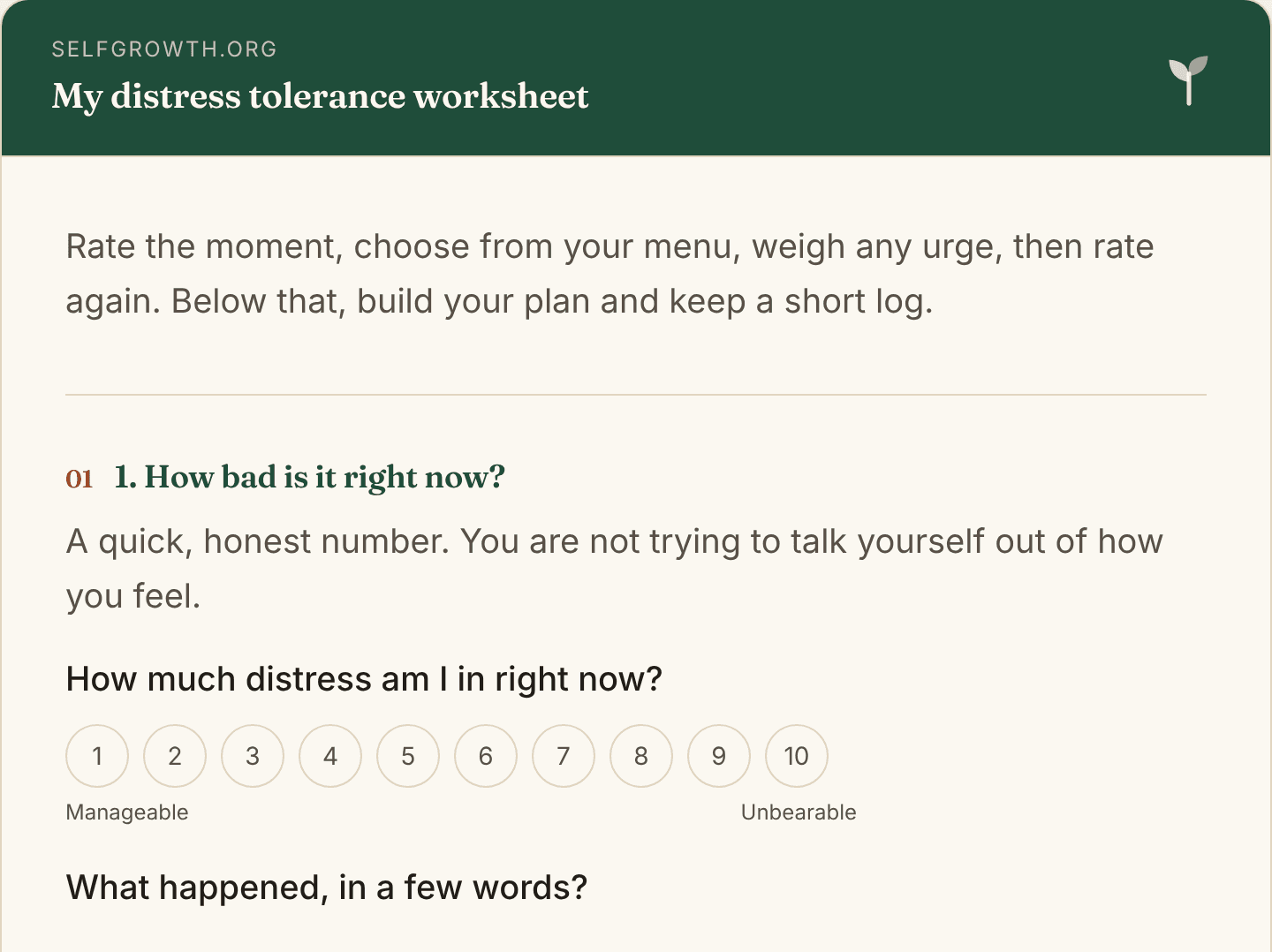
Distress Tolerance Worksheet
A free, printable distress tolerance worksheet: rate the moment, choose from your own skills menu, weigh the urge, and plan ahead. Self-help, not therapy.
Open worksheet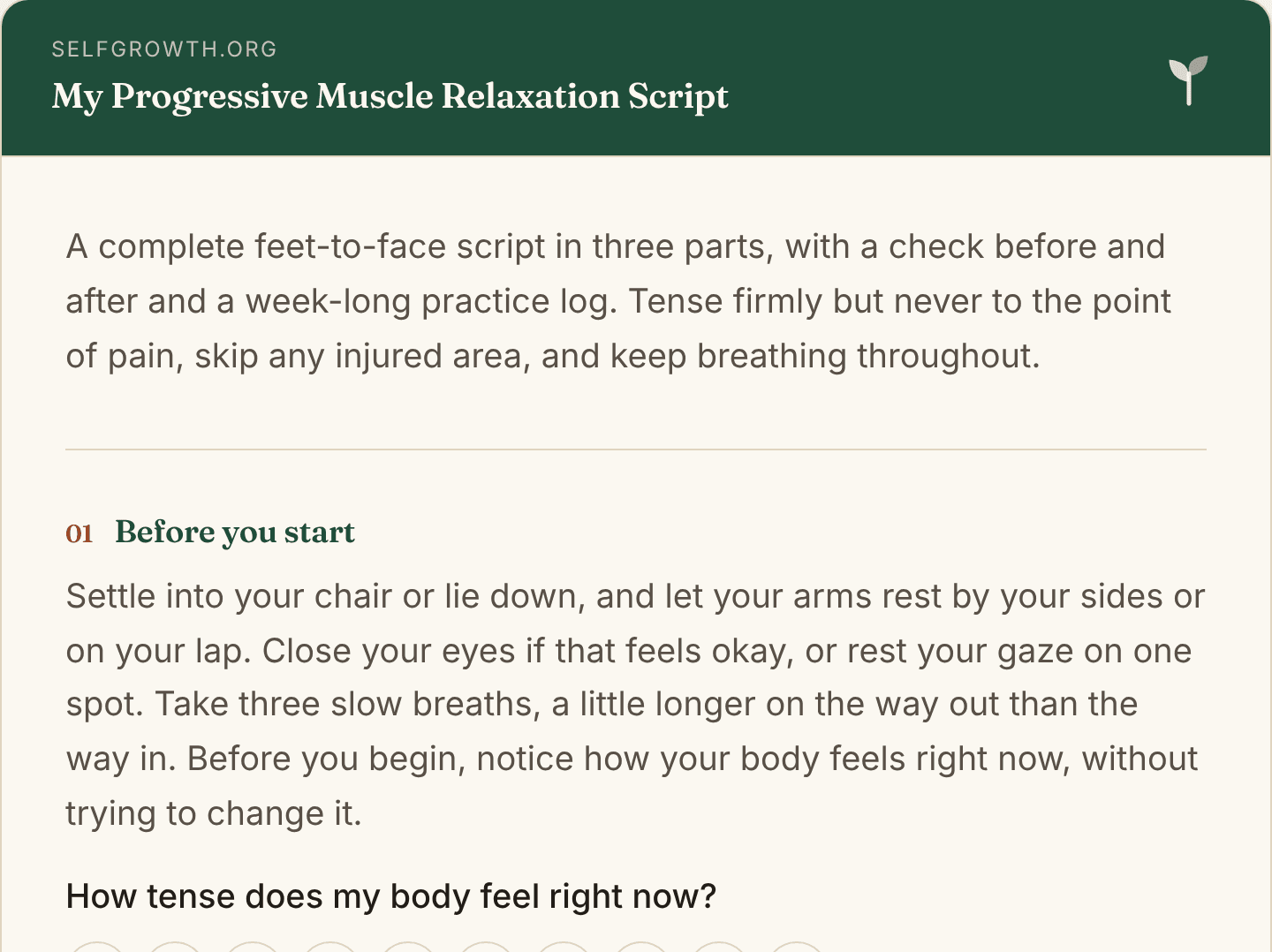
Progressive Muscle Relaxation Script
A free progressive muscle relaxation script in plain English: tense and release 13 muscle groups from feet to face, with a before-and-after check and 7-day log.
Open worksheet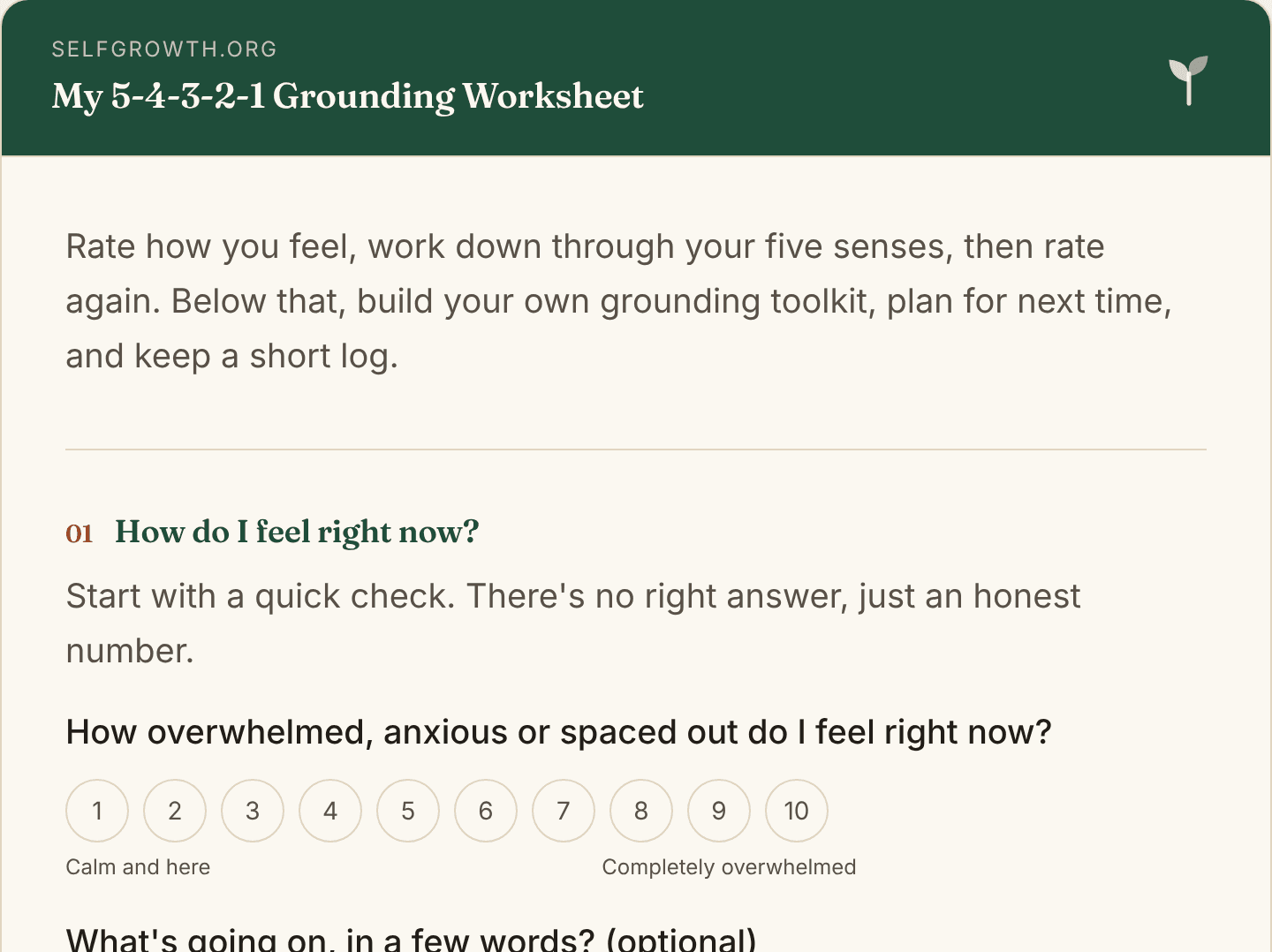
5-4-3-2-1 Grounding Worksheet
A free, printable 5-4-3-2-1 grounding worksheet: rate how you feel, work through your five senses, re-rate, then build your own toolkit and plan for next time.
Open worksheetNew worksheets, straight to your inbox
An occasional new worksheet or tool, sent only when there's something genuinely worth your time. No spam, no pressure, unsubscribe any time.