
Guide
Personal growth activities: practical ideas you can start today
Updated 25 October 2026 · 8 min read
Personal growth activities are small, practical things you do on purpose to know yourself better or build a skill, habit or relationship. Examples include listing your values, tracking one habit, journaling, practising active listening, resting properly and learning a new skill. Pick one that fits where you are now and try it this week.
Drawn from everyday self-development practice · Part of self-discovery
Searching for self improvement ideas can leave you with a list of fifty things and no idea where to begin. Pick the group that matches what you want more of, and start with one idea. Most point to a free tool you can use straight away.
These are practical ideas, not a tested programme. You do not need to do them all. Choose one, try it for a few weeks, and keep it only if it suits you. If you want a bigger picture first, the guide to what self-growth is explains it, and the self-growth goals guide helps you choose what to aim at.
What counts as a personal growth activity?
A personal growth activity is anything you do on purpose to understand yourself better, build a skill, change a habit or improve how you treat yourself and other people. It can take five minutes or run for months. You can do it alone, with a friend or in a group.
It also goes by other names: self improvement activities, personal development activities, self-development exercises. They mean much the same thing. What matters is that the activity is small enough to start and that it is about something you care about.
Personal growth activities to know yourself better
These help you see what you value, what you are good at and where you are now.
- Write a list of your top values, then check one decision this week against it. Try the core values worksheet.
- Answer 'who am I?' in ten different ways, without editing. Try the who am I worksheet.
- List what you are good at and what you enjoy. Try the strengths list worksheet.
- Score each area of life from 1 to 10 for how you feel about it. Try the wheel of life worksheet.
Personal growth activities for your mind and habits
These are about how you think and what you do every day.
- Track one small habit for two weeks and see what gets in the way. Try the habit tracker.
- Look at a recent setback and ask what it says you can learn, not what it says about you. Try the growth mindset worksheet.
- Write for ten minutes, with a prompt if you are stuck. Try the self-discovery journal prompts.
Personal growth activities for your relationships
Relationships are skills too.
- In your next conversation, listen to the end before you reply, then say back what you heard. Try the active listening worksheet.
- Next time you are upset, say how you feel and what you need, without blaming. Try the I-statements worksheet.
- Message one friend you have lost touch with.
Personal growth activities for your body and rest
Looking after your body is part of growth, not a reward for finishing it.
- Tick off the basics you are already doing, and pick one to add. Try the self-care checklist.
- Work out which kind of rest you are missing. Read about the types of rest, the idea that sleep is only one kind.
- Take a ten-minute walk without your phone.
Personal growth activities for work and skills
Learning something new lets you see progress.
- Choose one skill and break it into a first small practice session. Read how to learn a new skill.
- Plan your next year at work, with skills, support and check-ins. Try the professional development plan template.
- Ask a colleague or friend for feedback on one piece of work.
Personal growth activities for meaning
These are about what makes your days feel worth it.
- Write down three things you are grateful for, and why. Try the gratitude journal prompts.
- Map what you love, what you are good at, what the world needs and what you could be paid for. Try the ikigai worksheet.
- Spend an hour helping someone or something you care about, such as a neighbour, a club or a cause.
Personal growth activities for groups or teams
Some of the ideas above work with other people. Everyone takes part by choice, and nobody has to share more than they want to.
- Each person names one strength they bring, and one they would like to build.
- Pairs take turns listening for three minutes without interrupting.
- Everyone writes one goal for the next month and one first step, and checks in with a partner.
- The group shares one thing they learned this week.
How to choose where to start
- 1Notice what feels most like a gap right now. It might be energy, direction, friendships or confidence.
- 2Pick one group of activities above that speaks to it.
- 3Choose one activity from that group, the one that looks easiest to begin.
- 4Decide when you will do it, for example 'Sunday after breakfast, ten minutes'.
- 5Look back after a few weeks. Keep it, change it or swap it for another.
If you are not sure where you stand, begin with the wheel of life. It shows which areas feel strong and which feel thin.
Open the Wheel of Life WorksheetWhen you are ready to turn an idea into a plan, the self-growth plan gives you space for goals, first steps and check-ins.
Open the Self-Growth PlanWhen to get more support
These activities are self-help, not therapy. If low mood, stress or worry is what is really in the way, or you feel stuck in a way a worksheet cannot fix, talk to your GP.
If you ever feel unsafe or have thoughts of harming yourself, call Samaritans on 116 123 (UK and Ireland), 988 (US), or find a line at findahelpline.com.
Sources and further reading
This is an educational self-reflection resource, not therapy or medical advice.
Your questions, answered
- What are some personal growth activities?
- Listing your values, tracking one habit, journaling, practising active listening, taking proper rest, learning a new skill and writing down what you are grateful for. Each is small enough to start this week.
- What are good self improvement ideas for beginners?
- Start with one that is quick and low pressure, such as a ten-minute journal entry, a walk without your phone, or scoring each area of life from 1 to 10. Try it for a few weeks before adding another.
- How do I choose a personal development activity?
- Notice which part of life feels thinnest right now, pick the group of activities that matches it, and choose the easiest one in that group. Decide when you will do it, and look back after a few weeks.
- What are personal growth activities for a group or team?
- Sharing one strength each, listening in pairs for three minutes without interrupting, setting one goal and a first step for the month, or sharing one thing learned this week. Keep taking part optional.
- How many activities should I do at once?
- One is enough to begin with. A few small activities you keep doing are easier to stick to than a long list you drop. Add another only when the first feels natural.
- Is there a free tool to track my personal growth?
- Yes. The self-growth plan and the habit tracker are free to fill in on screen or print, with no payment and no email needed. Your answers save in your browser.
- Is this a substitute for therapy?
- No. It is a self-help tool, not therapy. If low mood or stress is what is really in your way, talk to your GP. If you ever feel unsafe or have thoughts of harming yourself, call Samaritans on 116 123 (UK and Ireland), 988 (US), or find a line at findahelpline.com.
Worksheets to do the work
Free to fill in online or print. No email needed.

Wheel of Life Worksheet
A free printable PDF Wheel of Life exercise. Score each area of your life out of ten, see where you're out of balance, and pick one to work on next.
Open worksheet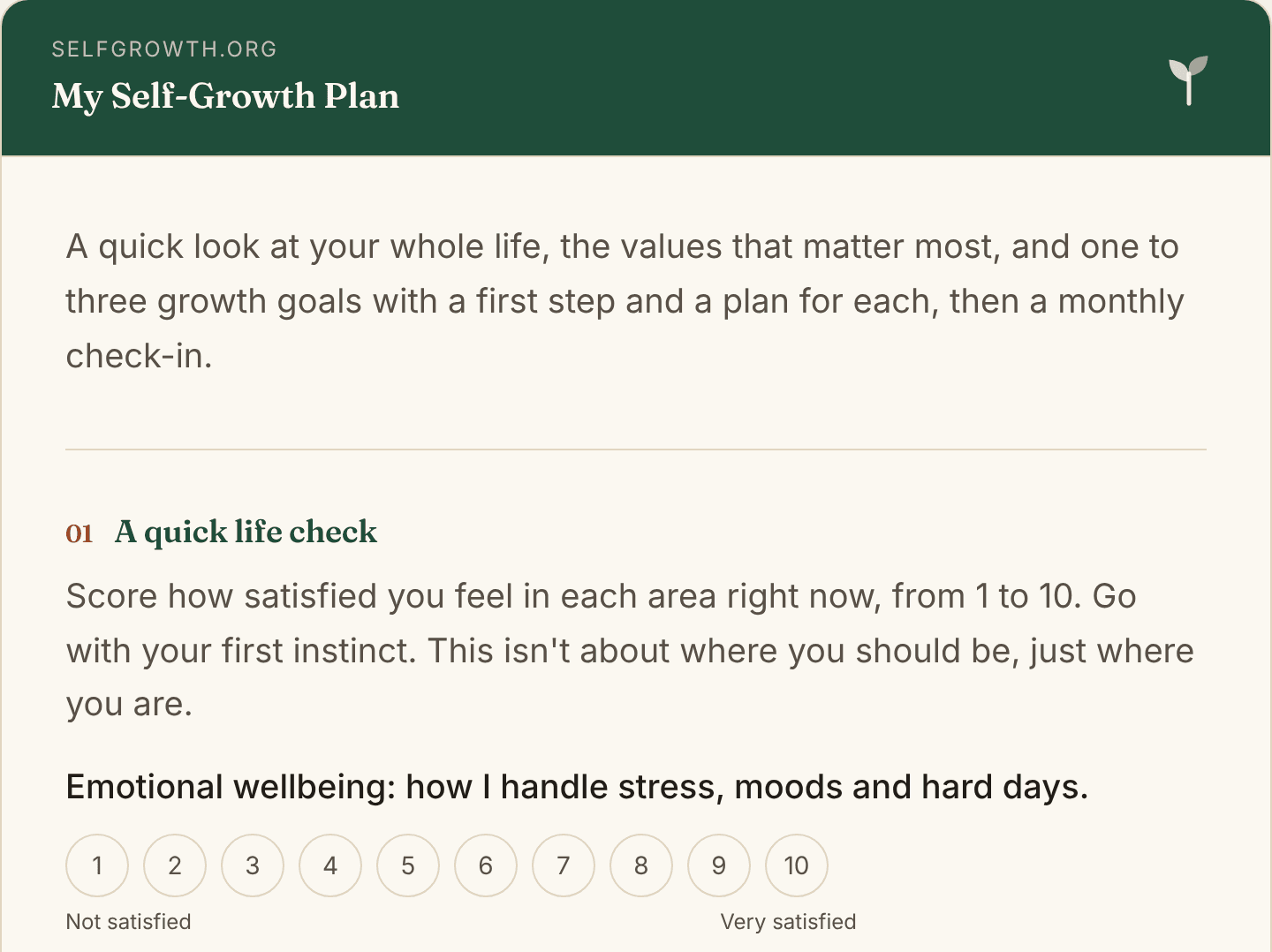
Self-Growth Plan
A free, printable self-growth plan template: check in on six areas of life, pick three values, choose one to three goals, plan a first step and review monthly.
Open worksheet
Who Am I? Worksheet
A free, printable 'Who am I?' worksheet to explore your identity and values, with the classic twenty-statements exercise and guided prompts.
Open worksheet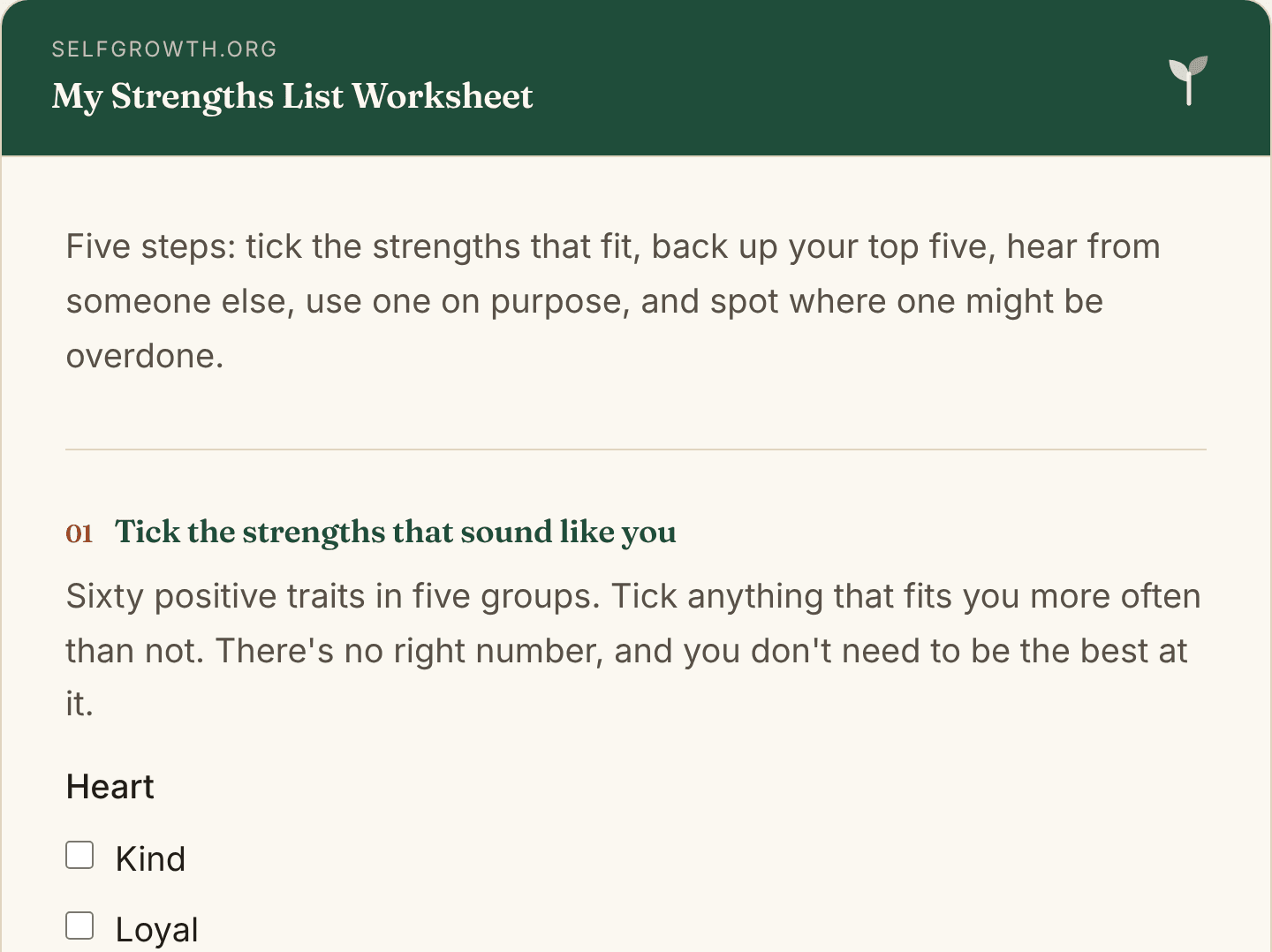
Strengths List Worksheet
A free list of 60 positive character traits and strengths to tick, with space for evidence, what others see in you and one strength to use on purpose this week.
Open worksheet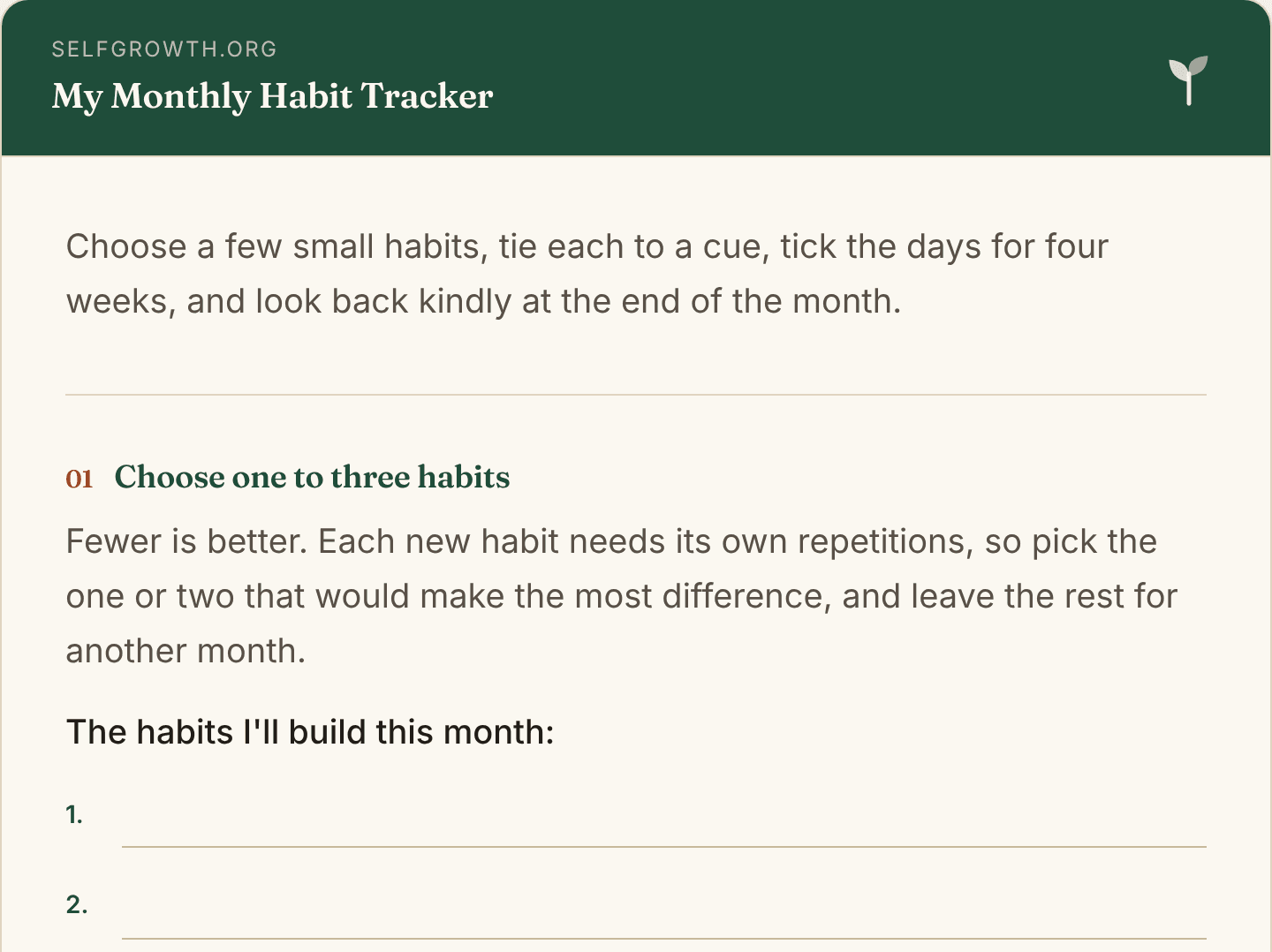
Habit Tracker Printable
A free printable habit tracker for one month: choose one to three small habits, tie each to a cue, tick the days, and review what helped. Print or fill it in.
Open worksheetRelated guides
New worksheets, straight to your inbox
An occasional new worksheet or tool, sent only when there's something genuinely worth your time. No spam, no pressure, unsubscribe any time.