
Work
Professional development plan template: a free printable plan for the next 12 months
Updated 25 October 2026 · 7 min read · Free to print
A professional development plan template helps you write down where you are in your work now, where you want to be in 12 months, and which skills to grow to get there. This one adds how you will learn each skill, the support you need, evidence of progress and quarterly check-ins.
Drawn from goal-setting research · Part of work and skills
Fill it in here (it saves in this browser, but not in a private window), print it, or download the PDF. Free, no sign-up.
A professional development plan is a short, honest plan for how you want to grow at work. Many people in the UK know it as a PDP, or keep a CPD record (continuing professional development). In the US it may be called a development plan or a learning plan. There is no single official format. Employers and professional bodies each use their own, so this sheet is a plain one you can use alone or bring to a meeting.
You start with where you are now and where you want to be in a year. Then you choose a few skills, say how you will learn each one, and name the help you need. There is space for learning that is not a course, for evidence you can point to, and for questions to ask a manager or mentor. If you are not sure what you are good at, try the strengths list worksheet first. To sharpen a target, use the SMART goals worksheet.
This is a self-help planning tool, not career advice or therapy. If stress or low mood at work is the real problem, a GP is a good first call, and the plan can wait.
How to use this worksheet
- 1Print the page, or type straight onto it. Set aside about 40 minutes.
- 2Fill in the first two sections quickly. Rough answers are fine, you can change them.
- 3Choose three to five skills, not ten. A short plan is a plan you will use.
- 4Put the quarterly check-in dates in your calendar before you put the page down.
The worksheet
selfgrowth.org
My Professional Development Plan
Where I am now, where I want to be in 12 months, skills to grow, ways to learn, evidence, a conversation to have, and check-ins.
01Where I am now
Start with what is true today. Include what is going well. A plan built only on gaps tends to feel like a telling-off.
My role, and how long I have been in it:
What is going well at work right now:
What I do that others rely on me for:
What frustrates me or holds me back:
How satisfied am I with my work right now?
02Where I want to be in 12 months
Picture a year from now. It could be a promotion, a bigger part of the job, a new skill, a move to another team, or doing the same job with more confidence. All of these count.
In 12 months, I would like my work to look like this:
The one outcome that would tell me it went well:
Why this matters to me (not to anyone else):
03Skills to grow
Choose three to five. Mix one or two of your strengths you want to use more with one or two gaps. Be clear about why each one matters, and give each a date.
Entry 1
Entry 2
Entry 3
Entry 4
Entry 5
04Learning that is not a course
Courses are one way to learn. Much of what you pick up at work comes from doing things, from other people and from reading. Tick what you could use, then pick one to start this month.
The one I will start this month, and how:
05Evidence of progress
Write down proof as you go: things you did, feedback you got, results you can point to. It makes reviews, pay talks and job applications much easier, and it shows you how far you have come.
Entry 1
Entry 2
Entry 3
Entry 4
Entry 5
06A conversation with my manager or mentor
You do not have to do this alone. Asking is a normal part of most jobs. Tick the prompts you would like to use and note their answers.
What they said, and what we agreed:
07Quarterly check-ins
Look at the plan every three months. Say what happened, what changed and what comes next. If a skill no longer matters, cross it out. If your job changed, change the plan.
Entry 1
Entry 2
Entry 3
Entry 4
08If there is no support at work
Some jobs have no time, money or interest in development. You can still grow. Pick what fits and write your own plan.
My plan if work gives no support, and the date I will look at it again:
When you're done, a moment to reflect
- Which skill on your list excites you, and which feels like a duty? What does that tell you?
- What can you learn from the job you already have, before you look anywhere else?
- Who at work or outside it has seen you at your best? Could you ask them for a view?
- What would you have to stop doing to make room for this plan?
- If nothing about your job changed in the next year, what would you still want to have learned?
Done for now?
Save today's answers as a dated entry. You can come back, fill it in again and compare the two side by side.
Where this plan comes from
The professional development plan is a working format, not a tested treatment, and there is no single official version. Employers, schools and professional bodies each use their own, in the UK often under the names PDP or CPD record. This sheet uses the parts most of them share: where you are, where you want to be, skills, how to learn them, support, evidence and review.
The research behind the planning is on goal setting. Edwin Locke and Gary Latham published a summary of 35 years of work on goal-setting theory in 2002. The central finding is that specific, difficult goals led to higher performance than being told to 'do your best', until a person reached the limit of their ability or lost commitment. Most of those studies looked at work tasks, so they fit a work plan well. They are not proof that this particular sheet will work for you.
Nothing here is a guarantee. Plans help when you use them and review them. Treat this as a prompt to think and talk, not as career advice or therapy.
These are educational self-reflection tools, not therapy.
If you want to go deeper
- Locke, E. A. & Latham, G. P. (2002). Building a practically useful theory of goal setting and task motivation: A 35-year odyssey. American Psychologist, 57(9), 705-717.
Your questions, answered
- What is a professional development plan?
- It is a short written plan for how you want to grow at work. It usually covers where you are, where you want to be, the skills to build, how you will learn them and when you will check in. There is no single official format, so employers and professional bodies each use their own.
- What is the difference between a PDP, a CPD record and a development plan?
- The names overlap. In the UK, PDP (personal development plan) often means the plan itself, and CPD (continuing professional development) often means a record of learning you have done. Some professional bodies ask for one or both. If your employer or body has its own form, use that, and use this sheet to think it through first.
- What should I put in a professional development plan?
- Where you are now, where you want to be in 12 months, three to five skills to grow, how you will learn each, what support you need, dates, and evidence as you go. Add a check-in every three months. Keep it short enough to read in five minutes.
- How is a development plan different from a goal?
- A goal is one target. A development plan holds a few skills, how you will learn them and the help you need. Research by Edwin Locke and Gary Latham, who summarised 35 years of goal-setting studies in 2002, focused mostly on work tasks. It suggests clear goals help. So the plan has dates and specific outcomes for each skill.
- What if my manager does not support my development?
- You can still plan. Use free learning, small stretches inside your job and an evidence file of what you have done. Build contacts outside your team. Look at what a professional body or a government service such as the UK's National Careers Service offers. The last section of this sheet is for this case.
- Is there a professional development plan template PDF?
- Yes. Use the Download PDF button for a clean, print-ready copy, or Print to print straight from the page. It is completely free, with no payment and no email needed. You can also fill it in on screen, and your answers save in your browser.
- Is this career advice or therapy?
- No. It is a self-help planning tool, not career advice, therapy or medical advice. If stress, burnout or low mood at work is what is really in the way, a GP can point you to support. If you ever feel unsafe or have thoughts of harming yourself, call Samaritans on 116 123 (UK and Ireland), 988 (US), or find a line at findahelpline.com.
Keep going, related worksheets
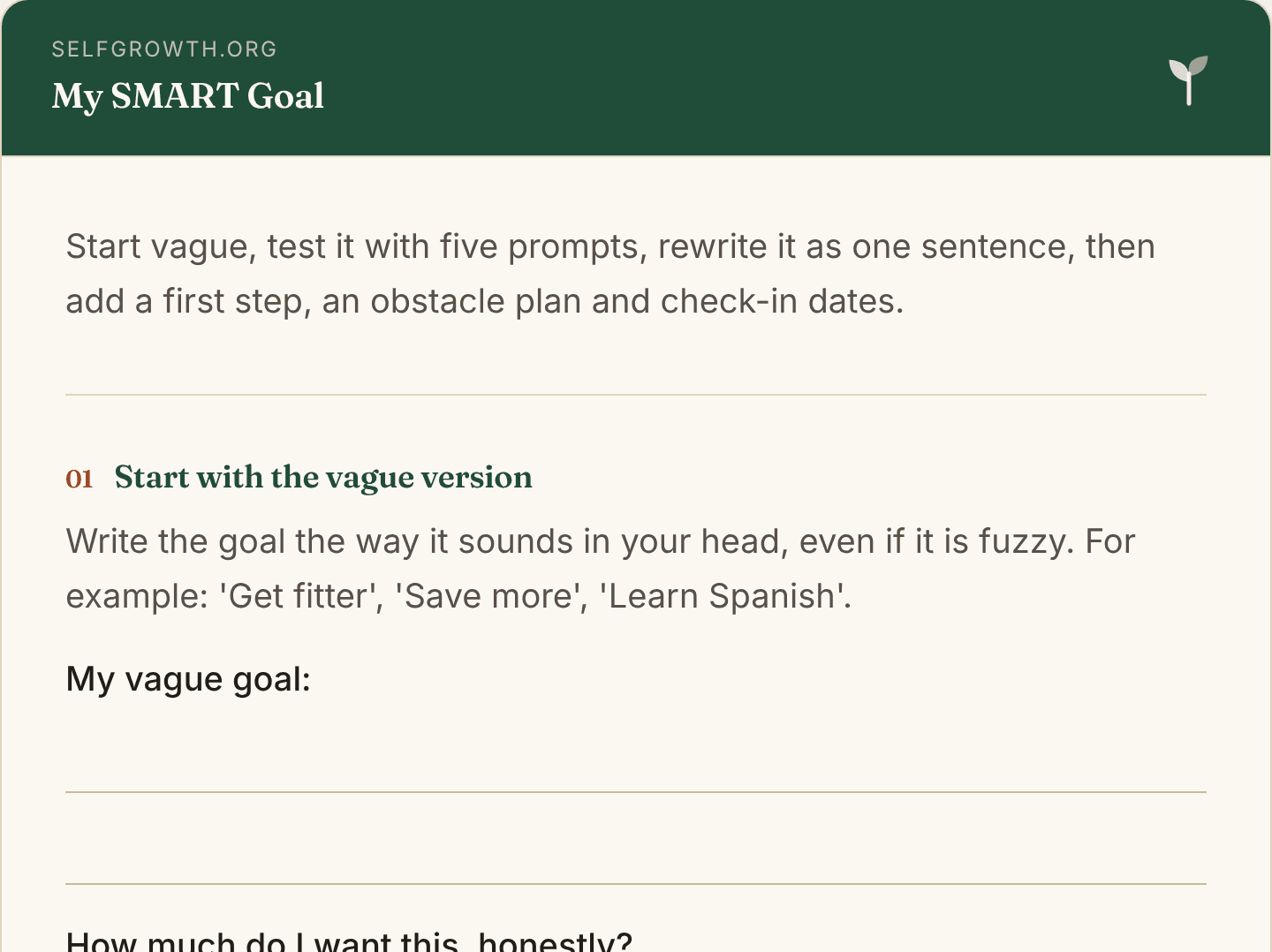
SMART Goals Worksheet
A free, printable SMART goals worksheet: start with one vague goal, answer five prompts with examples, rewrite it as one sentence, then add a first step and check-in dates.
Open worksheet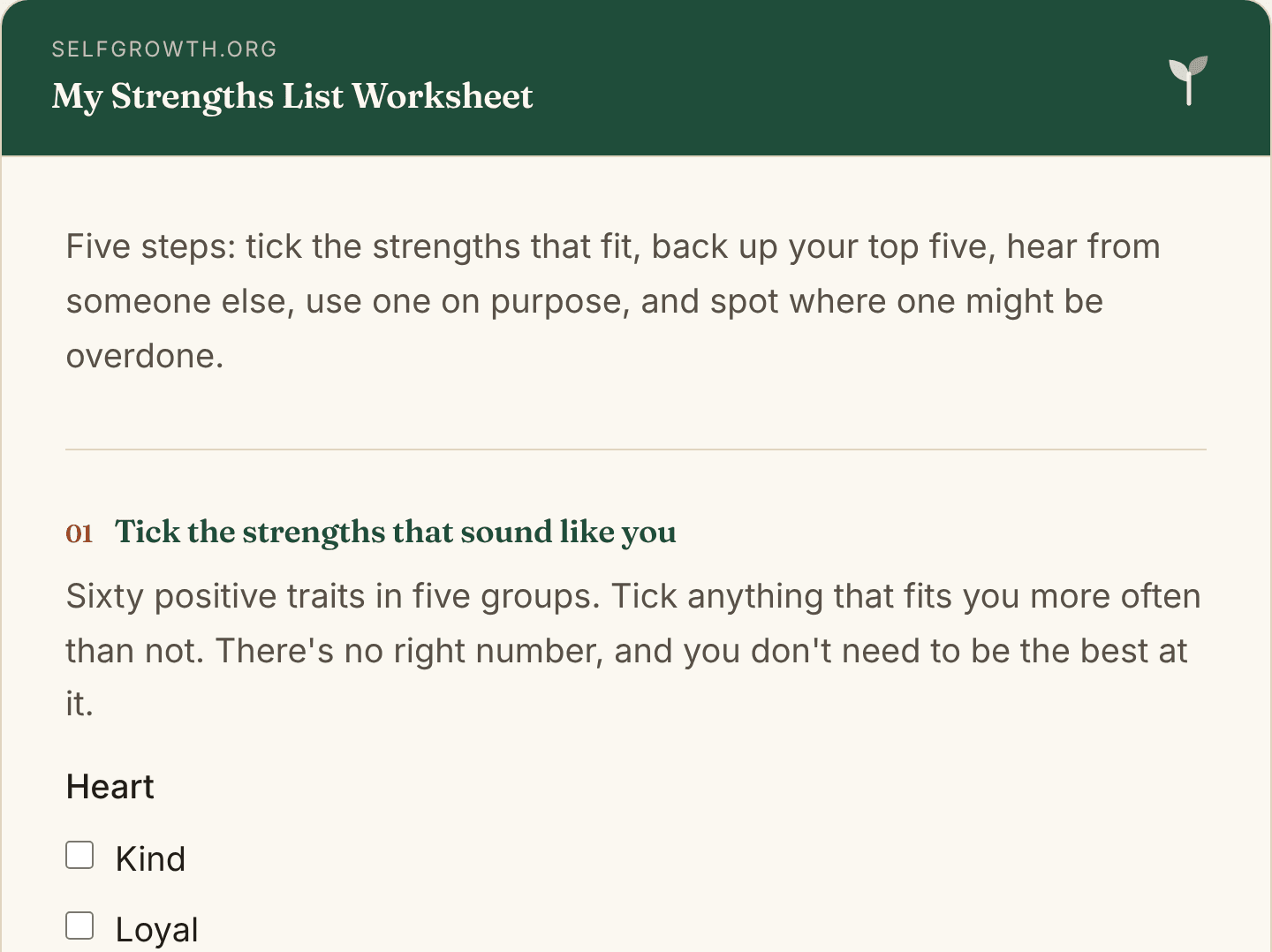
Strengths List Worksheet
A free list of 60 positive character traits and strengths to tick, with space for evidence, what others see in you and one strength to use on purpose this week.
Open worksheet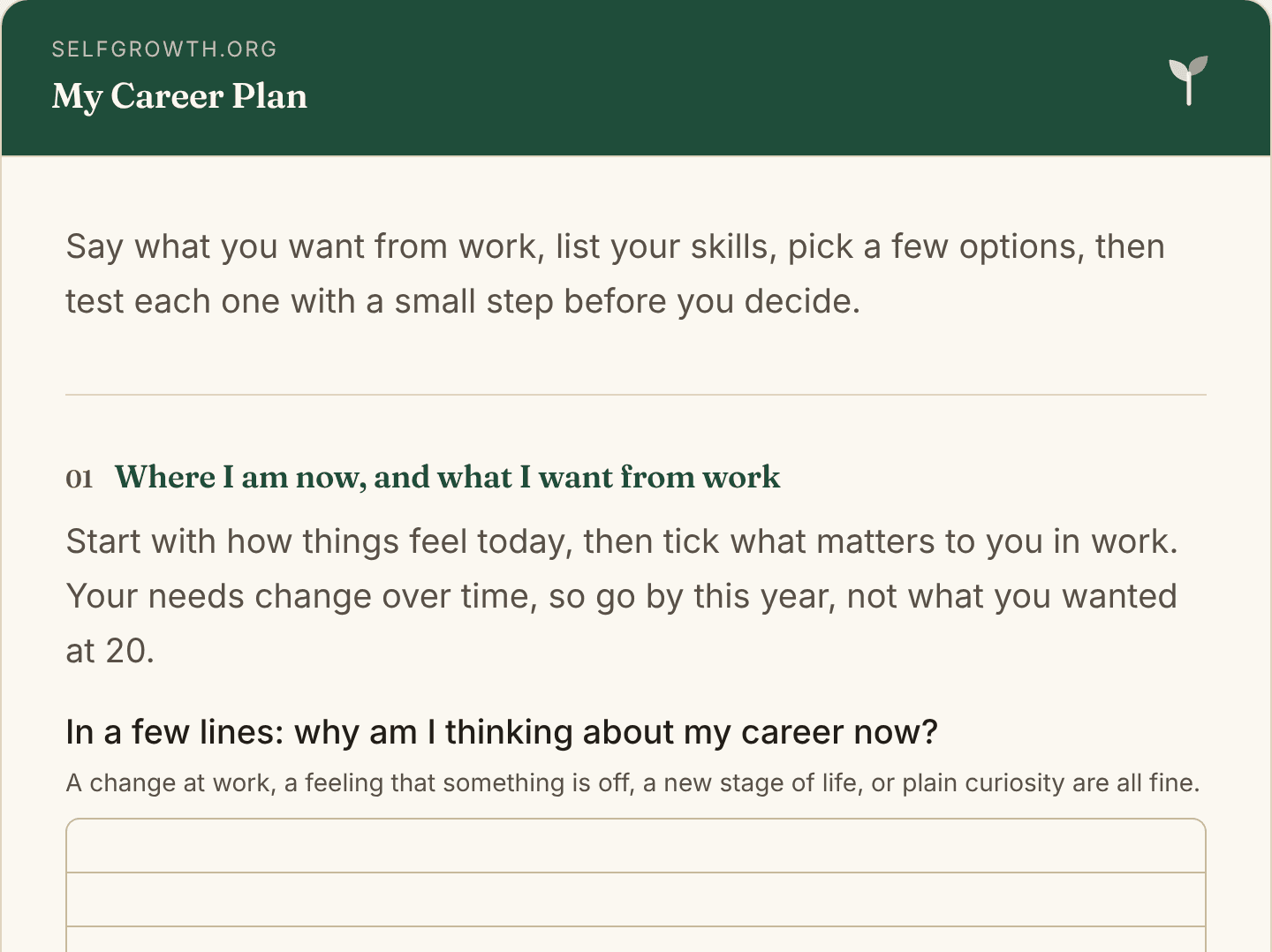
Career Planning Worksheet
A free career planning worksheet with a skills inventory, values checklist and small experiments. Use it for a first plan or a career change. No email needed.
Open worksheetNew worksheets, straight to your inbox
An occasional new worksheet or tool, sent only when there's something genuinely worth your time. No spam, no pressure, unsubscribe any time.