
Goal-setting
SMART goals worksheet: a free, printable way to turn one vague goal into a clear one
Updated 23 October 2026 · 6 min read · Free to print
A SMART goals worksheet turns one vague goal into a clear one by testing it against five prompts: specific, measurable, achievable, relevant and time-bound. You start with the vague version, answer each prompt, rewrite it as one sentence, then add a first step with a date, a plan for the obstacle and check-in dates.
Drawn from a 1981 management article and goal-setting research · Part of goals and life balance
Fill it in here (it saves in this browser, but not in a private window), print it, or download the PDF. Free, no sign-up.
'Get fit.' 'Sort my money out.' 'Be more confident.' These are real wishes, but they give you nothing to do on Tuesday. SMART is a way of sharpening a wish like that until you can see what the first move is.
The sheet works on one goal only. You write it down as vaguely as it sits in your head, ask it five questions in turn, and rewrite it as one clear sentence. Then you give it a first step with a date, a plan for the thing most likely to get in the way, and dates to check in with yourself.
One honest note. SMART comes from a business article, not from a psychology experiment, and the letters mean slightly different things in different versions. Use it as a tidy checklist for your thinking. It is not a guarantee, and it is not therapy. Some goals, like 'feel less anxious', need support more than a sentence.
How to use this worksheet
- 1Pick one goal. If you have five, pick the one you would most like to move this month.
- 2Write the vague version first, exactly as it sounds in your head. That is the starting point, not a mistake.
- 3Work down the five prompts in order. If a prompt makes you realise the goal is not really yours, that is useful. Change the goal.
- 4Finish by putting the first step and the check-in dates in your calendar before you put the page down.
The worksheet
selfgrowth.org
My SMART Goal
Start vague, test it with five prompts, rewrite it as one sentence, then add a first step, an obstacle plan and check-in dates.
01Start with the vague version
Write the goal the way it sounds in your head, even if it is fuzzy. For example: 'Get fitter', 'Save more', 'Learn Spanish'.
My vague goal:
How much do I want this, honestly?
02S and M: specific and measurable
Specific means you could point at it. Measurable means you would know when you had done it. 'Get fitter' becomes 'Walk briskly for 30 minutes, three times a week'. 'Save more' becomes 'Put £100 a month into a separate account'.
Specific: what exactly will I do or have? Where, and with whom, if that matters?
Measurable: how will I count it, so I can see progress? (a number, a tick, a date)
03A and R: achievable and relevant
These two letters change most between versions. Some versions say 'assignable' (who will do it) or 'realistic'. Others say 'achievable' and 'relevant'. Here, achievable asks whether it fits your actual week and means. Relevant asks whether it matters to you, not to someone else.
Achievable: what do I have to make this work (time, money, skills, help)? What is missing?
Relevant: why does this matter to me now? What does it connect to in my life?
How realistic does this feel, as it stands?
04T: time-bound, then rewrite it as one sentence
Give it a real date, not 'soon'. Then put it all together. Template: 'By [date], I will [specific action], measured by [how I will count it], because [why it matters].'
Time-bound: the date I will finish, or review it:
My goal, rewritten as one sentence:
05First step and obstacle plan
A clear goal still needs a first move. Make it small enough that you could do it in the next two days. Then name what is most likely to get in the way, and decide what you will do when it does.
My first step (small, specific):
I will do it on (date and time):
The obstacle most likely to get in the way, and my plan: 'If [it happens], then I will [response].'
06Check-in dates
Pick the dates now, while you are clear. At each one, look at your measure and ask what is working, what is not, and whether the goal still fits. Changing a goal is allowed. It is not failing.
Entry 1
Entry 2
Entry 3
Entry 4
07Does my rewritten goal pass?
Read your one-sentence goal back and tick what is true.
When you're done, a moment to reflect
- Did the goal change when you made it specific? What does that tell you about what you really want?
- Is there a number or date in your goal that you chose to feel impressive rather than to be useful?
- What is the first thing likely to knock this off course, and is your plan for it honest?
- If you reached this goal, what would you do next?
- Does this goal rely on something you cannot control, like another person's decision? Could you set a version that is in your hands?
Done for now?
Save today's answers as a dated entry. You can come back, fill it in again and compare the two side by side.
Do SMART goals work?
SMART was introduced by George T. Doran in a short article in Management Review in November 1981, written to help managers write clearer objectives. His original words were specific, measurable, assignable, realistic and time-related. Later versions replaced some of them, for example achievable and relevant, which is why you will see different lists. It is a management writing aid, not a finding from psychology.
The evidence worth knowing is about the ideas underneath it. Edwin Locke and Gary Latham summarised 35 years of goal-setting research in 2002. They report that specific, difficult goals led to higher performance than telling people to do their best, and that performance dropped off only at the limits of ability or when commitment lapsed. That is mostly work-task research, so treat it as a good reason to be specific, not proof that every personal goal works the same way.
So this sheet uses SMART as a tidy way to ask good questions, and adds extras that are not part of the acronym. The first step, obstacle plan and check-ins are there to help you follow through. It is an educational tool for everyday goals, not therapy.
These are educational self-reflection tools, not therapy.
If you want to go deeper
- Doran, G. T. (1981). There's a S.M.A.R.T. way to write management's goals and objectives. Management Review, 70(11), 35-36.
- Locke, E. A. & Latham, G. P. (2002). Building a practically useful theory of goal setting and task motivation: A 35-year odyssey. American Psychologist, 57(9), 705-717.
Your questions, answered
- What is a SMART goals worksheet?
- It is a page that takes one vague goal and tests it against five prompts: specific, measurable, achievable, relevant and time-bound. You then rewrite the goal as a single clear sentence. This version adds a first step with a date, a plan for the obstacle and check-in dates, so the goal does not stop at a sentence.
- What does SMART stand for?
- A common version today is specific, measurable, achievable, relevant and time-bound. The original 1981 version by George T. Doran used specific, measurable, assignable, realistic and time-related. The A and R vary between versions, so if you see a different list online, it is not wrong, just another version.
- Who invented SMART goals?
- George T. Doran published the acronym in an article called 'There's a S.M.A.R.T. way to write management's goals and objectives' in Management Review, November 1981. It was written for managers writing business objectives. It was not a psychology study.
- Do SMART goals actually work?
- The acronym itself has not been tested much. The research underneath it is stronger. In their 2002 review of 35 years of goal-setting research, Edwin Locke and Gary Latham report that specific, difficult goals led to higher performance than being told to 'do your best'. That research is mainly on work tasks. SMART is a handy checklist, not the science.
- Is a SMART goal always the best kind of goal?
- No. Some goals, like becoming a calmer person or finding what you want from life, are hard to turn into a number, and forcing one can miss the point. For those, a plain intention plus a small experiment can work better. SMART suits goals where a clear finish line makes sense.
- Is there a SMART goals worksheet PDF?
- Yes. Use the Download PDF button for a clean, print-ready copy, or Print to print straight from the page. It is completely free, with no payment and no email needed. You can also fill it in on screen, and your answers save in your browser.
- Is this a substitute for therapy?
- No. It is a self-help planning tool, not therapy or medical advice. If low mood, anxiety or a hard life situation is what is really blocking you, a GP can point you to support. If you ever feel unsafe or have thoughts of harming yourself, call Samaritans on 116 123 (UK and Ireland), 988 (US), or find a line at findahelpline.com.
Keep going, related worksheets

Goal-Setting Worksheet
A free, printable goal-setting worksheet that turns a vague wish into a specific goal, a when-and-where plan, and a first step you'll actually take this week.
Open worksheet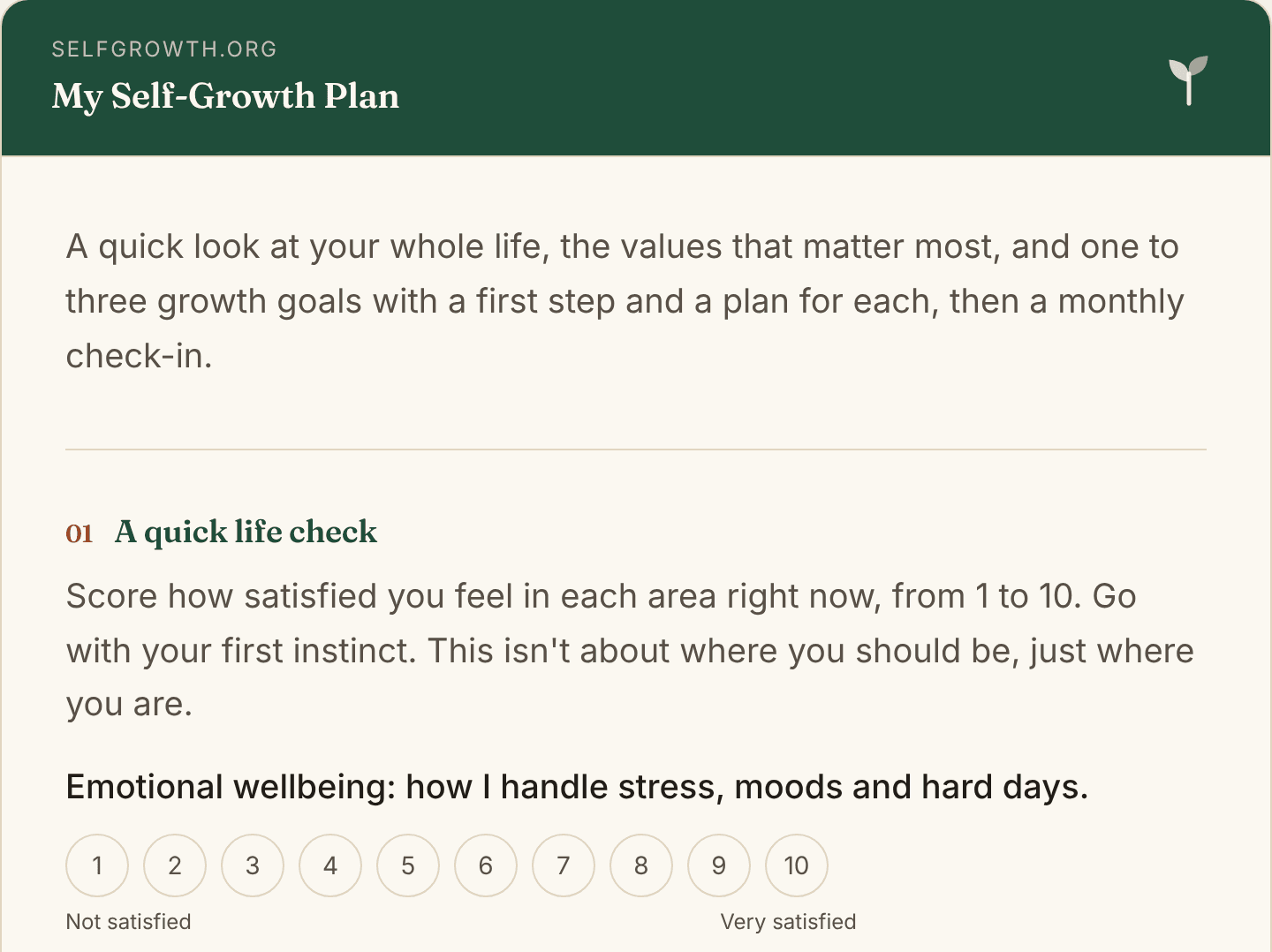
Self-Growth Plan
A free, printable self-growth plan template: check in on six areas of life, pick three values, choose one to three goals, plan a first step and review monthly.
Open worksheet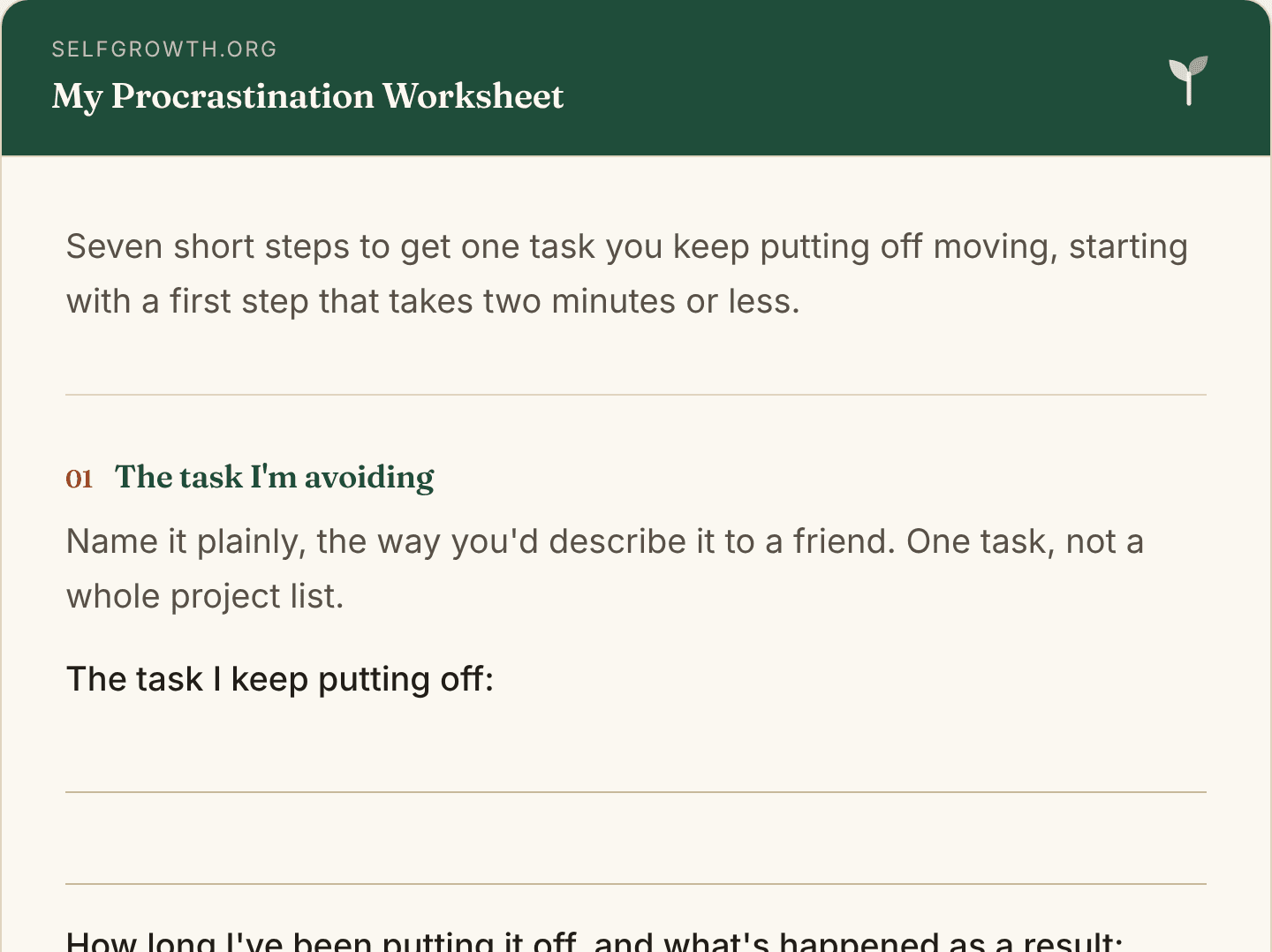
Procrastination Worksheet
A free, printable procrastination worksheet: name the feeling you're avoiding, find a two-minute first step, make an if-then plan and log seven days of starts.
Open worksheetNew worksheets, straight to your inbox
An occasional new worksheet or tool, sent only when there's something genuinely worth your time. No spam, no pressure, unsubscribe any time.