
Guide
How to make friends as an adult
Updated 25 October 2026 · 9 min read
To make friends as an adult, go where the same people gather again and again, such as a class, club, team or volunteering group, and keep turning up. Then take small steps: chat, swap numbers, suggest one easy plan. Friendship builds with time spent together, so give it weeks, not days.
Drawn from research on how friendships form · Part of relationships and communication
School and university put you in a room with the same people every day. Adult life does not. Friends move away, jobs change, and the people you see most may be colleagues or family. If you are wondering where the next friend will come from, you are asking a fair question.
Making friends is a set of small, learnable steps. Here is the practical side: where to meet people, what to do next, and how to be a good friend once you have one. If what you mostly feel is the ache of being lonely, start with how to deal with loneliness. This is self-help, not therapy.
Why is it hard to make friends as an adult?
It is not that something is wrong with you. A few things change once you leave school, and each one makes friendship take more effort.
- You no longer share a daily routine with a big group, so there is less chance to bump into the same people.
- Time is tighter. Work, family, caring and money can leave little room for a long coffee.
- You may have moved, and your old friends are now far away.
- Reaching out first can feel risky. It is easy to read a slow reply as a no.
- Everyone else may be just as busy, so plans slip and nobody wants to push.
Notice that these are about circumstances, not about whether you are likeable. Circumstances can be changed with a little planning.
Where to meet people as an adult
The best places have two things in common: you see the same faces more than once, and there is something to do together so you are not just making small talk. Some ideas:
- A regular, repeated setting: a weekly class, a run club, a choir, a book group, a board games night. Going every week matters more than which one you pick.
- Volunteering: a food bank, a community garden, a charity shop or a local clean-up. You work alongside people, which gives you something to talk about.
- A class to learn something: pottery, a language, climbing, cooking, first aid.
- A club or team: sport, walking groups, photography, a faith or community group.
- Work: lunch with a colleague, or a coffee after a shared project. Friendships that start here can carry on after the job.
- Your neighbours: say hello, borrow a ladder, join a street group or a local event.
- Online groups that meet in person. If you meet someone from the internet, choose a public place, tell a friend or family member where you are going and who you are meeting, arrange your own way home, and leave if anything feels off.
Pick something you are curious about, not something you think you should like. If the activity interests you, it is easier to keep going, and the conversation has something to hang on.
How to make friends as an adult: step by step
You do not need to do all of these at once. Start with step one and go at the pace that suits you.
- 1Pick one repeated activity and put it in your diary. Choose something weekly, so you see the same people. Decide to go at least four times before you judge it.
- 2Arrive with one small aim. For example: learn one person's name, or ask one question. A small aim feels easier than 'make friends'.
- 3Ask open questions and listen. 'How did you get into this?' works well. Remember what they say, and bring it up next time.
- 4Share a little about yourself. Friendship grows when both people give a bit. You do not have to share anything deep on day one.
- 5Move from the group to one person. When you click with someone, say so: 'I enjoyed chatting, shall we grab a coffee after next week?' Be specific. A named day and place is easier to say yes to than 'we should meet up sometime'.
- 6Keep in touch between meetings. A short message about something you talked about is enough: 'Saw this and thought of you.'
- 7Keep showing up and suggest the next plan. Friendships can stall when each person waits for the other to ask. Be the one who suggests it, at least some of the time.
- 8Expect some plans to go nowhere. Not everyone you meet will become a friend, and that is normal. Try again with someone else without taking it as a verdict on you.
How long does it take to make a friend?
There is no fixed number, and it will differ from one friendship to the next. One piece of research gives a useful idea, though. In a 2019 paper, researcher J. A. Hall asked how many hours it takes to make a friend.
In the first study, 355 adults who had recently moved estimated how much time they had spent with a new acquaintance. More hours together went with a closer friendship, and so did time spent doing leisure activities together. In the second study, 112 first-year students reported their hours with two new acquaintances at three points over nine weeks. More hours together went with growing closeness, and two kinds of everyday talk also predicted it.
These are findings from two studies, and they show links, not proof of cause. They do suggest something simple: friendship needs time together, and doing something you both enjoy helps. One coffee is a start, not a test.
How to be a better friend
Making a friend is one skill. Keeping one is another. A few habits make a difference:
- Reply, even briefly. 'Can't talk now, will call you Sunday' is better than silence.
- Listen more than you fix. Try summing up what they said before you give advice. Active listening is a skill you can practise.
- Remember the small things: their big day, their sick relative, their new job. Ask how it went.
- Say how you feel without blaming. If something bothers you, an 'I' statement keeps it kind. See the I statements worksheet.
- Be the one who suggests plans, and say yes sometimes when they do.
- Share good news and bad news. Let them see a real you.
- Give a friend room. People get busy. A quiet month does not always mean the friendship is over.
- Say sorry if you got it wrong, and mean it. Saying the harder things kindly is a skill you can practise.
It also helps to know what you value in a friend, and what kind of friend you want to be. The core values worksheet is a good place to work that out.
Open the Core Values WorksheetIf you feel anxious meeting people
Feeling nervous before meeting new people does not mean you will do it badly. A few ways to make it easier:
- Make the first visit short. Tell yourself you can leave after thirty minutes.
- Choose an activity with a built-in focus, such as a class or a walk, so you are not facing a silent room.
- Plan two or three questions in advance.
- Notice the story in your head. 'Nobody wants to talk to me' is a guess, not a fact. Try treating it as a guess and see what happens.
- Be kind to yourself afterwards. Note one thing that went fine, however small.
If the feeling is bigger than nerves and it is keeping you from going out at all, that deserves proper support. See the next section.
When to get more support
Making friends can be a slow process, and a few flat weeks are part of it. Think about talking to a GP if:
- Loneliness or fear of meeting people is making everyday life hard.
- You avoid work, shops or social events because of anxiety.
- You feel low, empty or hopeless for weeks, or have lost interest in things you used to enjoy.
- Your sleep, appetite or energy have changed and you are not sure why.
A GP can talk it through and point you to support, which can include talking therapies and local groups. You can also call Samaritans free on 116 123 (UK and Ireland), at any time, just to talk. In the US, call or text 988. Elsewhere, findahelpline.com lists free, confidential lines.
If you feel you cannot see a way out, or you are thinking about ending your life or harming yourself, put your safety first: contact one of these lines now, or go to your nearest emergency department or call your local emergency number.
Sources and further reading
This is an educational self-reflection resource, not therapy or medical advice.
If you want to go deeper
- Hall, J. A. (2019). How many hours does it take to make a friend? Journal of Social and Personal Relationships, 36(4), 1278-1296.
Your questions, answered
- How do I make friends as an adult?
- Go to something regular where you will see the same people, such as a class, club, team or volunteering group. Chat, ask questions, then suggest one easy plan with a named day. Keep in touch between meetings. Friendships grow with time together, so give it weeks.
- Where can I meet new friends as an adult?
- Look for repeated settings with a shared activity: classes, clubs, sports teams, volunteering, work, neighbours and local groups. Online groups can work if they meet in person. Meet strangers from online in a public place and tell someone where you are going.
- How long does it take to make a friend?
- There is no set time. One 2019 study found that more hours spent together went with closer friendship, and so did doing leisure activities together. These are findings from two studies, so treat them as a guide to how friendship grows, not a rule.
- Why is it so hard to make friends as an adult?
- Adult life offers fewer daily chances to see the same people, and time is tighter. Moving, work and family can also pull people apart. It is about circumstances, not about you, and small changes to your routine can open up new chances.
- How do I make friends if I am shy or anxious?
- Start small. Choose an activity with a focus, keep the first visit short, and plan a couple of questions. If anxiety keeps you from going out, talk to a GP.
- Is there a how to make friends worksheet or PDF?
- Yes. The linked worksheets are free to use. Use the Download PDF button or Print, with no payment and no email needed. You can also fill them in on screen, and your answers save in your browser.
- Is this a substitute for therapy?
- No. This is a self-help tool, not therapy or medical advice. If loneliness or social anxiety is making life hard, talk to your GP. If you ever feel unsafe or have thoughts of harming yourself, call Samaritans on 116 123 (UK and Ireland), 988 (US), or find a line at findahelpline.com.
Worksheets to do the work
Free to fill in online or print. No email needed.

Self-Confidence Worksheet
Free self-confidence worksheets (PDF) for adults, for one situation you dread: list strengths and past wins, answer self-doubt, take one small step.
Open worksheet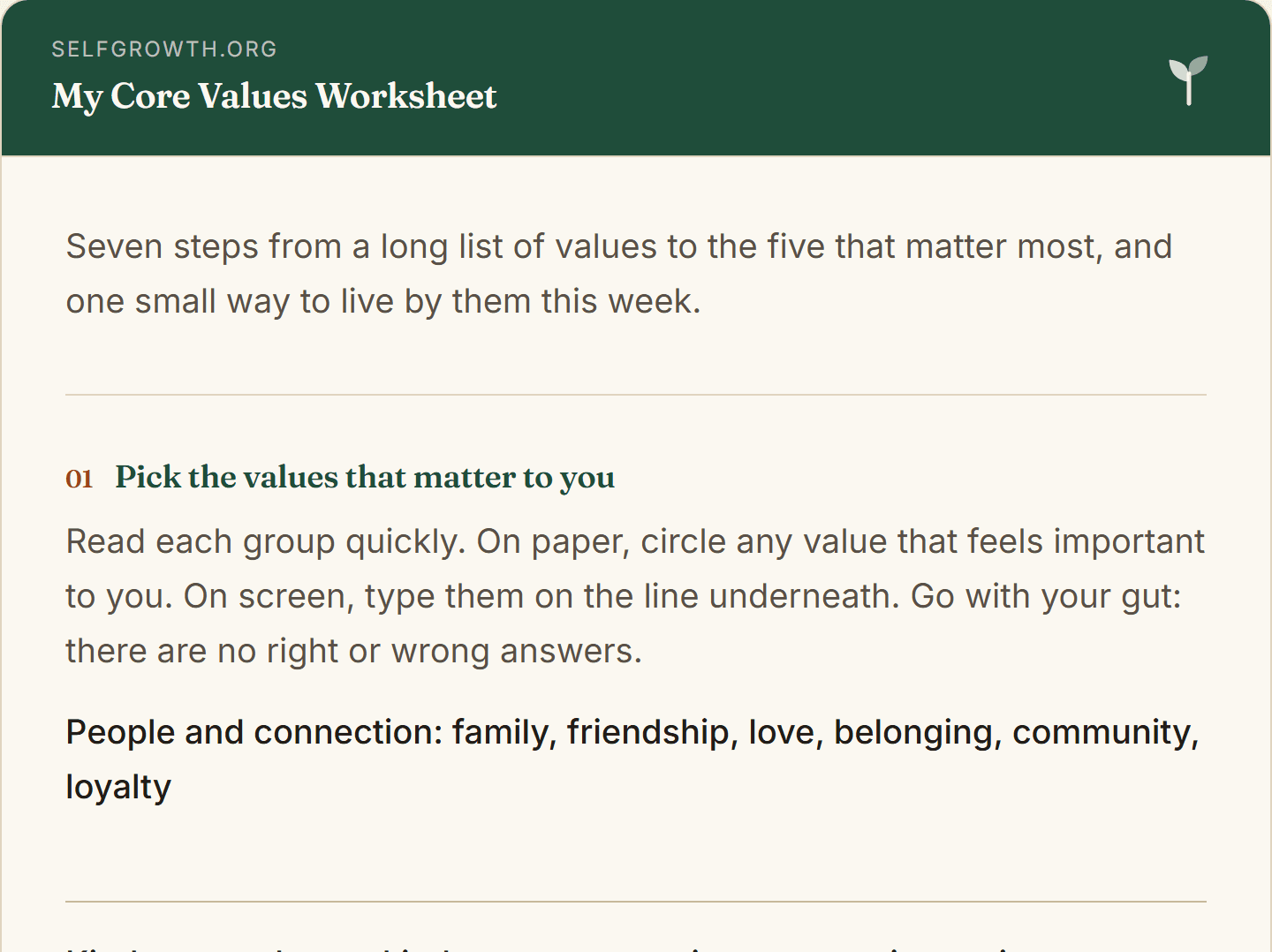
Core Values Worksheet
A free, printable core values worksheet: pick values from a list, narrow them to your top five, put them in your own words and plan one step to live by them.
Open worksheet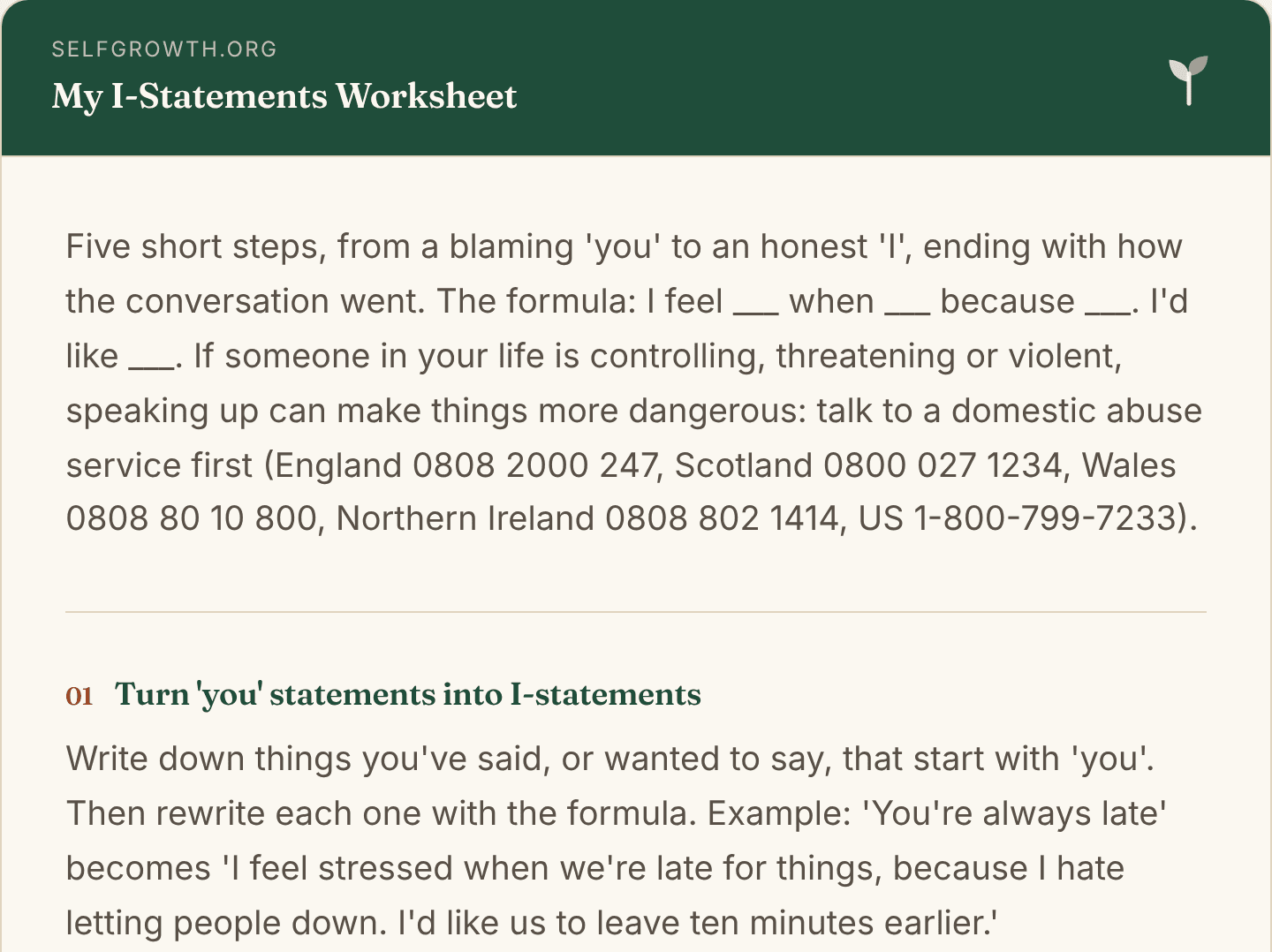
I-Statements Worksheet
A free, printable I-statements worksheet with I statement examples, the 'I feel... when... because...' formula, and space to plan one real conversation.
Open worksheet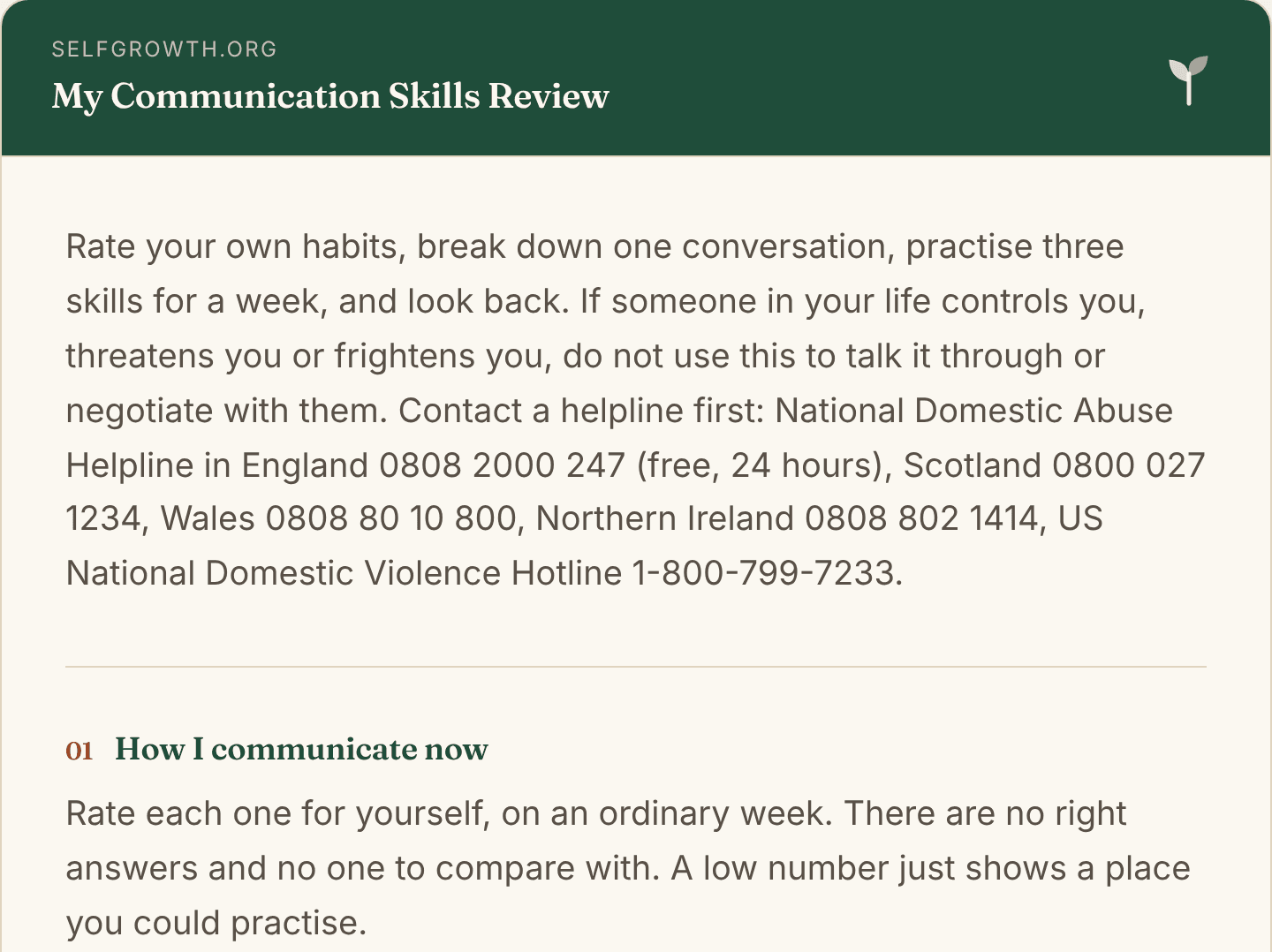
Communication Skills Worksheet
A free communication skills worksheet: rate your own habits, break down one hard conversation, practise three skills for a week, and use a phrase bank.
Open worksheet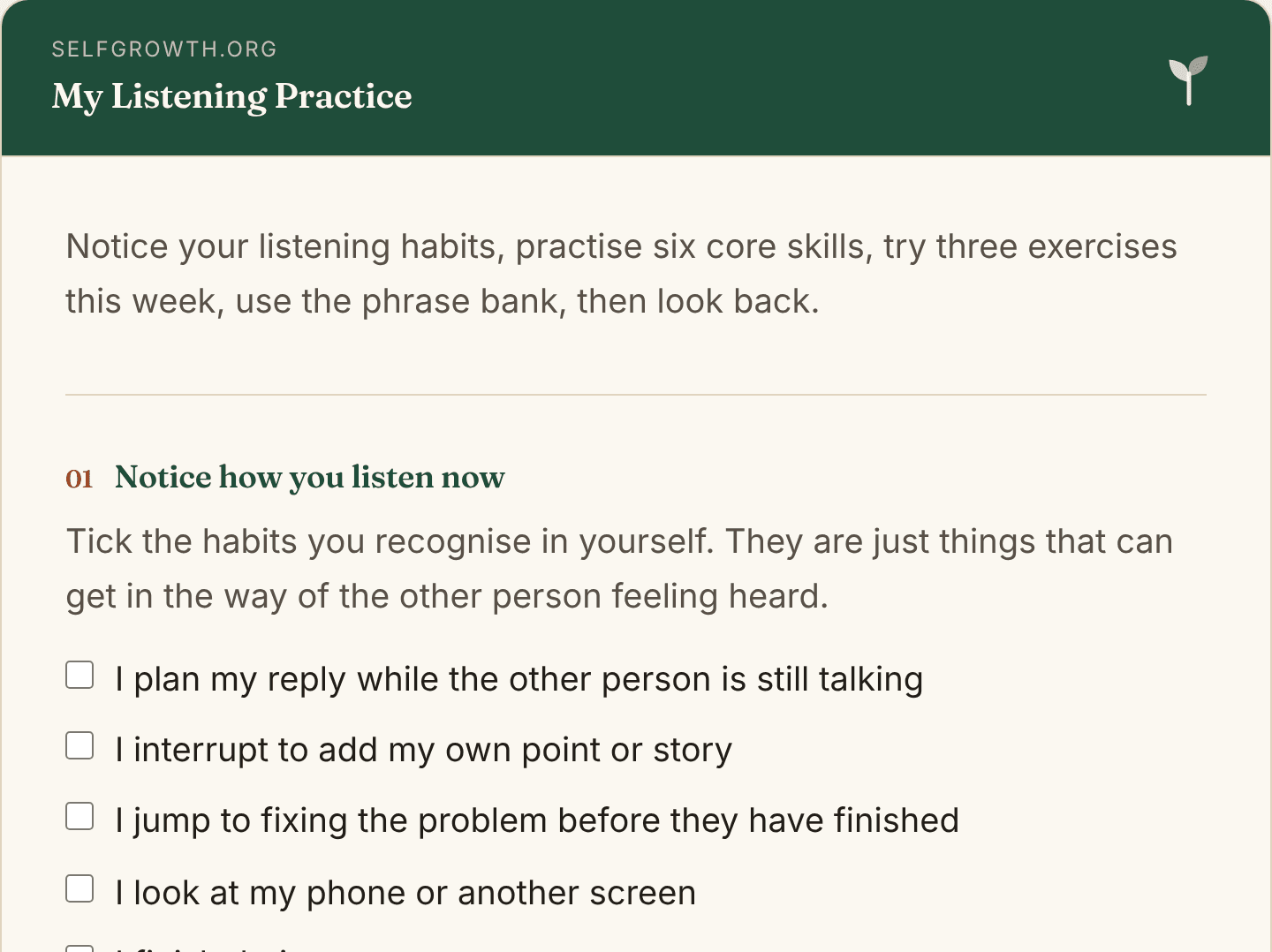
Active Listening Worksheet
A free active listening worksheet with exercises: spot your listening habits, practise six core skills, try three conversations this week and look back at what you noticed.
Open worksheetRelated guides
New worksheets, straight to your inbox
An occasional new worksheet or tool, sent only when there's something genuinely worth your time. No spam, no pressure, unsubscribe any time.