
Guide
How to deal with loneliness
Updated 23 October 2026 · 9 min read
To deal with loneliness, start small and aim for connection you can feel, not a bigger crowd. Message one person, say yes to one regular thing, and be kind to yourself when it feels awkward. Loneliness can also sit alongside low mood, so if it lingers or weighs on you, talk to a GP.
Drawn from research on loneliness and social connection · Part of relationships and communication
The evening stretches out. The phone is quiet, or it is busy and none of it reaches you. You might be surrounded by people and still feel on the outside of everything.
Feeling lonely is painful, and it is a human signal, not a flaw in you. This guide is self-help, not therapy, and it is written for you at a time when reaching out may feel like the hardest thing.
What is loneliness?
Loneliness is the painful feeling that the connection you have does not match the connection you want. It is about how your relationships feel to you, not about how many people are in your life. Two people with the same number of friends can feel completely differently about them.
That is why loneliness and being alone are not the same thing. You can be alone and content, enjoying the quiet. You can also be in a busy office, a family home or a relationship and feel deeply lonely, because nobody there seems to see or know you. Being alone is about circumstances. Loneliness is about how it feels.
Signs of loneliness
Loneliness does not always announce itself. You might notice some of these:
- A heavy, empty or aching feeling, especially in the evenings or at weekends.
- Feeling that nobody really knows you, even when you are with people.
- Scrolling for hours, hoping something will fill the gap.
- Pulling back from invitations, then feeling worse for being alone.
- Reading too much into small things, like a message left unanswered.
- Feeling tired, flat or low in energy.
- A sense that everyone else belongs somewhere and you do not.
Having some of these now and then is part of being human. It is worth paying attention when the feeling stays with you, or starts to colour how you see yourself and other people. These are not a diagnosis. Only you can say what this is like for you.
What causes loneliness?
There is rarely a single cause, and it is not a sign that you did something wrong. Things that can play a part include:
- A change: moving to a new place, starting or leaving a job, finishing a course, a break-up, becoming a parent, retiring.
- A loss: a friendship that faded, a bereavement, or a group that no longer meets.
- Life getting busy, so that friendships slip without anyone deciding they should.
- Feeling different from the people around you, or not able to be yourself with them.
- Low mood, anxiety or low confidence, which can make reaching out feel risky.
- Health, money, caring duties or a disability that make getting out harder.
Researchers are still working out how these fit together, and what applies to one person may not apply to you. One useful idea from the research is about social thinking. When you feel lonely, it is easy to expect rejection and read neutral faces as cold. Those expectations can make reaching out feel riskier, so the loneliness can feed itself.
Why does loneliness feel so heavy?
People with stronger relationships tended to live longer. Close people mattered more than simply not living alone. That comes from a 2010 review of studies by Julianne Holt-Lunstad and colleagues. It shows an association only, not that loneliness causes illness, and it says nothing about what will happen to you. It does suggest that connection is not a luxury.
It may also be that how close a relationship feels matters more than how many you have. You may find one person who really knows you means more than a full contacts list.
How to deal with loneliness: small steps
You do not have to do all of these, and you do not have to do them quickly. Pick the one that feels least scary and try it this week.
- 1Name what you are feeling. Saying 'I feel lonely' to yourself is a start. If you are not sure what is going on, the feelings wheel can help you find the word, and noticing it is part of taking it seriously.
- 2Make one small reach. Send a short message to one person you have lost touch with: 'Was thinking of you, how are you?' It does not need to be clever. A small, easy reach is more likely to happen than a big plan.
- 3Aim for quality over quantity. Think about one or two people you feel even slightly more yourself with, and ask how you could spend a bit more time together, such as a regular walk, call or coffee. A few real conversations can matter more than many surface ones.
- 4Join something that repeats. A class, club, volunteering role, faith or community group gives you the same faces week after week, which takes the pressure off having to start from scratch each time. Pick something you are curious about, so the activity can carry the conversation.
- 5Test the story your mind tells. If you catch yourself thinking 'they won't want me there', write the prediction down before an invite, then note afterwards what actually happened. Masi and colleagues (2011) reviewed studies of ways to reduce loneliness. Among the randomised studies, those that worked on unhelpful social thinking were the most successful. That is a review of research, not a promise. The thought record worksheet is another way to test a thought like that.
- 6Be kind to yourself while you build connection. New attempts can feel clumsy, and some will fall flat. Talk to yourself as you would to a friend who had a flat evening, and keep sleep, food, movement and time outdoors going, since they give you more energy for reaching out. The self-compassion worksheet and the self-care worksheet can help, and gratitude journal prompts can turn your attention to the connections you already have.
Does going online help with loneliness?
It depends on what you do there, and it is worth testing for yourself. Online can help when it connects you to real people: a video call with a friend, a group built around something you care about, or a way to take a first step if leaving the house is hard. It can be a lifeline if you are housebound, caring for someone or live far from people like you.
It may help less when it turns into scrolling other people's lives, which can leave you feeling more on the outside. A simple check: after you log off, do you feel a bit more connected, or a bit emptier? Use that answer to decide how much of it to keep.
When it feels too hard to reach out
Sometimes the thing that helps feels impossible, because loneliness can make you wary and tired. If so, make the step smaller. Reply to a message you have been avoiding. Sit in a café for ten minutes. Say hello to one neighbour. Notice how it felt afterwards, not whether it was perfect.
If people close to you are making you feel smaller, controlled or scared, that is a different problem from loneliness and this guide is not the right tool for it. Please see the help page for where to turn.
A boundary can also be part of connection. If you find yourself saying yes to everything so as not to be left out, the boundaries worksheet can help you work out what you actually want.
When to get more support
Loneliness is not an illness, but it can sit alongside low mood, anxiety or other things that deserve proper help. Think about talking to a GP if:
- The feeling has lasted for weeks and is not lifting.
- You feel low, empty or hopeless much of the time, or have lost interest in things you used to enjoy.
- Loneliness is affecting your sleep, appetite, work or day-to-day life.
- You are using alcohol or other things to get through the loneliness.
A GP can talk it through with you and point you to support, which can include talking therapies and local groups. You can also call Samaritans free on 116 123 (UK and Ireland), at any time, just to talk. In the US, call or text 988. Elsewhere, findahelpline.com lists free, confidential lines.
Thoughts like these are serious. If you feel you cannot see a way out, or you are thinking about ending your life or harming yourself, please put your safety first: contact one of these lines now, or go to your nearest emergency department or call your local emergency number. You do not have to wait until it feels bad enough.
Sources and further reading
This is an educational self-reflection resource, not therapy or medical advice.
If you want to go deeper
- Masi, C. M., Chen, H.-Y., Hawkley, L. C. & Cacioppo, J. T. (2011). A meta-analysis of interventions to reduce loneliness. Personality and Social Psychology Review, 15(3), 219-266.
- Holt-Lunstad, J., Smith, T. B. & Layton, J. B. (2010). Social relationships and mortality risk: A meta-analytic review. PLoS Medicine, 7(7), e1000316.
Your questions, answered
- How do I deal with loneliness?
- Start with something small and doable: name the feeling, message one person, or say yes to one regular activity. Aim for a few connections that feel real, rather than lots of surface ones, and be gentle with yourself when it feels awkward. If it lingers or comes with low mood, talk to a GP.
- What is the difference between loneliness and being alone?
- Being alone is about your circumstances: nobody else is there. Loneliness is a feeling: the connection you have does not match what you want. You can be alone and content, or surrounded by people and lonely.
- Why do I feel lonely even when I am around people?
- Loneliness is about how connected you feel, not how many people are near you. If you cannot be yourself with them, or nobody seems to really know you, you can feel lonely in a crowd, a family or a relationship. Finding one or two people you feel more yourself with can help.
- Does loneliness cause depression?
- Loneliness and low mood can sit side by side, and each can make the other harder, but loneliness is not the same thing as depression and this page cannot tell you which you have. If you feel low, empty or hopeless for weeks, or lose interest in things, talk to a GP.
- Can social media make loneliness better or worse?
- It depends on how you use it. Online can help when it leads to real contact, such as calls or groups around something you enjoy. Scrolling through other people's lives can leave you feeling more left out. Notice how you feel after you log off.
- What can I do when I feel lonely right now?
- Name the feeling, then do one small thing: reply to a message, call someone, step outside, or write down what you are feeling. If you are in distress, Samaritans are on 116 123 (UK and Ireland) and you can call or text 988 (US). Elsewhere, see findahelpline.com.
- Is this free, and is it a substitute for therapy?
- It is free, with no payment and no email needed, and the worksheets can be filled in online or printed. This guide is self-help, not therapy or medical advice. If loneliness comes with low mood, talk to a GP. If you ever have thoughts of harming yourself, contact a crisis line straight away.
Worksheets to do the work
Free to fill in online or print. No email needed.
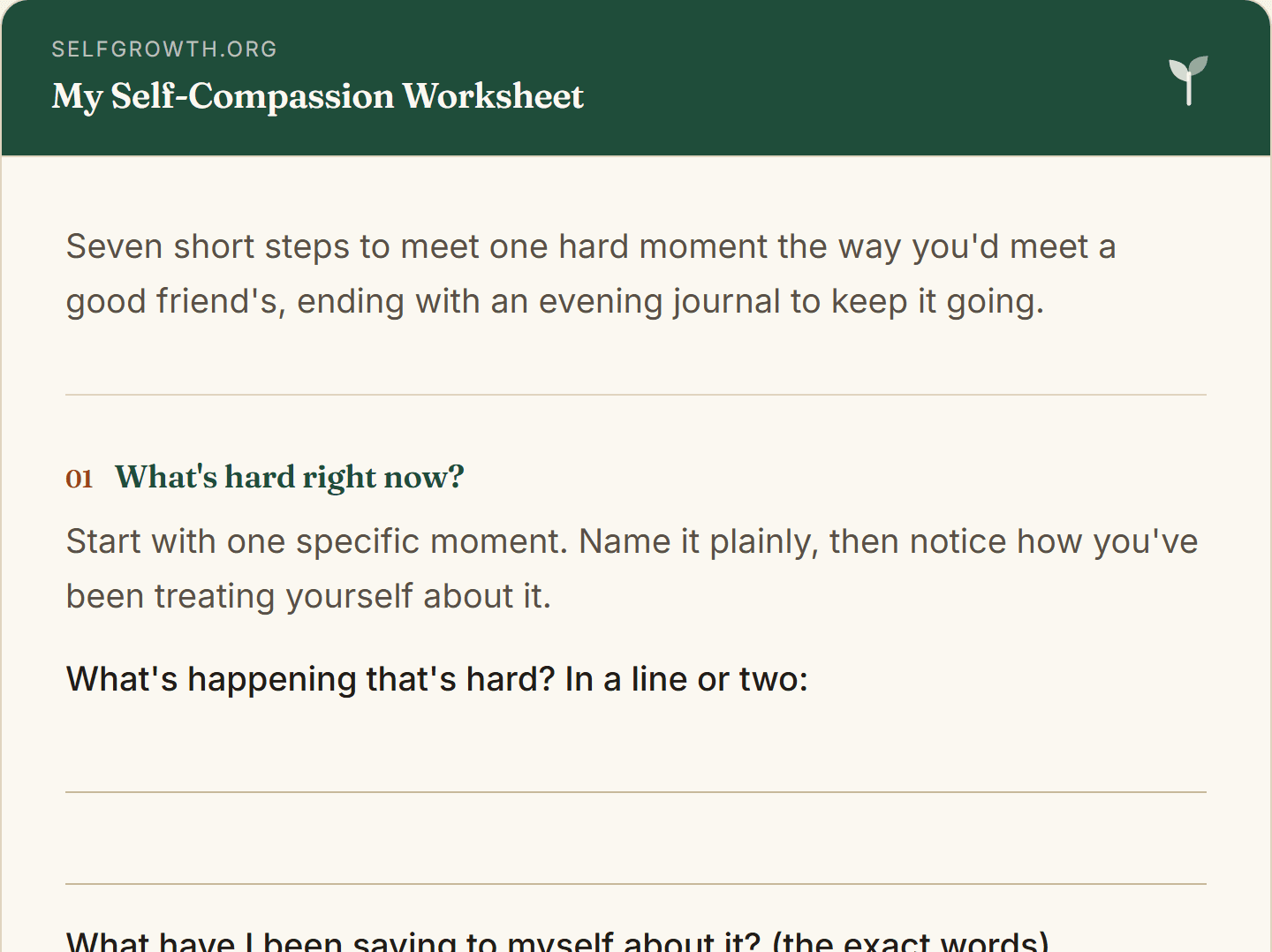
Self-Compassion Worksheet
A free, printable self-compassion worksheet: the self-compassion break, the friend test, a kind letter and journal prompts, based on Kristin Neff's research.
Open worksheet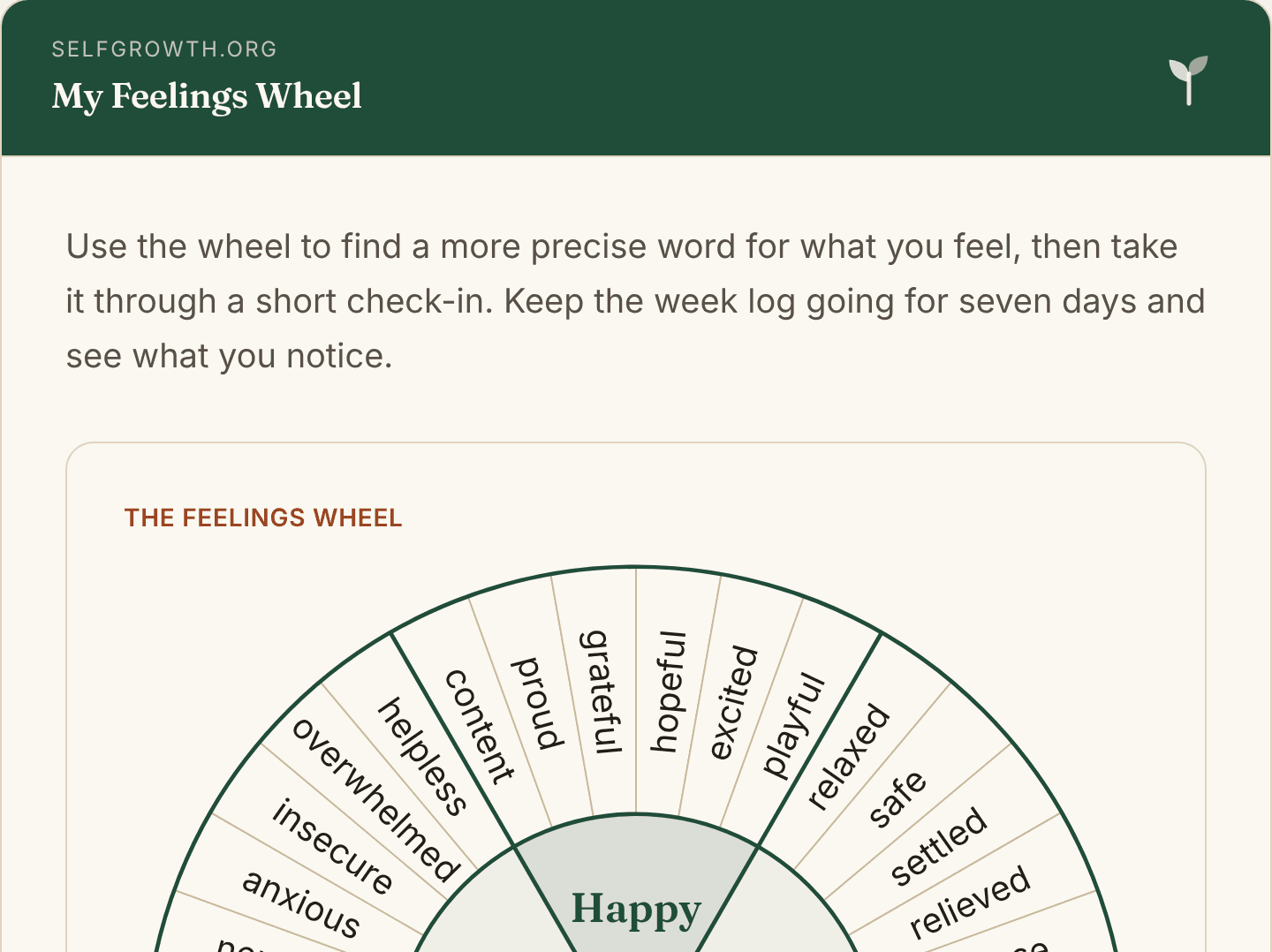
Feelings Wheel
A free printable feelings wheel (emotion wheel) PDF: six core feelings and 36 more precise words, with a daily check-in and a week log to name what you feel.
Open worksheet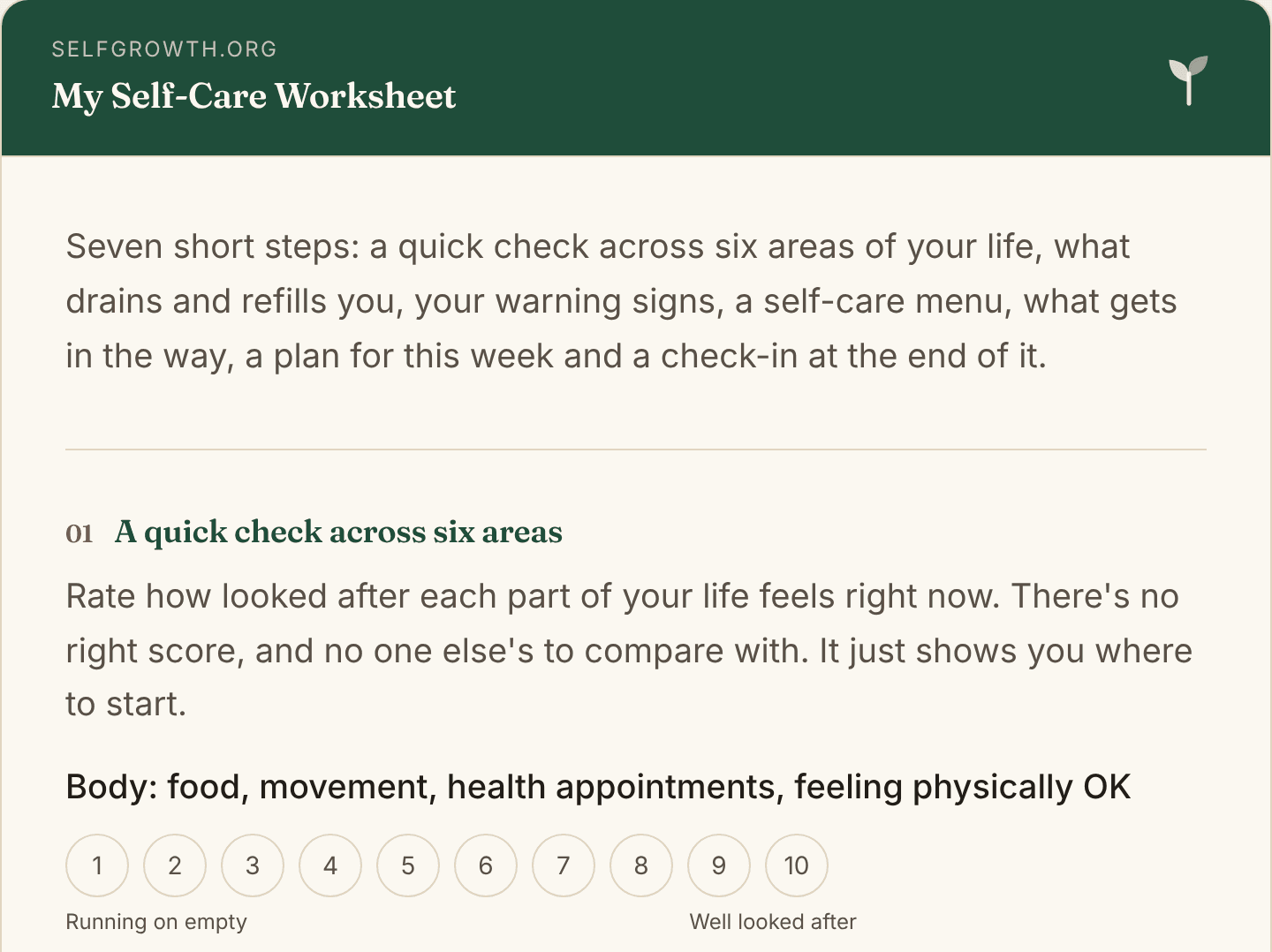
Self-Care Worksheet
A free, printable self-care worksheet for adults: check six areas of your life, see what drains and refills you, and make a self-care plan that costs nothing.
Open worksheet
Gratitude Journal Prompts
Free, printable gratitude journal prompts: guided questions with space to write, plus a take-away list, to help you notice and savour what's already good.
Open worksheet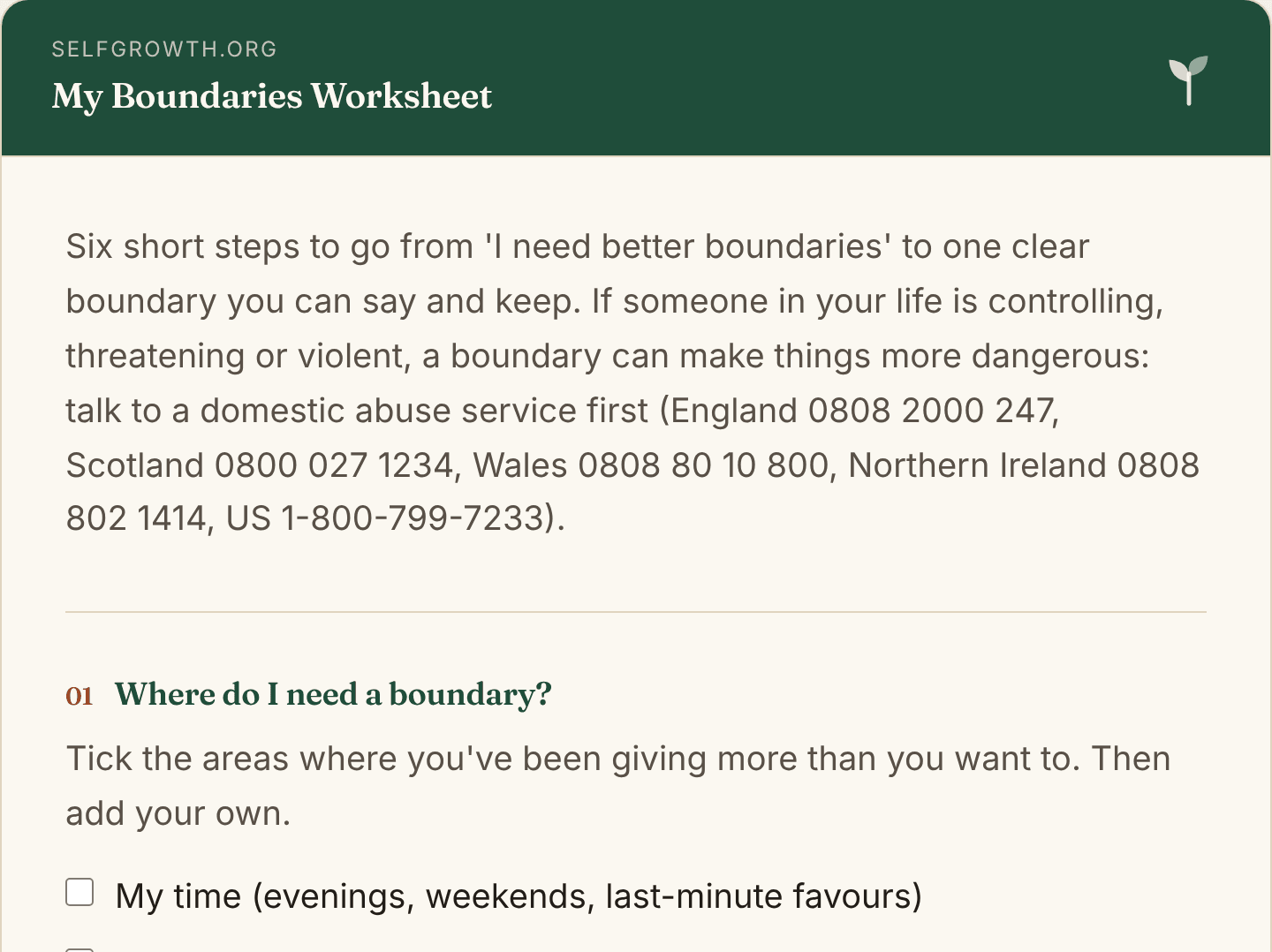
Boundaries Worksheet
A free, printable boundaries worksheet: spot where you need a limit, write it as something you'll do, plan the exact words, and decide what you'll do if it's crossed.
Open worksheet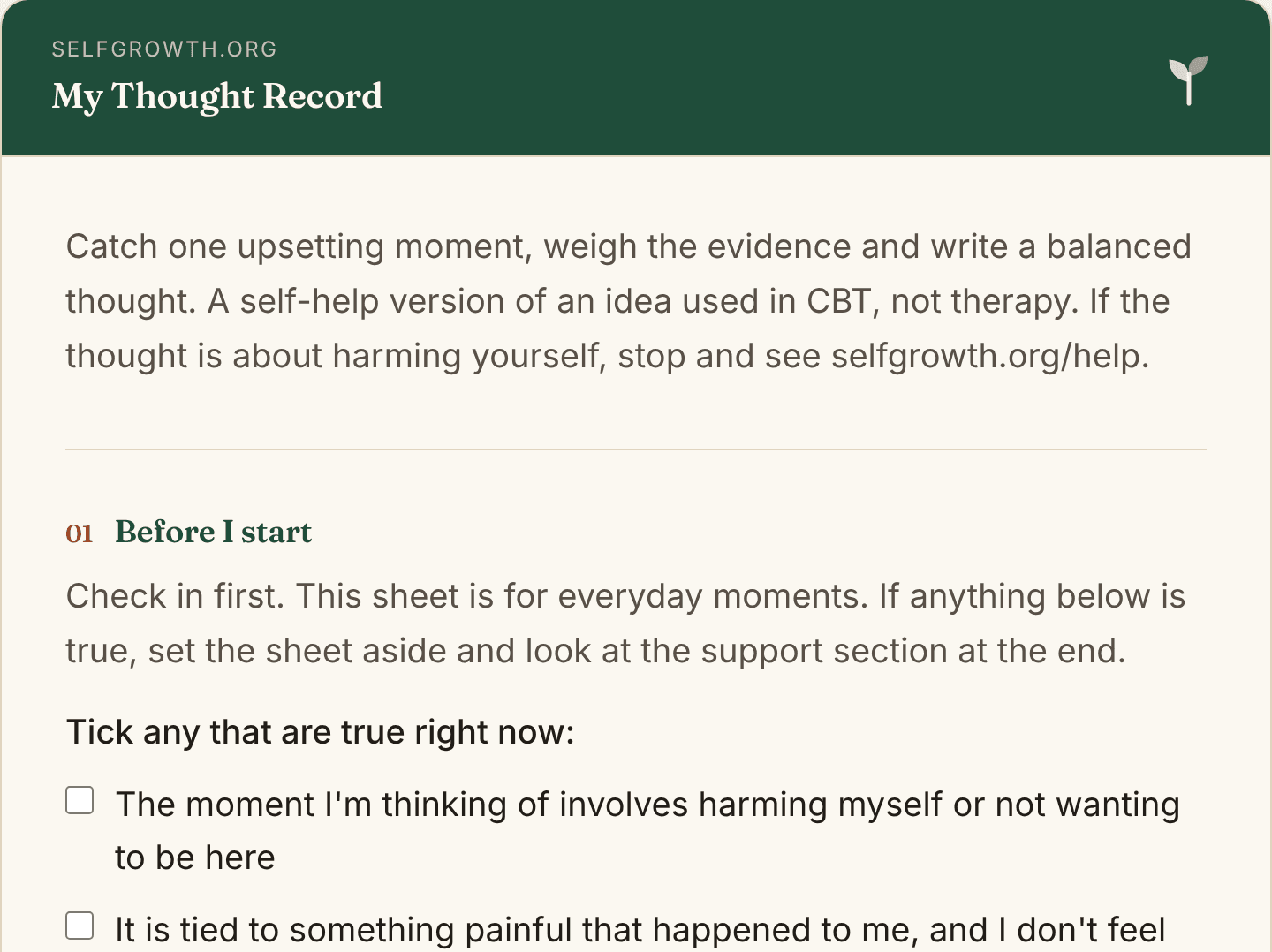
Thought Record Worksheet
Free thought record worksheet: note the situation, feeling and thought, weigh the evidence and write a balanced thought. Self-help, not therapy. Free PDF.
Open worksheetRelated guides
New worksheets, straight to your inbox
An occasional new worksheet or tool, sent only when there's something genuinely worth your time. No spam, no pressure, unsubscribe any time.