
Communication
Communication skills worksheet: a free self-review to practise healthy communication, one skill at a time
Updated 25 October 2026 · 7 min read · Free to print
A communication skills worksheet helps you look honestly at how you talk and listen, then practise one skill at a time. This free, printable version lets you rate your own habits, break down one conversation that went badly, plan three skills to practise, use a phrase bank and look back each week.
A practice format for everyday communication · Part of relationships and communication
Fill it in here (it saves in this browser, but not in a private window), print it, or download the PDF. Free, no sign-up.
Healthy communication is built from small things done again and again: listening properly, asking before assuming, saying what you need, and speaking calmly when you are stressed. You can practise all of it. This sheet gives you a way to look at your own habits and choose where to start.
You rate how you do things now, using only your own sense of yourself. Then you take one conversation that went badly and pull it apart: what you meant to say, what you said, what the other person may have heard, and what you would change. After that you pick three skills, practise them for a week, and keep a phrase bank of words you can reach for in the moment.
If you want a script for one hard moment, use the I-statements worksheet. For the wider picture of speaking up clearly and kindly, read the guide to assertive communication. This is a practice format, not a tested programme. It is a self-help tool, not therapy.
How to use this worksheet
- 1Rate your habits in the first section. Be fair to yourself: this is for you, not for anyone else.
- 2Pick a real conversation that you can think about calmly. Not the most painful one in your life.
- 3Choose three skills only. Write where you will practise each one this week.
- 4Keep the phrase bank somewhere you can see it.
- 5Look back at the end of the week and change one thing.
The worksheet
selfgrowth.org
My Communication Skills Review
Rate your own habits, break down one conversation, practise three skills for a week, and look back. If someone in your life controls you, threatens you or frightens you, do not use this to talk it through or negotiate with them. Contact a helpline first: National Domestic Abuse Helpline in England 0808 2000 247 (free, 24 hours), Scotland 0800 027 1234, Wales 0808 80 10 800, Northern Ireland 0808 802 1414, US National Domestic Violence Hotline 1-800-799-7233.
01How I communicate now
Rate each one for yourself, on an ordinary week. There are no right answers and no one to compare with. A low number just shows a place you could practise.
Listening to understand, not just waiting to reply
Asking questions before I assume
Saying clearly what I need or want
Keeping my tone steady when I'm stressed
Body language: facing the person, eye contact, putting the phone down
Choosing a good time to raise something
Writing messages that are clear and kind
One thing I already do well:
02Take apart one conversation that went badly
Choose a real, recent one. The aim is not to decide who was right. It is to see where the gap opened between what you meant and what happened.
Who it was with, and what it was about:
What I wanted to say or get across:
What I actually said (and my tone):
What they may have heard (I can only guess):
What I'd change next time (the timing, my words, my tone, asking a question first):
03Where my habits slip
Tick any that sound like you under pressure. These describe your own habits, not anyone else's.
When I'm stressed, I sometimes:
The one I'd most like to change:
04Practise three skills this week
Choose three, no more. Small and specific is better than big and vague, for example 'ask one open question in the team meeting'. Fill in the last column at the end of the week.
Entry 1
Entry 2
Entry 3
05My phrase bank
Words are easier to find when you have chosen them in advance. Tick the ones you could say, then change them into your own voice.
Open questions:
Checking I understood:
Saying what I need:
Pausing a heated talk:
Phrases in my own words:
- 1.
- 2.
- 3.
06My weekly look back
At the end of the week, check in with yourself. Whatever happened, you were practising.
A moment this week when I communicated the way I wanted to:
A moment I'd handle differently, and how:
How do I feel about how I communicated this week?
The one skill I'll keep practising next week:
When you're done, a moment to reflect
- Which skill would make the biggest difference to one relationship that matters to me?
- When I go quiet or get sharp, what am I feeling underneath?
- Who do I find it easiest to talk to, and what do I do differently with them?
- What would it be like to ask a question first, before I answer?
- What is one small thing I can do this week that I'd be glad of?
Done for now?
Save today's answers as a dated entry. You can come back, fill it in again and compare the two side by side.
Is there evidence this works?
The format puts together a few ordinary ideas: rate your own habits, review one real conversation, practise a small number of skills in real moments, and look back each week. The phrase bank is plain example wording to adapt, not a script that has been tested.
It works only on your side of a conversation: your listening, your tone, your timing and your words. You cannot control how the other person responds.
If you want one hard conversation planned step by step, try the I-statements worksheet. If you want the bigger picture of speaking up clearly and kindly, read about assertive communication.
These are educational self-reflection tools, not therapy.
Your questions, answered
- What are the main communication skills?
- Listening to understand, asking open questions, saying clearly what you need, keeping your tone steady when you are stressed, using open body language, choosing a good time to talk, and writing clear messages. This worksheet lets you rate each one for yourself and pick three to practise.
- What is healthy communication?
- It is talking and listening in a way that lets both people be heard. That can mean listening before replying, checking you have understood, saying what you feel and need without blame, and pausing when a talk gets too heated..
- How can I improve my communication skills?
- Pick one or two skills and practise them in real moments. For example, ask one open question in a chat, or check you understood before you answer. Look back each week at what went well. Small, specific practice is easier to keep up than trying to change everything at once.
- What do I do when a conversation turns into an argument?
- Pause. Say you want to get it right and suggest a break with a time to come back. Take a few slow breaths. Return to it when you are calmer. The phrase bank in this worksheet has words for this. If the other person frightens or controls you, do not try to talk it through: get support first (England 0808 2000 247, Scotland 0800 027 1234, Wales 0808 80 10 800, Northern Ireland 0808 802 1414, US 1-800-799-7233).
- How is this different from the I-statements worksheet?
- The I-statements worksheet gives you a way to say one hard thing without blame. This worksheet is a wider review of your everyday habits: listening, asking, tone, timing and written messages. You could do this one first, then use I-statements for a specific conversation.
- Is there a communication skills worksheet PDF?
- Yes. Use the Download PDF button for a print-ready copy, or Print to print straight from the page. It is free, with no payment and no email needed. You can also fill it in on screen, and your answers save in your browser on that device.
- Is this a substitute for therapy?
- No. It is a self-help tool, not therapy or medical advice. If low mood or stress is what is getting in the way of how you talk to people, see your GP. If you ever feel unsafe or have thoughts of harming yourself, call Samaritans on 116 123 (UK and Ireland), 988 (US), or find a line at findahelpline.com.
Keep going, related worksheets
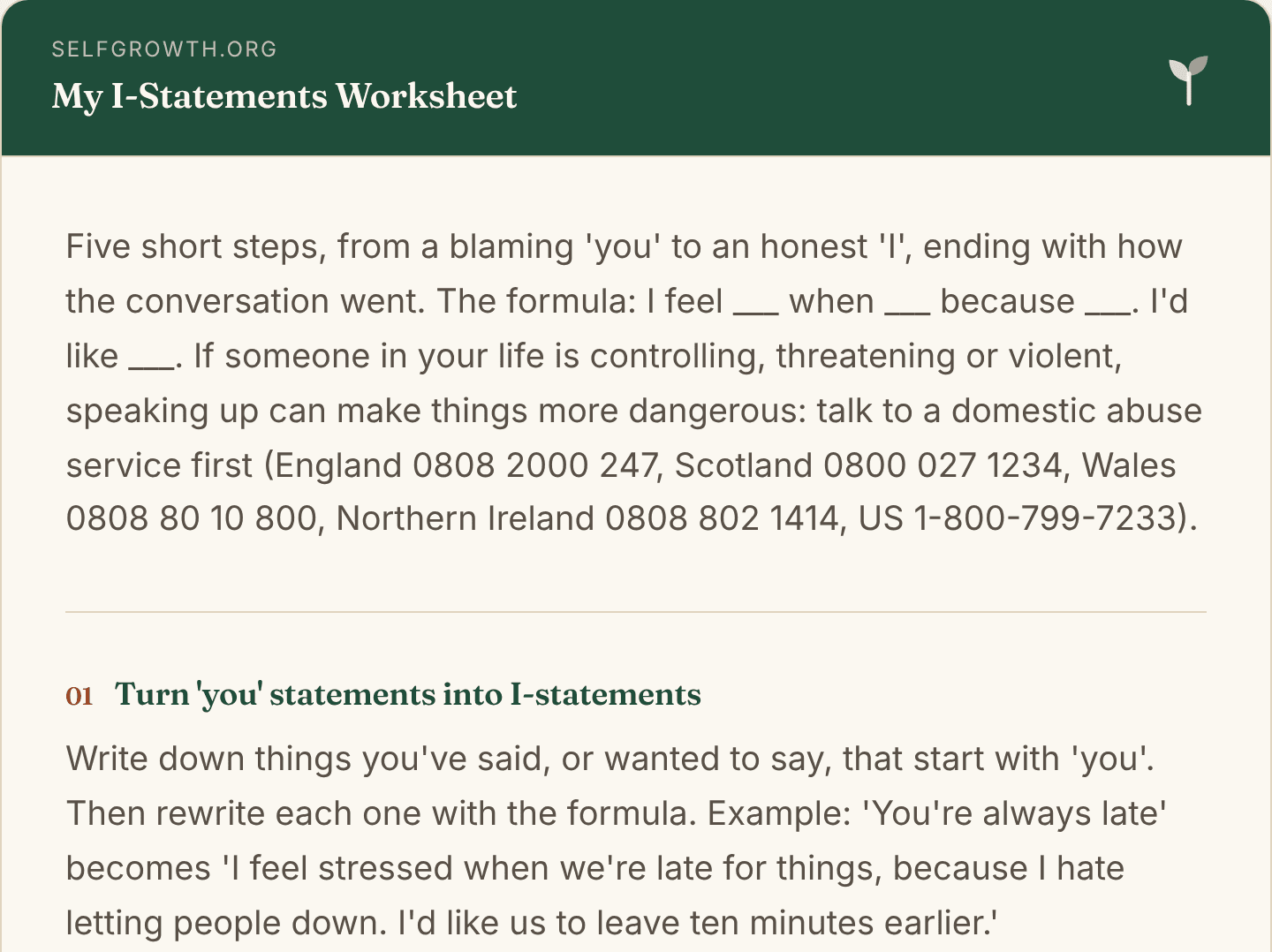
I-Statements Worksheet
A free, printable I-statements worksheet with I statement examples, the 'I feel... when... because...' formula, and space to plan one real conversation.
Open worksheet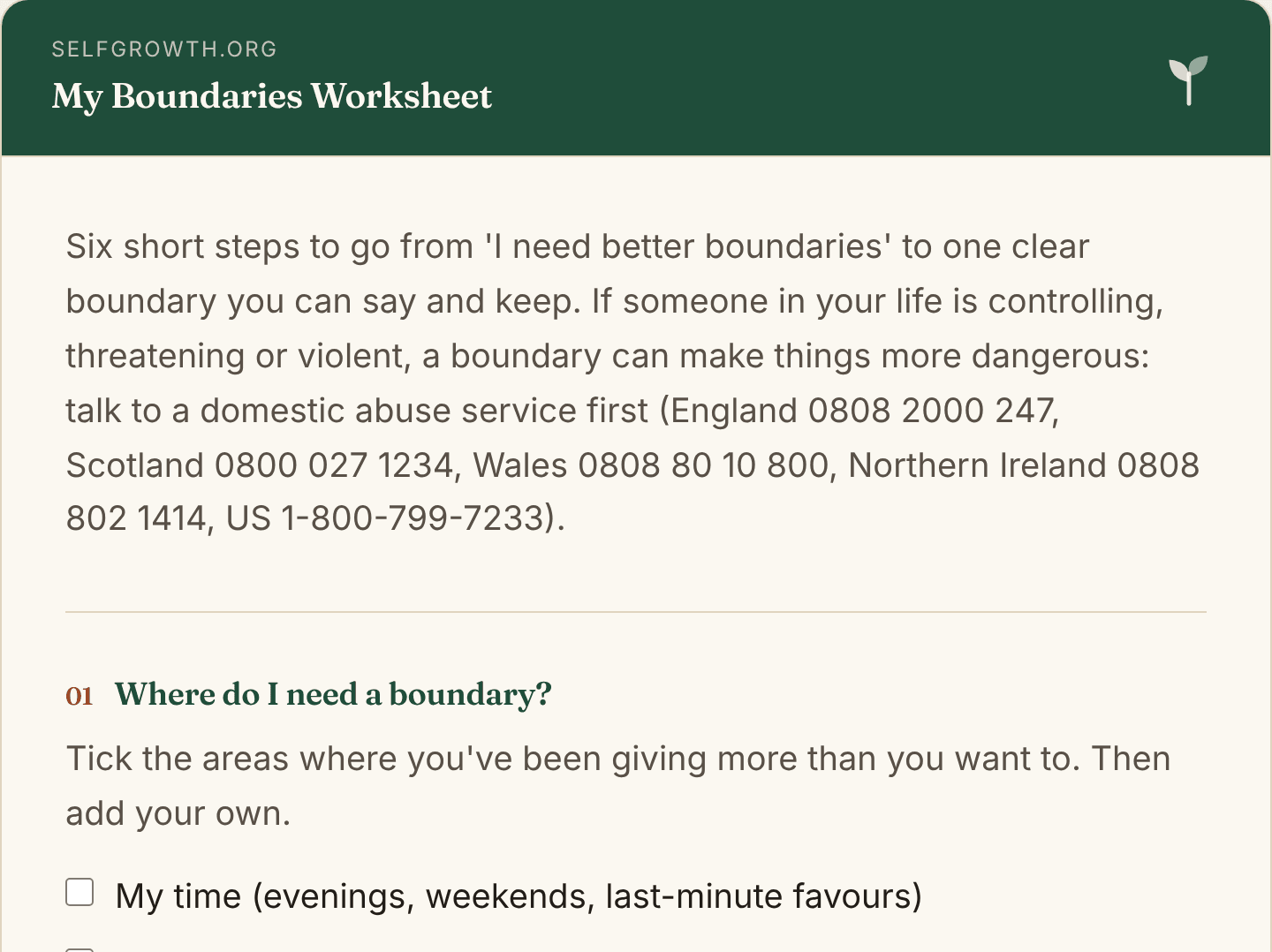
Boundaries Worksheet
A free, printable boundaries worksheet: spot where you need a limit, write it as something you'll do, plan the exact words, and decide what you'll do if it's crossed.
Open worksheet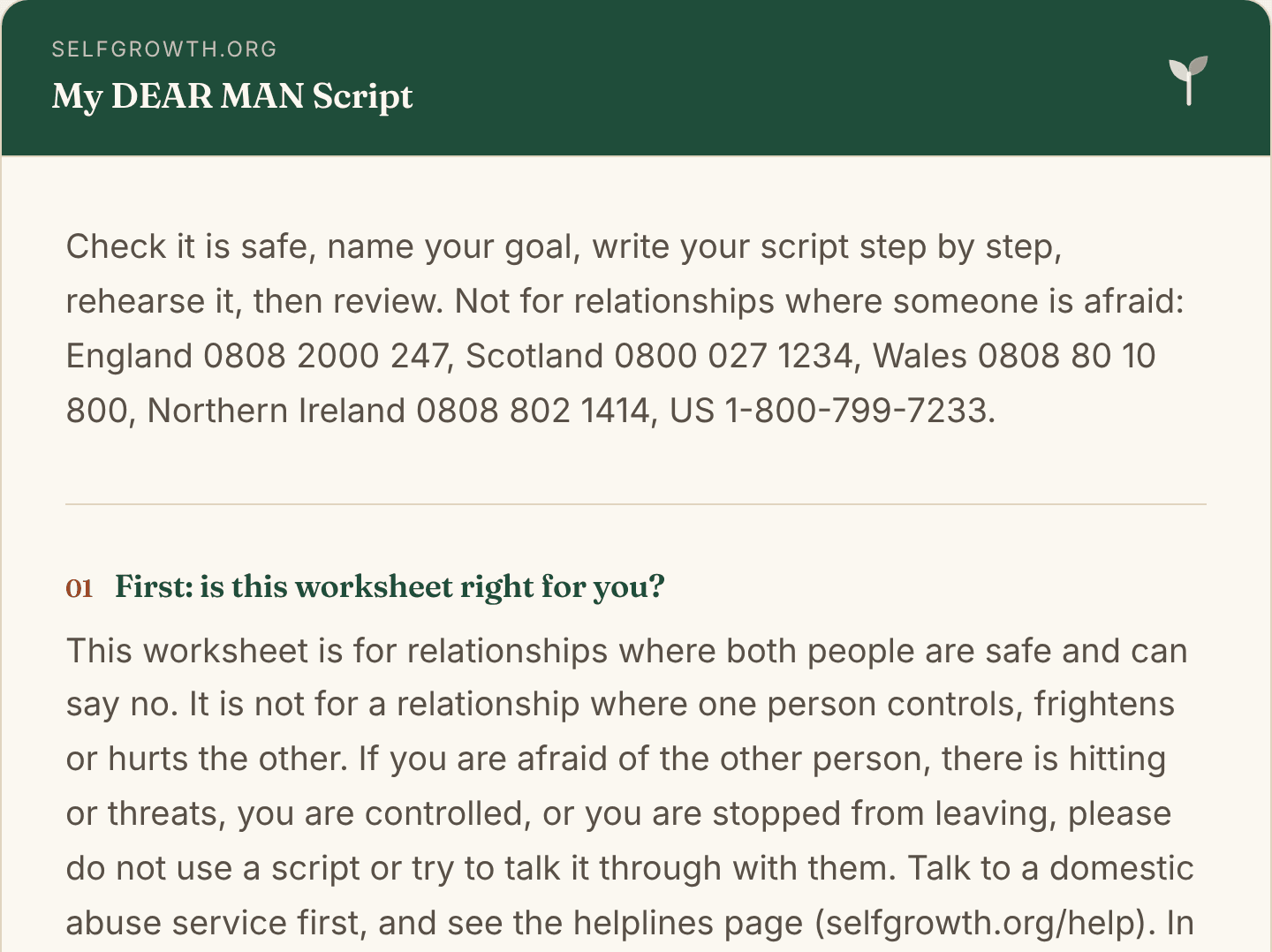
DEAR MAN Worksheet
A free, printable DEAR MAN worksheet: write a script for one request or one no, step by step, then rehearse and review. Not for unsafe relationships.
Open worksheetNew worksheets, straight to your inbox
An occasional new worksheet or tool, sent only when there's something genuinely worth your time. No spam, no pressure, unsubscribe any time.