
Communication
DEAR MAN worksheet: script one request, or one no, step by step
Updated 23 October 2026 · 7 min read · Free to print
DEAR MAN is a skill from dialectical behaviour therapy (DBT) for asking for something or saying no. The letters stand for describe, express, assert, reinforce, mindful, appear confident and negotiate. This free worksheet turns them into a fill-in script for one request, in your own words. It is self-help, not therapy.
A skill from dialectical behaviour therapy (DBT) · Part of relationships and communication
Fill it in here (it saves in this browser, but not in a private window), print it, or download the PDF. Free, no sign-up.
Asking for what you need can feel harder than the thing itself. You rehearse it for days, say it in a rush, then wonder why it came out wrong. A script does not make you stiff. It lets you decide in advance what you want, so you are not working it out while your heart is pounding.
DEAR MAN is an acronym from dialectical behaviour therapy (DBT), developed by Marsha Linehan, taught in its interpersonal effectiveness skills. The first four letters are about what you say. The last three are about how you say it.
This is one skill borrowed from DBT, not DBT, and not therapy. It is for ordinary, safe relationships: a colleague, a friend, family, a landlord. It is not a way to deal with someone who frightens or controls you. The first section covers that.
How to use this worksheet
- 1Pick one request or one no, not a whole relationship. A small one is a good first go.
- 2Write the script in your own voice. If a line sounds like someone else, change it until you could say it out loud.
- 3Say it aloud once or twice before the real conversation, to yourself, in a mirror, or to someone you trust.
- 4After, use the review. The other person may say no. Having asked clearly still counts.
The worksheet
selfgrowth.org
My DEAR MAN Script
Check it is safe, name your goal, write your script step by step, rehearse it, then review. Not for relationships where someone is afraid: England 0808 2000 247, Scotland 0800 027 1234, Wales 0808 80 10 800, Northern Ireland 0808 802 1414, US 1-800-799-7233.
01First: is this worksheet right for you?
This worksheet is for relationships where both people are safe and can say no. It is not for a relationship where one person controls, frightens or hurts the other. If you are afraid of the other person, there is hitting or threats, you are controlled, or you are stopped from leaving, please do not use a script or try to talk it through with them. Talk to a domestic abuse service first, and see the helplines page (selfgrowth.org/help). In England, the National Domestic Abuse Helpline is free and open 24 hours on 0808 2000 247. In Scotland, call 0800 027 1234; in Wales, 0808 80 10 800; in Northern Ireland, 0808 802 1414. US: National Domestic Violence Hotline 1-800-799-7233. In immediate danger, call 999 (UK) or 911 (US).
02Your goal
A clear goal comes first. Is this a request (you want something) or a no (you want to turn something down)? Decide what is a must, and what you could let go of.
Who is this with, and what is the situation?
What I want, in one sentence (a request or a no):
How anxious am I about raising it?
03D, E, A, R: what you say
Write short lines. If a sentence runs past two lines, cut it.
Describe: the plain facts of the situation, with no blame and no guesses about their motives.
For example: 'The last three weekends I have covered your shift.'
Express: how it affects you, as 'I feel...' or 'I think...'. Do not assume they can tell.
For example: 'I am tired, and I feel taken for granted.'
Assert: the clear ask, or the clear no. One sentence, no long apology.
For example: 'I would like you to cover your own shifts from now on.' or 'I can't do that this time.'
Reinforce: what is in it for them, or for you both, if they agree. Keep it honest.
For example: 'It means I'll have the energy to help out when it really matters.'
04M, A, N: how you say it
These three are about delivery, and they matter most when the conversation goes off script.
Mindful: my one point, to return to if they change the subject or pick a fight.
For example: 'I hear you, and I still need...' said calmly, as many times as it takes.
Appear confident: how I will carry myself (voice, posture, eye contact, no over-apologising).
You can look steady while feeling nervous. That is allowed.
Negotiate: what I could offer instead, if they cannot say yes to all of it.
My must-haves, and what I could give up:
05Rehearse it
Read your script aloud once or twice. Then write the full version in your own natural words, as you would say it.
My script, start to finish:
What they might say back, and my calm reply:
A good time and place to raise it:
06Review it afterwards
Do this once you are calm. Whether or not you got a yes, ask whether you said what you meant, in a way you can stand behind.
How well did I say what I meant?
What happened, and what did they say?
The step that helped most, and the one I would change:
Entry 1
Entry 2
Entry 3
When you're done, a moment to reflect
- What is the hardest step for you to write: describing without blame, saying how you feel, or making the ask?
- What do you fear will happen if you ask, and how likely is it, honestly?
- How would you want a friend to say this same thing to you?
- What would you do if the answer were no?
- If this person has stopped listening however you ask, is a different kind of support worth considering?
Done for now?
Save today's answers as a dated entry. You can come back, fill it in again and compare the two side by side.
Does DEAR MAN work?
Dialectical behaviour therapy was developed by the psychologist Marsha Linehan at the University of Washington. Its skills training includes interpersonal effectiveness skills, and DEAR MAN is the one for asking for something or saying no.
DBT as a whole therapy has trial evidence. A 1991 randomised trial by Linehan and colleagues compared a year of DBT with ordinary community treatment in women with borderline personality disorder. The DBT group had fewer episodes of self-harm or suicide attempts and fewer psychiatric inpatient days. There was no difference between the groups on depression, hopelessness or suicidal thinking. It was for women with borderline personality disorder and tested the whole therapy, not one skill.
DEAR MAN used alone from a worksheet has not been well tested, so treat it as a practical tool to try. The review section is there so you can judge for yourself whether it helps, and the skill cannot control how the other person responds.
These are educational self-reflection tools, not therapy.
If you want to go deeper
- Linehan, M. M., Armstrong, H. E., Suarez, A., Allmon, D. & Heard, H. L. (1991). Cognitive-behavioral treatment of chronically parasuicidal borderline patients. Archives of General Psychiatry, 48(12), 1060-1064.
- Linehan, M. M. DBT Skills Training Manual. Guilford Press. The manual teaches mindfulness, interpersonal effectiveness, emotion regulation and distress tolerance skills.
- National Domestic Abuse Helpline (nationaldahelpline.org.uk); National Domestic Violence Hotline (thehotline.org).
Your questions, answered
- What is DEAR MAN?
- DEAR MAN is a skill taught in dialectical behaviour therapy (DBT), developed by Marsha Linehan, for asking for something or saying no. The seven letters stand for describe, express, assert, reinforce, mindful, appear confident and negotiate. It gives you a set order for what to say and how to hold your ground.
- What does DEAR MAN stand for?
- Describe the situation, express how you feel, assert what you want or say no, and reinforce why it would help. Then stay mindful of your goal, appear confident, and be willing to negotiate. The first four are what you say. The last three are how you say it. This worksheet gives you a space for each in your own words.
- How do you use DEAR MAN?
- Pick one request or one no, then write a short line for each step on this worksheet. Rehearse it aloud, choose a calm time to raise it, and stay on your point if the conversation drifts. Afterwards, use the review to see what you would change. You do not have to say every step in order or word for word.
- Does DEAR MAN work?
- DBT as a whole therapy has been tested. In a 1991 randomised trial by Linehan and colleagues, women with borderline personality disorder had fewer episodes of self-harm or suicide attempts and fewer psychiatric inpatient days than with ordinary community treatment, but no difference on depression, hopelessness or suicidal thinking. That tested the whole therapy, not one skill. DEAR MAN used alone from a worksheet has not been well tested, so we cannot promise it works. It also cannot make someone say yes. Treat it as a way to ask clearly.
- What is the difference between DEAR MAN and assertiveness or I-statements?
- DEAR MAN is a structured form of assertive communication: it adds a clear ask, a reason for them to say yes and a way to stay on track. An I-statement is one building block, and it fits in the express step. If you want to practise just the feeling part, the I-statements worksheet is a gentler start.
- Is there a DEAR MAN worksheet PDF?
- Yes. Use the Download PDF button for a clean, print-ready copy, or Print to print straight from the page. It is completely free, with no payment and no email needed. You can also fill it in on screen, and your answers save in your browser.
- Is this worksheet a substitute for therapy?
- No. It is a self-help tool borrowing one skill from DBT, which is a full therapy given by trained professionals. It is not therapy or medical advice. If a relationship feels frightening or controlling, go to the helplines page (selfgrowth.org/help) or call a domestic abuse service (England 0808 2000 247, Scotland 0800 027 1234, Wales 0808 80 10 800, Northern Ireland 0808 802 1414, US 1-800-799-7233). If you ever have thoughts of harming yourself, call Samaritans on 116 123 (UK and Ireland), 988 (US), or find a line at findahelpline.com.
Keep going, related worksheets
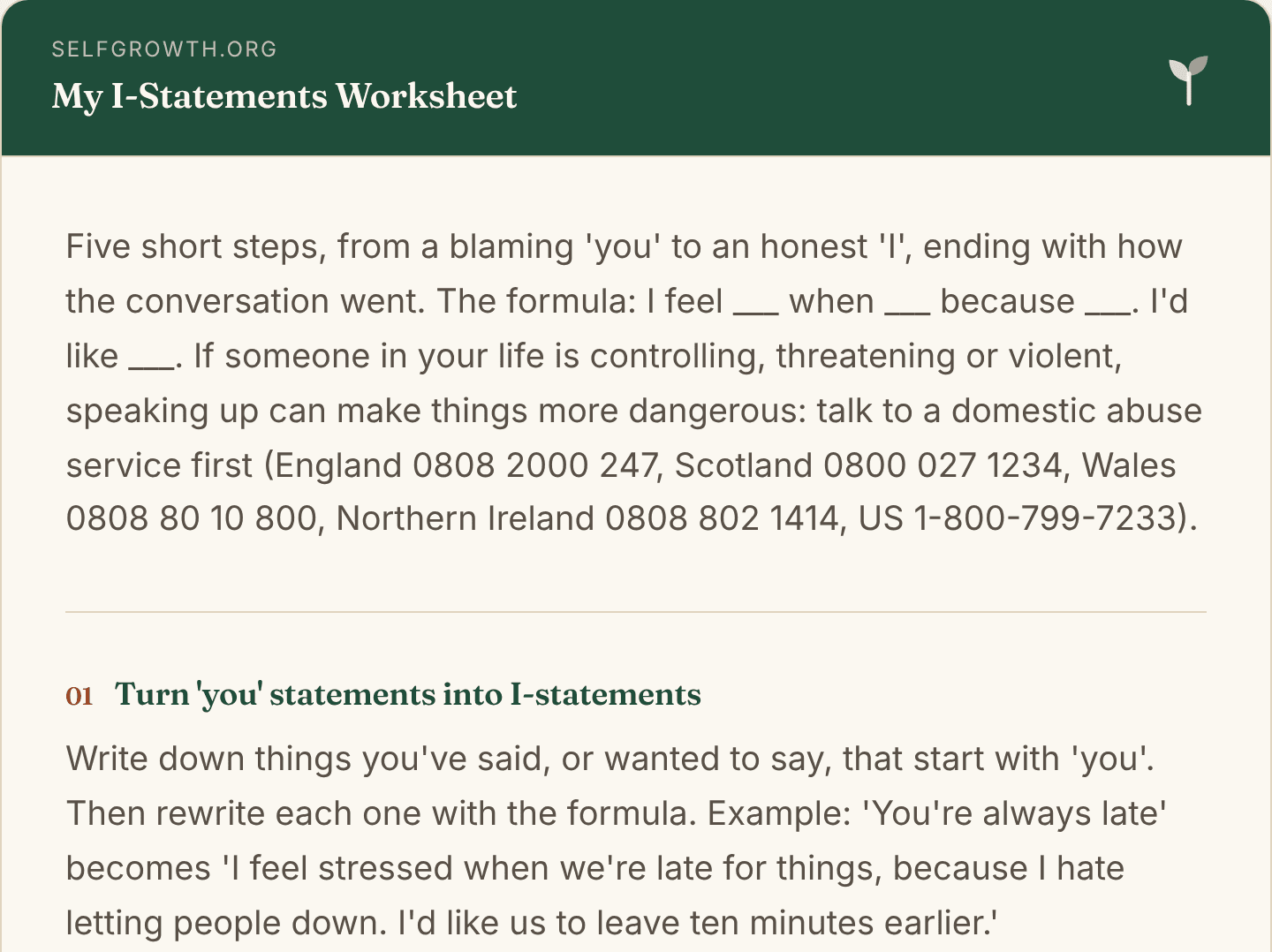
I-Statements Worksheet
A free, printable I-statements worksheet with I statement examples, the 'I feel... when... because...' formula, and space to plan one real conversation.
Open worksheet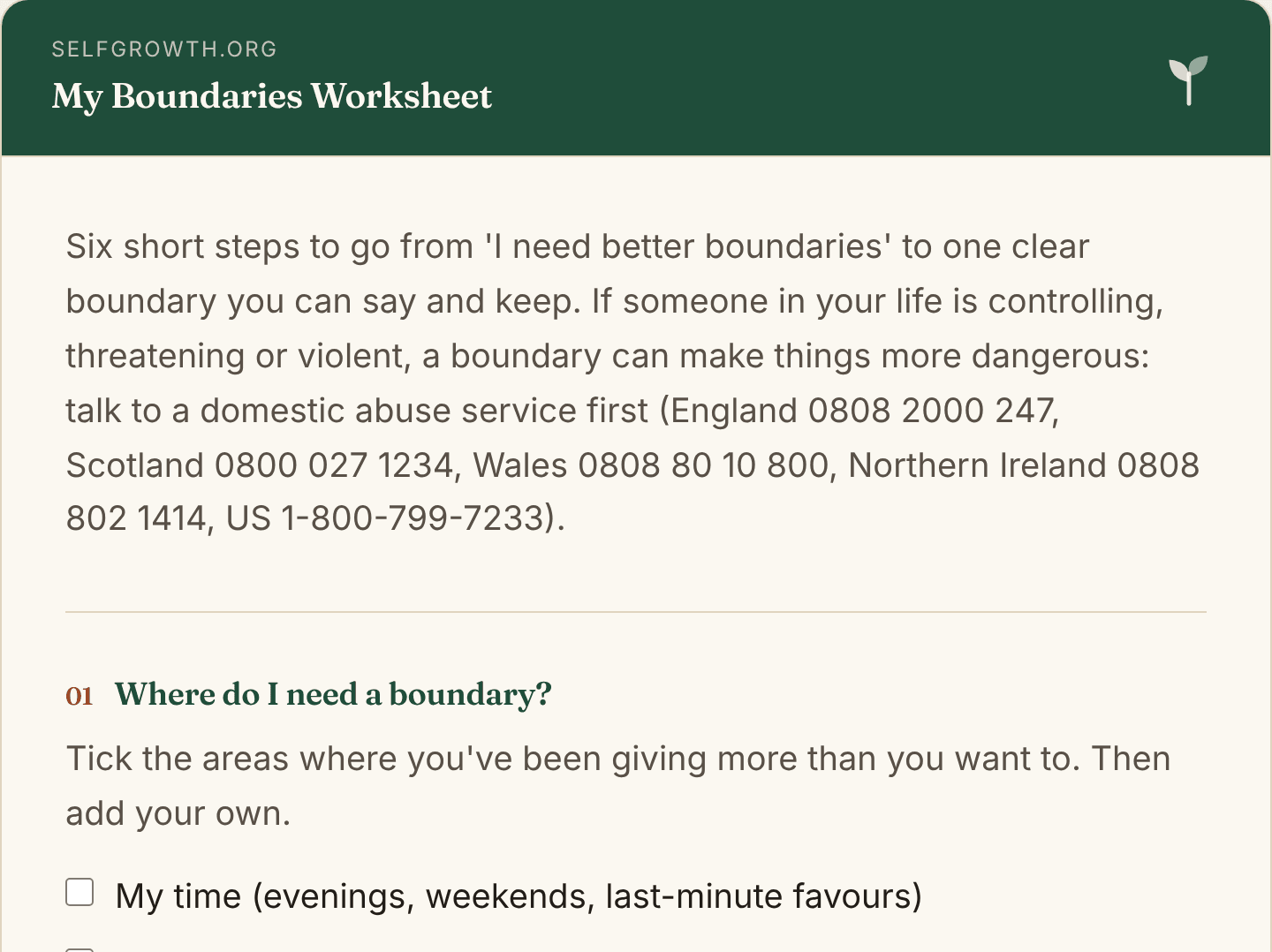
Boundaries Worksheet
A free, printable boundaries worksheet: spot where you need a limit, write it as something you'll do, plan the exact words, and decide what you'll do if it's crossed.
Open worksheet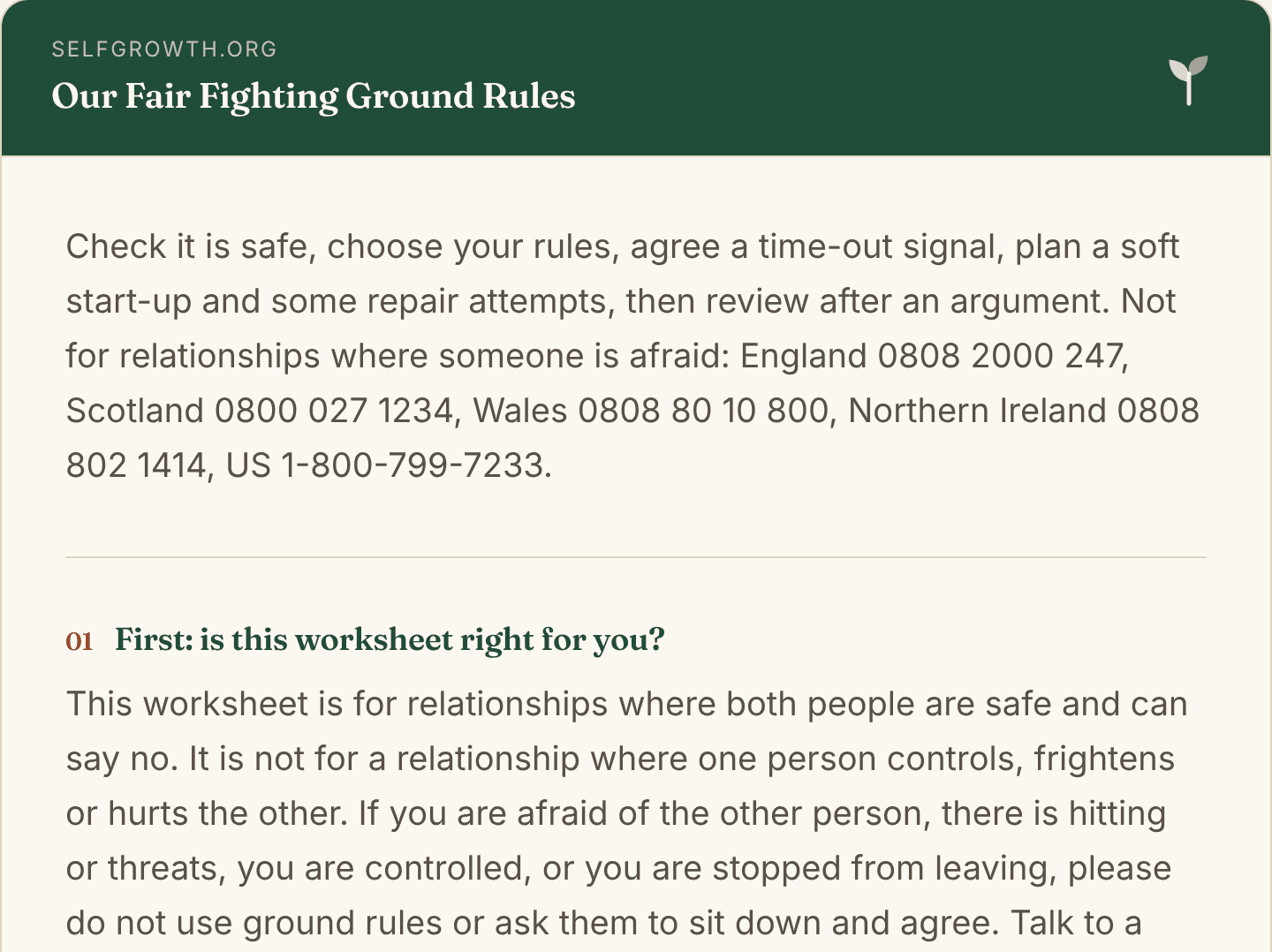
Fair Fighting Rules Worksheet
A free, printable fair fighting rules worksheet for couples, family or housemates: choose your rules, set a time-out signal, plan a soft start-up and review after.
Open worksheetNew worksheets, straight to your inbox
An occasional new worksheet or tool, sent only when there's something genuinely worth your time. No spam, no pressure, unsubscribe any time.