
Communication
Fair fighting rules worksheet: agree your own ground rules for arguments
Updated 23 October 2026 · 7 min read · Free to print
Fair fighting rules are ground rules you agree before an argument, so a row stays about the problem and not the person. This worksheet lets you choose your own rules, set a time-out signal, write a soft start-up, list repair attempts and review an argument afterwards. It is for safe relationships only.
Drawn from public Gottman Institute articles on conflict · Part of relationships and communication
Fill it in here (it saves in this browser, but not in a private window), print it, or download the PDF. Free, no sign-up.
Every close relationship has arguments. What makes them harder or easier is how they go: who raises their voice, what gets said, whether anyone can stop, and whether you can come back together afterwards. Agreeing a few rules in a calm moment is easier than inventing them in the middle of a row.
This sheet works for partners, family members or housemates. You choose rules from a list rather than being handed a set, because rules you picked yourselves are the ones you will remember. Then you plan a time-out signal, a gentler way to start a hard conversation, some ways to repair things mid-argument, and a short review for afterwards. Ideally each person fills in their own copy, then you compare.
The checklist of rules is a common self-help idea and is not a tested programme. This is not couples therapy and it will not fix a deep problem. It is a practical agreement.
How to use this worksheet
- 1Read the safety box in section 1 first. If any of it is true for you, stop and use the numbers there instead.
- 2Fill in your own copy first, then share. You do not need to agree on everything, just on the rules you will both try.
- 3Do it at a calm time, not straight after a row. Keep it short for a first go.
- 4After your next argument, use the review in section 6. Change one rule at a time.
The worksheet
selfgrowth.org
Our Fair Fighting Ground Rules
Check it is safe, choose your rules, agree a time-out signal, plan a soft start-up and some repair attempts, then review after an argument. Not for relationships where someone is afraid: England 0808 2000 247, Scotland 0800 027 1234, Wales 0808 80 10 800, Northern Ireland 0808 802 1414, US 1-800-799-7233.
01First: is this worksheet right for you?
This worksheet is for relationships where both people are safe and can say no. It is not for a relationship where one person controls, frightens or hurts the other. If you are afraid of the other person, there is hitting or threats, you are controlled, or you are stopped from leaving, please do not use ground rules or ask them to sit down and agree. Talk to a domestic abuse service first. In England, the National Domestic Abuse Helpline is free and open 24 hours on 0808 2000 247. In Scotland, call 0800 027 1234; in Wales, 0808 80 10 800; in Northern Ireland, 0808 802 1414. US: National Domestic Violence Hotline 1-800-799-7233. In immediate danger, call 999 (UK) or 911 (US). If you are the one whose anger has led to hitting, threatening or controlling someone, this worksheet is not enough on its own: the Respect Phoneline (UK 0808 8024040) is free and confidential.
Who is this agreement with, and what situation is it for?
02Choose your rules
Tick the rules you would both be willing to try. A few rules you can keep are better than many you forget. Add your own at the bottom.
Our own rules:
- 1.
- 2.
- 3.
The one rule I find hardest to keep, and why:
03Agree a time-out signal
The Gottman Institute describes 'flooding' as feeling overwhelmed so fast that it is hard to listen or think clearly. Its article '5 Steps to Fight Better if Your Relationship is Worth Fighting For' suggests that if either person is flooded, a 20 to 30 minute break helps, and its article 'Why Is My Husband Yelling at Me?' says the break works best when you calm yourself rather than going over the argument in your head. A time-out is a pause, not a way to avoid the subject, so agree a time to come back.
Our time-out signal (a word, a phrase or a gesture):
What I will say, for example: 'I need a break. I will be back at ___.'
How long we will take, and when we will return to the conversation:
What I will do during my break:
04Plan a soft start-up
The Gottman Institute says soft start-ups avoid criticism and contempt, and suggests opening with 'I' instead of 'You'. The idea is to begin with your own feeling about a specific situation, not a verdict on the other person. A way to start: 'I feel ___ about ___. I need ___.'
A hard start-up I have used (or heard):
Softer version: 'I feel [feeling] about [one specific situation]. I would like [a clear request].'
A good time and place to raise it:
05List your repair attempts
A repair attempt is anything either of you says or does to stop things getting worse. The Gottman Institute groups example phrases such as 'Can we take a break?', 'Let me try again', 'I am sorry' and 'I understand'. Its article also notes that a repair attempt only works if the other person can take it in, which is harder when someone is flooded. Choose a few you could say, and a few you would welcome hearing.
Entry 1
Entry 2
Entry 3
06Review after an argument
Do this once you are both calm, not straight after. Keep it to what happened and what to try next, not who was right. Make a copy of this section to reuse.
How well did we keep our rules this time?
What was the argument really about, underneath?
A rule or repair that helped:
A rule I broke, and what I will do differently:
One thing to change before next time:
Entry 1
Entry 2
Entry 3
When you're done, a moment to reflect
- When an argument goes badly, what is usually the first thing that tips it: a tone, a topic or a time of day?
- Which rule would make the biggest difference if you both kept it?
- What do you do when you feel overwhelmed in an argument, and what would you prefer to do?
- Is there something you want from the other person that you have never asked for plainly?
- If the arguments keep repeating, is it about this issue or something underneath it that deserves its own conversation, or outside help?
Done for now?
Save today's answers as a dated entry. You can come back, fill it in again and compare the two side by side.
Do fair fighting rules work?
The three skills in the middle of this sheet, the soft start-up, the break when you feel flooded and repair attempts, come from the Gottman Institute's public articles on conflict, and each is credited where it appears.
The list of fair fighting rules itself is different. It is a common self-help idea passed around in many versions, and no single originator or study of this exact checklist is agreed. So the honest position is that these are sensible agreements to try, not a method with proven results.
The review section is there so you can test it yourselves. If a rule does not help, drop it. This is an educational tool for everyday disagreements, not therapy, and it is not suitable where anyone is afraid.
These are educational self-reflection tools, not therapy.
If you want to go deeper
- The Gottman Institute. 5 Steps to Fight Better if Your Relationship is Worth Fighting For. https://www.gottman.com/blog/5-steps-to-fight-better-if-your-relationship-is-worth-fighting-for/
- The Gottman Institute. Manage Conflict: Repair and De-Escalate. https://www.gottman.com/blog/manage-conflict-repair-and-de-escalate/
- The Gottman Institute. Why Is My Husband Yelling at Me? https://www.gottman.com/blog/why-is-my-husband-yelling-at-me/
- National Domestic Abuse Helpline (nationaldahelpline.org.uk); National Domestic Violence Hotline (thehotline.org); Respect Phoneline (UK 0808 8024040).
Your questions, answered
- What are fair fighting rules?
- They are ground rules for how you argue, agreed in advance. Examples are sticking to one issue, no name-calling, taking turns, and being able to call a time-out. They do not stop disagreements. They keep a disagreement about the problem instead of turning it into an attack on the person.
- What are the rules of fair fighting for couples?
- There is no official list, and the tick-list on this page is a common self-help one, not a tested programme. Typical rules cover one issue at a time, no insults, no old grievances, respectful tone and a way to pause. Pick the few that matter most to you both and add your own, rather than adopting a long list.
- How long should a time-out last?
- The Gottman Institute's article '5 Steps to Fight Better' suggests 20 to 30 minutes when someone is feeling flooded, spent calming down rather than rehearsing the argument. The exact length matters less than agreeing it beforehand and coming back. Say when you will return, so the break does not feel like being abandoned.
- What is a soft start-up?
- It is a way to raise a problem that begins with your own feeling about one specific situation, rather than criticism of the other person. The Gottman Institute describes soft start-ups as avoiding criticism and contempt. For example, 'I feel worried about the bills and I would like us to look at them together' rather than 'You never care about money.'
- Do fair fighting rules work?
- We can't point to a test of this particular checklist, so we won't claim it works. The ideas behind it, such as gentler openings, pausing when overwhelmed and repairing afterwards, appear in the Gottman Institute's public material. Treat the sheet as a practical agreement to try, and change it if it does not help.
- Can I use this with a housemate or family member?
- Yes. The rules do not depend on a romantic relationship. They work for anyone you live with or argue with regularly, provided you both feel safe and free to say no. If anyone in the situation is afraid, controlled or hurt, do not use it. Contact a domestic abuse service instead (England 0808 2000 247, Scotland 0800 027 1234, Wales 0808 80 10 800, Northern Ireland 0808 802 1414, US 1-800-799-7233).
- Is there a fair fighting rules worksheet PDF?
- Yes. Use the Download PDF button for a clean, print-ready copy, or Print to print straight from the page. It is completely free, with no payment and no email needed. You can also fill it in on screen, and your answers save in your browser.
- Is this a substitute for therapy?
- No. It is a self-help tool, not couples therapy or medical advice. If arguments are frightening, constant or leave you feeling unsafe, please talk to a GP, a counsellor or a domestic abuse service. If you ever feel unsafe or have thoughts of harming yourself, call Samaritans on 116 123 (UK and Ireland), 988 (US), or find a line at findahelpline.com.
Keep going, related worksheets
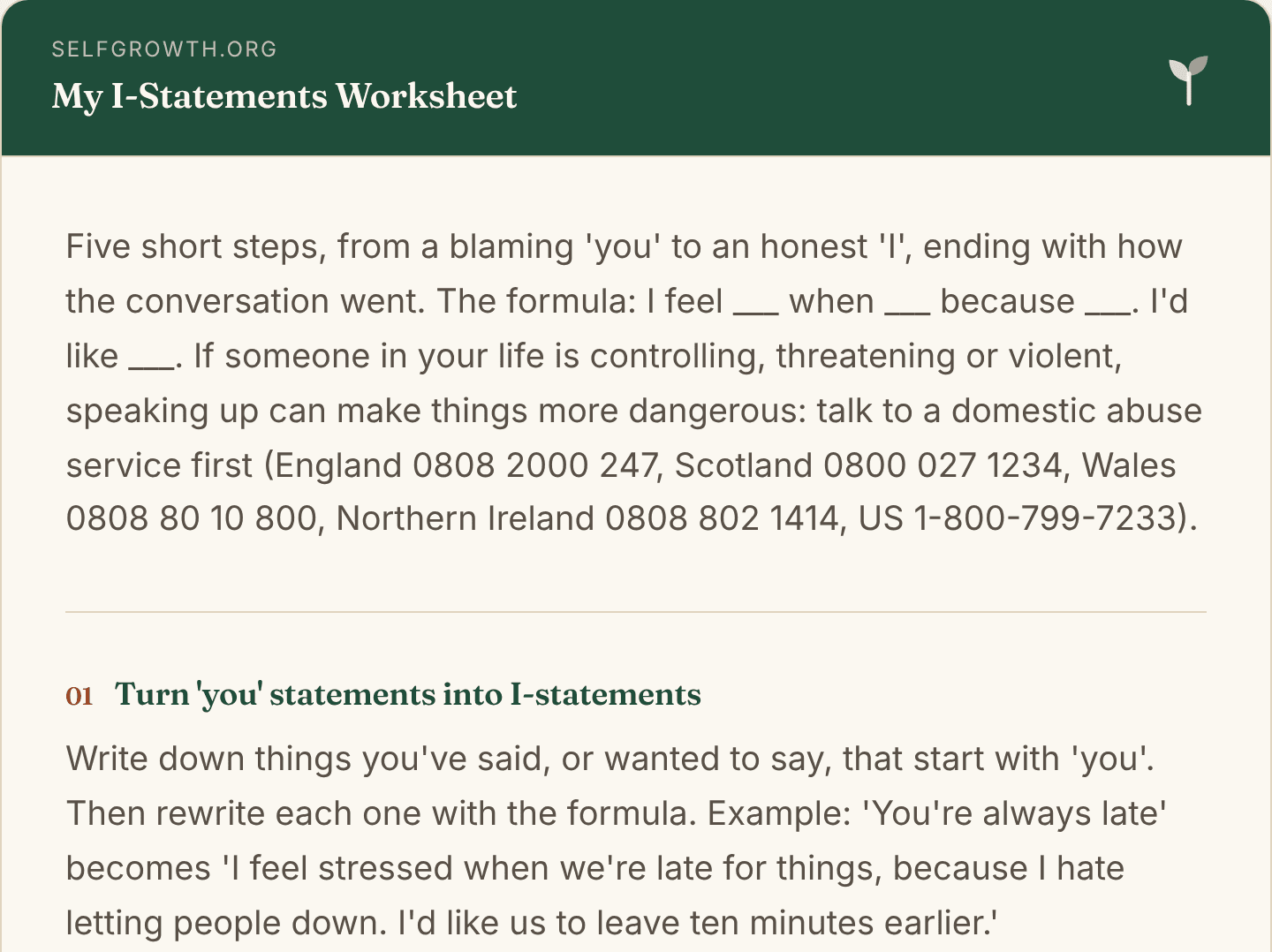
I-Statements Worksheet
A free, printable I-statements worksheet with I statement examples, the 'I feel... when... because...' formula, and space to plan one real conversation.
Open worksheet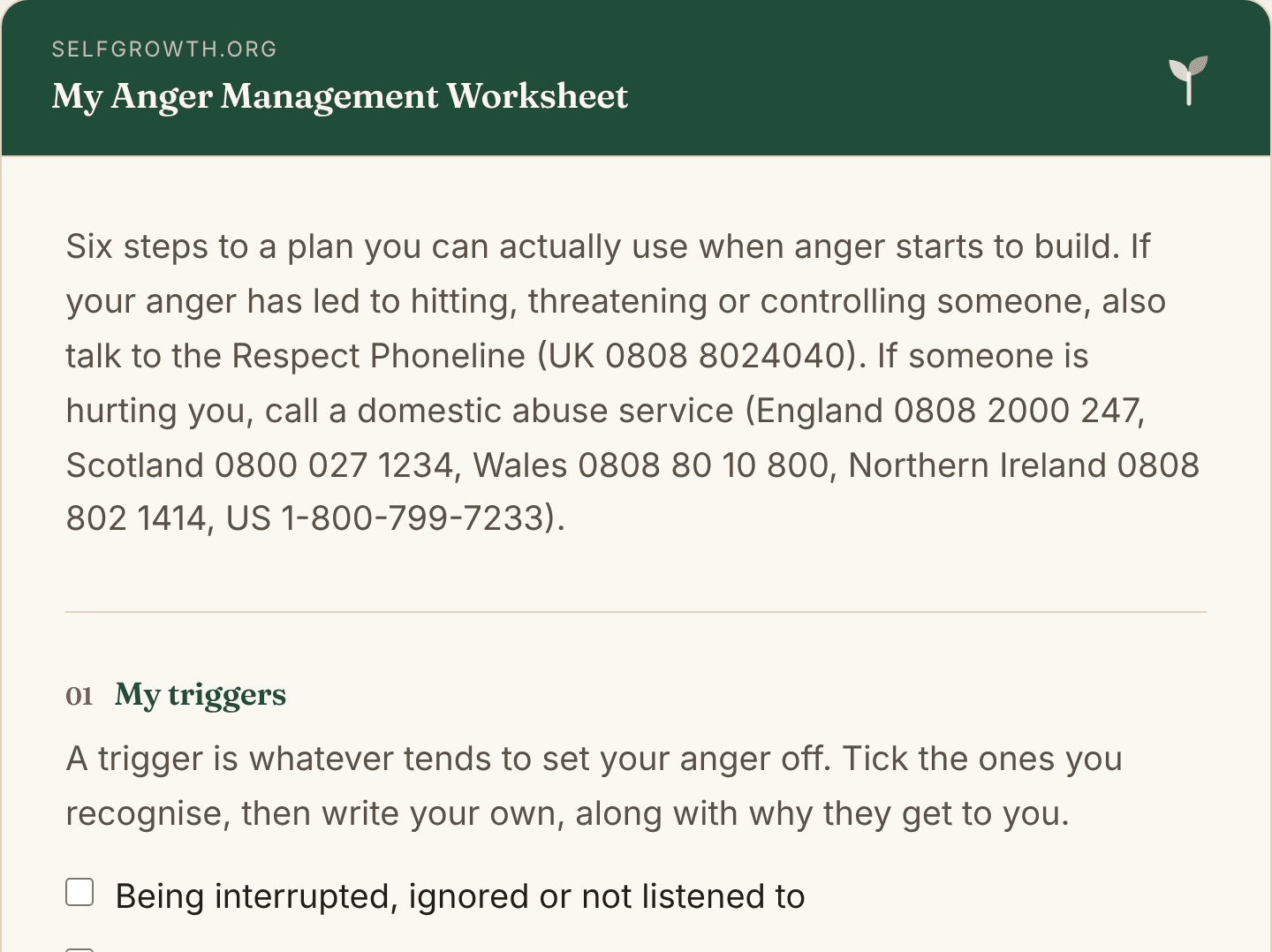
Anger Management Worksheet
A free anger management worksheet for adults: your triggers, an anger thermometer with your own warning signs, a time-out plan and calming skills. Free PDF.
Open worksheet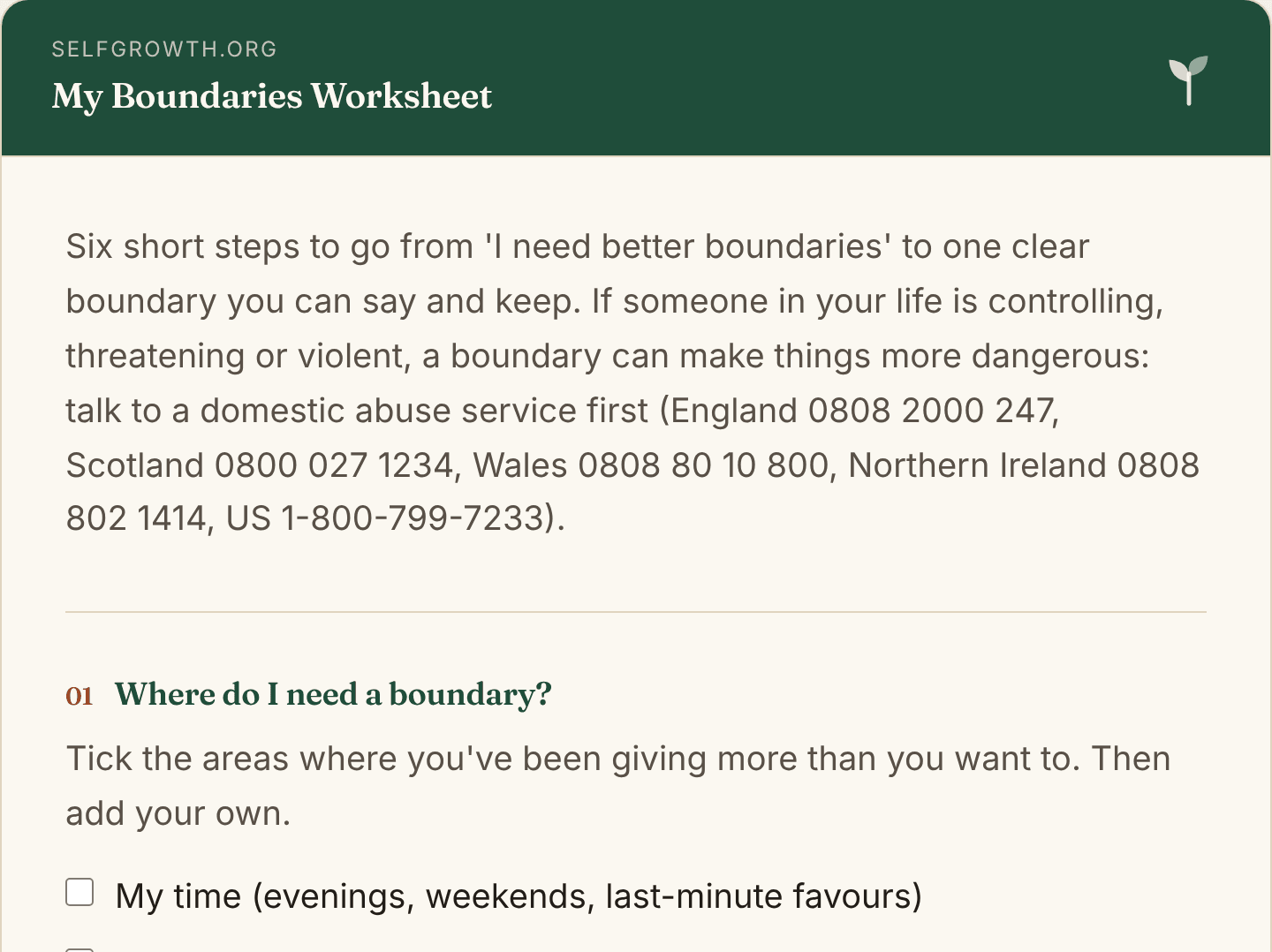
Boundaries Worksheet
A free, printable boundaries worksheet: spot where you need a limit, write it as something you'll do, plan the exact words, and decide what you'll do if it's crossed.
Open worksheetNew worksheets, straight to your inbox
An occasional new worksheet or tool, sent only when there's something genuinely worth your time. No spam, no pressure, unsubscribe any time.