
Guide
Energy management: how to plan your days around your energy
Updated 25 October 2026 · 8 min read
Energy management means noticing when you have the most and least energy across a day and week, then planning your work, people and rest around that. Track your energy for a week, find what drains and fills you, put hard tasks in your best hours, and plan short breaks. It is different from time management.
A plain planning method, with NHS guidance on tiredness · Part of work and skills
You can have a well-planned day and still run out of energy by three o'clock. Time is only part of the picture. What you do, who you are with and how much you rest all change how much you have left.
Energy management is a way to plan around that. If you want to plan the hours themselves, see how to be more productive. If you want to understand rest, see types of rest.
What is energy management?
Energy management means treating your energy as something that goes up and down, and planning around it. You notice when you feel clear and when you feel flat. You notice which tasks, people and places drain you, and which ones fill you up. Then you arrange your days and weeks to match.
Tony Schwartz and Catherine McCarthy published an article in Harvard Business Review in October 2007 called 'Manage Your Energy, Not Your Time'. The method below is a plain planning format of its own. No study has tested it, so treat it as an experiment you run on your own week.
Signs your energy needs managing, not just your time
Look for these. They suggest that the problem is not how many hours you have, but how much you have left in them.
- You finish the day tired even though you did not do much.
- You have time to do something, but cannot make yourself start.
- You feel drained after certain meetings, people or tasks.
- You hit a slump at the same time most days.
- You say yes to things and then dread them.
- Your free time goes on scrolling, because you have nothing left for anything else.
- You rest, and still do not feel rested.
If you also feel tired all the time for no reason you can name, read 'When low energy is more than a busy week'.
How to manage your energy: step by step
Try these over a few weeks. Start with step 1, and add the rest one at a time.
- 1Notice your energy for a week. Three times a day, such as morning, afternoon and evening, rate your energy from 1 to 10 and note what you were doing.
- 2Find your drains and fills. Look back over the week. Which tasks, people and places left you lower? Which left you higher? Write two short lists.
- 3Save your sharpest time for demanding work. Do the jobs that need the most thought when your energy is highest, and keep routine tasks for your lower moments.
- 4Plan recovery breaks. Add a short break after anything on your drain list, and before the slump you spotted. Five to ten minutes of real rest counts.
- 5Protect your sleep time. Keep to regular sleep and wake times where you can. For medical questions about sleep, talk to a GP.
- 6Limit draining commitments. Pick one thing on your drain list that you can say no to, shorten, or do less often.
- 7Review each week. Look at what changed, keep what helped, and adjust one thing for the next week.
A weekly plan is where steps 3 to 6 go. The wellness wheel can also show which areas of your life are running low. For the planning side, see how to be more productive.
Open the Wellness WheelOpen the Weekly Planner PrintableEnergy management at work
Work can drain your energy, because the schedule is often not yours. You can still make small changes. Put your most demanding task in your best hour if you can. Group short, draining jobs together so they do not spread across the day. Take your lunch away from your desk.
Some of it is about how much you take on. If your drain list is mostly other people's requests, work boundaries can help you say what you can and cannot do. If tiredness is building week after week, read the signs of burnout.
Energy management vs time management
Time management asks how to fit everything into the hours you have. Energy management asks how much you have left to give in those hours. Both matter. A tight schedule fails when you are too tired to keep it, and plenty of energy is wasted without a plan.
A simple way to use both: plan your week with the time tools, then place each task where your energy is best suited to it. The time management tips cover the planning side.
When low energy is more than a busy week
The NHS says it is normal to feel tired sometimes. It lists not getting enough sleep, stress, depression and dealing with life challenges among the common causes of tiredness. It also says not to self-diagnose.
Planning around your energy cannot fix an underlying cause. The NHS advice is to see a GP if you have been tired for a few weeks and are not sure why, or if your tiredness affects your daily life. The NHS also suggests sticking to the same sleep times and aiming for 6 to 9 hours of sleep.
When to get more support
This is a self-help tool, not therapy or medical advice. If you feel drained most days, low, or on edge, you deserve real support. A GP is a good first step.
If you ever feel unsafe or have thoughts of harming yourself, call Samaritans on 116 123 (UK and Ireland), 988 (US), or find a line at findahelpline.com.
Sources and further reading
This is an educational self-reflection resource, not therapy or medical advice.
If you want to go deeper
- Schwartz, T. & McCarthy, C. (2007). Manage Your Energy, Not Your Time. Harvard Business Review, October 2007.
- NHS. Tiredness and fatigue (nhs.uk/conditions/tiredness-and-fatigue).
Your questions, answered
- What is energy management?
- It is planning your days and weeks around your energy, not just your time. You notice when you feel clear and flat, what drains and fills you, and arrange tasks, people and rest to match.
- How do I manage my energy?
- Track your energy for a week, list your drains and fills, put hard tasks in your best hours, and plan short breaks after draining things. Keep regular sleep times, cut one draining commitment, and review each week.
- What is the difference between energy management and time management?
- Time management is about fitting tasks into the hours you have. Energy management is about how much you have left in those hours. A plan that ignores your energy can fail even when the schedule looks fine.
- How do I manage my energy at work?
- Put your hardest task in your clearest hour, group draining jobs together, and take breaks away from your desk. If other people's requests drain you most, work on boundaries about what you can take on.
- Why do I have no energy even when I sleep enough?
- Tiredness can come from more than sleep. The NHS lists stress, depression and life challenges among the common causes. If you have been tired for a few weeks and are not sure why, see a GP. Do not self-diagnose.
- Is there an energy management worksheet or PDF?
- Yes. The free wellness wheel and weekly planner printable both have a Download PDF button and a Print option. They are free, with no payment and no email needed. You can fill them in on screen, and your answers save in your browser.
- Is this a substitute for therapy?
- No. It is a self-help tool, not therapy or medical advice. If you are tired all the time, or low mood or stress is what is really in the way, see your GP. If you ever feel unsafe or have thoughts of harming yourself, call Samaritans on 116 123 (UK and Ireland), 988 (US), or find a line at findahelpline.com.
Worksheets to do the work
Free to fill in online or print. No email needed.
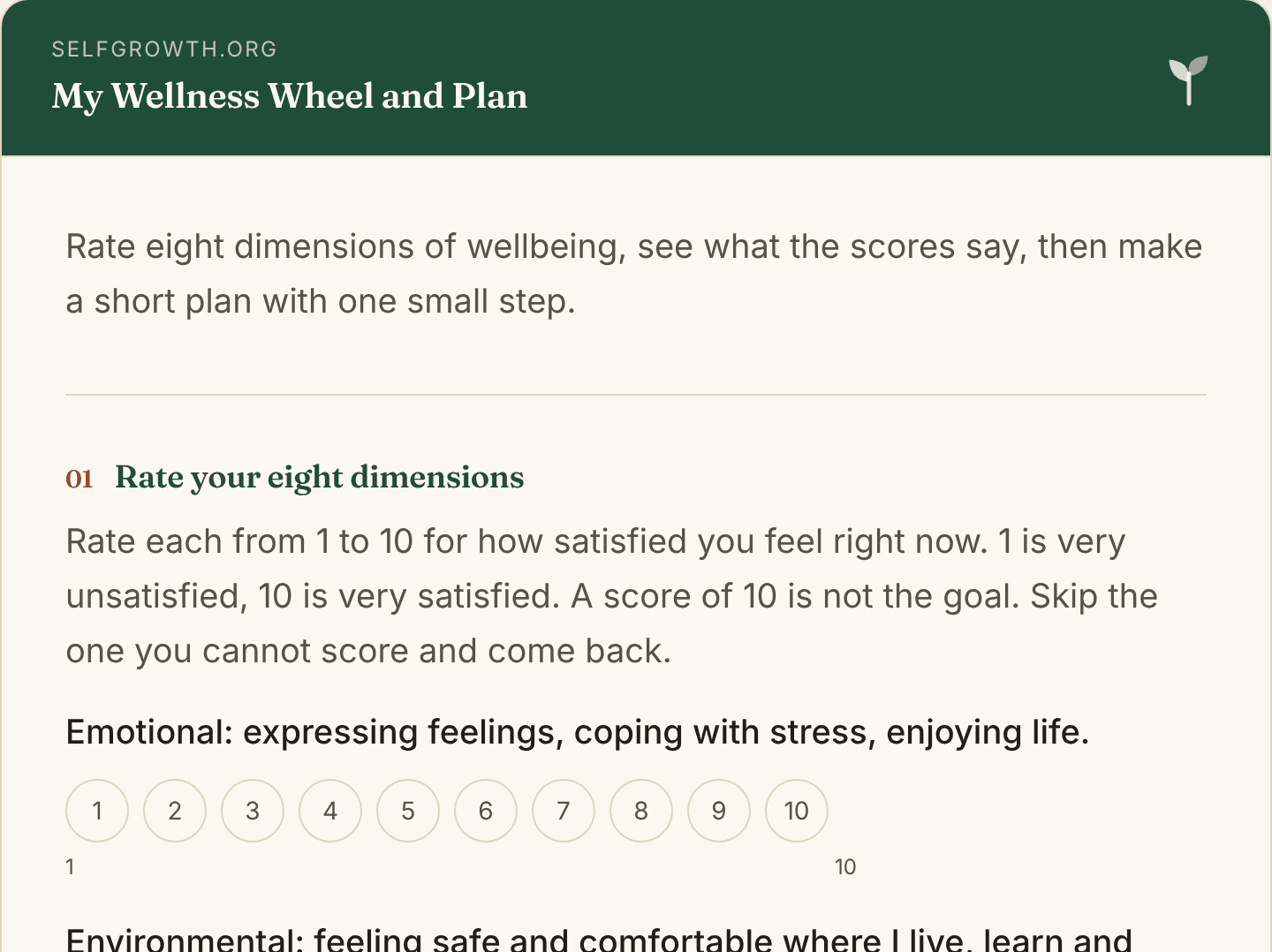
Wellness Wheel
A free printable wellness wheel: rate eight dimensions of wellbeing from 1 to 10, see your wheel, then make a simple wellness plan with one small step.
Open worksheet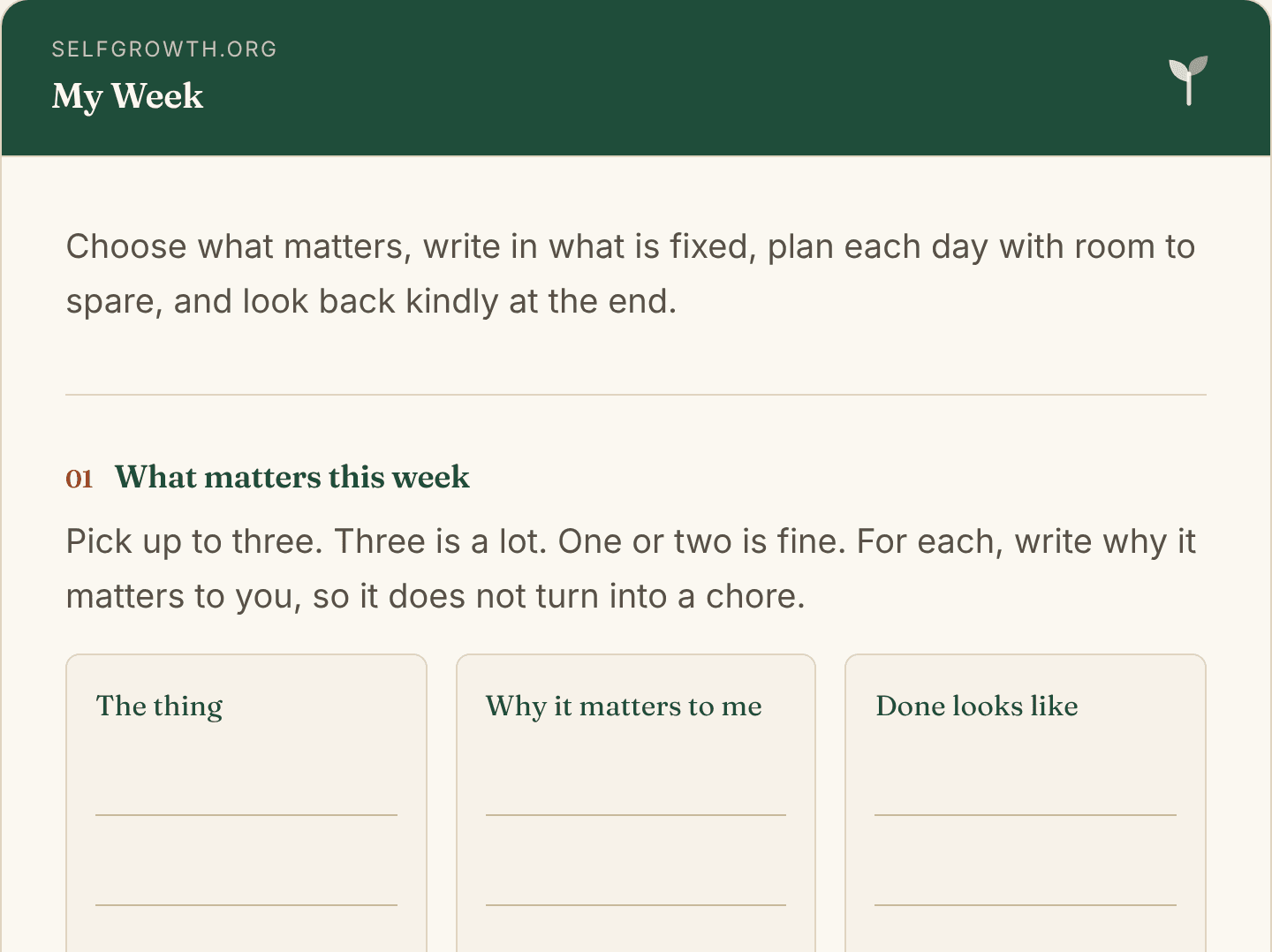
Weekly Planner Printable
A free weekly planner printable: pick up to three priorities, note fixed times, plan each day with a buffer and rest, then look back kindly. Print or fill in.
Open worksheet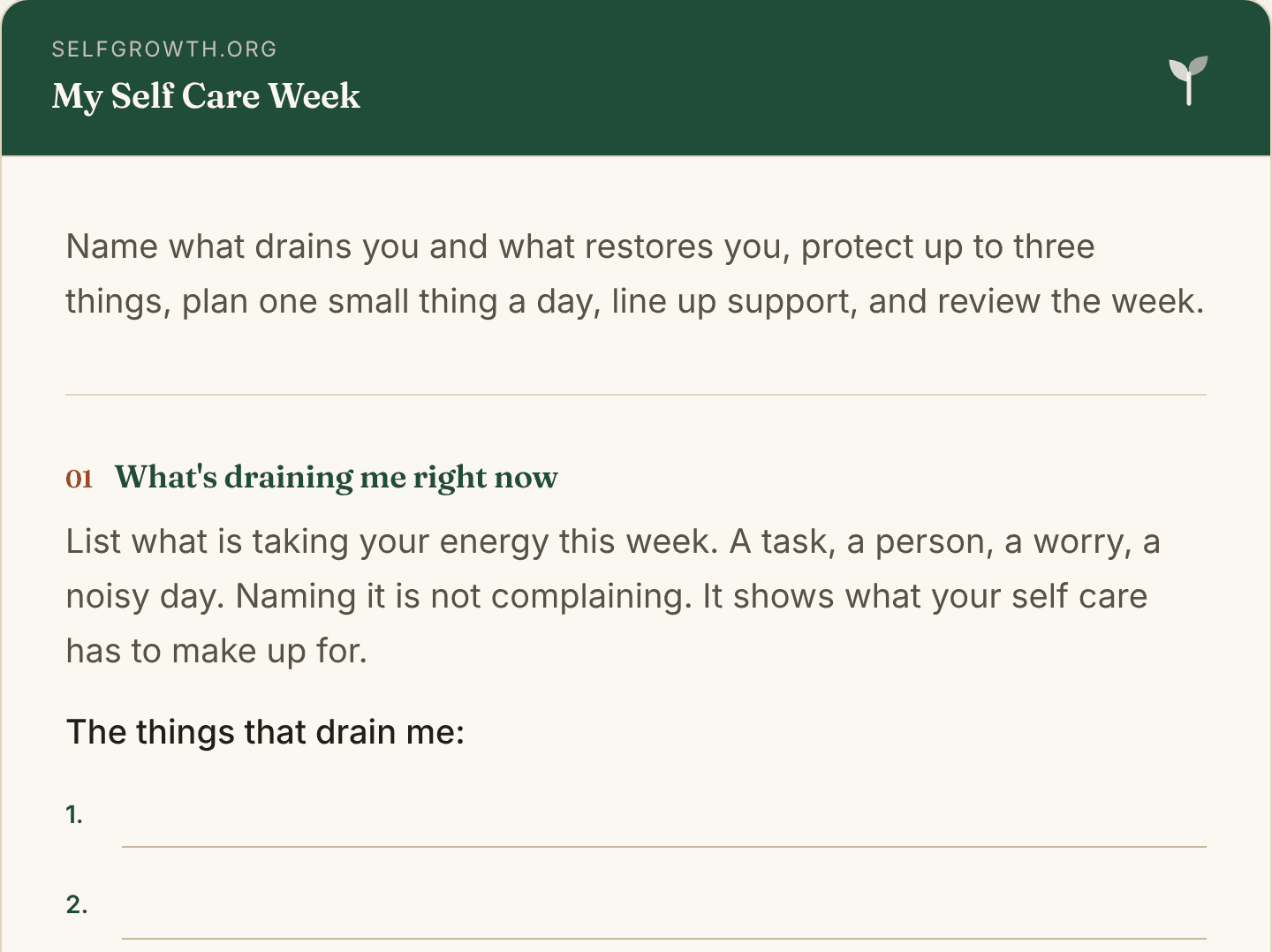
Self Care Planner
A free self care planner printable: name what drains you, list what restores you, protect up to three non-negotiables and plan one small thing each day.
Open worksheet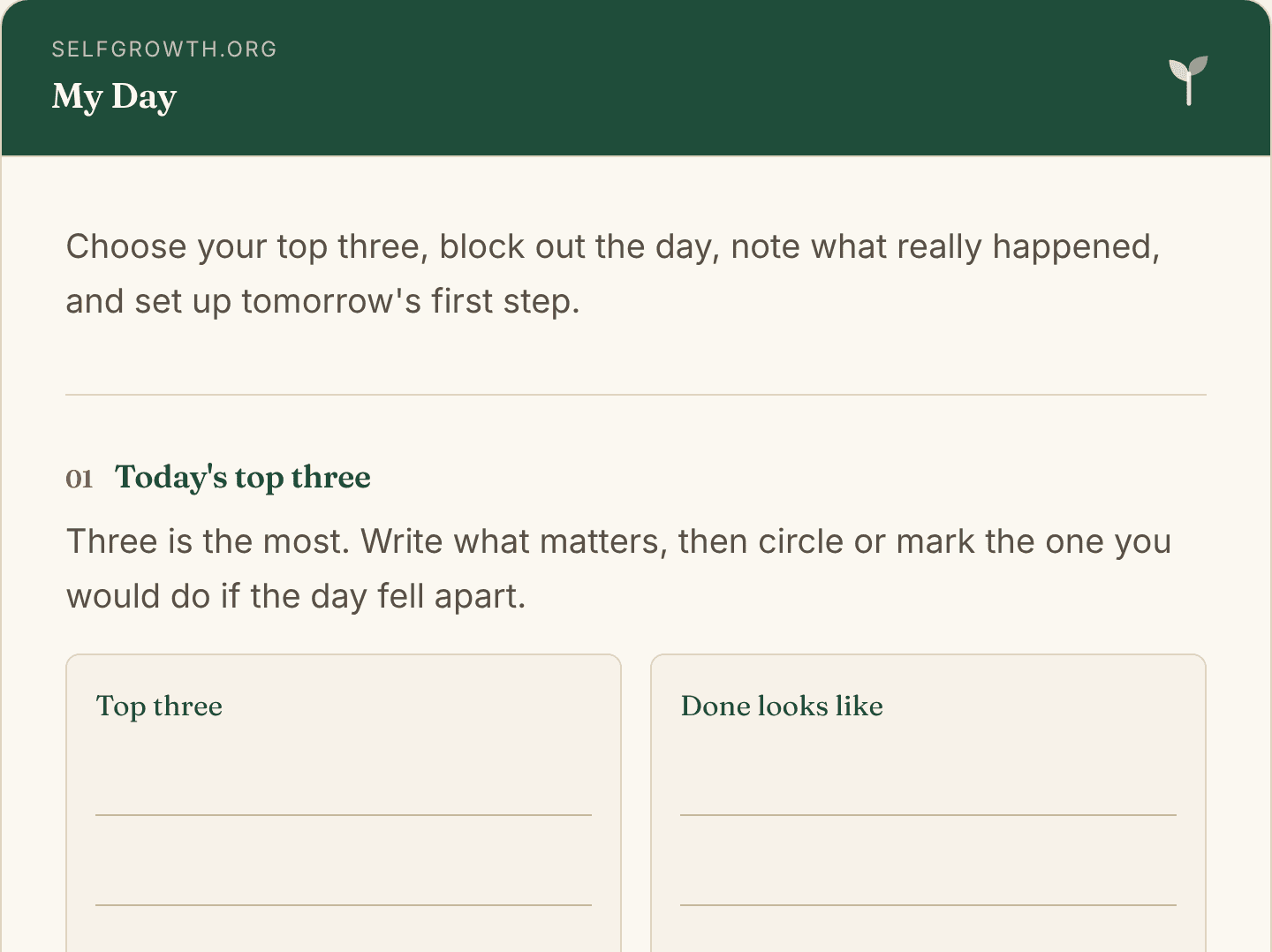
Daily Planner Template
A free daily planner template on one page: top three, time blocks, appointments, breaks, a short to-do list and a two-minute look back. Print or fill in.
Open worksheetRelated guides
New worksheets, straight to your inbox
An occasional new worksheet or tool, sent only when there's something genuinely worth your time. No spam, no pressure, unsubscribe any time.