
Guide
Time management tips: twelve simple ones to try
Updated 25 October 2026 · 8 min read
The best time management tips are simple: plan the week before the day, write down fixed commitments first, choose your top three, leave buffers because tasks run long, and decide when and where you will start. Add a weekly review so you can adjust. Pick two tips to try, not twelve.
Drawn from planning fallacy research and if-then planning research · Part of habits and getting things done
There are never enough hours, but some days leave you feeling like you used yours well and some do not. Often it comes down to whether you decided what mattered before the day started.
Here are twelve practical tips. You do not need all of them. Try two this week and see what sticks. If time management does not seem to be the problem, the section further down is for you.
What is time management, really?
Time management is choosing what gets your time, and when. You cannot make more hours. You can decide what goes in them, what waits and what you say no to.
It is a set of habits, not a personality type. You do not have to be a naturally organised person. You need a few simple routines for planning, starting, protecting your attention and looking back.
Time management tips that work in real life
Work down the list in order, or jump to the one that fits your problem today. The how to say no guide goes with tip 11.
- 1Plan the week before the day. Ten minutes on Sunday evening or Monday morning shows you what the week holds, so each day starts with a plan instead of a blank.
- 2Write down the fixed things first. Appointments, school runs, meetings and deadlines go in before anything flexible. What is left is the time you really have.
- 3Choose your top three. Each day, pick the three things that matter most. If only those get done, the day still counts.
- 4Time-block your top three. Give each one a start time and a length, instead of leaving them on a list. A task with a time attached is harder to drift past.
- 5Leave buffers. Plans tend to run long. In a 1994 paper, Buehler, Griffin and Ross found that people's predicted times were too optimistic across a range of tasks, partly because they pictured the plan going smoothly instead of remembering similar past tasks. In one of their studies, the bias disappeared when people were asked to link their guess to past experience. So look at how long it took last time, and leave empty time between things.
- 6Batch small tasks. Group emails, calls, forms and errands into one slot instead of dotting them through the day.
- 7Sort urgent from important. Ask of each task: does it need doing soon, and does it matter? Do the important things before they become urgent, and let go of what is neither.
- 8Decide when and where. 'I will write the report' is vague. 'If it is 9am and I have made my coffee, then I open the report at my desk' is a plan. A 2006 review by Gollwitzer and Sheeran pooled 94 independent tests and found that these if-then plans made a medium-to-large difference to reaching goals, across many kinds of goal.
- 9Do one thing at a time. Close the extra tabs, put the phone out of reach, and finish one task before opening the next.
- 10Protect one focus block. Pick a stretch of the day, even 45 minutes, when you do your top task with notifications off. Tell people when you are back.
- 11Say no, or not yet. Every yes uses time you then do not have. A short, kind answer such as 'I cannot this week' keeps your plan intact (the guide on how to say no has wording to borrow).
- 12Review weekly. At the end of the week, note what got done, what moved and what to change. Then plan the next one.
The urgent-versus-important sort in tip 7 is the idea behind the Eisenhower matrix template, which lays your tasks out in four boxes. The rest of this list is practical advice that has not been tested as a set.
Open the Weekly Planner PrintableThe weekly planner puts tips 1 to 5 and 12 on one page: your priorities, the fixed things, a buffer and a look back.
Open the Eisenhower Matrix TemplateTime management for students, at work and at home
For students:
- Put every deadline in one place on the first day of term, then work backwards to set your own earlier dates.
- Block your study hours like lessons, with a time, a place and a start task.
- Start with the task you are most likely to put off, while your energy is fresh.
- Leave a buffer before deadlines for the thing that always takes longer than planned.
At work:
- Choose your top three before you open your inbox.
- Check messages at set times, not all day.
- Block a focus hour and mark yourself as busy.
- Ask what is most important when two requests clash, and say what you will move.
At home:
- Keep one shared calendar for the household, and look at it together once a week.
- Batch chores into one slot, such as laundry, bins and shopping on the same morning.
- Plan meals for the week in one go.
- Protect real rest on the plan, the same way you protect appointments.
When time management isn't the problem
Sometimes a better system does not help, because the problem is not the system. Three things to look at:
- Too much on your plate. If the fixed things already fill the week, no tip will fit more in. The answer is to take something off, ask for help or say no.
- Unclear priorities. If you cannot say what matters most, planning feels like shuffling. Spend ten minutes writing what you want from the next month before you plan the week.
- Putting things off. If you know what to do and keep not starting, the cause is often a feeling about the task, not the clock. The guide on how to stop procrastinating is the place to start.
If you are tired all the time, dreading work or feeling you have nothing left, that is a different question from planning. The signs of burnout guide can help you look at it.
When to get more support
This is a self-help tool, not therapy or medical advice. If you are overwhelmed, cannot concentrate for weeks, or your sleep, mood or health is suffering, see your GP. They can talk it through with you and point you to proper support.
If you ever feel unsafe or have thoughts of harming yourself, call Samaritans on 116 123 (UK and Ireland), 988 (US), or find a line at findahelpline.com.
Sources and further reading
This is an educational self-reflection resource, not therapy or medical advice.
If you want to go deeper
- Buehler, R., Griffin, D. & Ross, M. (1994). Exploring the planning fallacy: Why people underestimate their task completion times. Journal of Personality and Social Psychology, 67(3), 366-381.
- Gollwitzer, P. M. & Sheeran, P. (2006). Implementation intentions and goal achievement: A meta-analysis of effects and processes. Advances in Experimental Social Psychology, 38, 69-119.
Your questions, answered
- What are the best time management tips?
- Plan the week before the day, write down fixed commitments first, choose a top three for each day, give those a time, leave buffers, and review once a week. Start with two tips rather than all of them, and keep the ones that make your days easier.
- How do I manage my time better when I have too much to do?
- Write everything down, then sort it by what is urgent and what is important. Do the important things first, move or drop what is neither, and ask for help or say no to the rest. If the fixed things already fill the week, the plan needs fewer things, not tighter timing.
- Why do my tasks always take longer than I plan?
- Psychologists call it the planning fallacy. In a 1994 paper, Buehler, Griffin and Ross found that people's predicted times were too optimistic across a range of tasks. In one of their studies, the bias disappeared when people linked their guess to past experience. Check how long it took last time and add a buffer.
- What is the top-three rule?
- It is a way to keep a day realistic by choosing the three tasks that matter most. If only those get done, the day still counts. Anything else is a bonus.
- How can I stop wasting time on my phone?
- Pick one small change, such as turning off notifications, moving tempting apps off your first screen or leaving the phone in another room during a focus block. A step-by-step plan is in the digital detox guide.
- Is there a time management printable?
- Yes. The weekly planner printable and the Eisenhower matrix template both have a Download PDF button and a Print option. They are free, with no payment and no email needed. You can fill them in on screen, and your answers save in your browser.
- Is this a substitute for therapy?
- No. It is a self-help tool, not therapy. If stress, low mood or poor sleep is the real block, talk to a GP. If you ever feel unsafe or have thoughts of harming yourself, call Samaritans on 116 123 (UK and Ireland), 988 (US), or find a line at findahelpline.com.
Worksheets to do the work
Free to fill in online or print. No email needed.
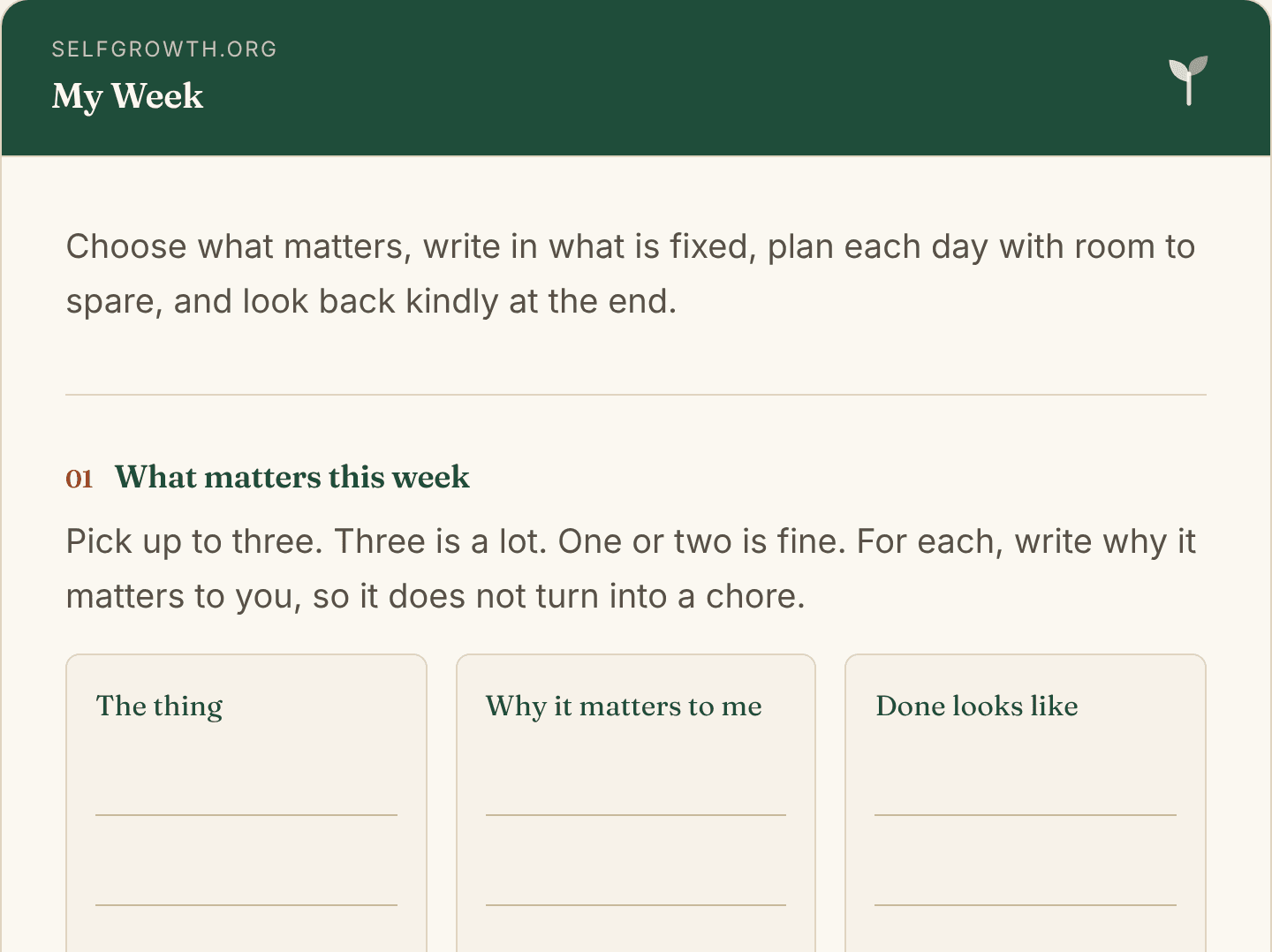
Weekly Planner Printable
A free weekly planner printable: pick up to three priorities, note fixed times, plan each day with a buffer and rest, then look back kindly. Print or fill in.
Open worksheet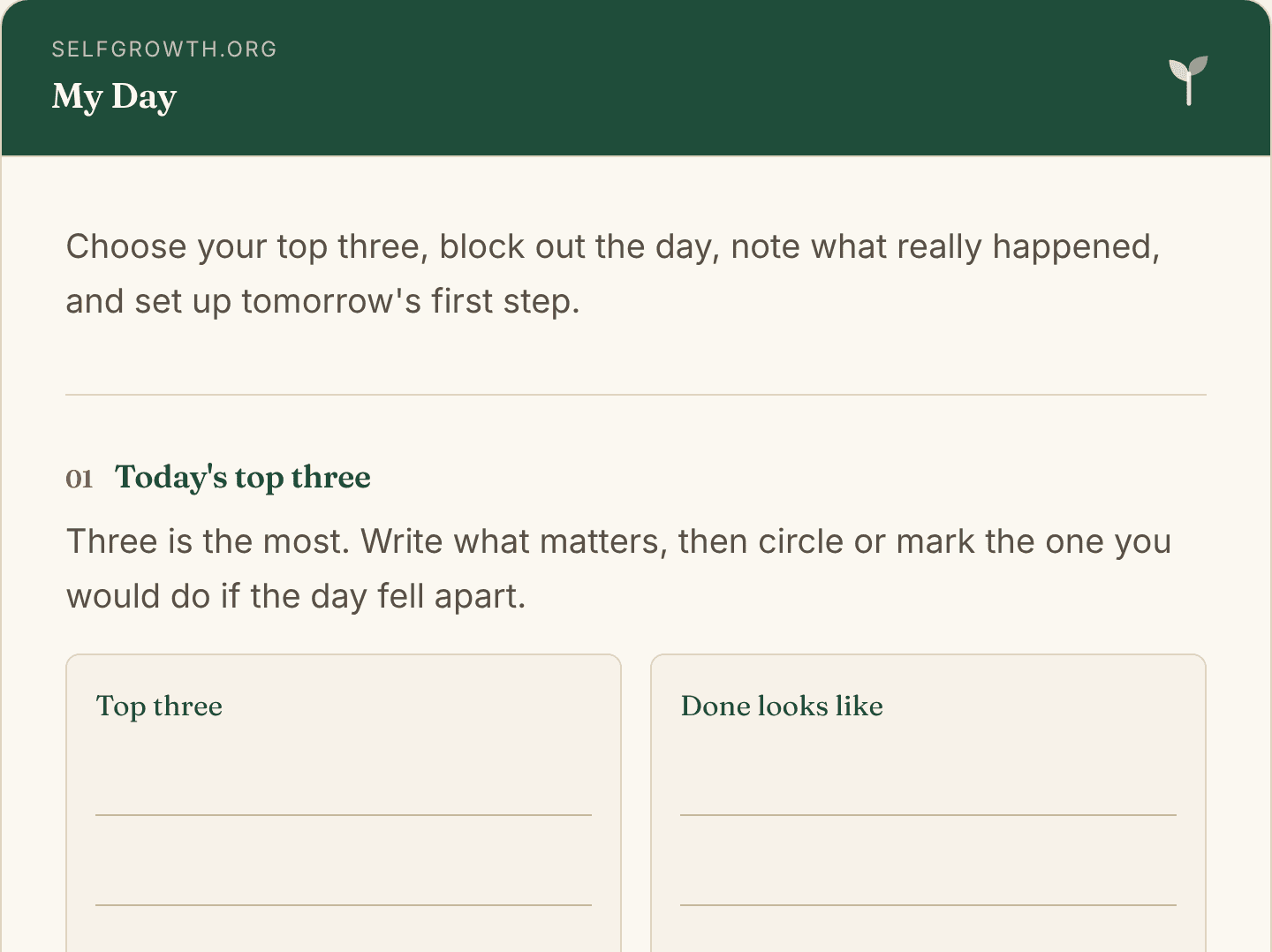
Daily Planner Template
A free daily planner template on one page: top three, time blocks, appointments, breaks, a short to-do list and a two-minute look back. Print or fill in.
Open worksheet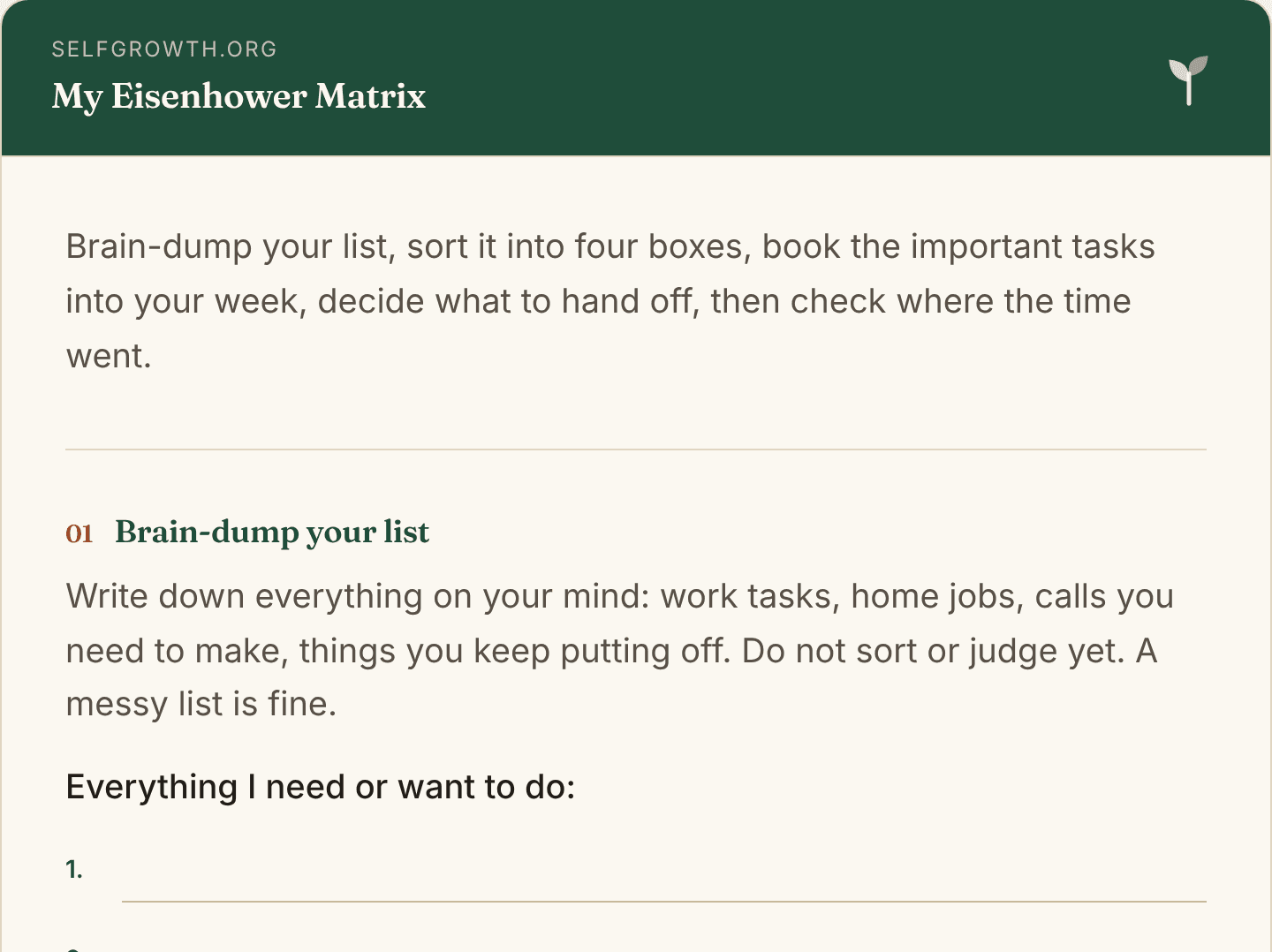
Eisenhower Matrix Template
A free Eisenhower matrix template: empty your head onto a list, sort it into four boxes, book the important tasks into your week, and check where time went.
Open worksheet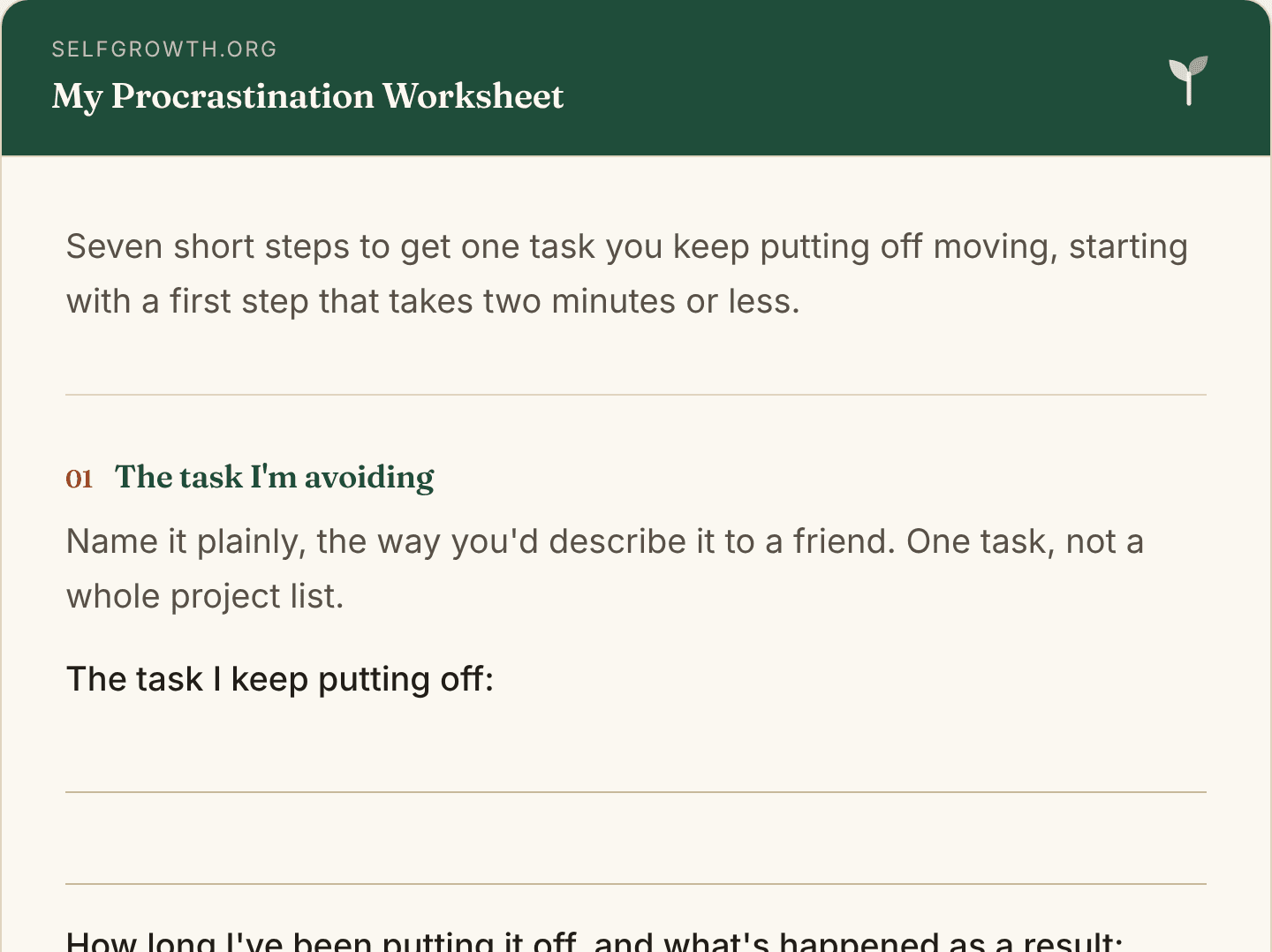
Procrastination Worksheet
A free, printable procrastination worksheet: name the feeling you're avoiding, find a two-minute first step, make an if-then plan and log seven days of starts.
Open worksheetRelated guides
New worksheets, straight to your inbox
An occasional new worksheet or tool, sent only when there's something genuinely worth your time. No spam, no pressure, unsubscribe any time.