
Guide
How to say no: kind, clear words you can use today
Updated 25 October 2026 · 8 min read
To say no, pause before you answer, decide what you actually want, then say it short and kind: 'Thanks for asking, but I can't.' You don't owe a long reason or a fix. Offer an alternative only if you mean it. If they push, repeat your answer calmly. It gets easier with practice.
Plain communication tips on pausing, short answers and calm repetition · Part of relationships and communication
You know the moment. Someone asks, and the yes is out of your mouth before you have checked what you want. Or you say no, then spend the next hour explaining, apologising and wondering if you were rude.
Saying no is a skill, and a small one. It is a few plain words, said calmly, without a speech around them. Below you will find a method, words you can borrow for different situations, and answers for the push-back and the guilt that can follow. These are common communication tips, not tested treatments.
Why is it so hard to say no?
A no can feel risky. You may worry the other person will be hurt, angry or let down, or that they will think less of you. Saying yes can feel like the safe move, even when it costs you time, money or energy.
If an automatic yes is a pattern for you, not just a bad week, the people-pleasing guide looks at where it comes from and the belief behind it. Here is the practical part: what to say, and how.
How to say no: step by step
You do not need to be confident first. You need a few seconds and a short sentence.
- 1Pause. You are allowed to not answer yet. Say 'Let me think about it' or 'Let me check and get back to you.' Time takes the pressure off.
- 2Check what you want. Ask yourself: do I want to do this? What would it cost me, in time, money or energy? What would I have to drop to fit it in?
- 3Decide your answer before you speak. Yes, no, or 'not like that'. Knowing your answer first makes it easier to say it calmly.
- 4Say it short. Start with thanks if you like, then give the no: 'Thanks for asking, but I can't.' One sentence is enough.
- 5Offer an alternative only if you mean it. 'I can't this week, but I could help next month' is fine if it is true. If it is just guilt talking, leave it out.
- 6Stop explaining. A long reason invites a debate about the reason. You can give one short reason, or none. 'It doesn't work for me' is a full answer.
- 7Handle the push-back. If they ask again, say your answer again in the same calm words. The next section shows how.
If you want to practise before the real moment, the worksheet below helps you write your own words and rehearse them.
Open the People-Pleasing WorksheetHow to say no politely: examples
Change the words so they sound like you. Each one is short on purpose.
- A friend asks you out when you need a quiet night: 'I'd love to see you, but I need a night in. Can we do next week?' (Only say the second part if you want to.)
- A friend asks to borrow money you can't spare: 'I can't lend money right now. I hope it works out.'
- Family expect you at every event: 'We won't make it this time. Have a lovely day.'
- A relative asks a question you don't want to answer: 'I'd rather not talk about that. How was your week?'
- A colleague asks you to take on their task: 'I can't take that on today. I'm full with my own deadlines.'
- A salesperson is pressing you: 'No, thank you.' Then say it again if needed. You do not have to give a reason or be sorry.
- A favour you can't afford (time, money or energy): 'I wish I could, but it's not something I can do.'
- By text, when you want to avoid a back-and-forth: 'Thanks for thinking of me. I can't make it. Hope it goes well.' Send it, then put the phone down.
Saying no to your manager is its own case, because you may need to point to your workload and offer a choice. The work boundaries guide has scripts for that.
- To your manager: 'I can do this, but not alongside the other two things. Which should I put first?'
- To your manager, when something is outside your role or hours: 'I'm not able to take that on. Can we talk about what I should drop?'
What to do when someone pushes back
A first no does not always end it. Someone may ask again, argue or try to change your mind. That does not mean you were wrong to say it.
A plain method is the broken record (more in the assertive communication guide). You repeat the same calm sentence, in nearly the same words, as often as needed. You do not add new reasons, because each reason is something to argue with.
- 'I understand. My answer is still no.'
- 'I hear that it's hard. I can't do it.'
- 'I've thought about it, and it's a no. I'm happy to talk about something else.'
If it carries on, you can end the talk: 'I've answered, so I'm going to stop here.' Then change the subject, or leave the room or the call. Keep your voice level and slow. You do not need to win the argument. You only need to keep your answer.
If pushing back makes you afraid, see 'When saying no isn't safe' below.
Saying no without feeling guilty
The guilt can show up even when you said it well. A no can feel wrong at first because you are not used to it. The feeling is not proof you did something wrong.
- Ask: did I say something untrue or cruel? If not, you can let the feeling pass without fixing it.
- Remind yourself that you chose a no, so something else got a yes: your rest, your money, your other plans.
- Do not make up for it. Going back with an apology or an extra offer teaches you that a no has to be paid for.
- Do something small and kind for yourself afterwards. A walk or a cup of tea gives the feeling somewhere to go.
- Start small. Practise on low-stakes asks first, such as a shop offer or an invitation you do not mind declining.
One study looked at wording in refusals, though in a different setting. In 2012, Vanessa Patrick and Henrik Hagtvedt reported four studies on whether saying 'I don't' rather than 'I can't' to yourself (self-talk) helped people resist temptation and stick to a goal. It was about self-talk for resisting your own temptations, not about refusing other people. It may still be a thought to try on yourself: 'I don't check work email in the evenings' can sound firmer to yourself than 'I can't.'
When saying no isn't safe
Everything above assumes the other person will be annoyed or disappointed at worst. If you are afraid of the person, or they control what you do, threaten you or hurt you, a no may not be safe to say, and you do not have to negotiate or push back on your own.
Your safety comes first. You can say yes now and get support later. In England, the National Domestic Abuse Helpline is free and open 24 hours on 0808 2000 247. In Scotland, call 0800 027 1234; in Wales, 0808 80 10 800; in Northern Ireland, 0808 802 1414. In the US, the National Domestic Violence Hotline is 1-800-799-7233. If you are in danger right now, call your local emergency number.
When to get more support
This is a self-help tool, not therapy. If you cannot say no even in small, safe situations, if you feel dread or panic about it, or if saying yes all the time is wearing you down, you deserve real support. A GP is a good first step, and they can talk through counselling options.
If you ever feel unsafe or have thoughts of harming yourself, call Samaritans on 116 123 (UK and Ireland), 988 (US), or find a line at findahelpline.com.
Open the Boundaries WorksheetSources and further reading
This is an educational self-reflection resource, not therapy or medical advice.
If you want to go deeper
- Patrick, V. M. & Hagtvedt, H. (2012). 'I Don't' versus 'I Can't': When Empowered Refusal Motivates Goal-Directed Behavior. Journal of Consumer Research, 39(2), 371-381.
- National Domestic Abuse Helpline (UK): nationaldahelpline.org.uk. The National Domestic Violence Hotline (US): thehotline.org.
Your questions, answered
- How do I say no politely?
- Start with thanks if you want to, then give a short, clear no: 'Thanks for asking, but I can't.' Keep your voice calm and your reason brief, or leave it out. A polite no is short and kind, not long and apologetic.
- How do I say no without giving a reason?
- Say 'I can't, but thank you for asking' or 'That doesn't work for me.' You are allowed to keep your reasons to yourself. If they ask why, you can say 'I'd rather not get into it' and then change the subject.
- How do I say no to my boss?
- Point to your workload and offer a choice: 'I can do this, but not alongside the other tasks. Which should I put first?' That keeps the talk about priorities, not about you refusing. If your manager keeps adding work, the work boundaries guide has more scripts.
- Why do I feel guilty when I say no?
- A no can feel wrong when you are used to saying yes. Guilt is a feeling about the habit changing, not proof you did something wrong. Ask whether you said anything untrue or cruel. If not, you can let the feeling pass, and avoid rushing back to make up for it.
- What do I say when someone keeps asking after I've said no?
- Repeat your answer in the same calm words: 'I understand. My answer is still no.' Do not add new reasons, because each one gives them something to argue with. If it carries on, end the conversation or step away.
- Is there a how to say no PDF or worksheet?
- Yes. The free people-pleasing worksheet and the boundaries worksheet both help you plan and rehearse your words. Use the Download PDF button or Print. They are free, with no payment and no email needed. You can also fill them in on screen, and your answers save in your browser.
- Is this a substitute for therapy?
- No. It is a self-help tool, not therapy or medical advice. If saying no feels impossible or frightening, or low mood or stress is what's really in the way, see your GP. If you ever feel unsafe or have thoughts of harming yourself, call Samaritans on 116 123 (UK and Ireland), 988 (US), or find a line at findahelpline.com.
Worksheets to do the work
Free to fill in online or print. No email needed.

People-Pleasing Worksheet
A free, printable people-pleasing worksheet: see where you over-give, name the fear underneath, count the real cost, and practise one small, honest no.
Open worksheet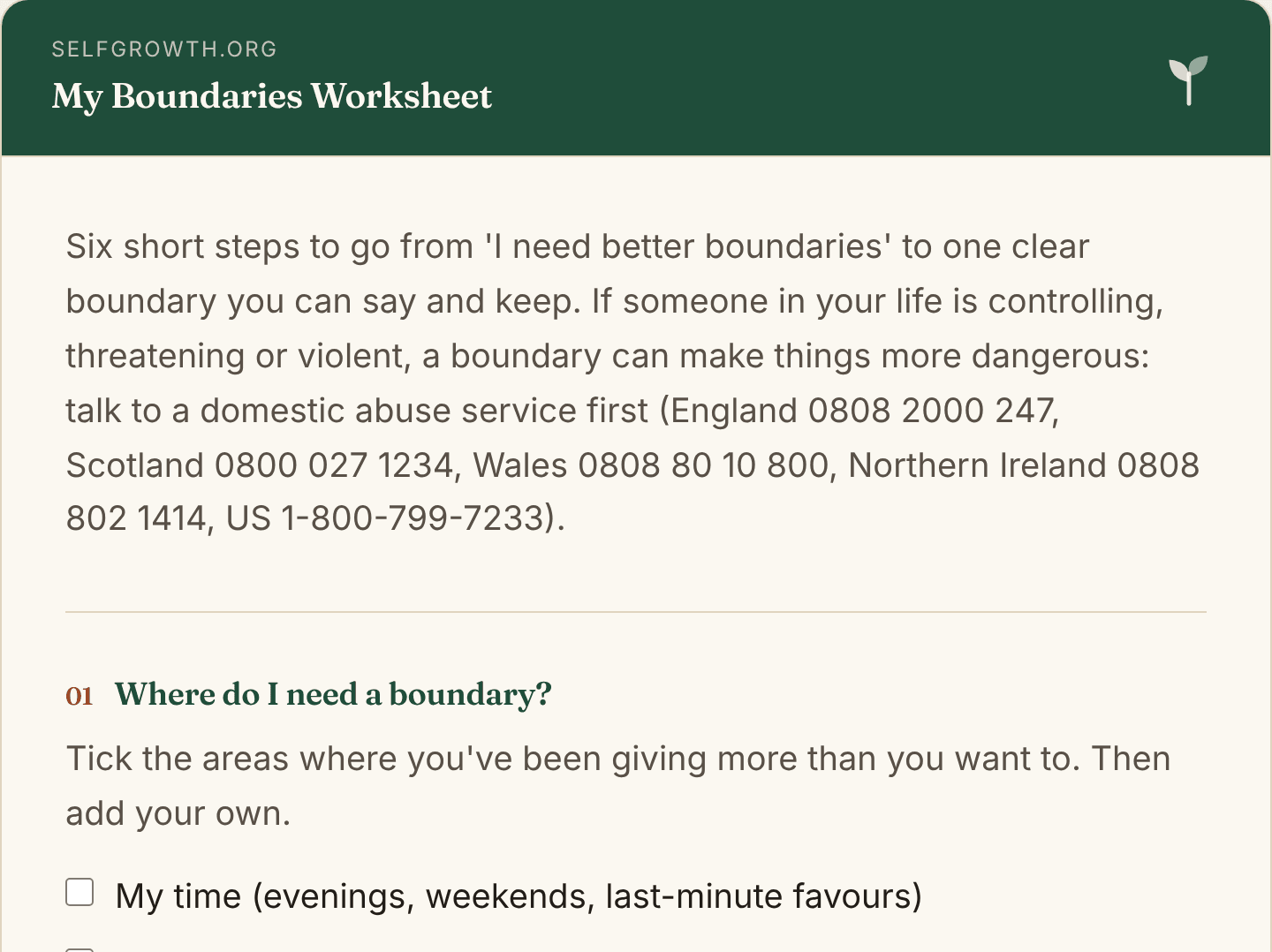
Boundaries Worksheet
A free, printable boundaries worksheet: spot where you need a limit, write it as something you'll do, plan the exact words, and decide what you'll do if it's crossed.
Open worksheet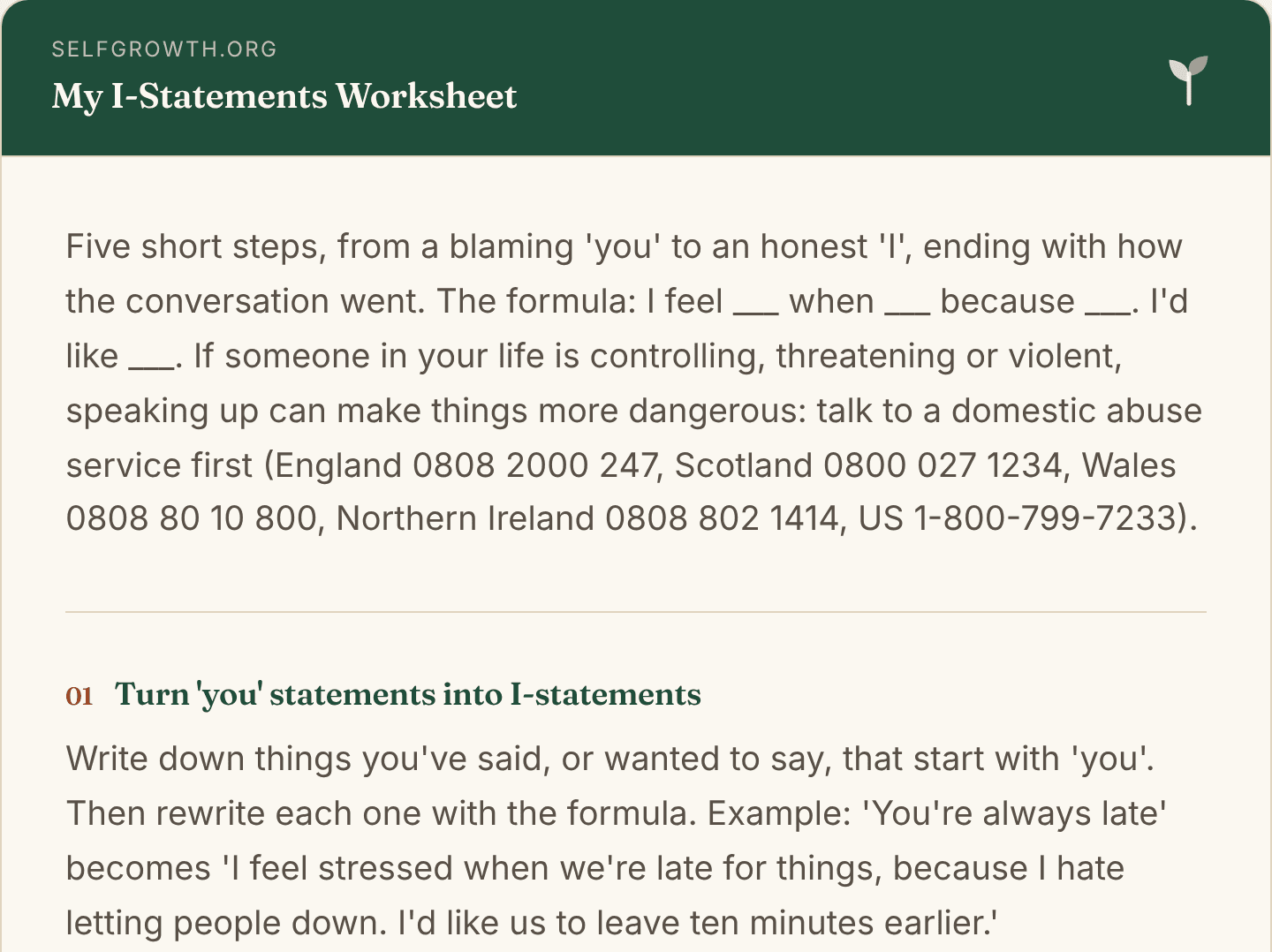
I-Statements Worksheet
A free, printable I-statements worksheet with I statement examples, the 'I feel... when... because...' formula, and space to plan one real conversation.
Open worksheet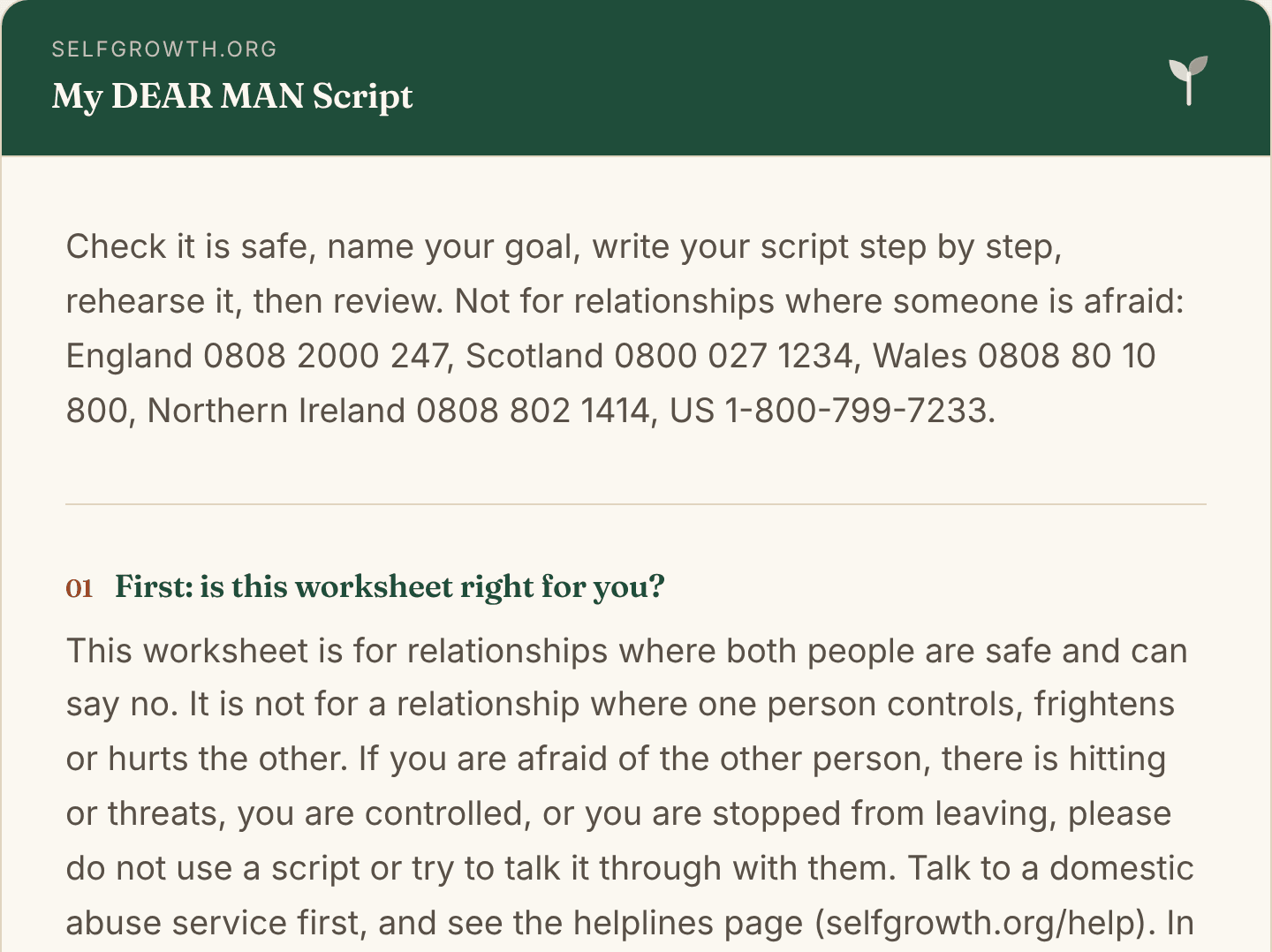
DEAR MAN Worksheet
A free, printable DEAR MAN worksheet: write a script for one request or one no, step by step, then rehearse and review. Not for unsafe relationships.
Open worksheetRelated guides
New worksheets, straight to your inbox
An occasional new worksheet or tool, sent only when there's something genuinely worth your time. No spam, no pressure, unsubscribe any time.