
Self-care
Wellness wheel: a free, printable worksheet to rate eight parts of your wellbeing and plan one small step
Updated 25 October 2026 · 7 min read · Free to print
A wellness wheel is a simple chart that shows how you feel about eight parts of your wellbeing: emotional, environmental, financial, intellectual, occupational, physical, social and spiritual. You rate each from 1 to 10, see the shape it makes, then choose one or two small steps for a short wellness plan. It is not a health test.
Using the eight dimensions of wellness set out by SAMHSA · Part of rest and self-care
Fill it in here (it saves in this browser, but not in a private window), print it, or download the PDF. Free, no sign-up.
Feeling run down can be hard to pin down. Is it sleep, money worries, a lonely month, or work? A wellness wheel splits "wellbeing" into parts so you can look at each one in turn. You rate how satisfied you are with each, and the wheel draws itself as you go.
This version uses a common eight-part list, set out in a guide from the US Substance Abuse and Mental Health Services Administration (SAMHSA). Other wellness models use a different number of parts, so treat the list as a handy frame, not the one true map. If you want to look at life areas like career, family and fun instead, try the wheel of life worksheet. This one looks at the ingredients of wellbeing. For daily habits that look after you, the self-care worksheet is a good next step.
One honest note. This is a self-help worksheet, not therapy, and it does not measure your health. Your scores are only about how satisfied you feel. If you have physical symptoms or your mood has been low for a while, see your GP. A wheel cannot tell you what is wrong, and you deserve real support for that.
How to use this worksheet
- 1Allow about 20 minutes. Print it, or fill it in on screen.
- 2Score on instinct, from 1 to 10, about how satisfied you feel. Not how you think you should feel, and not against anyone else.
- 3Look at the wheel, then pick one or two areas only. Trying to change all eight at once is hard to keep up.
- 4Put the plan where you will see it, and re-rate in 30 days.
The worksheet
selfgrowth.org
My Wellness Wheel and Plan
Rate eight dimensions of wellbeing, see what the scores say, then make a short plan with one small step.
01Rate your eight dimensions
Rate each from 1 to 10 for how satisfied you feel right now. 1 is very unsatisfied, 10 is very satisfied. A score of 10 is not the goal. Skip the one you cannot score and come back.
Emotional: expressing feelings, coping with stress, enjoying life.
Environmental: feeling safe and comfortable where I live, learn and work, and having time in pleasant or natural places.
Financial: how I feel about my income, debts and savings, and my future money.
Intellectual: keeping my mind active, learning, and hearing other points of view.
Occupational: whether my work or daily activity gives me meaning and fits my values.
Physical: movement, food, rest and looking after my body.
Social: close relationships, friends, family and community.
Spiritual: my beliefs and values, and a sense of meaning, purpose and peace.
✦Your wheel
It fills in as you score the eight areas above. A rounder wheel means your scores are close together. A spiky one shows where you feel better and worse supported.
02What each low score is about
Pick your two or three lowest scores. A low number is information, not a verdict. Ask what is behind it.
Entry 1
Entry 2
Entry 3
A score that surprised me, and why:
03What is already working
Look at your higher scores too. They show what you already do that looks after you.
Two or three things that are already going well:
- 1.
- 2.
- 3.
What helps those areas stay steady:
04Choose one or two areas
Start small. Pick the area that matters most to you right now, or the one where a small change could help other areas too. SAMHSA's guide describes the eight dimensions as connected, so a step in one can reach another.
The area or areas I will focus on:
Why these, and why now:
If one of these went up by a point or two, what would be different in my week?
05My simple wellness plan
One small step for each area you chose. Small means you could do it this week, even on a tired day. Examples: a ten-minute walk after lunch, a call to a friend, a look at one bill, a tidy of one shelf.
Entry 1
Entry 2
What might get in the way, and what I will do if it does:
06Re-rate in 30 days
Pick a date about a month away and put it in your calendar. Re-rate the same eight areas on a fresh copy, then come back here. Scores can stay the same, and that is fine. The point is to look, not to climb.
My re-rate date:
After 30 days: what changed, what did not, and what will I keep, change or drop?
Overall, how looked after do I feel compared with when I started?
When you're done, a moment to reflect
- Which score did you hesitate over, and what made it hard to rate?
- Is a low score low because of your circumstances, or because it has quietly stopped getting any of your attention?
- Which area do you most often put last, and who taught you to do that?
- Which high score are you taking for granted?
- Is there an area where the real need is support from another person or a professional, not a plan?
Done for now?
Save today's answers as a dated entry. You can come back, fill it in again and compare the two side by side.
Where the eight dimensions of wellness come from
The eight-part list used here is set out in Creating a Healthier Life: A Step-by-Step Guide to Wellness, published in 2016 by the US Substance Abuse and Mental Health Services Administration (SAMHSA). The guide names the emotional, physical, occupational, intellectual, financial, social, environmental and spiritual dimensions, and describes them as interconnected. It credits the figure as adapted from a 2006 paper by M. Swarbrick on a wellness approach.
Wellness wheels come in many versions. Some use six dimensions, some use eight, and some use other labels altogether. There is no single official wheel. The guide comes from SAMHSA's Wellness Initiative, which focuses on people with mental health or substance use problems, and this worksheet borrows only the list of dimensions as a way to look at your own wellbeing.
Filling in a wellness wheel has not been shown to improve wellbeing. It is a planning and reflection format. It does not diagnose anything and it does not measure your health. It is a prompt to notice, choose one small step, and look again in a month.
These are educational self-reflection tools, not therapy.
If you want to go deeper
- Substance Abuse and Mental Health Services Administration (2016). Creating a Healthier Life: A Step-by-Step Guide to Wellness. HHS Publication No. SMA-16-4958.
Your questions, answered
- What is a wellness wheel?
- A wellness wheel is a chart with several spokes, one for each part of wellbeing. You rate each part, join the points, and the shape shows where you feel well supported and where you feel stretched. This worksheet uses eight dimensions and draws the wheel for you as you rate.
- What are the eight dimensions of wellness?
- The list in a SAMHSA guide, Creating a Healthier Life, is emotional, environmental, financial, intellectual, occupational, physical, social and spiritual. SAMHSA describes them as interconnected. It is one common version. Other wellness models use a different number of dimensions, so a list that looks different is not wrong.
- How is a wellness wheel different from the wheel of life?
- The wheel of life looks at areas of your life, such as career, family, money and fun. A wellness wheel looks at the dimensions of your wellbeing, such as emotional, physical and spiritual. They overlap in several places, such as money, health and work, but the wellness wheel adds emotional and spiritual wellbeing. You can do both and notice what repeats.
- Does a wellness wheel work?
- Filling in a wheel has not been shown to improve wellbeing. It is a planning and reflection format. Its value is that it makes you look at each part in turn and pick a small next step. Treat it as a way to notice and decide, not as a test or a treatment.
- How often should I do a wellness wheel?
- This worksheet suggests a re-rate after 30 days, then whenever life changes or the seasons turn. You do not need to do it often. If a monthly check-in starts to feel like a chore, stretch it to every few months.
- Is there a wellness wheel PDF?
- Yes. Use the Download PDF button for a clean, print-ready copy, or Print to print straight from the page. It is free, with no payment and no email needed. You can also fill it in on screen, and your answers save in your browser.
- Is this a substitute for therapy?
- No. It is a self-help tool, not therapy, and it does not measure your health. If you have physical symptoms, or low mood or stress is what is really getting in the way, see your GP. If you ever feel unsafe or have thoughts of harming yourself, call Samaritans on 116 123 (UK and Ireland), 988 (US), or find a line at findahelpline.com.
Keep going, related worksheets

Wheel of Life Worksheet
A free printable PDF Wheel of Life exercise. Score each area of your life out of ten, see where you're out of balance, and pick one to work on next.
Open worksheet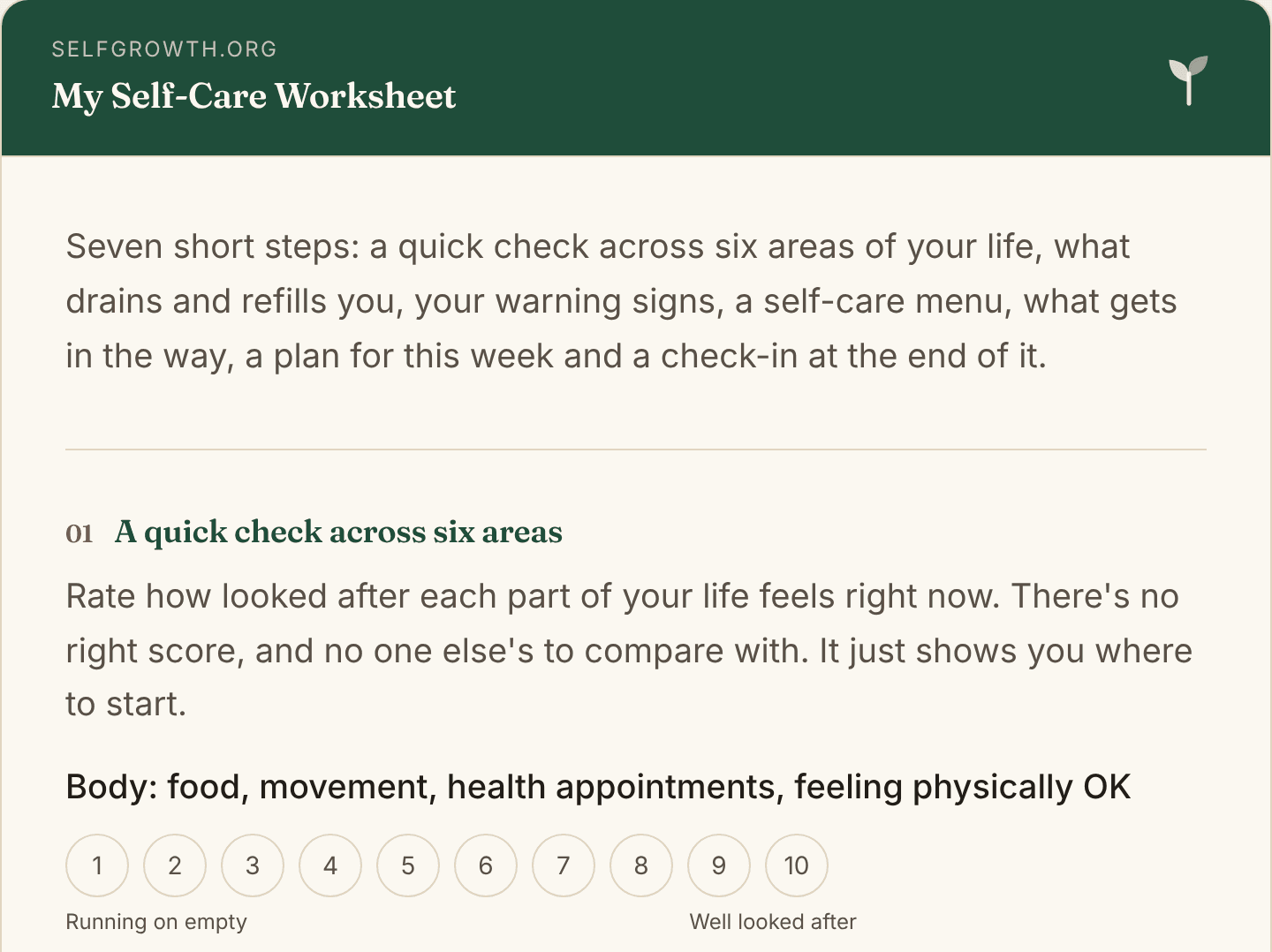
Self-Care Worksheet
A free, printable self-care worksheet for adults: check six areas of your life, see what drains and refills you, and make a self-care plan that costs nothing.
Open worksheet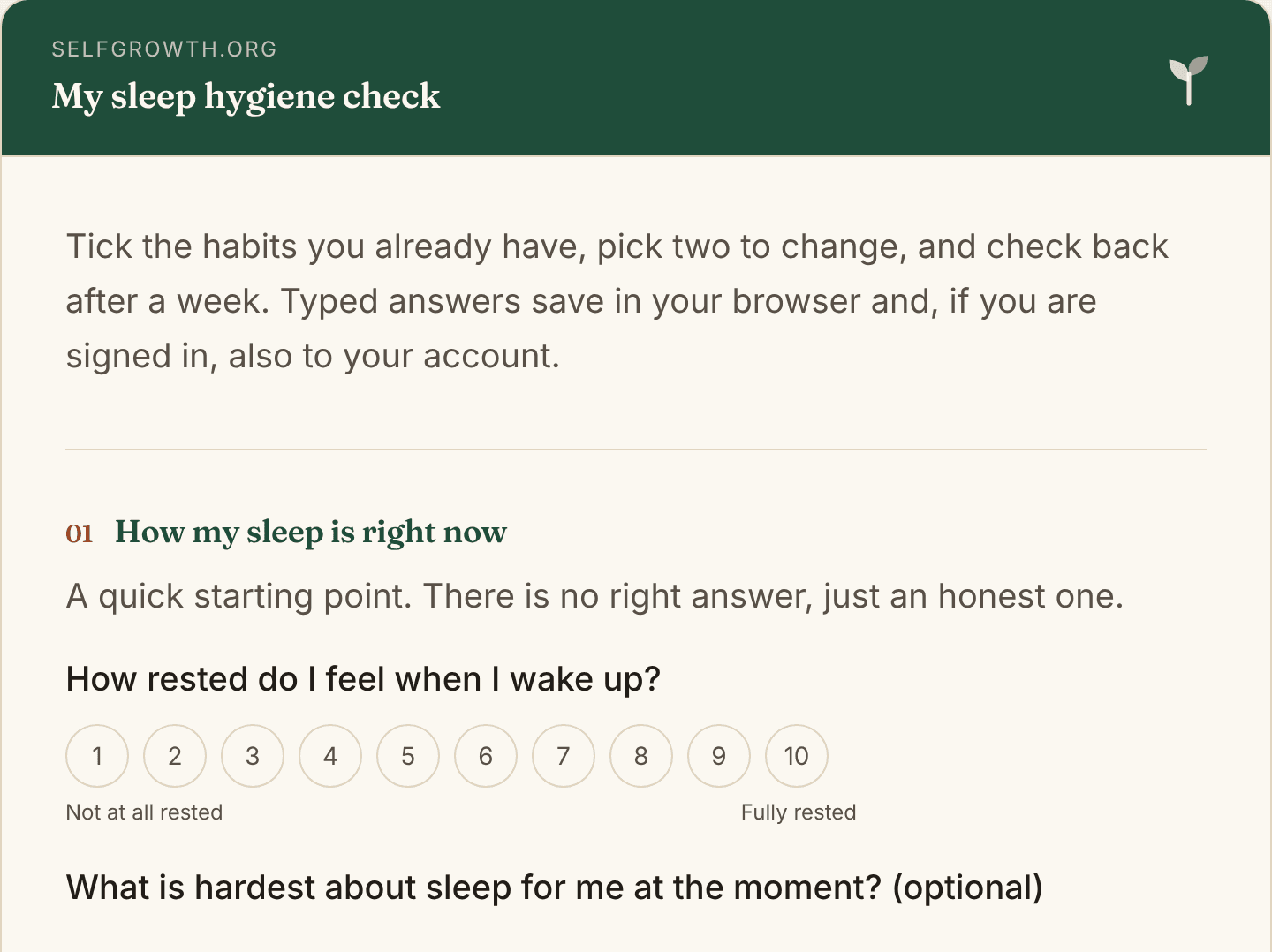
Sleep Hygiene Worksheet
A free printable sleep hygiene worksheet: tick the habits you already have, pick two to change, check back after a week, and know when to see a doctor.
Open worksheetNew worksheets, straight to your inbox
An occasional new worksheet or tool, sent only when there's something genuinely worth your time. No spam, no pressure, unsubscribe any time.