
Self-control
Self-control worksheet for teachers: a free, printable classroom plan
Updated 23 October 2026 · 7 min read · Free to print
A self-control worksheet for teachers is a planning sheet for you, not a form for pupils to complete. Use it to teach a stop-think-choose routine, build a calming moves menu, plan practice for calm moments, and log what you notice about the class and one pupil. It is free to print, with no email needed.
Drawn from research on self-control in childhood · Part of feelings and calm
Fill it in here (it saves in this browser, but not in a private window), print it, or download the PDF. Free, no sign-up.
Calling out, grabbing, rushing, struggling to wait a turn, blowing up over small things: moments like these can eat a lesson. A pupil who finds them hard is not simply choosing to be difficult. Self-control is a skill that grows with practice and support, and it is shaped by sleep, hunger, stress, noise, how clear the routine is and how the adults around a child respond. It is not a character flaw.
This sheet is for you. You look at when the hard moments happen, plan a short stop-think-choose routine the whole group can use, build a menu of calming moves, decide when you will practise (when everyone is calm, not mid-meltdown), choose your words for noticing effort, and keep a simple log for the class and for one pupil. Everything is written so it fits inside a normal timetable.
Research on self-control is worth knowing about, but it is easy to over-read. A long-running study found that children's self-control was linked with later health, money and criminal records. A review of programmes for children aged 4 to 12 found many kinds of activity can help. Neither tells you what will work for one pupil. This is classroom support, not therapy, not a professional assessment and not a way to work out why a child struggles.
How to use this worksheet
- 1Work through it in one planning session (about 30 minutes), then use the log over the following weeks. You can print it, or fill it in on screen. Typed answers save in your browser and, if you are signed in, also to your account, so never type pupil details: write them on the printout.
- 2Start with section 1. If a pupil has told you something that worries you, this sheet is not the tool: follow your school's safeguarding policy.
- 3Pick one or two moves to try, not all of them. A routine that is used the same way every day is worth more than a long list.
- 4Teach and practise the routines when the class is calm. Using them for the first time in the middle of a hard moment asks too much of anyone.
- 5Keep support private and kind. Talk to a pupil about a hard moment one to one, quietly, not in front of the group.
- 6Share what you notice with colleagues and the school's special educational needs coordinator, or SENCo (UK), or your school counsellor or psychologist (US). The log in section 6 is built to be handed over.
The worksheet
selfgrowth.org
My classroom self-control plan
Short sections for you: when it gets hard, what is behind it, a shared routine, a calming menu, practice, a log and who to work with.
011. Read first: when this is not the tool
If a child tells you someone is hurting them, or you are worried about their safety, stop here. This worksheet is not the tool: follow your school's safeguarding policy and speak to your designated safeguarding lead (DSL) the same day. In the US you are a mandated reporter: follow your school's reporting procedure and report to your state's child protective services or the police. Childhelp (1-800-422-4453, not a reporting line) can help you find the right agency. If a child is in immediate danger, call 999 (UK), 911 (US) or your local emergency number. If a pupil talks about hurting themselves, tell your DSL straight away. If difficulties with self-control are lasting, speak to your SENCo (UK) or school counsellor or psychologist (US) about getting support looked at. This is not therapy and not a professional assessment, and it cannot say why a child struggles. You matter too: look after yourself, and find someone to talk to about a hard week.
My DSL, and my SENCo or school counsellor (names and how to reach them):
How settled does my class feel at the moment?
022. When it gets hard, and what might be behind it
List the moments when impulses win. Then think about what is going on around the child, not what is wrong with them. Hunger, tiredness, noise, a change of routine, a worry from home or an unclear instruction can all make stopping and waiting harder for anyone.
Entry 1
Entry 2
Entry 3
Entry 4
Things in my room I could change before I ask a child to change:
What low self-control can look like in class (tick what you see, and describe it, do not label it):
033. A shared stop-think-choose routine
A short routine the whole class uses the same way: stop, take a breath, think about the choices, pick one. Many schools and homes teach a version of this routine, so adapt it. Keep the words short enough for a five-year-old or a fourteen-year-old to say to themselves.
Entry 1
Entry 2
Entry 3
Entry 4
A moment in my day where the whole class could use it first:
044. A calming moves menu for the room
A pupil who is overwhelmed may not be able to reason in that moment. A small menu lets them pick something that helps, without a fuss. Offer it as a choice, not a punishment, and let pupils try the moves when they are calm so they know what each one feels like. Do not use any move that involves holding a child.
Moves I could put on the menu:
Where the menu will live, and how a pupil can point to it without speaking:
055. Practise when calm, and notice effort
Repeated practice, with the challenge rising gradually, is what Diamond and Lee found shared by successful programmes. In school that can be as simple as a short game that needs waiting, stopping on a signal or taking turns, played at the start of a lesson. These are ideas to try and watch. If a child tells you something that worries you about their safety: stay calm, listen, do not promise to keep it secret, do not press for detail, write down their words, and use the numbers in the safety section at the top of this page today.
Practice ideas I could fit in (2 to 5 minutes):
Entry 1
Entry 2
Entry 3
Entry 1
Entry 2
Entry 3
066. My observation logs
Write down what you see, not what you think it means. A log helps you spot patterns, such as a moment of the day or a type of task, and gives you something concrete to share with colleagues. Keep a pupil's log secure and share it only with those who need it. Type no names or initials on screen. Write pupil details on the printout only.
Class log
Entry 1
Entry 2
Entry 3
Entry 4
Entry 5
Pupil I am watching (write on the printout, not here):
One-pupil log
Entry 1
Entry 2
Entry 3
Entry 4
Entry 5
After a few weeks: how steady are the hard moments in my class now?
077. Working with colleagues and school policy
A routine works better when other adults use the same words. Check how your plan fits your school's behaviour and inclusion policies, and agree anything shared with a pupil's family.
Before I carry on:
Who I will talk to this week, and what I will ask:
When you're done, a moment to reflect
- Which moment of the day is hardest for the class, and what is happening just before it?
- What could I change in the room or the routine before asking any child to change?
- Which one calming move would I want on the menu first, and why?
- When did I last see a pupil stop and choose differently, and what did I say?
- Who at school could I share my log with, and what would I like their help with?
Done for now?
Save today's answers as a dated entry. You can come back, fill it in again and compare the two side by side.
Does self-control in school really matter, and what helps?
A long-running study of about a thousand children, led by Terrie Moffitt (2011), linked childhood self-control with later health, money and criminal offending. It shows a link across a group, not a fixed path for any pupil.
Adele Diamond and Kathleen Lee (2011) reviewed programmes for children aged 4 to 12. Those with repeated practice and rising challenge helped, and emotional, social and physical development may matter too. For a class, that points to short, regular practice of routines you set up together.
Many schools and homes teach a version of the stop-think-choose routine, so adapt it to your room. These are ideas to try and watch, with your class log as the test.
These are educational self-reflection tools, not therapy.
If you want to go deeper
- Moffitt, T. E., Arseneault, L., Belsky, D., Dickson, N., Hancox, R. J., Harrington, H., Houts, R., Poulton, R., Roberts, B. W., Ross, S., Sears, M. R., Thomson, W. M. & Caspi, A. (2011). A gradient of childhood self-control predicts health, wealth, and public safety. Proceedings of the National Academy of Sciences, 108(7), 2693-2698.
- Diamond, A. & Lee, K. (2011). Interventions shown to aid executive function development in children 4 to 12 years old. Science, 333(6045), 959-964.
Your questions, answered
- What is self-control in children?
- It is the ability to pause before acting on an impulse, wait, calm down and keep going with a task when something else is more tempting. It is a skill that develops with practice and support. How easy it is on a given day depends on sleep, hunger, stress, the environment and the adults around a child, so a hard moment says little about a child's character.
- How do you teach self-control in the classroom?
- Teach a short routine such as stop, breathe, think, choose, and practise it when the class is calm. Keep routines predictable, say expectations before a hard moment, offer a calming moves menu as a choice, and describe the effort you see. Section 3 and section 5 of this sheet plan each of those steps.
- Do self-control activities work in class?
- There is no promise for any one pupil. A 2011 review by Adele Diamond and Kathleen Lee found that school programmes with repeated practice and rising challenge helped children aged 4 to 12, and that emotional, social and physical development may matter too. In your room that points to short, regular practice of shared routines, so treat the ideas here as things to try and watch in your class log.
- Does childhood self-control predict adult outcomes?
- A long-running study of about a thousand children, led by Terrie Moffitt in 2011, linked childhood self-control with later health, money and criminal offending. It shows an association across a group, not a prediction for any pupil in your class. What you can do is make transitions, seating and expectations clearer so every child has a fair chance to stop and think.
- Why does a child have trouble with self-control?
- Rarely for one reason, and never because a child is simply bad. Tiredness, hunger, stress, noise, an unclear routine, normal development and how adults respond all play a part, and many young children are still learning to wait and stop. Look at the room, the timing and the support before the child. If it lasts, share your log with the SENCo.
- What should I do if a pupil's difficulties are not improving?
- Keep your log and speak to your SENCo (UK) or school counsellor or psychologist (US), and the child's family, about getting support looked at. This worksheet cannot say why a child struggles. If a child tells you something that worries you about their safety, follow your school's safeguarding policy and speak to your designated safeguarding lead. In the US you are a mandated reporter: follow your school's reporting procedure and report to your state's child protective services or the police. Childhelp (1-800-422-4453, not a reporting line) can help you find the right agency.
- Is there a self-control worksheet PDF for teachers?
- Yes. Use the Download PDF button for a clean, print-ready copy, or Print to print straight from the page. It is completely free, with no payment and no email needed. You can also fill it in on screen. Typed answers save in your browser and, if you are signed in, also to your account, so never type pupil details.
- Is this a substitute for therapy or a professional assessment?
- No. It is a classroom planning tool, not therapy, medical advice or an assessment of any child. If you are finding the job overwhelming, talk to someone you trust. If you ever feel unsafe or have thoughts of harming yourself, call Samaritans on 116 123 (UK and Ireland), call or text 988 (US), or find a line at findahelpline.com. For a safeguarding concern about a child, the NSPCC helpline is 0808 800 5000 (UK) and the Childhelp hotline is 1-800-422-4453 (US). In an emergency, call 999 (UK), 911 (US) or your local emergency number.
Keep going, related worksheets
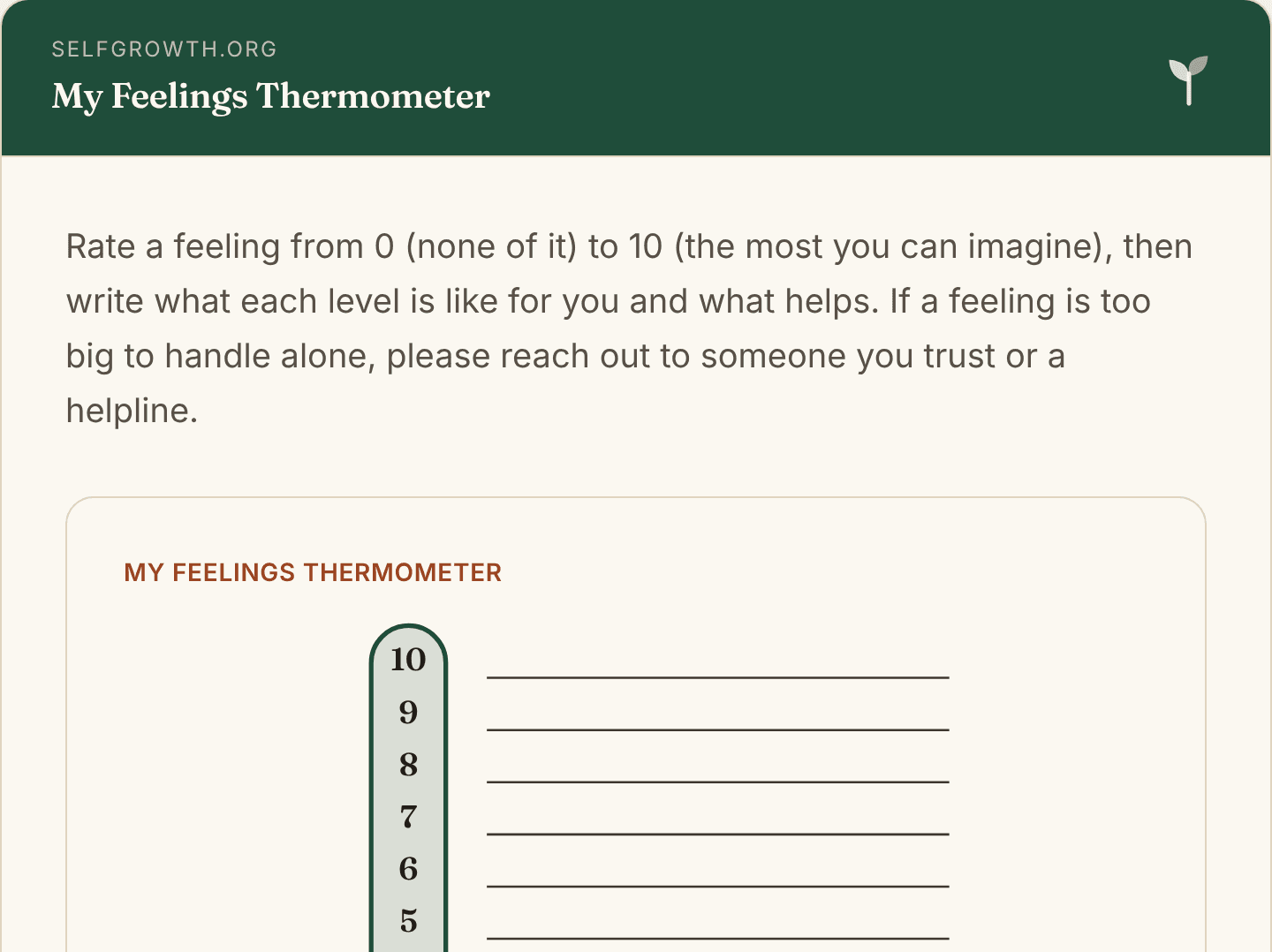
Feelings Thermometer
A free feelings thermometer: rate any feeling from 0 to 10, write what each level is like for you, and plan what helps. Works for adults and older kids. Free PDF.
Open worksheet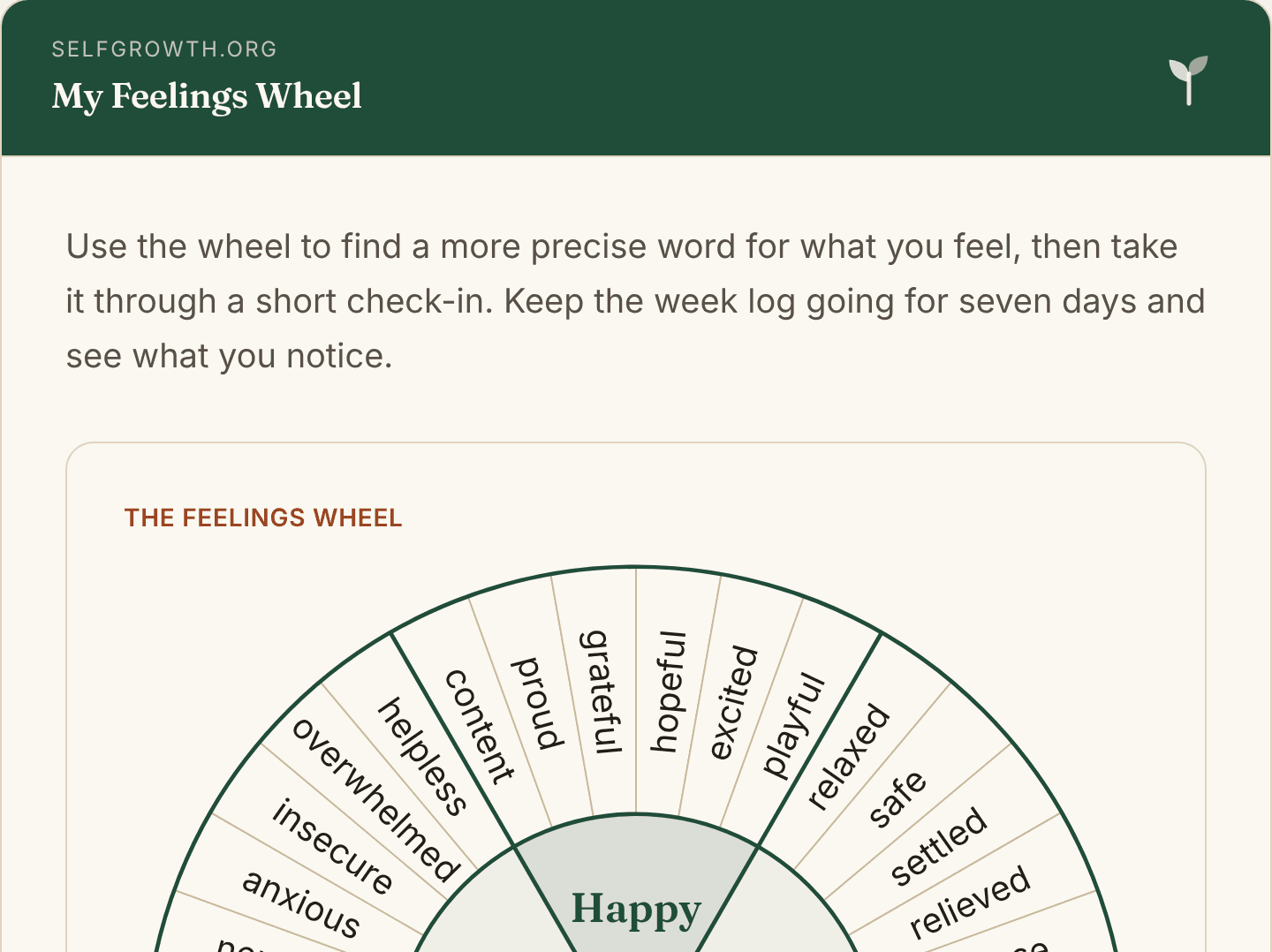
Feelings Wheel
A free printable feelings wheel (emotion wheel) PDF: six core feelings and 36 more precise words, with a daily check-in and a week log to name what you feel.
Open worksheet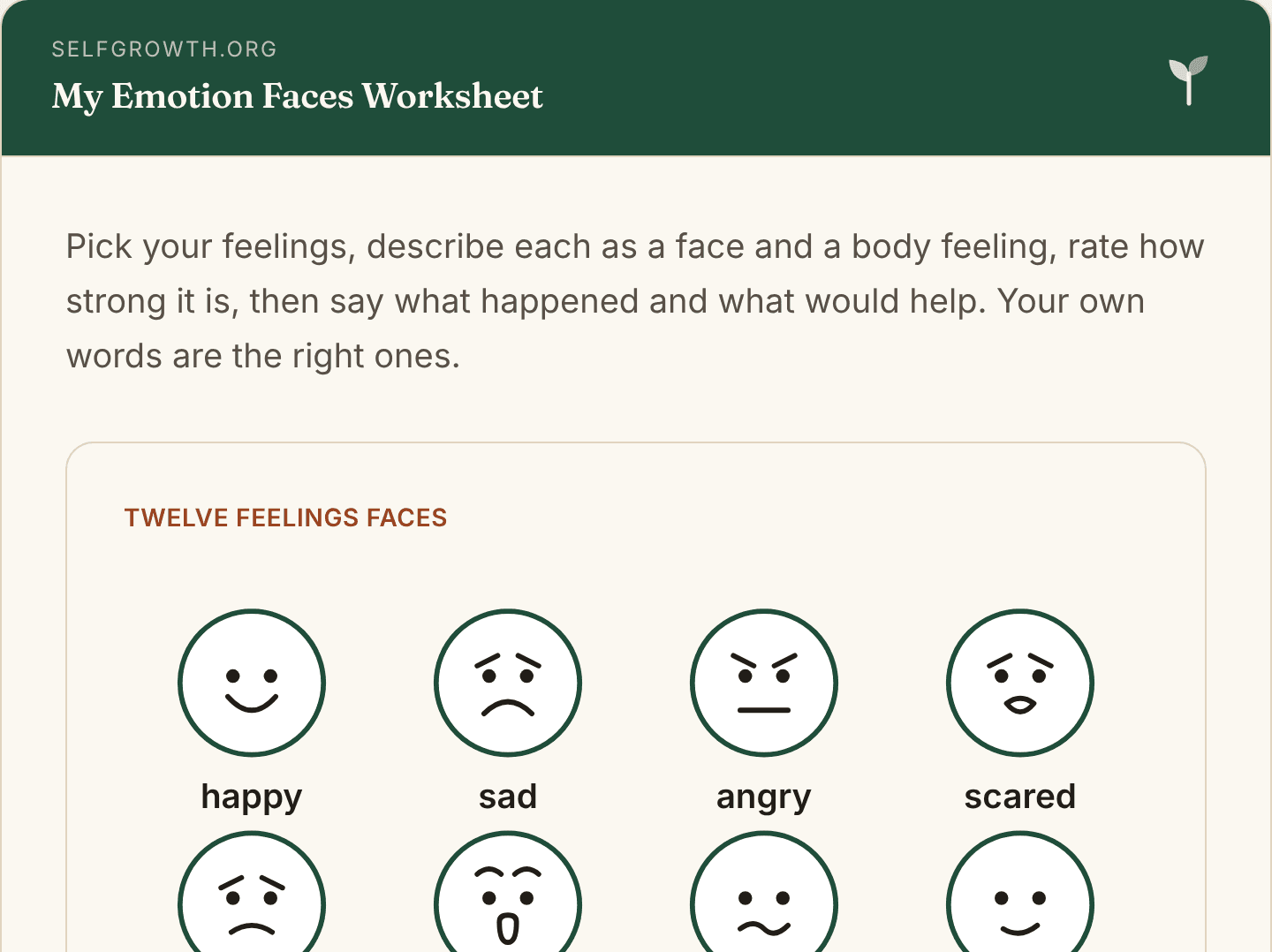
Emotion Faces Worksheet
A free printable emotion faces worksheet: pick from a set of plain feelings, describe each as a face and body feeling, rate how strong it is, note what would help.
Open worksheetNew worksheets, straight to your inbox
An occasional new worksheet or tool, sent only when there's something genuinely worth your time. No spam, no pressure, unsubscribe any time.