
Feelings
Emotion faces worksheet: a free, printable feelings faces activity
Updated 23 October 2026 · 6 min read · Free to print
An emotion faces worksheet helps you name a feeling by describing what it looks like on a face and feels like in your body. This free printable gives you a set of feeling words, from happy to tired, with space for a face, a body feeling, how strong it is, what happened and what would help.
A plain feelings-naming exercise, with an honest note on facial expressions · Part of feelings and calm
Fill it in here (it saves in this browser, but not in a private window), print it, or download the PDF. Free, no sign-up.
Sometimes the hardest part of a feeling is finding the word for it. A face can help, because it gives you something to picture. What do the eyes do? What does the mouth do? And then a second question: where do you feel it in your body, a tight chest, a heavy stomach, loose shoulders?
This worksheet gives you a set of plain feeling words to choose from. For each one you describe a face and a body feeling in your own words, rate how strong it is, and write what happened and what would help. You can use it on your own, or sit down with a child, a teenager or someone else you look after and fill it in together.
Faces are a starting point, not an answer. Research on facial expressions (see below) finds that the same face can mean different things in different people, so your own words matter more than any picture. This is a self-reflection tool, not therapy and not an assessment.
How to use this worksheet
- 1Start with the words. Tick the feelings you have noticed in the last day or two. You don't need to tick them all, and it's fine to tick just one.
- 2For each feeling you picked, describe the face in your own words (eyebrows, eyes, mouth, shoulders), then where you feel it in your body. If a printed faces chart is handy, use it to spark ideas, but write what is true for you.
- 3Rate how strong the feeling is on the 1 to 10 scale, then write what happened and what would help. A small thing is fine: a drink of water, a hug, a walk, five minutes alone.
- 4If you are doing this with a child, let them lead. Offer the words, ask 'what does your face do?' and 'where do you feel it?', and accept whatever they say. Don't correct their answers or tell them how they ought to feel.
- 5If a feeling is very big, or something frightening is going on, put the worksheet down. If you have thoughts of harming yourself, thoughts like these are serious: talk to a GP or call a helpline (details at the end). If another person is making you or a child feel scared, this worksheet is not the right tool: please see the help page.
The worksheet
selfgrowth.org
My Emotion Faces Worksheet
Pick your feelings, describe each as a face and a body feeling, rate how strong it is, then say what happened and what would help. Your own words are the right ones.
011. Pick the feelings I have had
Tick any feeling you have noticed lately. Be as honest as you can, and remember that every feeling is allowed, including the uncomfortable ones.
The feelings I have noticed:
A feeling I had that isn't on the list:
022. The face and the body
For each feeling you ticked, write the word, then describe the face (what do the eyebrows, eyes and mouth do?) and where you feel it in your body. Write 'not sure' if you aren't sure. Here is a prompt for each: happy (smile, loose body), sad (mouth turned down, heavy), angry (frown, tight jaw or fists), scared (wide eyes, racing heart), worried (tense forehead, tight tummy), surprised (eyebrows up, mouth open), disgusted (nose wrinkled, mouth turned away), embarrassed (hot cheeks, looking away), proud (chin up, chest wide), lonely (empty or aching, hard to look at others), calm (soft face, slow breathing), tired (heavy eyelids, slow body). Yours may be quite different, and that is fine.
Entry 1
Entry 2
Entry 3
Entry 4
Entry 5
Entry 6
033. One feeling in more detail
Pick the feeling that stood out most. Write what was going on, without judging yourself or anyone else.
The feeling I'm looking at:
How strong was it?
What happened just before? Where was I, and who was there?
What did I do, or want to do, when I felt it?
044. What would help?
Different feelings need different things. Tick what might help with the feeling above, or add your own. If the feeling is a pleasant one, what would help you enjoy it for longer?
One thing I will try:
055. For the grown-up (if you are doing this with a child)
You don't need to fix anything. Listening is the job here. A child's face may not match their feeling, and words may not come. 'Do you want to draw it?' is a fine alternative to words.
What I noticed, and one thing I'll do differently:
If a feeling keeps coming back or seems too big, who can I talk to? (a GP, a teacher, the school's pastoral lead, a helpline)
066. How I feel now
Check in again after you've written it down. Putting a feeling into words may change it a little, or not at all. Either is fine.
How strong is the feeling now?
What did I notice by doing this?
When you're done, a moment to reflect
- Which feeling was easiest to find a face for, and which was hardest?
- Where in your body do you tend to feel things first?
- Does your face always show what you are feeling? When might it not?
- What helps you most when the feeling is uncomfortable?
- Who could you tell when a feeling is bigger than you can manage alone?
Done for now?
Save today's answers as a dated entry. You can come back, fill it in again and compare the two side by side.
Do faces tell us how someone feels?
Naming a feeling and noticing where it shows up in the body are ordinary parts of many emotional skills exercises. This worksheet is our own plain version: everyday words, a face prompt, a body prompt and a rating. It isn't based on any one clinical tool, and we don't claim research shows it works.
The faces part comes with a caution. In 2019, Lisa Feldman Barrett and colleagues published a large review in Psychological Science in the Public Interest of the evidence on whether you can tell someone's emotion from their face. They found that people do sometimes smile when happy, frown when sad and scowl when angry, more than chance would predict. But how emotions are shown varies substantially across cultures, situations and even between people in one situation, and the same facial movement can go with more than one emotion. A scowl, for example, often communicates something other than an emotional state.
That is why this sheet asks you to describe your own face and body rather than choose a 'correct' picture. A face can start a conversation. It can't replace asking the person how they feel.
These are educational self-reflection tools, not therapy.
If you want to go deeper
- Barrett, L. F., Adolphs, R., Marsella, S., Martinez, A. M. & Pollak, S. D. (2019). Emotional expressions reconsidered: Challenges to inferring emotion from human facial movements. Psychological Science in the Public Interest, 20(1), 1-68.
Your questions, answered
- What is an emotion faces worksheet?
- It's a printable activity that helps you put a name to a feeling by connecting it to a face and to a feeling in your body. You choose from a set of feeling words, describe what the feeling looks like on a face and where you feel it, rate how strong it is and note what would help. It can be used by adults on their own, or by a grown-up and a child together.
- How do you use feelings faces with children?
- Let them lead. Show the words, or a faces chart, and ask 'what does your face do when you feel this?' and 'where do you feel it in your body?'. Accept their answers without correcting them, and don't push for words if they would rather draw or point. Keep it short, and stop if they lose interest or the feeling gets too big.
- Do faces really show what someone is feeling?
- Only partly. A major 2019 review by Lisa Feldman Barrett and colleagues found that people do sometimes smile when happy or frown when sad, more than chance would predict. But how emotions are expressed varies substantially across cultures, situations and even between people in the same situation, and one face can express more than one emotion. So treat a face as a starting point for a conversation, not proof of what someone feels. Ask them.
- What's the difference between this and the feelings wheel?
- The feelings wheel gives you many words, from broad to specific, to find the most accurate one. This worksheet uses a smaller set of plain words and asks you to describe the face and the body, which suits quick check-ins and children. The feelings thermometer on this site is for rating how big a feeling is.
- Is there an emotion faces printable PDF?
- Yes. Use the Download PDF button for a clean, print-ready copy, or Print to print straight from the page. It's free, with no payment and no email needed. You can also fill it in on screen, and your answers save in your browser.
- What if a feeling is too big to handle?
- Stop the worksheet. Help yourself or the child settle first: breathe out slowly, name five things you can see, or hold something cold. The grounding techniques guide on this site has more ideas. If you or a child are unsafe, or have thoughts of self-harm (thoughts like these are serious), talk to a GP or call a helpline straight away.
- Is this a substitute for therapy?
- No. It's an educational self-help activity, not therapy, an assessment or medical advice. If you or a child are struggling with persistent low mood, anxiety, anger or something frightening, please talk to a GP or a qualified mental health professional. If you're in crisis, contact a helpline: Samaritans on 116 123 (UK and Ireland), 988 (US), or find one near you at findahelpline.com.
Keep going, related worksheets
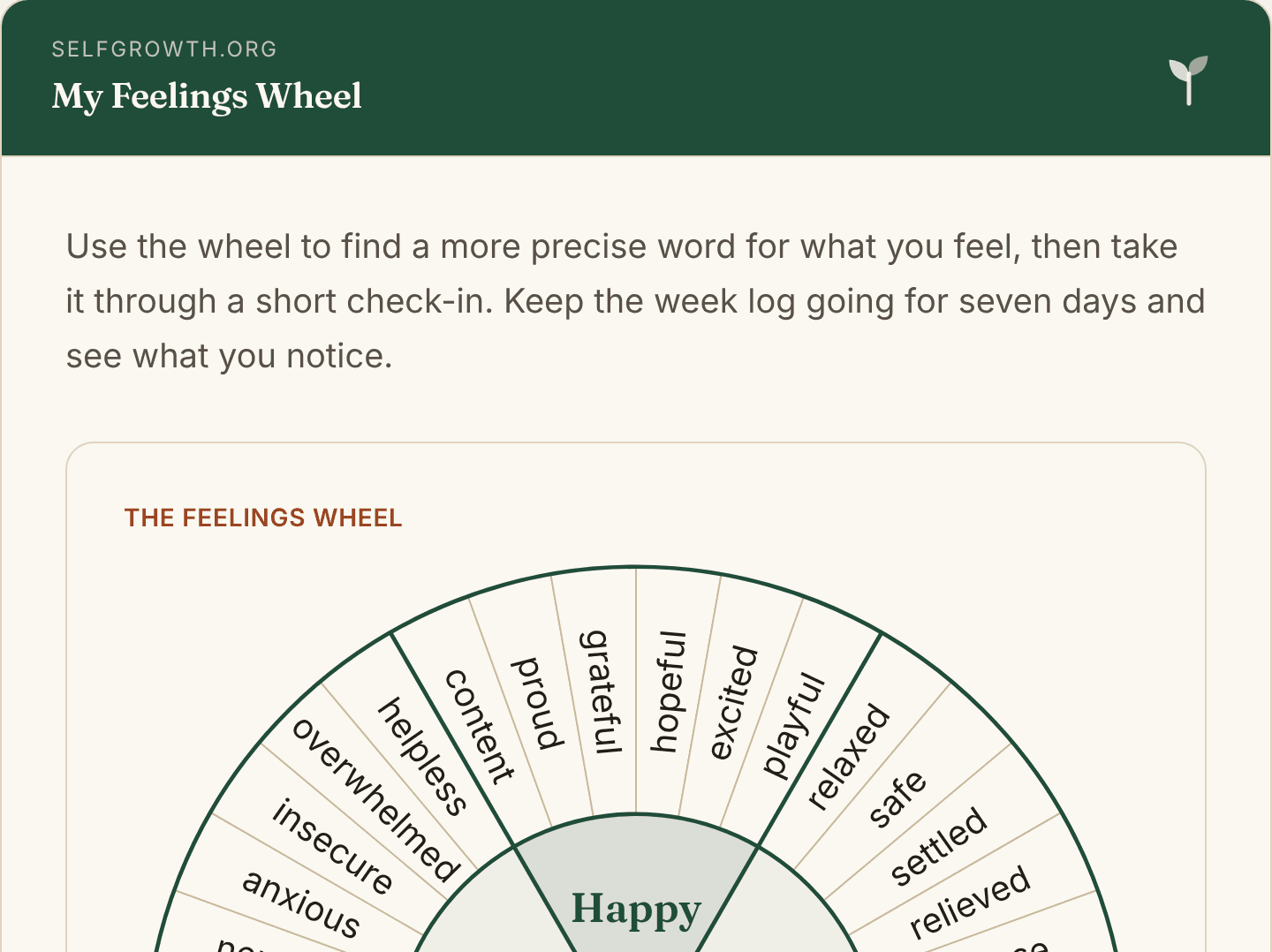
Feelings Wheel
A free printable feelings wheel (emotion wheel) PDF: six core feelings and 36 more precise words, with a daily check-in and a week log to name what you feel.
Open worksheet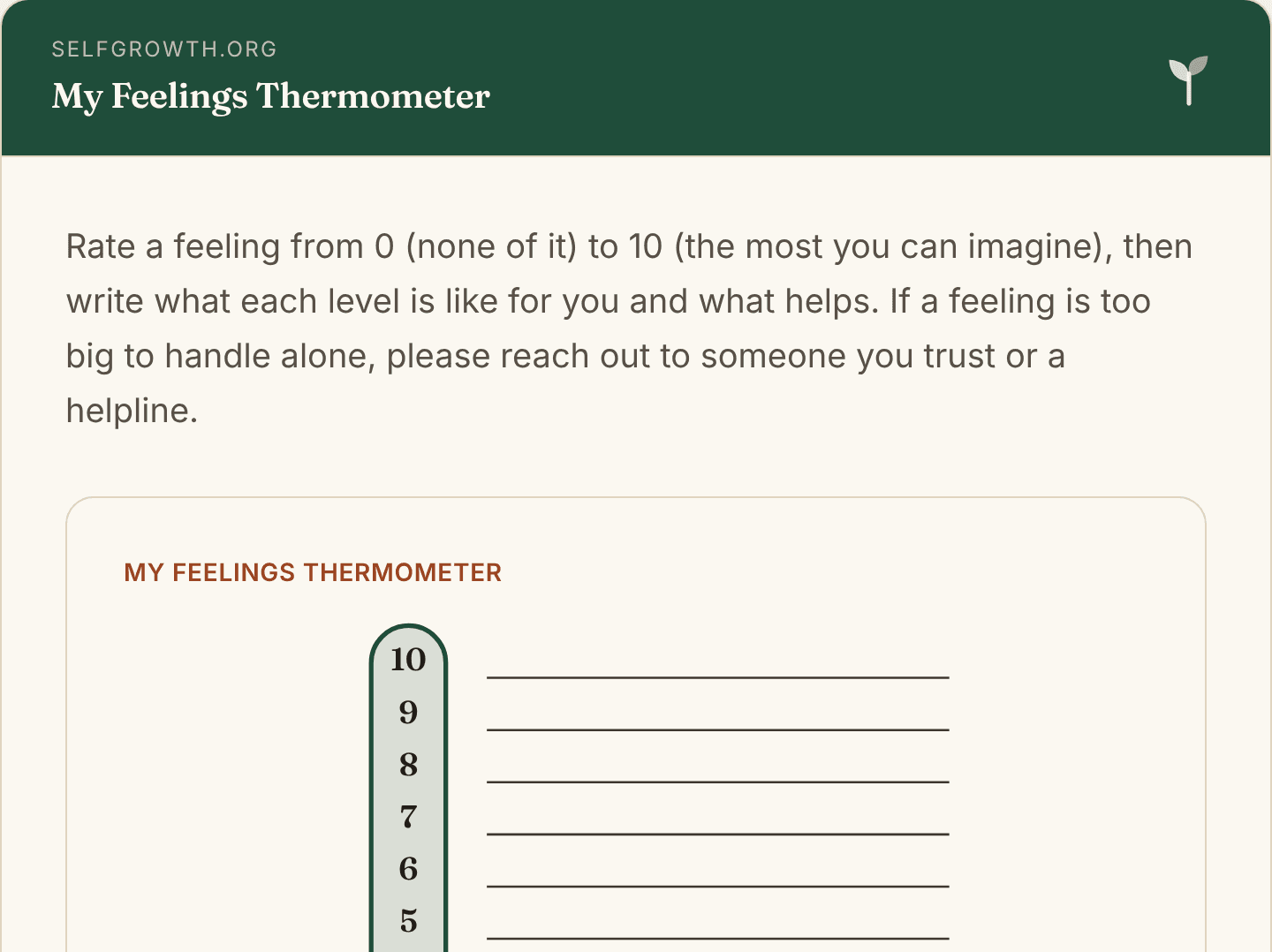
Feelings Thermometer
A free feelings thermometer: rate any feeling from 0 to 10, write what each level is like for you, and plan what helps. Works for adults and older kids. Free PDF.
Open worksheet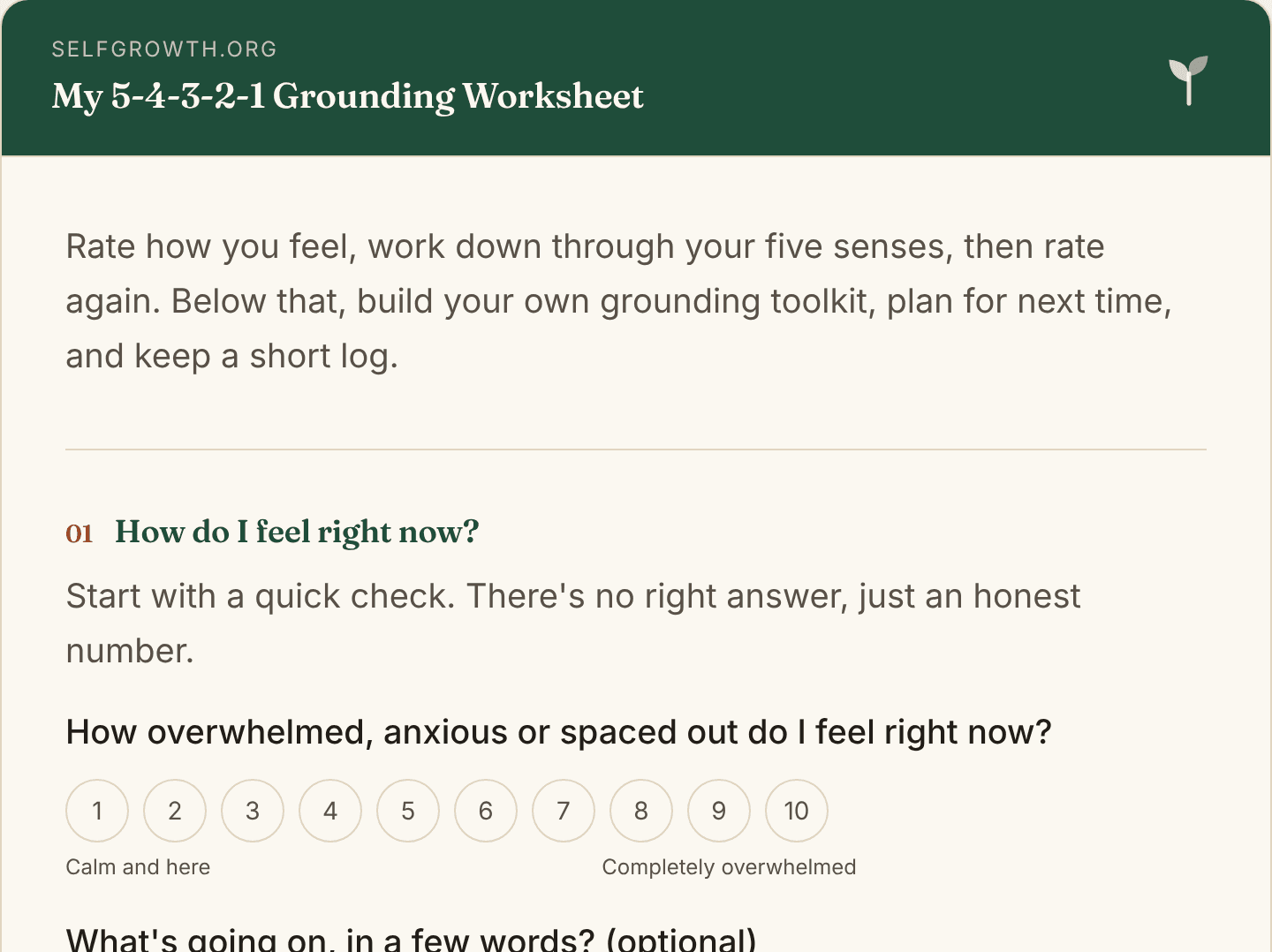
5-4-3-2-1 Grounding Worksheet
A free, printable 5-4-3-2-1 grounding worksheet: rate how you feel, work through your five senses, re-rate, then build your own toolkit and plan for next time.
Open worksheetNew worksheets, straight to your inbox
An occasional new worksheet or tool, sent only when there's something genuinely worth your time. No spam, no pressure, unsubscribe any time.