
Decisions
Decision matrix template: a free printable way to weigh your options and choose
Updated 25 October 2026 · 7 min read · Free to print
A decision matrix template helps you choose between options by scoring them against what matters to you. List two or three options, pick three to six criteria, weight each from 1 to 5, score every option, then multiply and add up. Treat the total as a prompt for thinking, then check it against your gut.
Drawn from decision-analysis scoring and decision research · Part of goals and life balance
Fill it in here (it saves in this browser, but not in a private window), print it, or download the PDF. Free, no sign-up.
A big decision can go round in your head for weeks. A decision matrix gets it onto one page. You list your options, decide what matters most, and score each option against it. The page does not decide for you. It shows you where your thinking is, so you can argue with it.
The sheet works on one decision at a time, personal or work. Start by writing the decision and when it needs to be made. Include 'keep things as they are' as an option, because it is always one. If you are unsure what matters most to you, try the core values worksheet first. If you have too many decisions at once, the Eisenhower matrix template can help you pick which one to settle first.
A fair warning. Scoring puts numbers on feelings, and numbers can look more certain than they are. That is why the sheet ends with a gut check and a question about what would change your mind. It is a self-help tool, not therapy. If a choice feels impossible because you are low or worn out, a GP is a good person to talk to.
How to use this worksheet
- 1Pick one decision. Write when it needs to be made, even if the date is soft.
- 2Fill in the criteria and weights before you score anything. Deciding what matters first keeps you from bending the scores to suit a favourite.
- 3Score quickly, going with your first thought. Then do the sums and look at the result.
- 4Do the gut check and the 'what would change my mind' questions before you make the call.
The worksheet
selfgrowth.org
My Decision Matrix
Name the decision, list your options, weight what matters, score each option, add it up, check your gut, and choose a first step.
01The decision and the deadline
Say what you are choosing in one sentence. 'Should I take the job offer?' is clearer than 'work stuff'. Then write when it has to be made, and who else it affects.
The decision I need to make:
It needs to be made by:
Who else it affects, and whether I need to ask them anything:
How much does this decision weigh on me right now?
02My options
List two or three. Always include 'keep things as they are', so you compare each change with what you already have. If you have only one option, take ten minutes to find a second, even if you doubt you would choose it.
Entry 1
Entry 2
Entry 3
03What matters: criteria and weights
A criterion is something you want from the choice, such as money, time with family, learning, or less stress. Choose three to six. Give each a weight from 1 (nice to have) to 5 (matters a lot). Not everything can be a 5. If everything is, you have not yet decided what matters most.
Entry 1
Entry 2
Entry 3
Entry 4
Entry 5
Entry 6
04Score each option
Copy your criteria and weights into the first two columns. Write your three option names in the headers on paper, or in your head if you are typing. Then give each option a score from 1 (poor) to 5 (very good) against each criterion. Score the criterion, not the option as a whole. Go with your first thought.
Entry 1
Entry 2
Entry 3
Entry 4
Entry 5
Entry 6
05Multiply and add up
For each cell, multiply the weight by the score. Then add up each option's column. Worked example: you give 'less stress' a weight of 5, and Option A scores 4 on it. That cell is 5 x 4 = 20. Do this for every criterion, then add up all of Option A's cells for its total. The highest total is the option your own scores favour. Close totals mean the choice is close, and that is useful to know.
Entry 1
Entry 2
Entry 3
Entry 4
If the winner surprised me, which score or weight do I want to look at again?
06Gut check
Numbers are only half the picture. Imagine the top-scoring option has been announced as final. Notice what your body does. You might feel relief, or a drop. A 'flip a coin' check works the same way: assign each option a side, flip, and notice whether you hope for a particular result while it spins. It is a way to notice your own feelings, not a method with proof behind it.
Picture the winning option as final. What do I feel, and where do I feel it?
If I flipped a coin, which result would I be hoping for?
If my gut and my scores disagree, what might my gut know that the criteria missed?
07What would change my mind, and a small test
Write down what would make you pick differently. That could be a number, a conversation or a deadline. Then look for a small, reversible way to try the choice before you commit, such as a trial week, a chat with someone who has done it, or a visit.
What new information or event would change my mind? Who or what could tell me?
A small test I could run first, if there is one (a trial, a conversation, a visit):
What I will do about the test, and by when:
08My decision and first step
Choose, in one sentence. Then write one step small enough to take in the next two days. A decision is more real once something has moved.
My decision, in one sentence:
My first step, and when I will take it:
A date when I will look back at how this is going:
When you're done, a moment to reflect
- Did writing the options down change how the decision looked? What surprised you?
- Which criterion did you weight highest, and is that really what you care about, or what you think you should?
- Did the option 'keep things as they are' score better or worse than you expected?
- Is there someone whose view you want before you decide, and what exactly will you ask them?
- If you chose and it turned out badly, what would you do next? Does that make the choice feel less final?
Done for now?
Save today's answers as a dated entry. You can come back, fill it in again and compare the two side by side.
Do decision matrices work?
Weighted scoring is a long-standing way to compare options. You will meet it under several names, such as a weighted decision matrix or a multi-criteria table. A related format, the Pugh matrix, comes from engineering design and is described in S. Pugh's book Total Design (1990). These are conventions for organising your thinking. No study behind this sheet tests whether filling one in leads to better personal decisions.
One piece of research supports a single habit the sheet builds in. Paul Nutt studied 358 decisions in medium to large organisations in the US and Canada. He traced failures to managers who imposed solutions, limited the search for alternatives and used power to push their plans through. Managers who made the need for action clear, set objectives, searched for solutions without restriction and involved key people were more likely to succeed. That is why the sheet asks for more than one option and for a chance to ask others. It is organisational research, so it does not tell you what will work for a personal choice.
The gut check is a prompt to notice how you feel, nothing more. It is not a proven test. Use the numbers and your feelings together, and treat the result as a good question to answer, not an order.
These are educational self-reflection tools, not therapy.
If you want to go deeper
- Nutt, P. C. (1999). Surprising but true: Half the decisions in organizations fail. Academy of Management Executive, 13(4), 75-90.
- Pugh, S. (1990). Total Design: Integrated Methods for Successful Product Engineering. Addison-Wesley.
Your questions, answered
- What is a decision matrix?
- A decision matrix is a table that compares options against the things that matter to you. You list the options down one side and the criteria across the top, give each criterion a weight, score every option, then multiply and add up. This sheet adds a gut check, a 'what would change my mind' question and a first step.
- How do I make a decision matrix?
- Write the decision and a date. List two or three options, including keeping things as they are. Choose three to six criteria and weight each from 1 to 5. Score each option from 1 to 5 on each criterion, multiply each score by its weight, and add up each option's column. Then check the result against your gut.
- How do I make better decisions?
- Write the decision down, name more than one option, and decide what matters before you score. A study of 358 decisions in medium to large organisations in the US and Canada (Nutt, 1999) linked failed decisions to managers who limited the search for alternatives. That is work research, not a test of personal choices, but it is a good reason to find a second option.
- What is a weighted decision matrix?
- It is a decision matrix where each criterion has a weight, so the things that matter most count for more. Instead of adding plain scores, you multiply each score by its weight first. A related format used in engineering design is called a Pugh matrix. It is a long-used convention, not a method proven to give better choices.
- What if my head and my gut disagree?
- Treat that as information, not a fault. Check whether a criterion is missing from your list, or whether a weight is too low for something you care about. Sometimes the gut is reacting to a real concern the numbers left out. Sometimes it is plain fear of change. The gut check on this sheet helps you tell which.
- Is there a decision matrix template PDF?
- Yes. Use the Download PDF button for a clean, print-ready copy, or Print to print straight from the page. It is completely free, with no payment and no email needed. You can also fill it in on screen, and your answers save in your browser.
- Is this a substitute for therapy?
- No. It is a self-help planning tool, not therapy or medical advice. If low mood, anxiety or exhaustion is what is really making the choice feel impossible, a GP can point you to support. If you ever feel unsafe or have thoughts of harming yourself, call Samaritans on 116 123 (UK and Ireland), 988 (US), or find a line at findahelpline.com.
Keep going, related worksheets
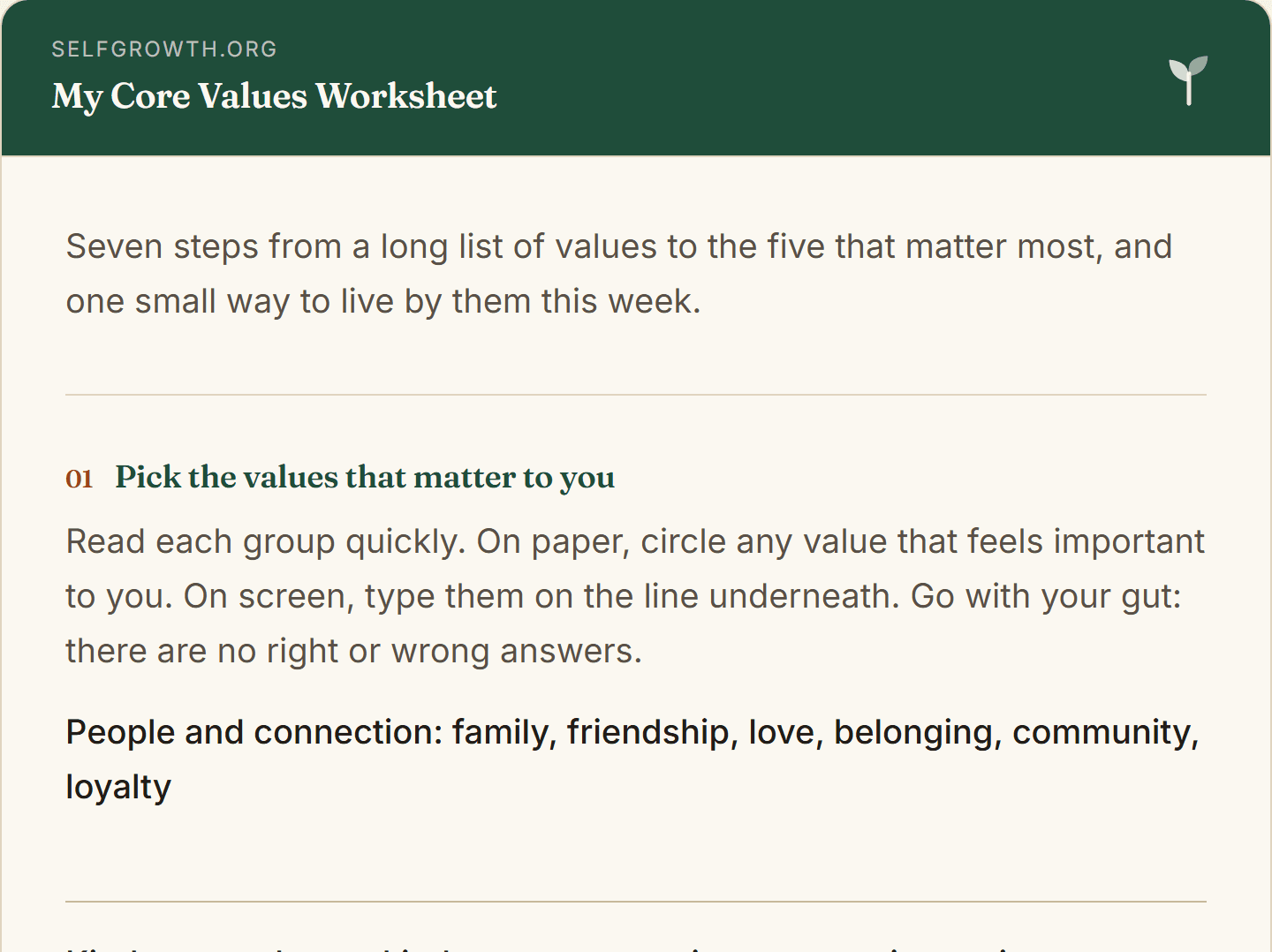
Core Values Worksheet
A free, printable core values worksheet: pick values from a list, narrow them to your top five, put them in your own words and plan one step to live by them.
Open worksheet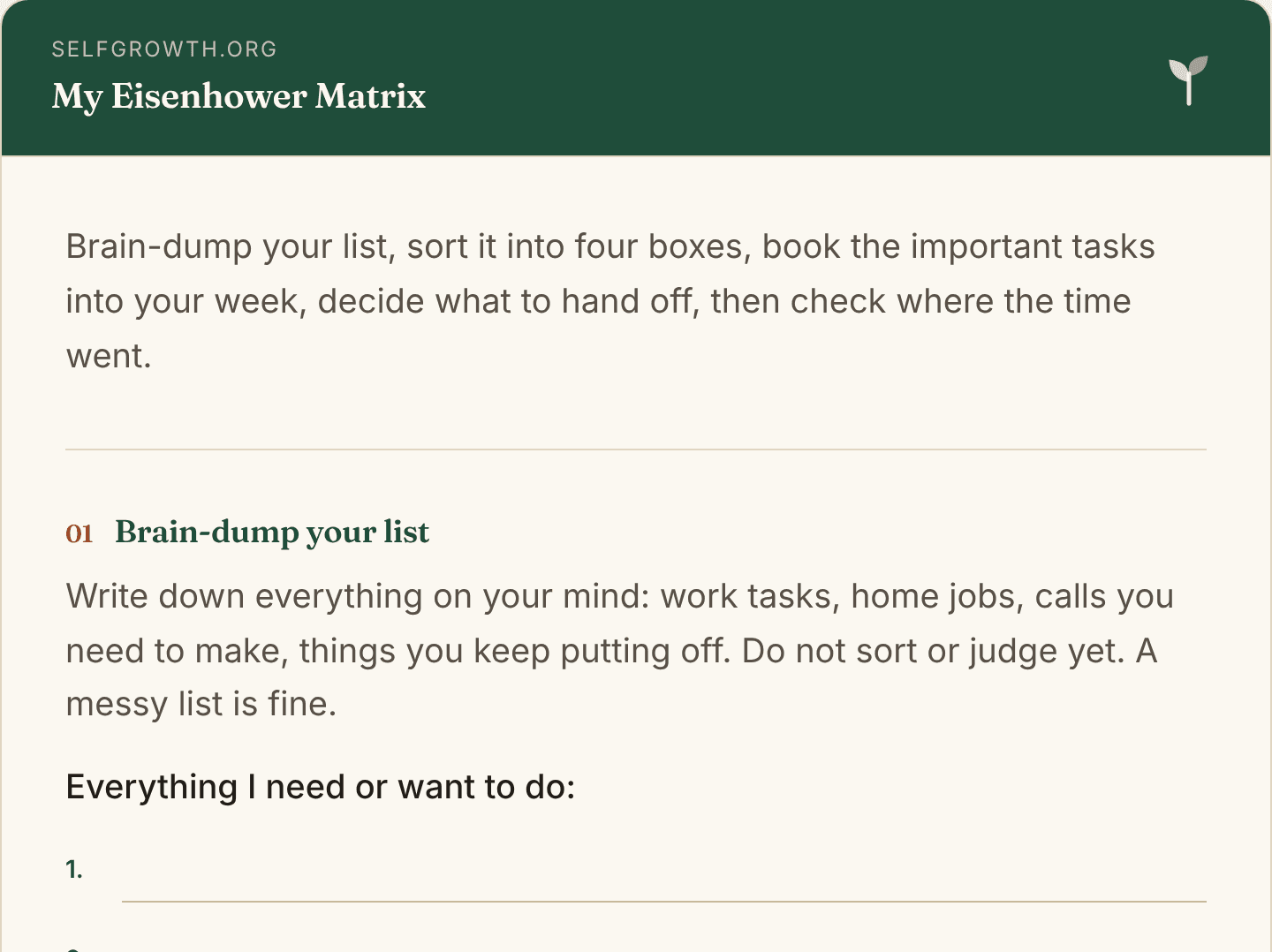
Eisenhower Matrix Template
A free Eisenhower matrix template: empty your head onto a list, sort it into four boxes, book the important tasks into your week, and check where time went.
Open worksheet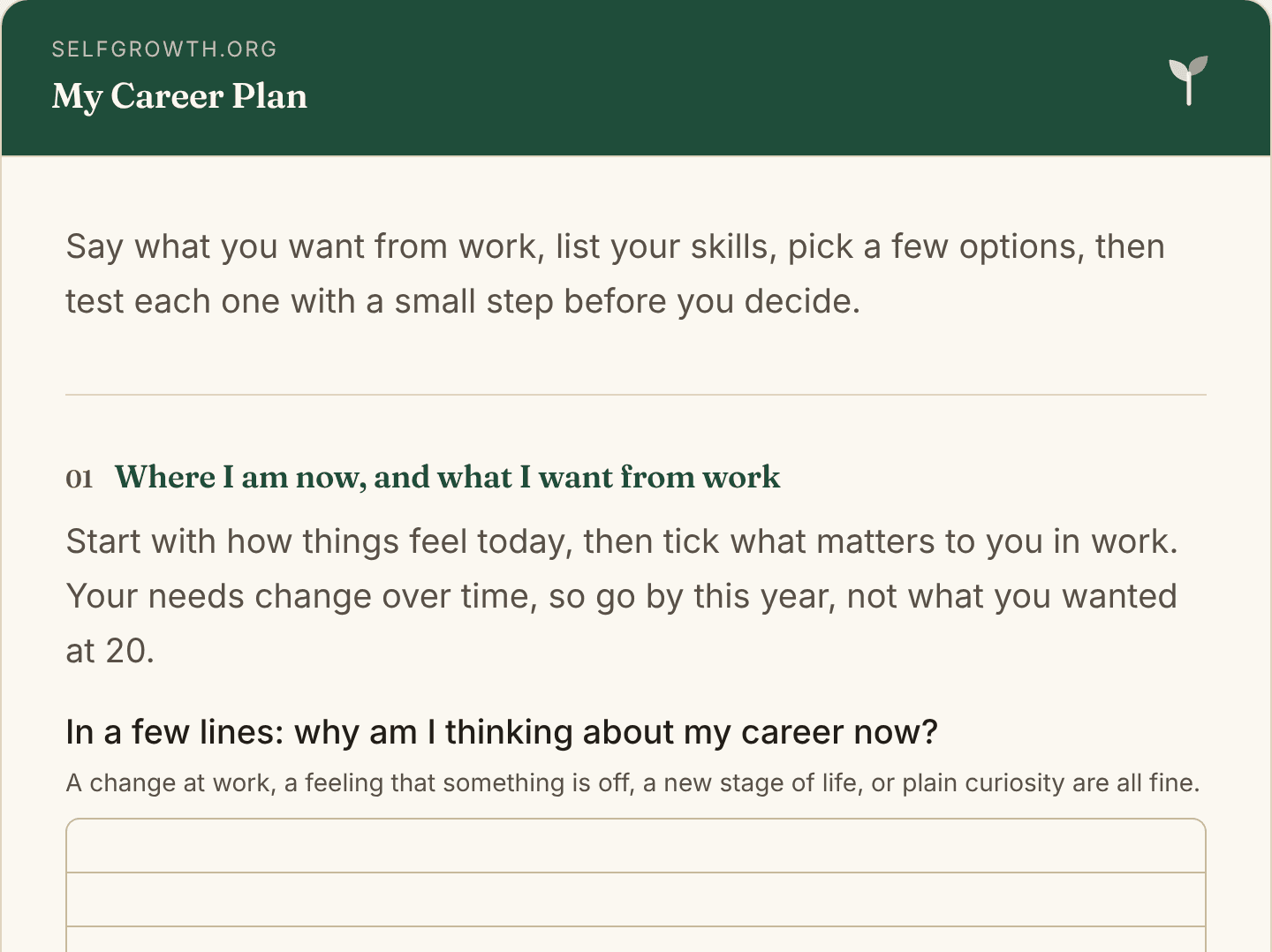
Career Planning Worksheet
A free career planning worksheet with a skills inventory, values checklist and small experiments. Use it for a first plan or a career change. No email needed.
Open worksheetNew worksheets, straight to your inbox
An occasional new worksheet or tool, sent only when there's something genuinely worth your time. No spam, no pressure, unsubscribe any time.