
Guide
How to make better decisions: a step-by-step way to choose
Updated 25 October 2026 · 8 min read
To make better decisions, name the choice and set a deadline, find more than one option, decide what matters most to you, then compare the options against that. Check your gut, test small if you can, and decide. Review it later, so the next choice is easier.
Drawn from everyday planning practice and decision research in organisations · Part of goals and life balance
Some decisions take up far more of your head than they should. You go round and round, ask five people, make a list, then lose the list. Or you put it off until the choice is made for you.
Better decisions do not come from a perfect method. They come from a few simple habits: seeing the choice clearly, looking past the first option, knowing what you care about, and then actually deciding. Below is a step-by-step way to do that. To do it on paper, the decision matrix template is free to print or fill in on screen.
This is a self-help guide, not therapy. It is for everyday and big life choices, not for emergencies or medical decisions.
Why some decisions feel so hard
A decision feels hard when something you care about is at stake and you cannot be sure how it will turn out. A few things can make it harder:
- You are afraid of picking the wrong one and regretting it.
- There are many options, or only two bad ones.
- You are not sure what you want, so nothing feels clearly right.
- Other people want different things for you.
- You are tired, stressed or upset, and everything looks heavier than it is.
Feeling stuck does not mean something is wrong with you. It can mean the decision matters to you. The goal is not to feel certain. It is to choose with your eyes open, and to be able to live with the choice.
How to make better decisions: step by step
Work through these in order. You can do the whole thing in an evening for a small choice, or spread it over days for a big one.
- 1Name the decision and the deadline. Write it as a question: 'Should I take the new job?' Then say when you need to decide by. A choice with no deadline can stay open for months.
- 2Widen the options. Write down at least three, even if two seem silly. Research on organisational decisions (Nutt, 1999) linked failed decisions to managers who limited the search for alternatives. It was not about personal choices, but a second or third option is worth looking for. Ask 'What else could I do?' and 'What if I did a bit of both?'
- 3Know what matters. Write the three to five things this choice needs to get right for you, such as money, time with family, growth, security or health. If you are not sure what matters most, the core values worksheet can help.
- 4Compare the options. For each one, note what it gives you and what it costs against what matters. Keep it short: a few words per cell.
- 5Check your gut. Imagine you have chosen each option. Notice whether you feel relief, dread, excitement or flatness. Your feelings are not an answer, but they are information about what you want.
- 6Test small if you can. Try a version of the option before committing: talk to someone who does the job, visit the town, do a trial month. A small test can show you something a list cannot.
- 7Decide and set a review date. Choose, tell someone, and put a date in your diary to ask 'How is this going?' A choice you can review is easier to make.
The decision matrix template lays out steps 2 to 4 on one page, so you can see the options side by side.
Open the Decision Matrix TemplateOpen the Core Values WorksheetCommon decision traps
These are patterns worth watching for in yourself. They are plain observations, not tested findings.
- Only one option: you are choosing between 'yes' and 'no' to a single thing. Ask what a third path might look like.
- Sunk cost: you keep going because of what you have already put in, such as time, money or effort. Ask 'If I were starting today, would I choose this?'
- Deciding when you are exhausted or upset: a bad day makes every option look worse. If the deadline allows, sleep on it and look again.
- Asking too many people: each person gives you a different answer, and your own voice gets lost. Ask one or two people who know you and the situation, and ask them what they see, not what you should do.
- Waiting for certainty: no one can know how it will turn out. Decide with what you have, then adjust.
Big life decisions
Choices about work, where to live or a relationship are bigger because they are hard to undo and they touch your whole life. Give them more time, more options and more testing. Talk to people who have made a similar choice. Try to separate what you want from what you think you should want.
If the decision is about leaving someone who frightens or controls you, talk to a domestic abuse helpline first (England 0808 2000 247, Scotland 0800 027 1234, Wales 0808 80 10 800, Northern Ireland 0808 802 1414, US 1-800-799-7233). In danger, call 999 (UK) or 911 (US).
If you are thinking about the longer picture, the life plan template helps you see what you want across your life. If the decision is about work, the guide to career change at 40 covers the questions to ask first.
When you can't decide
If you have done the steps and still cannot choose, try one of these:
- Shrink the decision: choose the next small step, not the whole path. 'Book a call' is easier than 'change career'.
- Set a time limit: give yourself until Friday, then pick the option you lean towards.
- Ask 'What would I regret not trying?' and 'What can I undo?' Some choices can be reversed, and that makes them lighter.
- Flip a coin and watch your reaction when it lands. If you feel relief or disappointment, that tells you something.
- Accept that two options may both be good. If so, either can work, and what you do after choosing matters as much as the choice.
If you often avoid choices, the guide to stopping overthinking may help.
When to get more support
Sometimes the trouble is not the decision. If anxiety or low mood makes every choice feel impossible, even small ones like what to eat, or if you cannot think clearly for weeks, talk to your GP. You deserve real support, and low mood can make even small choices feel very hard.
If you are struggling to cope or have thoughts of harming yourself, contact a crisis line now: Samaritans on 116 123 (UK and Ireland), 988 (US), or find a line in your country at findahelpline.com.
Sources and further reading
This is an educational self-reflection resource, not therapy or medical advice.
If you want to go deeper
- Nutt, P. C. (1999). Surprising but true: Half the decisions in organizations fail. Academy of Management Executive, 13(4), 75-90.
Your questions, answered
- How do you make a good decision?
- Name the choice and a deadline, find at least three options, and decide what matters most to you. Compare the options against that, check how each one feels, and test small if you can. Then decide and set a date to review it.
- Why is it so hard for me to make decisions?
- Fear of regret, too many options, unclear priorities, pressure from other people and tiredness can all make choosing harder. Writing down what matters to you can make the options clearer. If every decision feels impossible, talk to your GP.
- How do you make a decision when you have no clear answer?
- Shrink it to a smaller step, set a time limit and test one option on a small scale. Ask what you would regret not trying, and what you could undo. If two options are both good, either can work.
- Should I trust my gut or make a pros and cons list?
- You can use both. A list shows what each option gives and costs. Your gut feeling tells you how you react to each one. If they disagree, ask what the feeling is telling you that the list left out.
- How do you make a big life decision?
- Give it more time, widen your options, and talk to people who have made a similar choice. Try a small version before you commit if you can. Check that the choice matches what you value, not only what you think you should want.
- Is there a decision making worksheet PDF?
- Yes. The decision matrix template is free to use. Use the Download PDF button or Print, with no payment and no email needed. You can also fill it in on screen, and your answers save in your browser.
- Is this a substitute for therapy?
- No. This is a self-help tool, not therapy. If anxiety, low mood or stress is what makes deciding so hard, talk to your GP. If you ever feel unsafe or have thoughts of harming yourself, call Samaritans on 116 123 (UK and Ireland), 988 (US), or find a line at findahelpline.com.
Worksheets to do the work
Free to fill in online or print. No email needed.
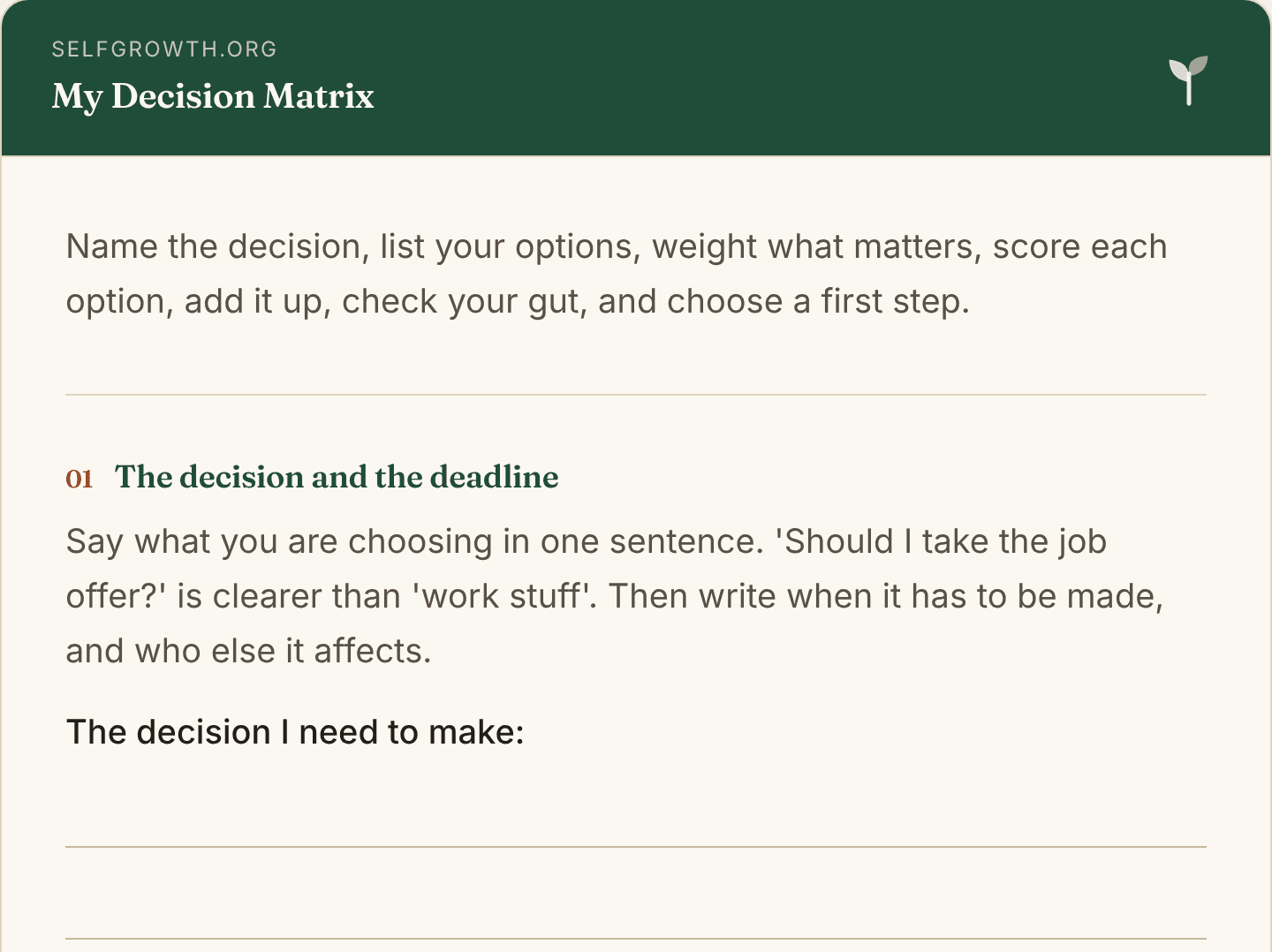
Decision Matrix Template
A free decision matrix template for one personal or work choice: list your options, weight what matters, score each one, check your gut, and name a first step.
Open worksheet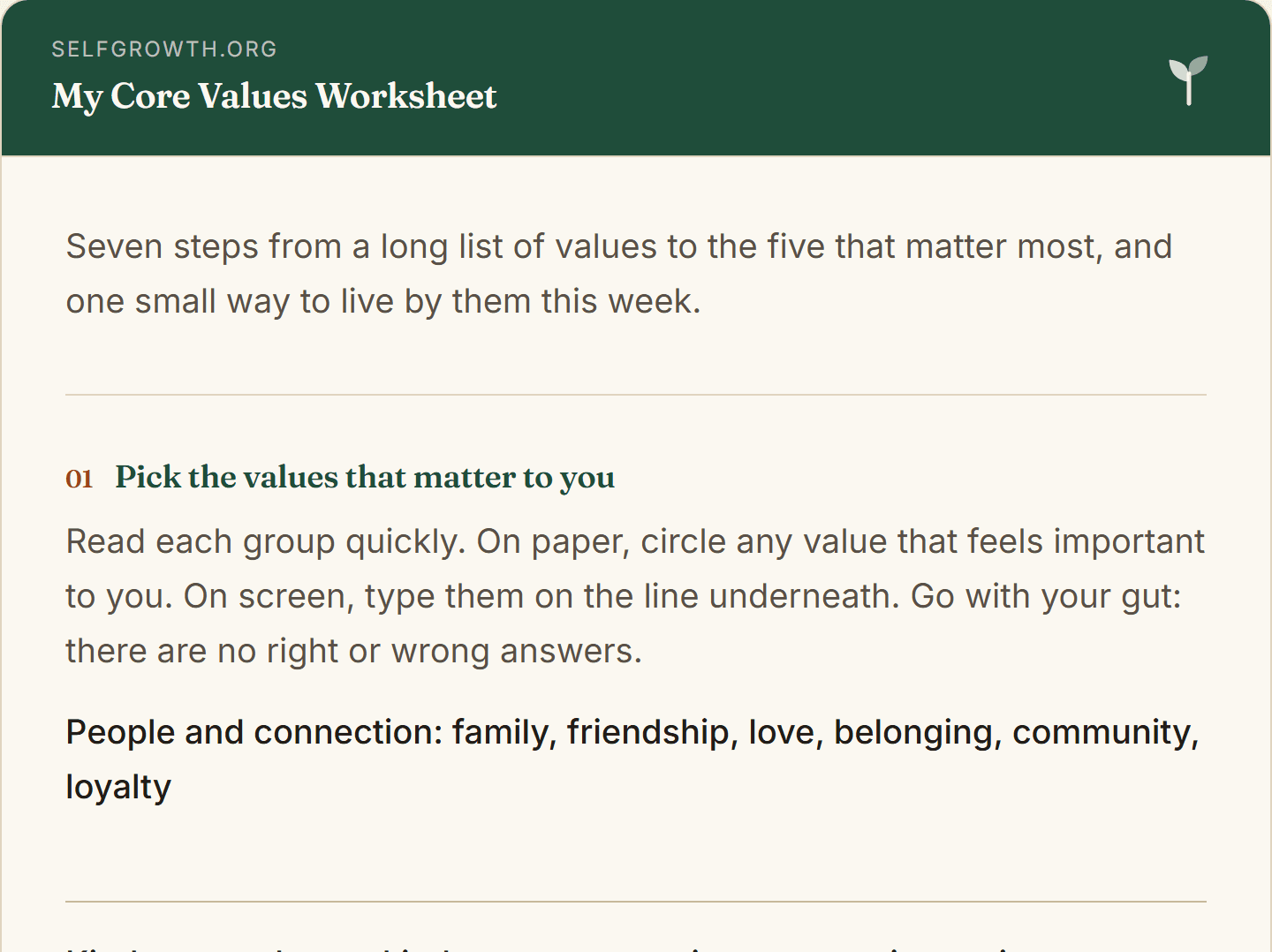
Core Values Worksheet
A free, printable core values worksheet: pick values from a list, narrow them to your top five, put them in your own words and plan one step to live by them.
Open worksheet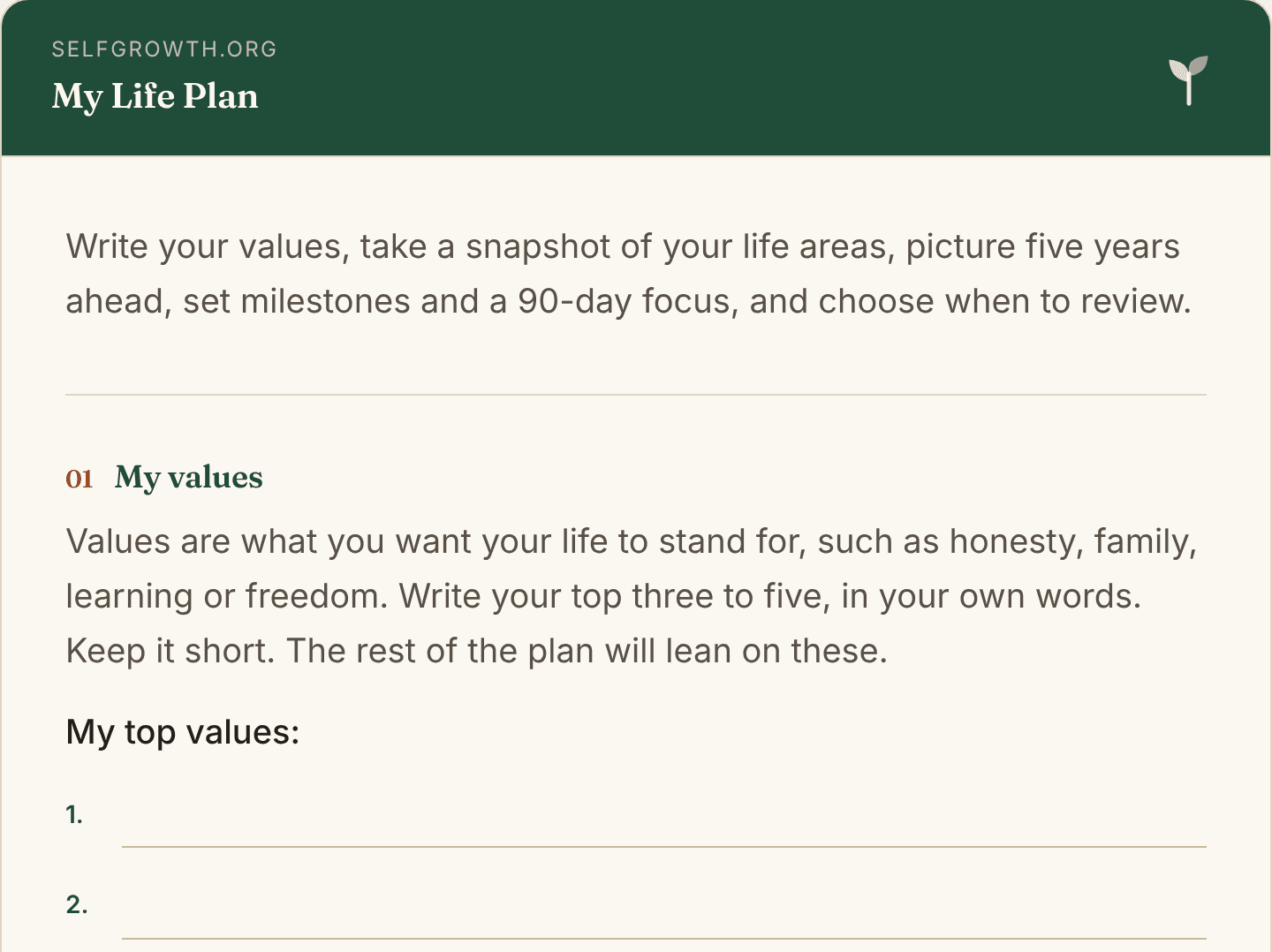
Life Plan Template
A free life plan template: write your values, see where each life area stands, picture five years ahead, set milestones and a 90-day plan, then pick a review.
Open worksheet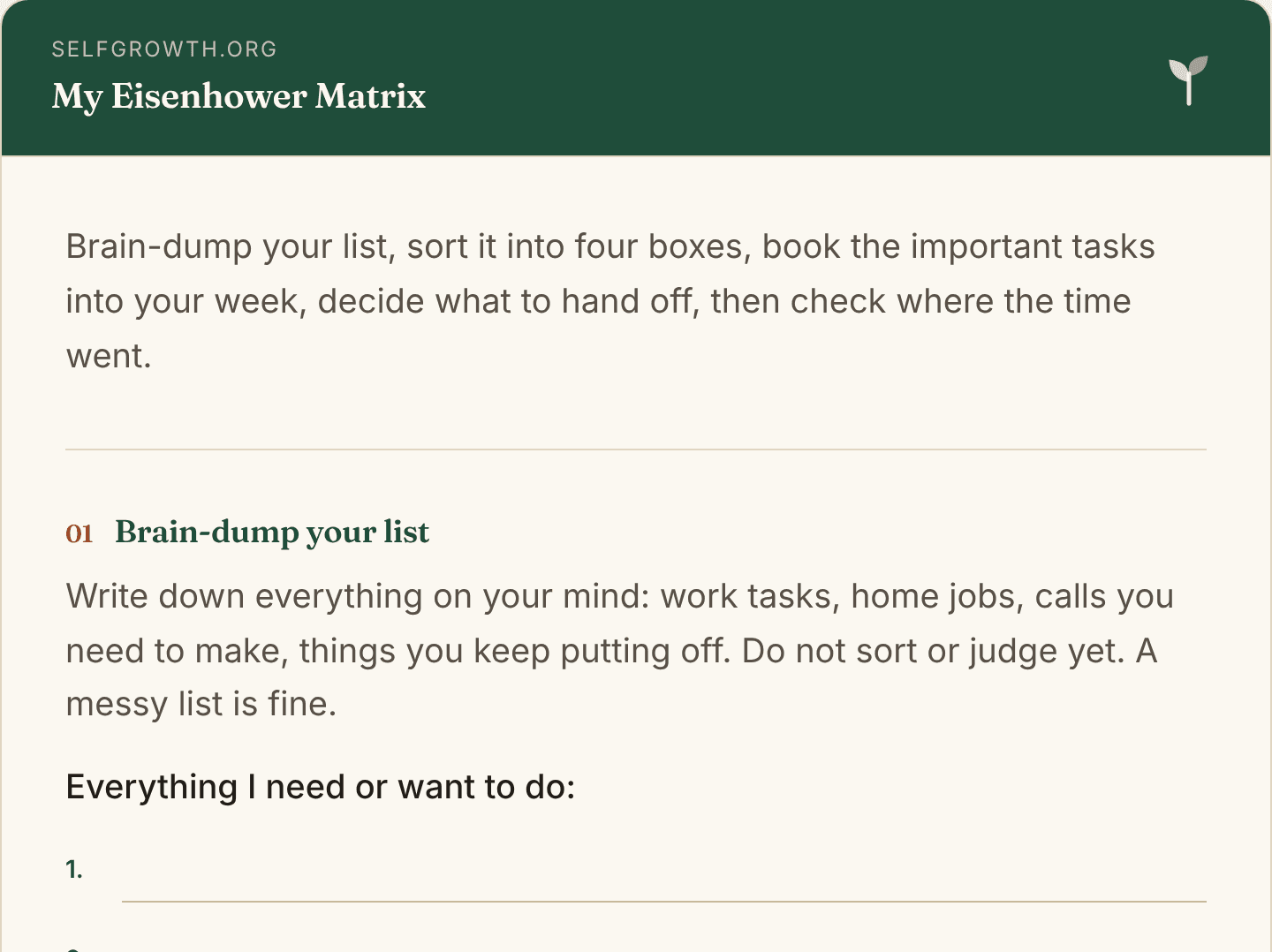
Eisenhower Matrix Template
A free Eisenhower matrix template: empty your head onto a list, sort it into four boxes, book the important tasks into your week, and check where time went.
Open worksheetRelated guides
New worksheets, straight to your inbox
An occasional new worksheet or tool, sent only when there's something genuinely worth your time. No spam, no pressure, unsubscribe any time.