
Guide
Strengths at work: how to find yours and use them more
Updated 25 October 2026 · 9 min read
Your strengths at work are the things you do well that also give you energy, such as explaining ideas, spotting errors, staying calm or getting things finished. To find yours, notice which tasks leave you energised, ask people for examples, look back at feedback and write a list. Then look for ways to do more of them.
Drawn from job crafting research · Part of work and skills
If someone asks 'what are your strengths?' and your mind goes blank, that is a common moment to freeze, and a little prep helps. It is easy to notice what you get wrong and overlook what you do well.
You can find your strengths at work, use them more in the job you have, and talk about them in an interview without bragging or waffling. The strengths list worksheet gives you a place to write them down. If you are also thinking about a bigger move, see the guide to a career change at 40.
This is a self-help guide, not therapy or personal career advice. If low confidence or stress at work is what is really in the way, it is worth talking to a GP or a careers adviser.
What are your strengths at work?
A strength at work is something you do well and that gives you energy, not just something you are able to do. You can be good at a task and still dread it. That is a skill you have, but it may not be a strength you want to build your week around.
A strength can be a skill (writing clearly), a habit of mind (noticing detail) or a way of being with people (keeping a team calm). It can also be quiet. Reliability and kindness count.
Your strengths are not fixed or ranked, and nobody has a perfect set. Think of them as a working list that you add to as you learn.
Examples of strengths at work
These examples are grouped loosely. Many strengths sit in more than one group, and the lists are only a prompt. Yours may not appear here at all.
- People: listening well, explaining things simply, encouraging others, resolving disagreements, building trust, welcoming new colleagues.
- Thinking: spotting patterns, solving problems, learning quickly, asking good questions, seeing the big picture, checking details.
- Doing: finishing what you start, organising tasks, meeting deadlines, working carefully, making things, fixing what is broken.
- Steadying: staying calm under pressure, being reliable, being honest, keeping confidence, handling change, giving a straight answer.
Pick the ones that make you think 'yes, that is me'. Be careful with the ones you think you should have. Strengths you only wish you had will not help you much.
Open the Strengths List WorksheetHow to find your strengths at work
You do not need a test. Most of the answers are already in your own working week. These steps take about an hour of writing, spread over a week.
- 1For one week, jot down the moments when time flew, you felt proud or you finished a task feeling more awake than when you started.
- 2Note the opposite too: the tasks that drain you, even when you do them well. They tell you what not to build on.
- 3Ask three people who know your work, such as a colleague, a manager or a friend, 'when have you seen me at my best?' Ask for a real example, not a label.
- 4Look back at feedback you have had: reviews, thank-you messages, things people keep coming to you for. Underline the repeated words.
- 5Write a list of ten things you do well and enjoy. Use the strengths list worksheet if it helps you start.
- 6Pick your top three and write one recent example for each. If you cannot give an example, move it down the list.
If you want a questionnaire as well, there are well-known ones. The VIA Survey on viacharacter.org is a free questionnaire about character strengths. CliftonStrengths is another well-known one, and it may cost money, so check first. Treat any result as a prompt for your own thinking, not a verdict on you.
Open the Strengths List WorksheetHow to use your strengths more in your job
You often cannot change your job title, but you can sometimes change how you do the job. Researchers Amy Wrzesniewski and Jane Dutton wrote about this in a 2001 paper in the Academy of Management Review, calling it job crafting. Their paper describes employees actively shaping their own work, for example the tasks they do, the relationships they have at work and how they think about the job. It is a theory paper, so treat it as a useful way of looking at your job, not as proof that it will work for you.
Here are small ways to try it:
- Tasks: look for one task a week where a strength fits, and offer to take it on. If you are good at explaining, offer to train a new starter.
- Tasks: trim or swap a task that drains you. Even a small change, such as batching it into one slot, helps.
- Relationships: spend a bit more time with people who bring out your best, or who work in the way you want to learn.
- How you see the job: write one sentence on who your work helps or what it makes possible. It can shift how a dull task feels.
- Ask: bring a specific suggestion to your manager, such as 'I would like to do more of X. Could we try that for a month?'
Start with one change and see how it goes. The professional development plan template can help you turn it into dated steps.
Open the Professional Development Plan TemplateStrengths and weaknesses: what to say in an interview
A plain, honest answer with one real example is easier to believe than a polished, vague one.
- Strength: name one that fits the job, then give a short real example. 'I explain complex things simply. Last year I wrote a one-page guide that new starters still use.'
- Keep it to one or two strengths. A long list sounds like a sales pitch.
- Weakness: name something real that is not central to the job, then say what you are doing about it. 'I used to put off asking for help. Now I set a time limit and ask once I pass it.'
- Avoid fake weaknesses such as 'I work too hard' and avoid anything that rules you out.
- Practise out loud once or twice. Your first try is rarely your best.
A simple shape for each answer: what it is, when you used it, what happened. Read the job advert first and pick the strengths it actually asks for.
When a strength becomes too much
Any strength can be overused. Being careful can turn into never finishing. Being helpful can turn into never saying no. Being direct can feel harsh to someone who needs a gentler touch. This is not a research finding, just a common pattern worth watching for in yourself.
- Check the cost: is this strength leaving you tired, resented or slow?
- Check the effect on others: has anyone hinted you take over, hold on too tightly or go too fast?
- Dial it, do not drop it: aim for 'a bit less' in the moments where it is not helping.
- Pair it: if you are very quick, ask someone steady to check your work. If you are very careful, set a deadline to stop.
If saying yes to everything is part of it, the guide to setting boundaries may help.
When to get more support
A careers adviser can look at your situation in a way a guide cannot. In England, adults aged 18 and over can use the National Careers Service (nationalcareers.service.gov.uk) or call 0800 072 0288, 8am to 6pm, Monday to Friday. In Wales, Careers Wales is on 0800 028 4844.
If work stress is affecting your sleep or mood, or you feel low most days, see your GP. That is a health question, and a new job or a new strength will not always fix it.
If you ever feel unsafe or have thoughts of harming yourself, call Samaritans on 116 123 (UK and Ireland), 988 (US), or find a line at findahelpline.com.
Sources and further reading
This is an educational self-reflection resource, not therapy or medical advice.
If you want to go deeper
- Wrzesniewski, A. & Dutton, J. E. (2001). Crafting a job: Revisioning employees as active crafters of their work. Academy of Management Review, 26(2), 179-201.
- VIA Institute on Character. VIA Character Strengths Survey (viacharacter.org).
- National Careers Service, contact page, UK government (nationalcareers.service.gov.uk).
Your questions, answered
- What are good strengths to say at work?
- Pick the ones that are true for you and that the job needs, such as clear communication, reliability, problem solving, organising or staying calm. Back each one with a short real example, so it does not sound like a label.
- How do I know what my strengths are?
- Notice which tasks give you energy, ask people who know your work for a real example of you at your best, and look at repeated feedback. Write a list of what you do well and enjoy, then pick your top three.
- What are my biggest strengths and weaknesses?
- Your strengths are what you do well and enjoy. Your weaknesses are things that hold you back and that you can name honestly. For an interview, give one real example of each and say what you are doing about the weakness.
- How can I be more confident at work?
- Start by writing down what you already do well, with examples. Use one strength a day on purpose and notice what happens. Ask for small, clear feedback, and take on one slightly stretching task at a time. The guide to building self-confidence has more.
- Can I use my strengths if my job doesn't suit them?
- Sometimes a little. You can shift a task, offer to help in an area that suits you, or use a strength in how you treat people. If the job rarely lets you use any strength, that is useful information about whether it is the right job.
- Is there a strengths list PDF?
- Yes. The strengths list worksheet has a Download PDF button and a Print option. It is free, with no payment and no email needed. You can fill it in on screen, and your answers save in your browser.
- Is this guide career advice or therapy?
- No. It is a self-help guide, not therapy or personal career advice. A careers adviser can look at your situation. If work stress is affecting your sleep or mood, see a GP. If you ever feel unsafe or have thoughts of harming yourself, call Samaritans on 116 123 (UK and Ireland), 988 (US), or find a line at findahelpline.com.
Worksheets to do the work
Free to fill in online or print. No email needed.
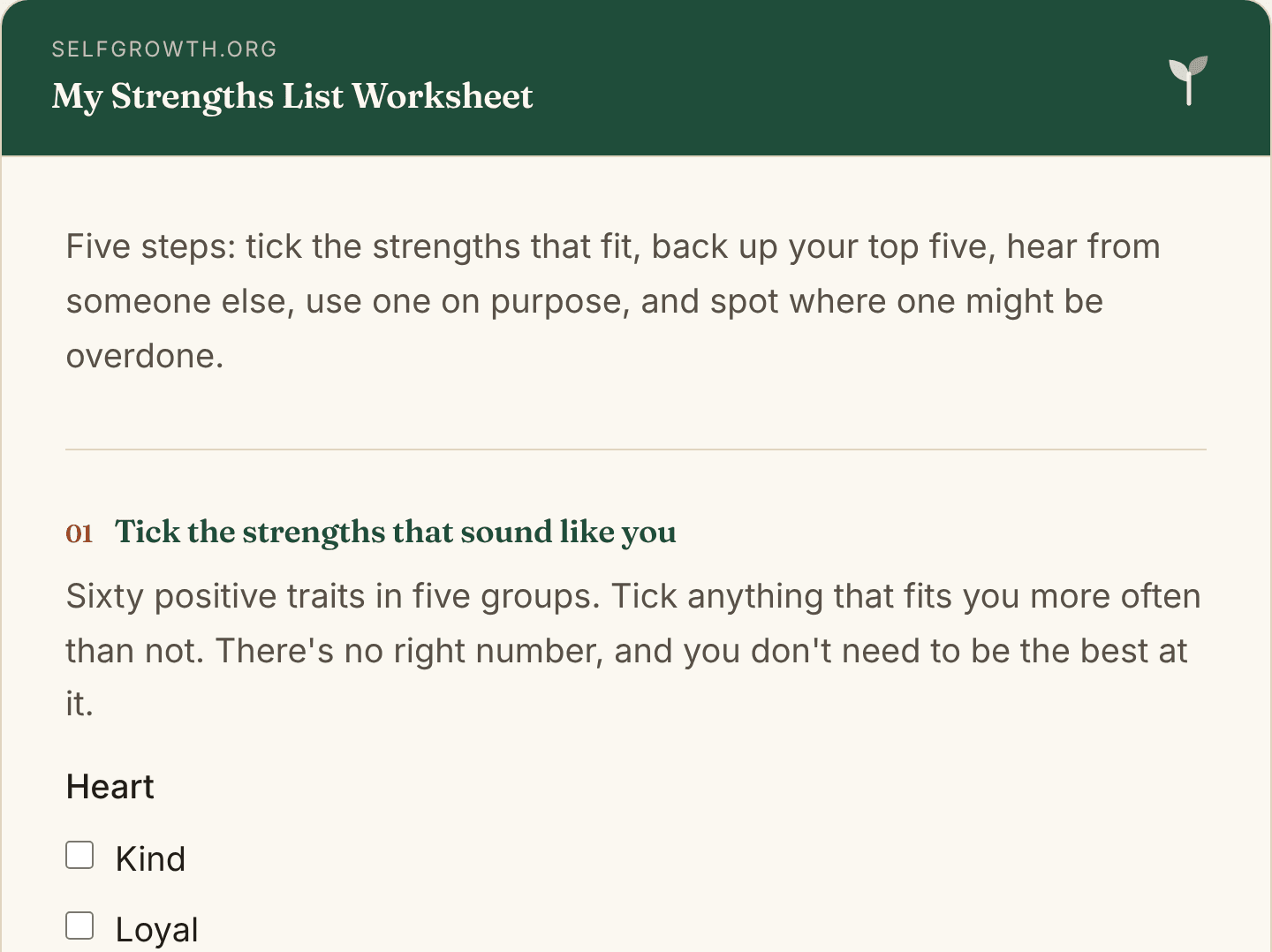
Strengths List Worksheet
A free list of 60 positive character traits and strengths to tick, with space for evidence, what others see in you and one strength to use on purpose this week.
Open worksheet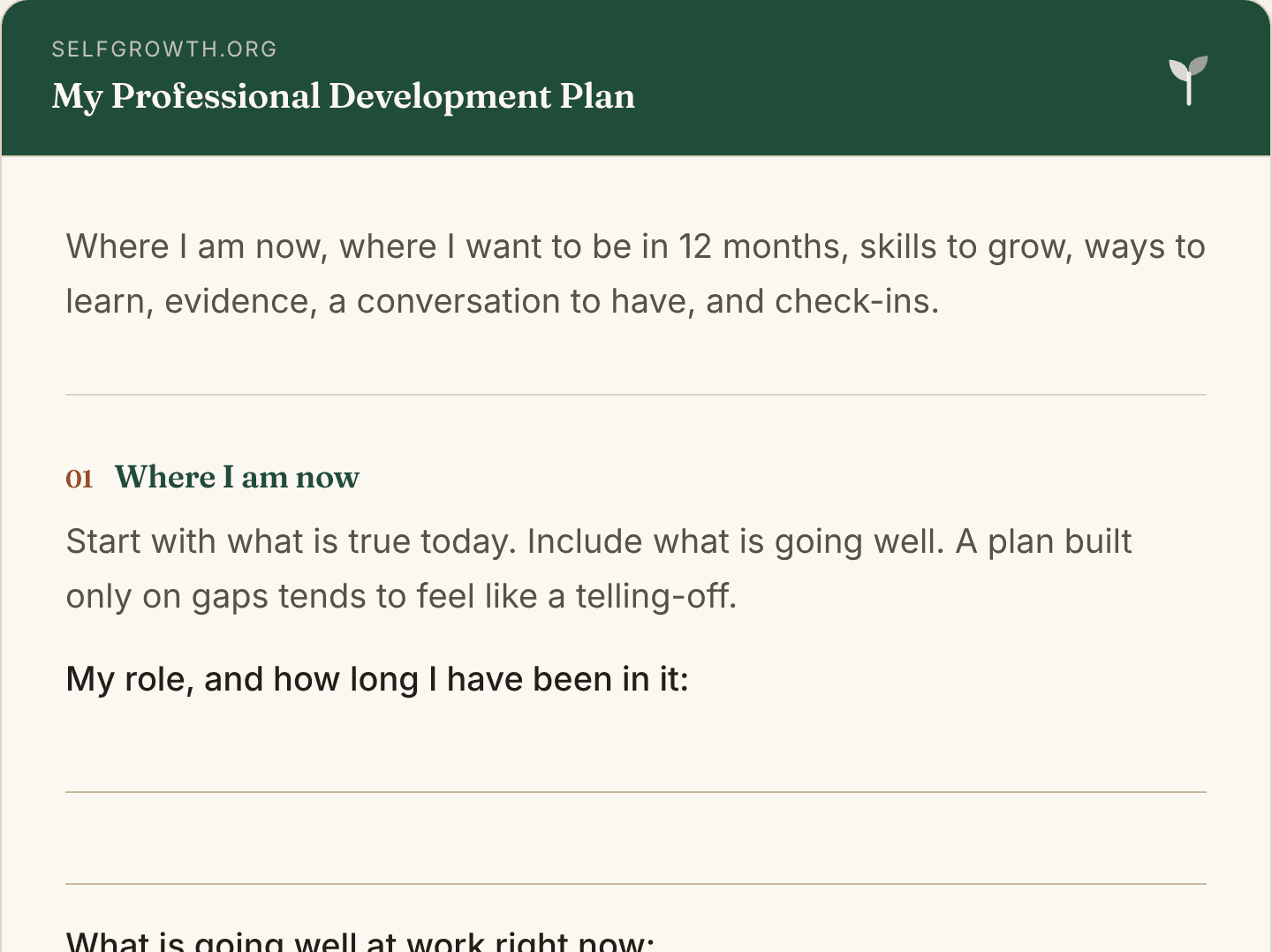
Professional Development Plan Template
A free printable professional development plan template: where you are now, 12-month aims, skills to grow, support, evidence and quarterly check-ins.
Open worksheet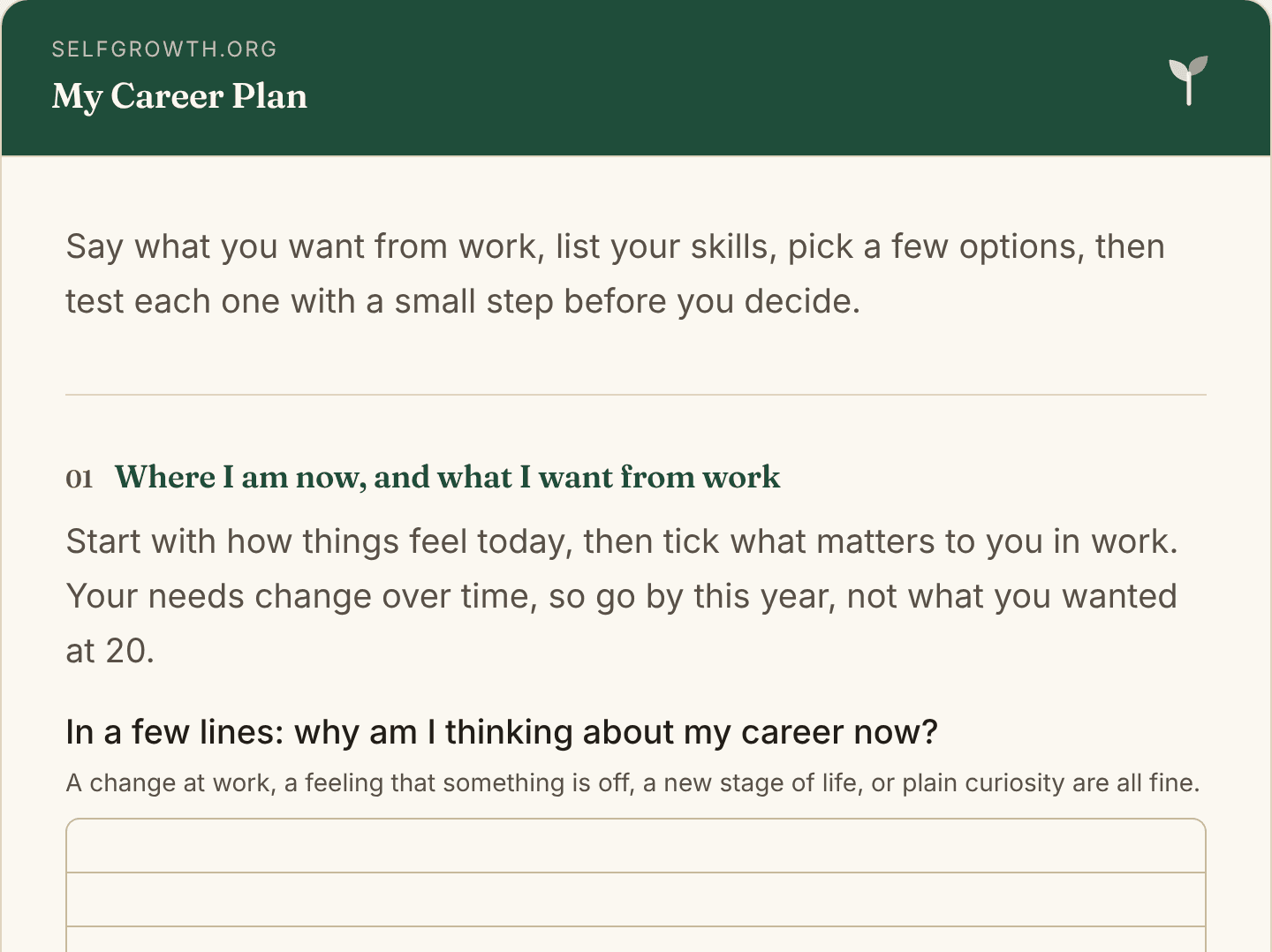
Career Planning Worksheet
A free career planning worksheet with a skills inventory, values checklist and small experiments. Use it for a first plan or a career change. No email needed.
Open worksheet
Self-Confidence Worksheet
Free self-confidence worksheets (PDF) for adults, for one situation you dread: list strengths and past wins, answer self-doubt, take one small step.
Open worksheetRelated guides
New worksheets, straight to your inbox
An occasional new worksheet or tool, sent only when there's something genuinely worth your time. No spam, no pressure, unsubscribe any time.