
Guide
Digital detox: how to do one that fits your life
Updated 25 October 2026 · 8 min read
A digital detox is a planned break from some or all of your devices, so you can use them on purpose again. To do one, decide what you want back, pick one small target, change your settings, make some places and times phone-free, plan what to do instead, and review after a week.
Drawn from research on digital detox interventions and if-then planning · Part of habits and getting things done
You pick up your phone to check one thing. Twenty minutes later you are still scrolling, and you cannot remember what the one thing was. Or you reach for it in a queue, at the table or in bed without ever deciding to.
A digital detox is one way to take that back. It does not have to mean a cabin and no signal. It can be one app, one evening a week or one room.
What is a digital detox?
A digital detox is a time when you step back from your devices, either completely or for part of your use. That might be a weekend with no phone, a month without one social app, or a daily hour with every screen off. Radtke and colleagues, in their 2022 review, define it as time away from electronic devices, either completely or for some uses.
The point is not to prove you can go without. The point is to find out what you miss, what you do not, and which habits you want to keep. A detox is a way to look at your habits with a bit of distance. It is about attention and routine, not about something being wrong with you.
Signs you might want a digital detox
Only you can say whether your screen time suits your life. These are signs to look for in yourself:
- You reach for your phone without deciding to, and notice only when it is already in your hand.
- You pick it up to do one thing and end up doing something else.
- You feel a pull to check it during a conversation, a film or a meal.
- You lose track of how long you have been scrolling.
- You feel flat or restless after a long stretch of it.
- You keep meaning to do something else with your evenings and it does not happen.
- You check work messages in places and at times you would rather not.
- You feel uneasy when your phone is not near you.
Seeing yourself in one or two of these is a reason to try a small experiment, not a reason to worry.
How to do a digital detox: step by step
Start smaller than you think you need to. A change you can keep up is worth more than a big one you drop on day three.
- 1Decide what you want back. Write one line: more time with a book, calmer evenings, a proper lunch break, being present with someone. This is what you will go back to when it feels hard.
- 2Pick one small target. Choose a single app, a single time of day or a single place. 'No social apps before 9am' is a better target than 'use my phone less'.
- 3Change the settings. Turn off notifications you do not need. Move the tempting apps off your first screen. Set the phone to grey, or set a time limit, if that helps you notice.
- 4Create phone-free places and times. For example, the bedroom, the table at meals, or the first half hour of the day. Put a charger somewhere other than your bed and use a cheap alarm clock if the phone is your alarm.
- 5Plan what you will do instead. A gap with nothing in it gets filled by the old habit. Decide on a book, a walk, a call or a puzzle, and put it where you can see it. Use an if-then plan: 'If I sit down after dinner, then I pick up my book.'
- 6Tell the people who rely on you. A short message such as 'I will be slower to reply this week' sets expectations. Say how they can reach you if it is urgent.
- 7Review after a week. Ask what you missed, what you did not, what got easier and what you want to keep. Then choose to keep it, change it or try the next small target.
An if-then plan, as in step 5, is the one part of this with research behind it. Psychologist Peter Gollwitzer's work on implementation intentions looks at plans that link a situation you expect to a response you decide in advance. A 2006 review by Gollwitzer and Paschal Sheeran pooled 94 independent tests and found that these plans made a medium-to-large difference to reaching goals. Those studies were about many kinds of goal, not phone use. The rest of this plan is a practical format. No study has tested this exact set of steps.
Open the Habit Tracker PrintableA habit tracker gives you somewhere to tick off each phone-free hour or evening. If your target is how you wind down at night, the evening routine checklist gives that time a shape, so the gap has something in it.
Open the Evening Routine ChecklistA 7-day digital detox challenge
One small step a day. Do them in order, or pick the ones that suit you. If you miss a day, carry on from where you are.
- Day 1: Notice. Do not change anything. Just look at how often you pick up your phone and what you were after each time.
- Day 2: Turn off notifications for every app that is not a person or something time-sensitive.
- Day 3: Move the apps you open without thinking off your first screen.
- Day 4: Pick one meal and have it with no screens at the table.
- Day 5: Charge your phone outside the bedroom tonight.
- Day 6: Take a walk, or do one errand, without your phone or with it left in your bag.
- Day 7: Look back. Write down what you missed, what you did not, and one change you want to keep.
You can do this alone or with a friend or partner. It is your choice whether to tell anyone.
Does a digital detox work?
The honest answer is that the research is mixed. A 2022 systematic review by Radtke and colleagues, in Mobile Media & Communication, looked at digital detox studies. They searched seven databases and found 21 studies with 3,625 participants in total, 12 of them randomised controlled trials. The effects varied across studies, whether they looked at health and well-being, social relationships, self-control or performance. Some studies found positive effects of a detox. Others found no effect, or even negative effects on well-being. The authors say more research is needed to understand why.
So a detox is not a guaranteed fix, and it may not change how you feel. What it can do is give you a clear look at your own habits, which only you can judge. If a break leaves you feeling better, keep what helped. If it does not, that is useful to know, and you can try a different target.
Digital detox at work
Work is where a full break is hardest, because messages may be part of the job. Aim for edges rather than a ban. Decide when you start and stop checking work messages, turn off alerts outside those times, and agree what counts as urgent and how people reach you if it is.
If you feel pulled to answer at all hours, that can be a boundary question as much as a phone question. The guide to work boundaries covers how to say what you are available for, and when.
When to get more support
This is a self-help tool, not therapy or medical advice. If you find screen use hard to control and it is harming your sleep, work, money or relationships, see your GP. They can talk it through with you and point you to proper support. It does not mean you have failed at a detox.
If you ever feel unsafe or have thoughts of harming yourself, call Samaritans on 116 123 (UK and Ireland), 988 (US), or find a line at findahelpline.com.
Sources and further reading
This is an educational self-reflection resource, not therapy or medical advice.
If you want to go deeper
- Radtke, T., Apel, T., Schenkel, K., Keller, J. & von Lindern, E. (2022). Digital detox: An effective solution in the smartphone era? A systematic literature review. Mobile Media & Communication, 10(2), 190-215.
- Gollwitzer, P. M. & Sheeran, P. (2006). Implementation intentions and goal achievement: A meta-analysis of effects and processes. Advances in Experimental Social Psychology, 38, 69-119.
Your questions, answered
- What is a digital detox?
- A digital detox is a planned break from some or all of your devices. It can be a weekend with no phone, a month without one app, or a daily hour with screens off. Radtke and colleagues, in their 2022 review, define it as time away from electronic devices, either completely or for some uses.
- How long should a digital detox last?
- There is no set length. A small one can be an evening, a day or a week, and the 7-day challenge above is one way to start. Pick a length you can keep to, then look back and decide whether to extend it, repeat it or keep one habit from it.
- How do I do a digital detox without quitting my phone?
- Change how you use it rather than whether you do. Pick one small target, such as one app or one time of day. Turn off notifications you do not need, move tempting apps off your first screen, charge the phone outside the bedroom and decide what you will do instead.
- Does a digital detox work?
- The research is mixed. A systematic review of 21 studies found that effects varied. Some studies found positive effects on outcomes such as well-being, others found no effect, and some found negative effects on well-being. It can still be a useful way to look at your own habits.
- What can I do instead of scrolling?
- Choose something specific before the urge hits, such as a book, a walk, a call to a friend, cooking, a puzzle or a hobby you have put off. Put it where you can see it, and link it to a moment with an if-then plan: 'If I sit down after dinner, then I pick up my book.'
- Is there a digital detox plan PDF?
- Not of the plan itself. The step-by-step plan and 7-day challenge above are free to read. The habit tracker printable (to tick off each phone-free hour or evening) has a Download PDF button and a Print option, with no payment and no email needed. You can fill it in on screen, and your answers save in your browser.
- Is this a substitute for therapy?
- No. It is a self-help tool, not therapy. If screen use feels hard to control and it is affecting your sleep, work, money or relationships, or if low mood or stress is the real block, talk to a GP. If you ever feel unsafe or have thoughts of harming yourself, call Samaritans on 116 123 (UK and Ireland), 988 (US), or find a line at findahelpline.com.
Worksheets to do the work
Free to fill in online or print. No email needed.
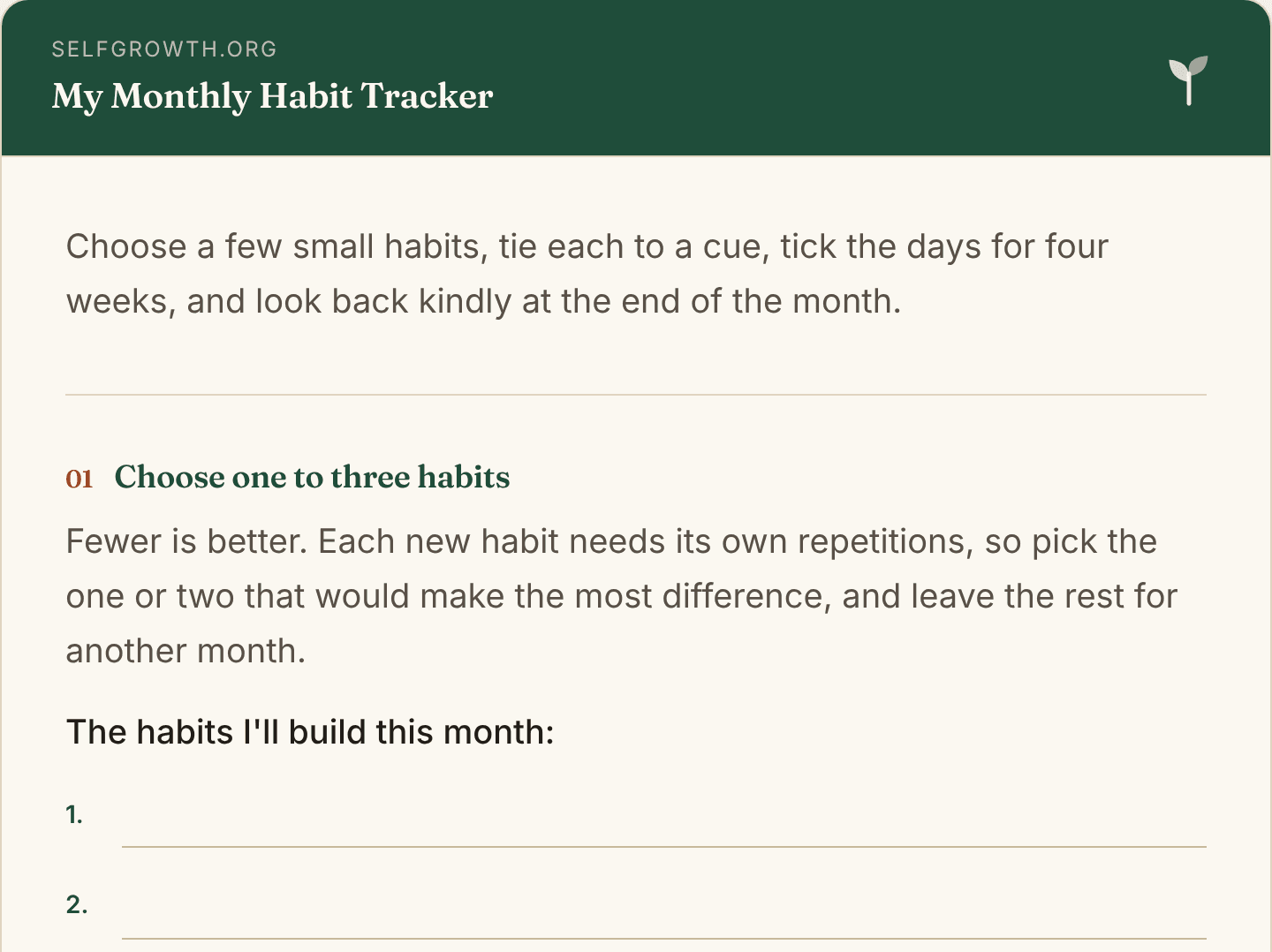
Habit Tracker Printable
A free printable habit tracker for one month: choose one to three small habits, tie each to a cue, tick the days, and review what helped. Print or fill it in.
Open worksheet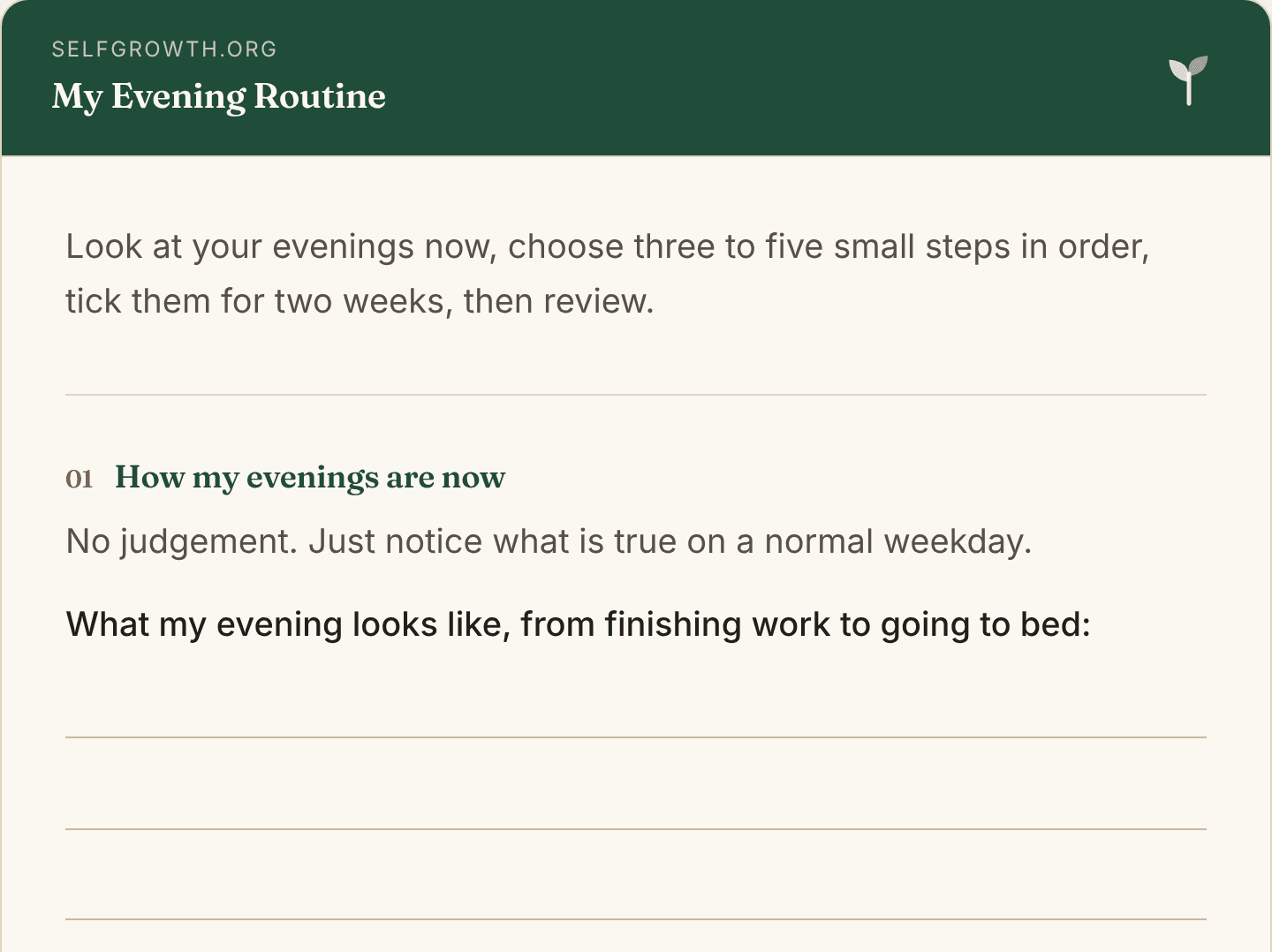
Evening Routine Checklist
A free evening routine checklist and wind down routine: pick 3 to 5 small steps, tick them for two weeks, set a tired-evening minimum, then review what to keep.
Open worksheet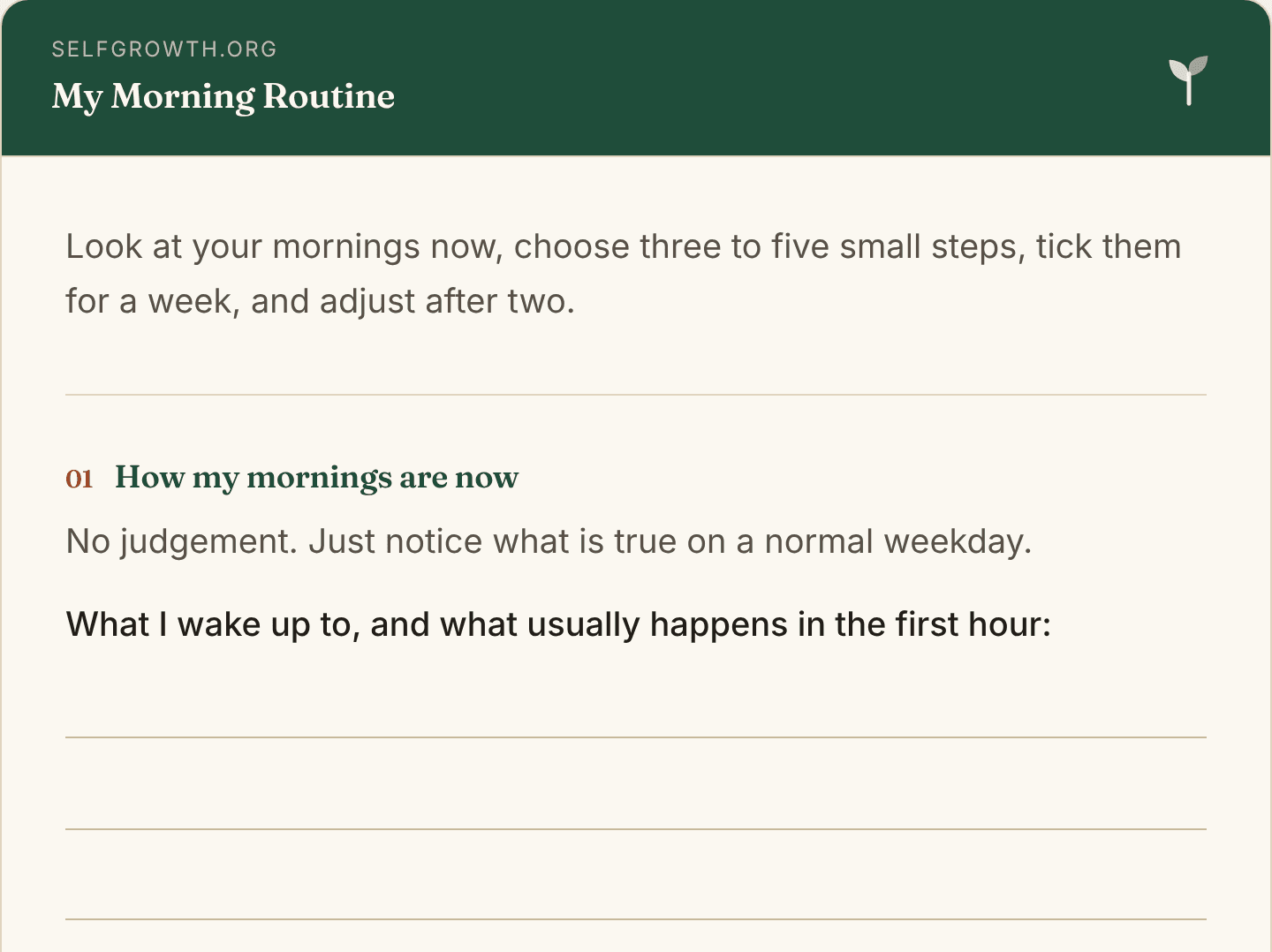
Morning Routine Checklist
A free morning routine checklist and daily routine template: pick 3 to 5 small steps, tick them for a week, plan the night before, set a bad-morning minimum.
Open worksheet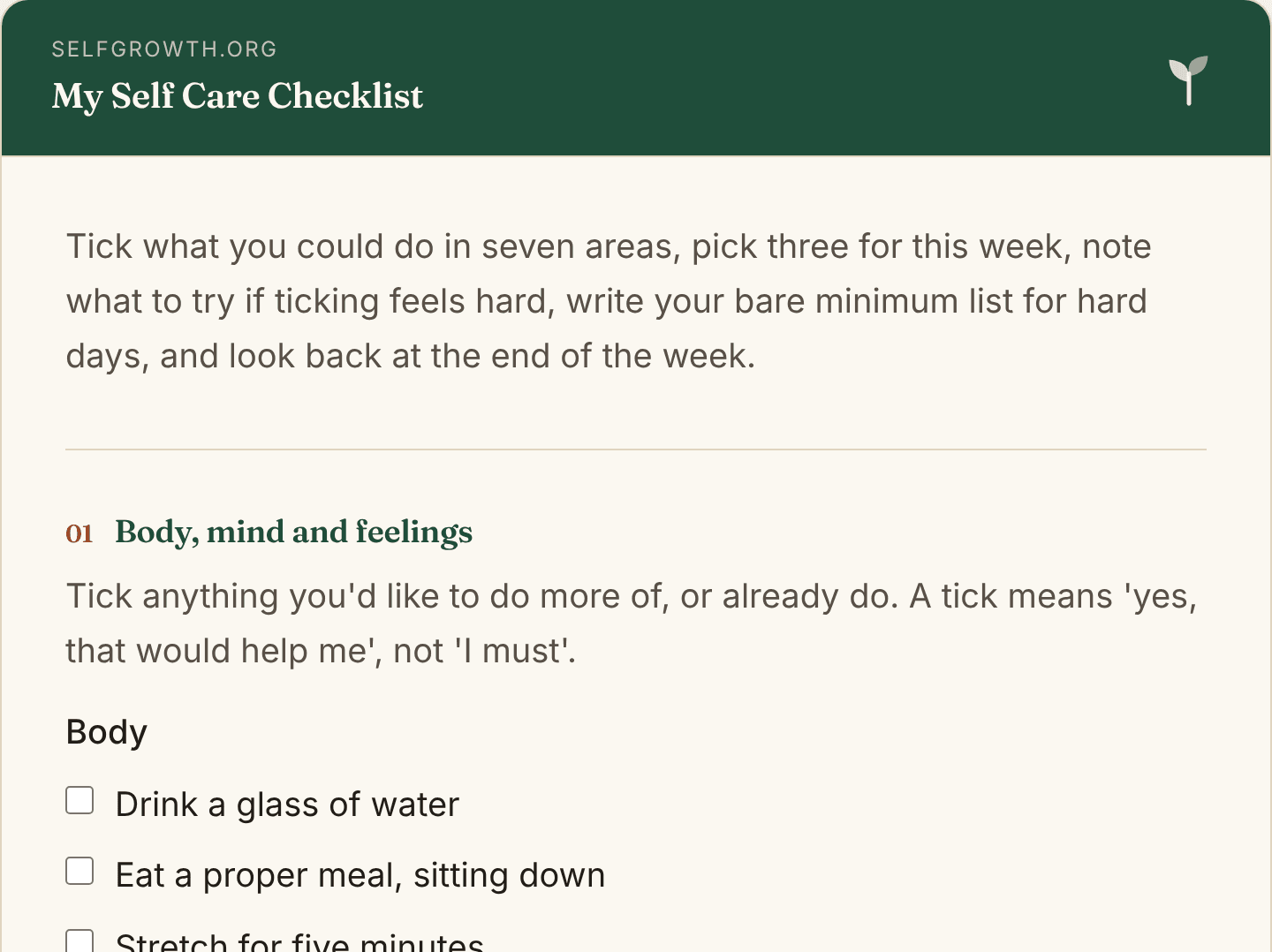
Self Care Checklist
A free self care checklist printable: tick small, cheap things across body, mind, feelings, people, home, money and rest. Pick three and add a hard-day list.
Open worksheetRelated guides
New worksheets, straight to your inbox
An occasional new worksheet or tool, sent only when there's something genuinely worth your time. No spam, no pressure, unsubscribe any time.