
Guide
Habit stacking: how to build a habit stack that sticks
Updated 25 October 2026 · 8 min read
Habit stacking means attaching a new habit to one you already do, so the old habit becomes the cue: 'After I pour my coffee, I'll write one line in my journal.' It is a form of if-then planning, which research supports. The name is popular, but stacks themselves have not been tested as a method.
Drawn from implementation-intention and habit-formation research · Part of habits and getting things done
You know the habit you want. The trouble is remembering it, day after day, when nothing in your day says 'now'. Habit stacking gives it a 'now'. You hang the new habit on something you already do without thinking.
Here is what habit stacking is, what the research does and does not say, and how to build your own stack in seven steps. If you want the bigger picture first, start with the guide to building good habits. A free tracker at the end gives you somewhere to tick it off.
What is habit stacking?
Habit stacking is a simple rule: 'After I [habit I already have], I will [new habit].' The habit you already have is the anchor. The new one rides on it. You stop trying to remember, because finishing the anchor is the reminder.
The word 'stack' comes from the idea that you can add more than one link. After you pour your coffee, you take your vitamins. After you take your vitamins, you write your plan for the day. Each habit sets off the next. Keep it to two or three links so one missed step does not break the chain.
Two books use the name: Habit Stacking by S. J. Scott (2014) and Atomic Habits by James Clear (2018). Who first used the phrase is unclear, and the idea underneath is older, so it is safest to treat 'habit stacking' as a handy label rather than a single person's invention.
Does habit stacking work?
Part of it has good research behind it. Part of it has none. Here is the split.
The solid part is the if-then plan. Psychologists call it an 'implementation intention': you decide in advance 'when this happens, I will do that'. In a large 2006 review, Peter Gollwitzer and Paschal Sheeran pooled the results of many tests and found that people who made these plans were more likely to reach their goals than people who only set the goal.
The second part is the cue. In a 2010 study led by Phillippa Lally, 96 volunteers each picked one eating, drinking or activity habit and did it daily in the same context, for example 'after breakfast', for 12 weeks. The habit felt more automatic the more they repeated it in that same context. The time it took varied a lot, from 18 to 254 days. A 2016 review by Wendy Wood and Dennis Rünger describes habits in the same way: the same action, repeated in the same situation, until the situation starts to prompt it.
What is missing is a test of stacks themselves. The research is on if-then plans and on repeating an action in a steady context. Whether chaining three habits together works better than a single plan is not something these studies show. So treat a stack as a neat way to write an if-then plan, not as a proven system.
That is a reasonable thing to try. It costs nothing, and you can see within a couple of weeks whether it works for you. The guide to building good habits covers how long to give it.
Habit stacking examples
A good stack is made of plain, everyday moments. These are starting points. Swap in whatever really happens in your day.
- Morning: After I switch off my alarm, I will drink a glass of water.
- Morning: After I pour my coffee, I will write down the one thing I want to finish today.
- Morning: After I brush my teeth, I will do two minutes of stretching.
- Work: After I sit down at my desk, I will open my to-do list and pick one task.
- Work: After I finish a call, I will stand up and take three deep breaths.
- Work: After I eat lunch, I will walk around the block.
- Evening: After I put the kettle on, I will tidy one surface.
- Evening: After I plug in my phone, I will read two pages of a book.
- Evening: After I get into bed, I will write down one thing that went well.
Notice that every anchor is something that happens at a fairly fixed time and place, and every new habit is small. You can find more ideas for the start of the day on the morning routine checklist.
Open the Morning Routine ChecklistHow to build a habit stack: step by step
Start with one stack of one link. Add a second only when the first feels easy.
- 1Pick one habit you want. Choose the one that would make the biggest difference to your week.
- 2Make it small enough for your worst day. Two pages, not a chapter. One minute, not twenty.
- 3List what you already do every day. Write down five or six things that happen without fail, such as waking up, making a drink, sitting down at your desk or brushing your teeth.
- 4Choose the anchor. Pick the one that happens at a steady time and place, and that you finish before the new habit begins. 'After I check my phone' is a weak anchor if you check it all day.
- 5Write the sentence: 'After I [anchor], I will [new habit].' Say it out loud once.
- 6Set the scene. Put what you need where the anchor happens: the book on your pillow, the water by the kettle.
- 7Tick it off for two weeks, then look back. If it is easy, add one more link. If it keeps slipping, change the anchor or make the habit smaller.
A paper tracker makes step 7 easy. It takes a few seconds a day, and the gaps show you where the stack is breaking.
Open the Habit Tracker PrintableWhy habit stacks fall apart (and what to do)
If a stack keeps failing, it is rarely about willpower. These are the usual causes, with a fix for each.
- The anchor is vague or happens at random times. Pick something with a steady time and place.
- The new habit is too big. Shrink it until it takes under two minutes.
- The stack is too long. A chain of seven habits breaks as soon as one link is missed. Go back to one or two links.
- The anchor does not happen every day. A habit tied to 'after I go to the gym' is gone on rest days. Choose a daily anchor.
- You are stressed or ill. Wood and Rünger's review describes research showing that stress makes people fall back on the habits they already have. A hard month is not the time to judge yourself. Keep only the smallest link.
- You missed a day and gave up. In Lally's study, missing one opportunity did not materially affect how the habit formed. Come back at the next anchor, without trying to catch up.
- You are putting off starting. If the first move keeps slipping, the guide to stopping procrastinating looks at what is behind it.
If you feel flat and have little energy for anything, the guide to getting motivated is a gentler place to begin than a stack.
When to get more support
Sometimes the trouble is bigger than the habit. If you cannot get going with anything because you feel low, hopeless or exhausted most days, that may be low mood rather than a lack of discipline. If the habit you want to change is drinking, drug use, gambling or eating in a way that feels out of control, a stack is not enough. A GP is a good first step and can talk you through your options.
This is a self-help tool, not therapy or medical advice. If you ever feel unsafe or have thoughts of harming yourself, call Samaritans on 116 123 (UK and Ireland), 988 (US), or find a line at findahelpline.com. You deserve real support, not just a checklist.
Sources and further reading
This is an educational self-reflection resource, not therapy or medical advice.
If you want to go deeper
- Gollwitzer, P. M. & Sheeran, P. (2006). Implementation intentions and goal achievement: A meta-analysis of effects and processes. Advances in Experimental Social Psychology, 38, 69-119.
- Lally, P., van Jaarsveld, C. H. M., Potts, H. W. W. & Wardle, J. (2010). How are habits formed: Modelling habit formation in the real world. European Journal of Social Psychology, 40(6), 998-1009.
- Wood, W. & Rünger, D. (2016). Psychology of habit. Annual Review of Psychology, 67, 289-314.
- Scott, S. J. (2014). Habit Stacking. CreateSpace.
- Clear, J. (2018). Atomic Habits. Avery.
Your questions, answered
- What is habit stacking?
- Habit stacking means linking a new habit to one you already do, so the old habit becomes the cue. The format is 'After I [habit I already have], I will [new habit].' For example: 'After I pour my coffee, I will write one line in my journal.'
- Does habit stacking really work?
- The research behind it is on if-then plans, which a large 2006 review found helped people reach goals, and on repeating an action in the same context so it becomes automatic. Stacks themselves, meaning chains of habits, have not been tested as a method. It is a sensible format to try, not a proven system.
- Who invented habit stacking?
- It is unclear. Two books use the name: Habit Stacking by S. J. Scott (2014) and Atomic Habits by James Clear (2018). The idea underneath, tying an action to a cue, is much older and sits within research on if-then plans and habit formation.
- How many habits should I stack?
- Start with one new habit on one anchor. Add a second link only when the first feels easy, and keep the whole stack to two or three links. A long chain breaks as soon as one link is missed.
- How long does it take for a habit stack to stick?
- It varies. In a 2010 study, the time for a daily habit to reach its limit of automaticity ranged from 18 to 254 days. Expect weeks or months, not a fixed number of days, and judge it by whether it feels a little easier over time.
- Is there a habit stacking PDF?
- Yes. The habit tracker and the morning routine checklist both have a Download PDF button, or you can use Print. They are free, with no payment and no email needed. You can fill them in on screen first, and your answers save in your browser.
- Is this a substitute for therapy?
- No. This is a self-help tool, not therapy. If low mood or stress is what is really getting in the way, a GP is a good first step. If you ever feel unsafe or have thoughts of harming yourself, call Samaritans on 116 123 (UK and Ireland), 988 (US), or find a line at findahelpline.com.
Worksheets to do the work
Free to fill in online or print. No email needed.
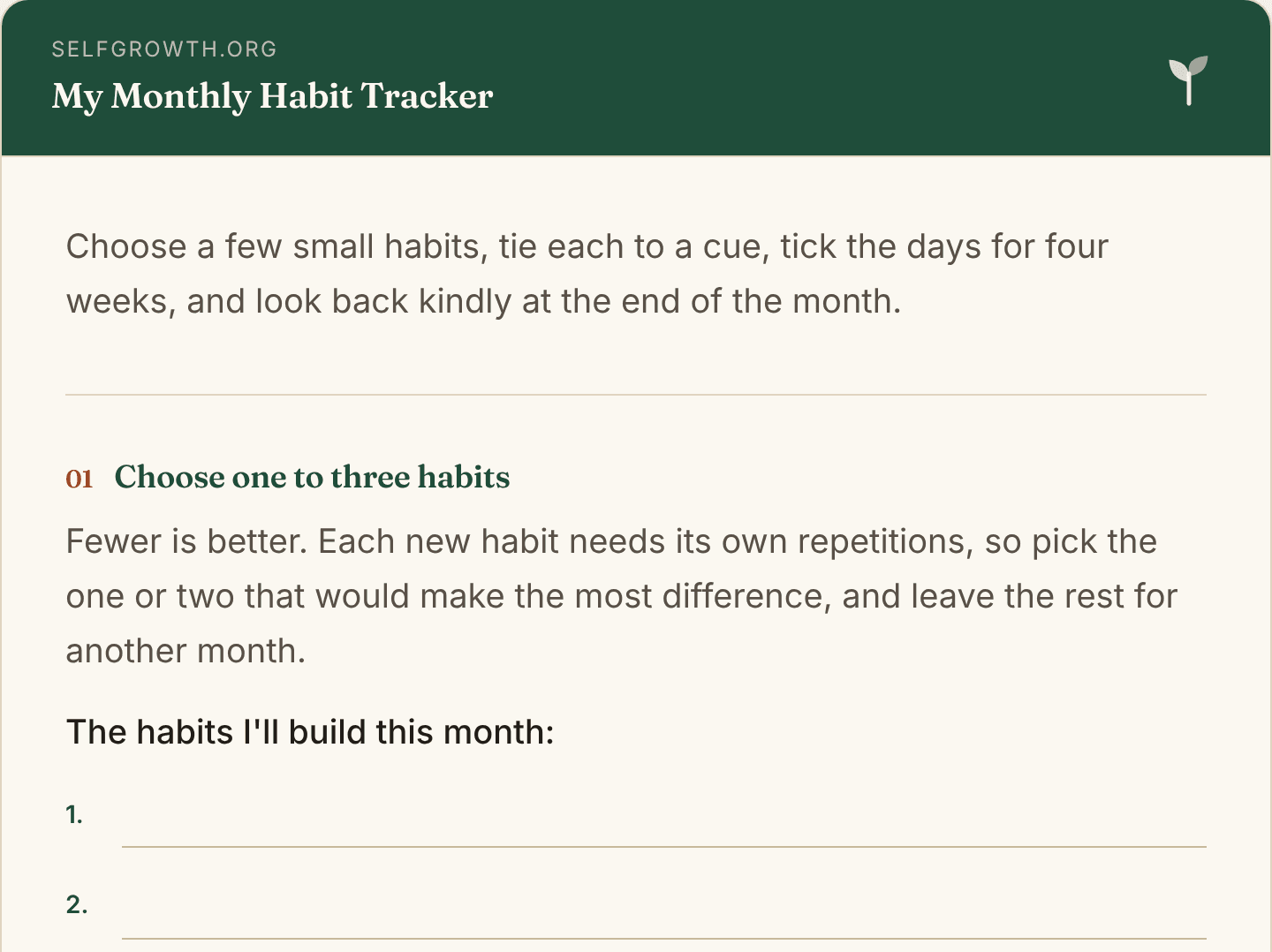
Habit Tracker Printable
A free printable habit tracker for one month: choose one to three small habits, tie each to a cue, tick the days, and review what helped. Print or fill it in.
Open worksheet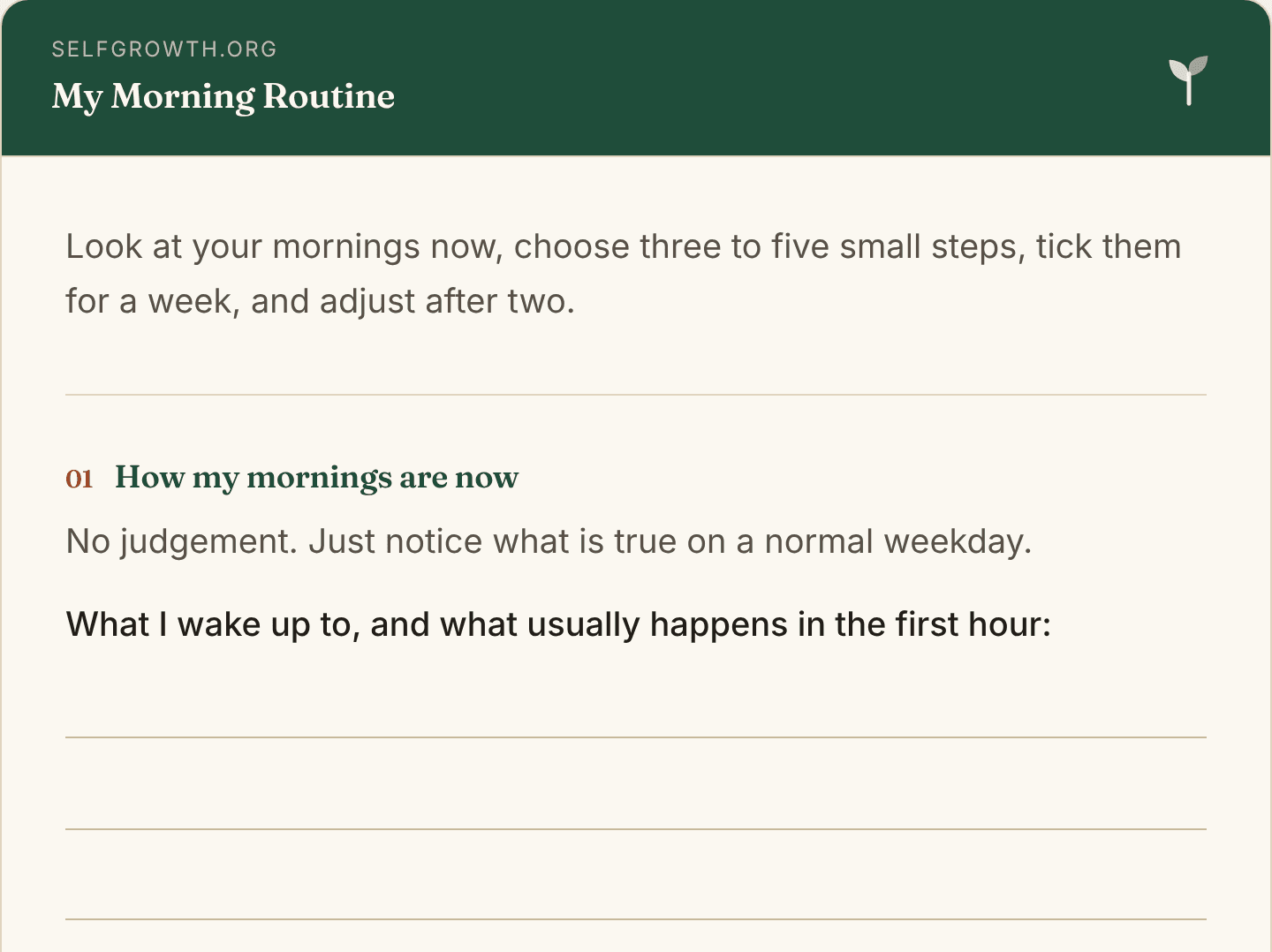
Morning Routine Checklist
A free morning routine checklist and daily routine template: pick 3 to 5 small steps, tick them for a week, plan the night before, set a bad-morning minimum.
Open worksheet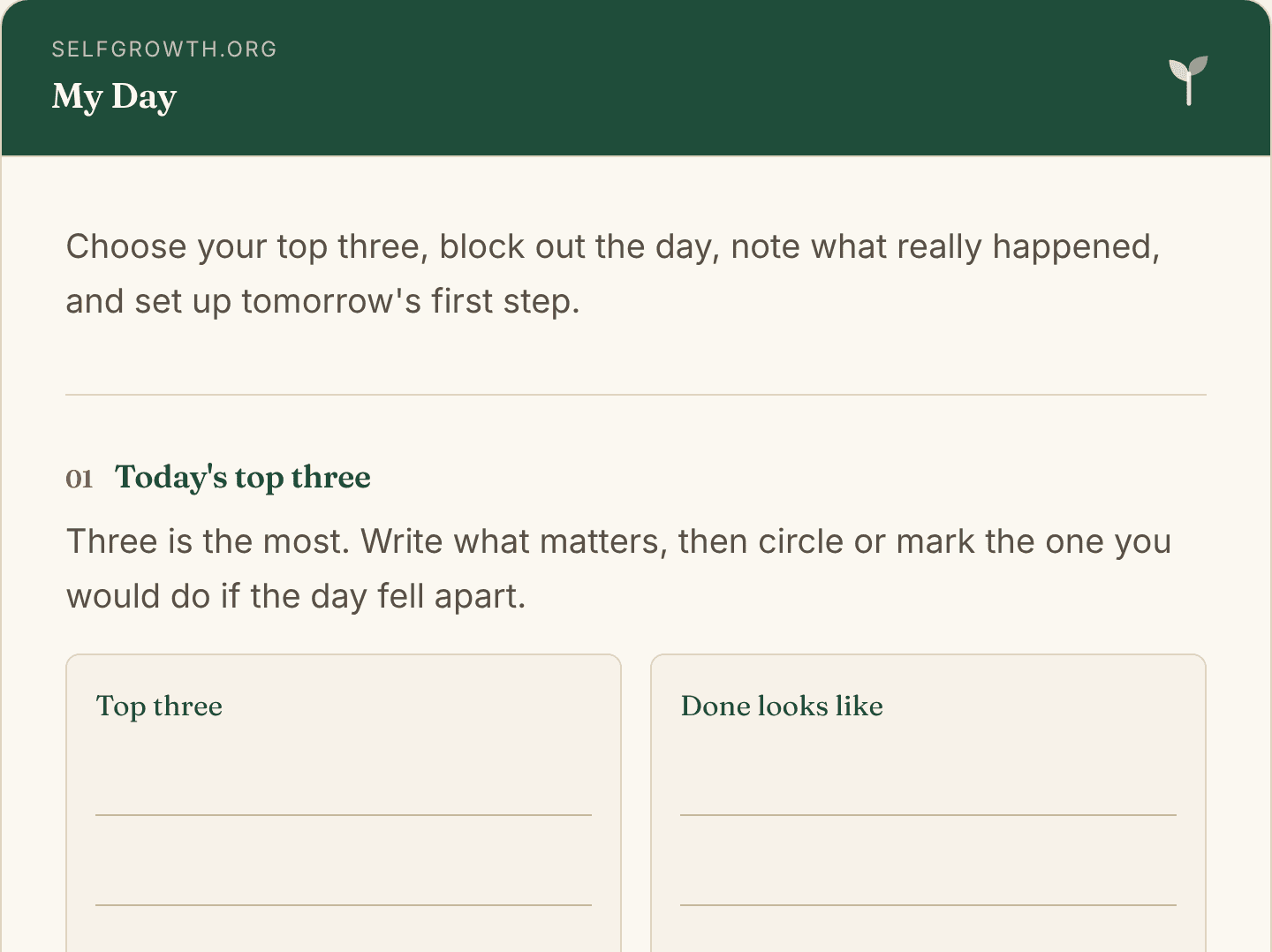
Daily Planner Template
A free daily planner template on one page: top three, time blocks, appointments, breaks, a short to-do list and a two-minute look back. Print or fill in.
Open worksheet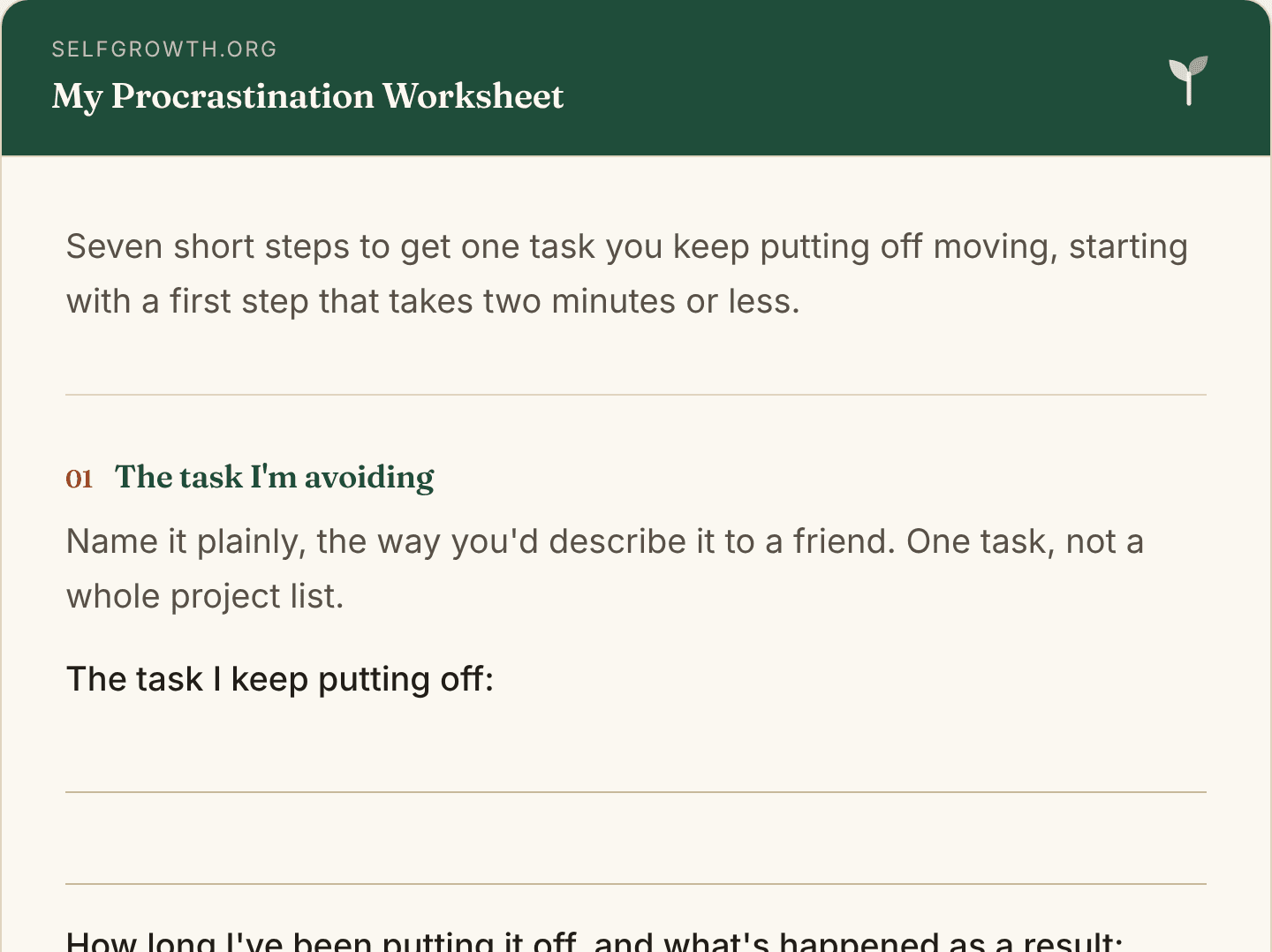
Procrastination Worksheet
A free, printable procrastination worksheet: name the feeling you're avoiding, find a two-minute first step, make an if-then plan and log seven days of starts.
Open worksheetRelated guides
New worksheets, straight to your inbox
An occasional new worksheet or tool, sent only when there's something genuinely worth your time. No spam, no pressure, unsubscribe any time.