
Anxious moments
Window of tolerance worksheet: a free printable to map your own signs
Updated 23 October 2026 · 7 min read · Free to print
The window of tolerance is a teaching metaphor for the zone where you can feel strong emotions and still think, cope and connect. Above it you may feel on edge or overwhelmed; below it, numb or shut down. This free printable worksheet helps you map your own signs and what brings you back.
A teaching metaphor from Daniel Siegel · Part of feelings and calm
Fill it in here (it saves in this browser, but not in a private window), print it, or download the PDF. Free, no sign-up.
Some days you can handle a hard conversation or a loud room. Other days the same thing tips you into panic, anger, or a flat, shut-down feeling. The window of tolerance is a way of picturing that: a middle zone where you can feel things and still cope, with too much activation above it and too little below it.
This sheet helps you build your own map. You describe what being inside your window looks like for you, what being above it looks like (wired, anxious, angry, racing) and what being below it looks like (numb, foggy, flat, far away). Then you list what helps you move back towards the middle.
The term comes from Daniel Siegel, in his 1999 book The Developing Mind. It is a teaching metaphor, a picture to help you notice yourself, not a measured scientific model. It is also not a diagnosis, and this sheet is a self-help tool, not therapy.
Please read this first. If you have lived through trauma, a GP or a trauma-informed therapist is the right place for support, and you don't have to revisit what happened on this sheet. It only asks about today's signs. If a worrying or dark thought turns up, including thoughts of harming yourself, it can be serious, so stop and call Samaritans on 116 123 (UK and Ireland), 988 (US), or find a line at findahelpline.com. If someone in your life scares you, this sheet isn't the right tool. See selfgrowth.org/help.
How to use this worksheet
- 1Fill it in on a calmer day, thinking back to recent moments, not in the middle of a bad one.
- 2Use your own words. There's no right list of signs, and yours may not match anyone else's.
- 3Stay with everyday moments. You don't need to describe what happened to you.
- 4Stop if it stirs up more than you can handle, and use something that settles you or reach out to someone.
- 5Come back and edit it as you learn more about yourself. It's a draft, not a verdict.
The worksheet
selfgrowth.org
My Window of Tolerance Map
Describe your signs inside, above and below your window, then what helps. A teaching metaphor, not a measured model, not a diagnosis, and not therapy. If you are in crisis, see the helplines in the FAQ.
011. Inside my window
Think of a time you felt steady: not necessarily happy, but able to feel things and still think and talk. What was that like?
Signs I'm inside my window (tick what fits):
My own signs of being inside my window:
022. Above my window
Too much activation. Some people describe feeling wired, panicky, angry or flooded. Describe what it's like for you.
Signs I'm above my window (tick what fits):
My own signs of being above my window (body, thoughts, behaviour):
What tends to push me above it (a trigger, a place, a time, a person):
033. Below my window
Too little activation. Some people describe feeling numb, foggy, flat or far away. Describe what it's like for you.
Signs I'm below my window (tick what fits):
My own signs of being below my window:
What tends to push me below it:
A note on low mood:
044. Where am I today?
A quick check you can repeat. The number is only for you.
Right now I feel more...
A word for how I am, and what I notice in my body:
055. What helps me move back
What you need above your window can be different from what you need below it. Tick what you've found useful or want to try, and add your own.
Entry 1
Entry 2
Entry 3
Entry 4
Ideas to try:
Someone I can reach out to when I can't get back on my own:
066. My check-in log
Notice the pattern over time. One row per check-in.
Entry 1
Entry 2
Entry 3
Entry 4
Entry 5
When you're done, a moment to reflect
- Which signs of being outside your window do you notice first, in your body, your thoughts or your behaviour?
- What tends to come just before you move above or below your window?
- Does the amount you can handle change with sleep, hunger, stress or company?
- What is one thing from your list that you could try this week?
- Is there something you'd like support with that a GP or a trauma-informed therapist could help with?
Done for now?
Save today's answers as a dated entry. You can come back, fill it in again and compare the two side by side.
Is the window of tolerance scientifically proven?
The term window of tolerance is credited to Daniel Siegel, who used it in his 1999 book The Developing Mind. It has since been used widely in teaching about stress and trauma, with the idea of being above the window (too activated) or below it (too shut down). This sheet is our own plain version of that idea.
It's a metaphor, not a measured model. A 2011 review by Corrigan, Fisher and Nutt describes the model and proposes brain processes that may sit behind it, but no studies test it, or show that using a worksheet like this one helps. Some explanations that tie it to specific nervous system theories are contested, so we haven't repeated them.
So treat the map as a prompt to know yourself better, not a fact about you. Your own notes and log are the best evidence you have.
These are educational self-reflection tools, not therapy.
If you want to go deeper
- Siegel, D. J. (1999). The Developing Mind: Toward a Neurobiology of Interpersonal Experience. Guilford Press.
- Corrigan, F. M., Fisher, J. J. & Nutt, D. J. (2011). Autonomic dysregulation and the Window of Tolerance model of the effects of complex emotional trauma. Journal of Psychopharmacology, 25(1), 17-25.
Your questions, answered
- What is the window of tolerance?
- It's a metaphor for the range of arousal (how switched on or off your body and mind are) in which you can handle strong feelings and still think, cope and connect. Being above the window is described as feeling wired or overwhelmed, and below it as feeling numb or shut down. It was introduced by Daniel Siegel in his 1999 book The Developing Mind.
- How do I use a window of tolerance worksheet?
- Fill it in on a calmer day. Describe your own signs of being inside, above and below your window, what pushes you out of it, and what helps you move back. Then use the check-in and log to notice your patterns. Steps 1 to 5 of this worksheet take you through it.
- Is the window of tolerance scientifically proven?
- No. It's widely used in teaching about stress and trauma, but it's a metaphor, not a measured model. There are no validation studies or trials testing it. A 2011 review (Corrigan, Fisher & Nutt) describes the model and suggests brain mechanisms behind it, but that is a proposal, not a test. The wording around it varies between sources, and links to specific nervous system theories are debated. It is a way of noticing yourself, not a diagnosis.
- What does it mean to be outside my window of tolerance?
- It's a way of describing feeling too activated (anxious, angry, flooded) or too shut down (numb, foggy, flat). Stress can push anyone outside their usual range. If it happens a lot, or gets in the way of your life, please talk to a GP.
- Is the window of tolerance the same as trauma?
- No. The idea is used in trauma education, but you don't need a trauma history to use it, and using this sheet doesn't mean you have been through trauma or have a condition. If you have been through something that still affects you, a GP or a trauma-informed therapist can help. This sheet doesn't ask you to revisit it.
- Is there a window of tolerance PDF?
- Yes. Use the Download PDF button for a clean, print-ready copy, or Print to print straight from the page. It's completely free, with no payment and no email needed. You can also fill it in on screen, and your answers save in your browser.
- Is this worksheet a substitute for therapy?
- No. It's a self-help tool for noticing yourself, not therapy or medical advice. If stress, panic, numbness or flashbacks are part of daily life, a GP can point you to support. If you ever feel unsafe or have thoughts of harming yourself, call Samaritans on 116 123 (UK and Ireland), 988 (US), or find a line at findahelpline.com.
Keep going, related worksheets
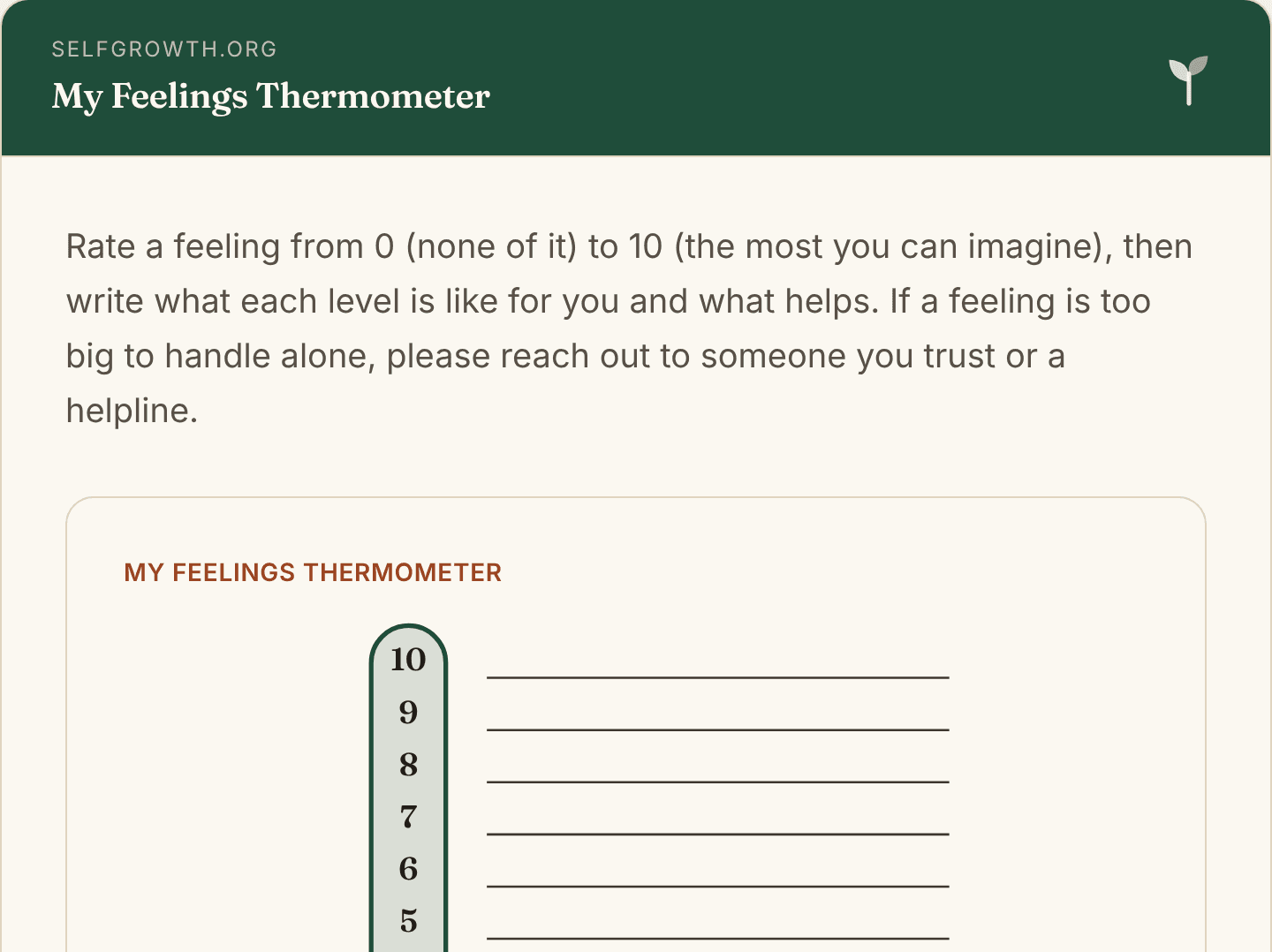
Feelings Thermometer
A free feelings thermometer: rate any feeling from 0 to 10, write what each level is like for you, and plan what helps. Works for adults and older kids. Free PDF.
Open worksheet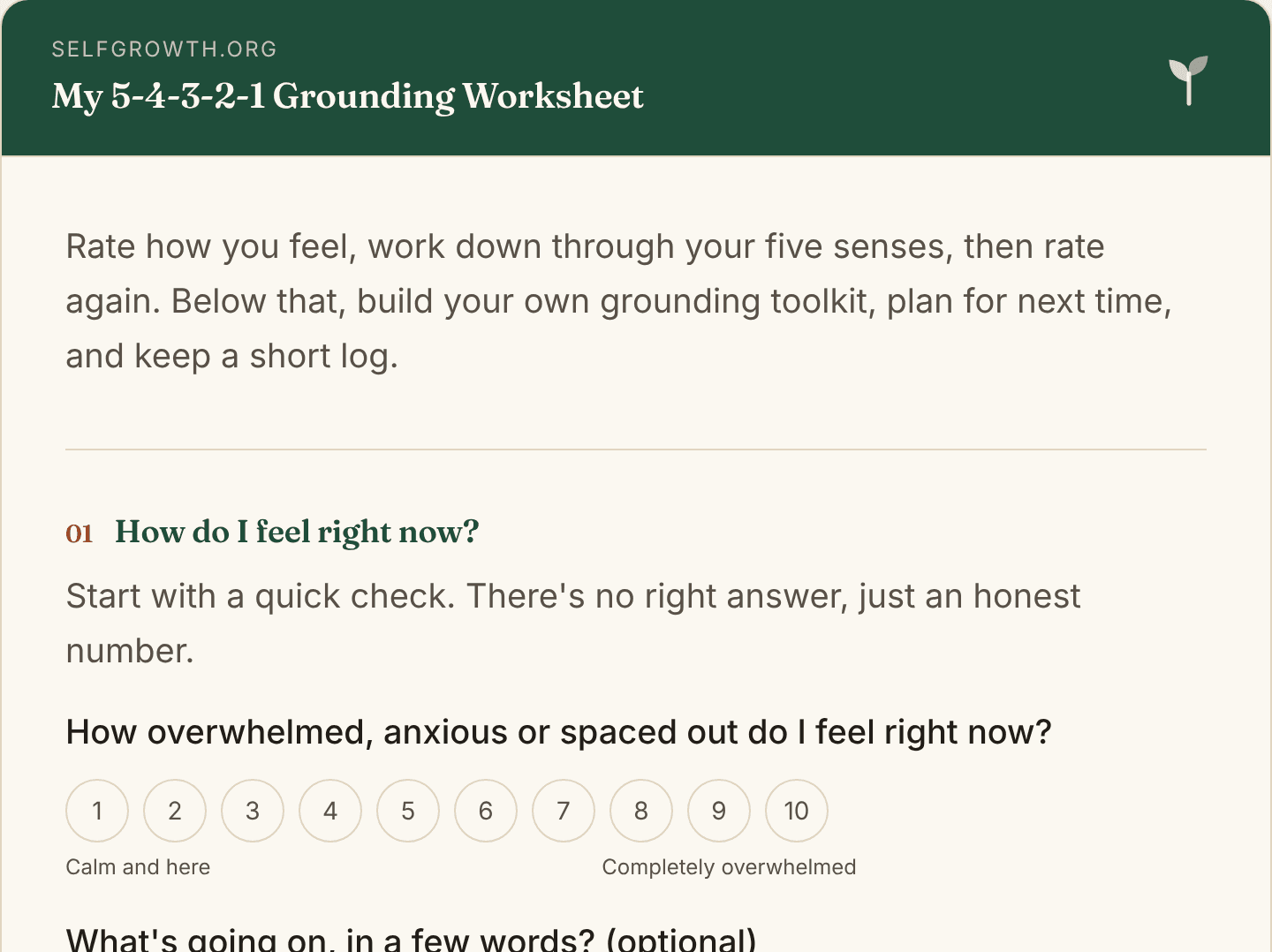
5-4-3-2-1 Grounding Worksheet
A free, printable 5-4-3-2-1 grounding worksheet: rate how you feel, work through your five senses, re-rate, then build your own toolkit and plan for next time.
Open worksheet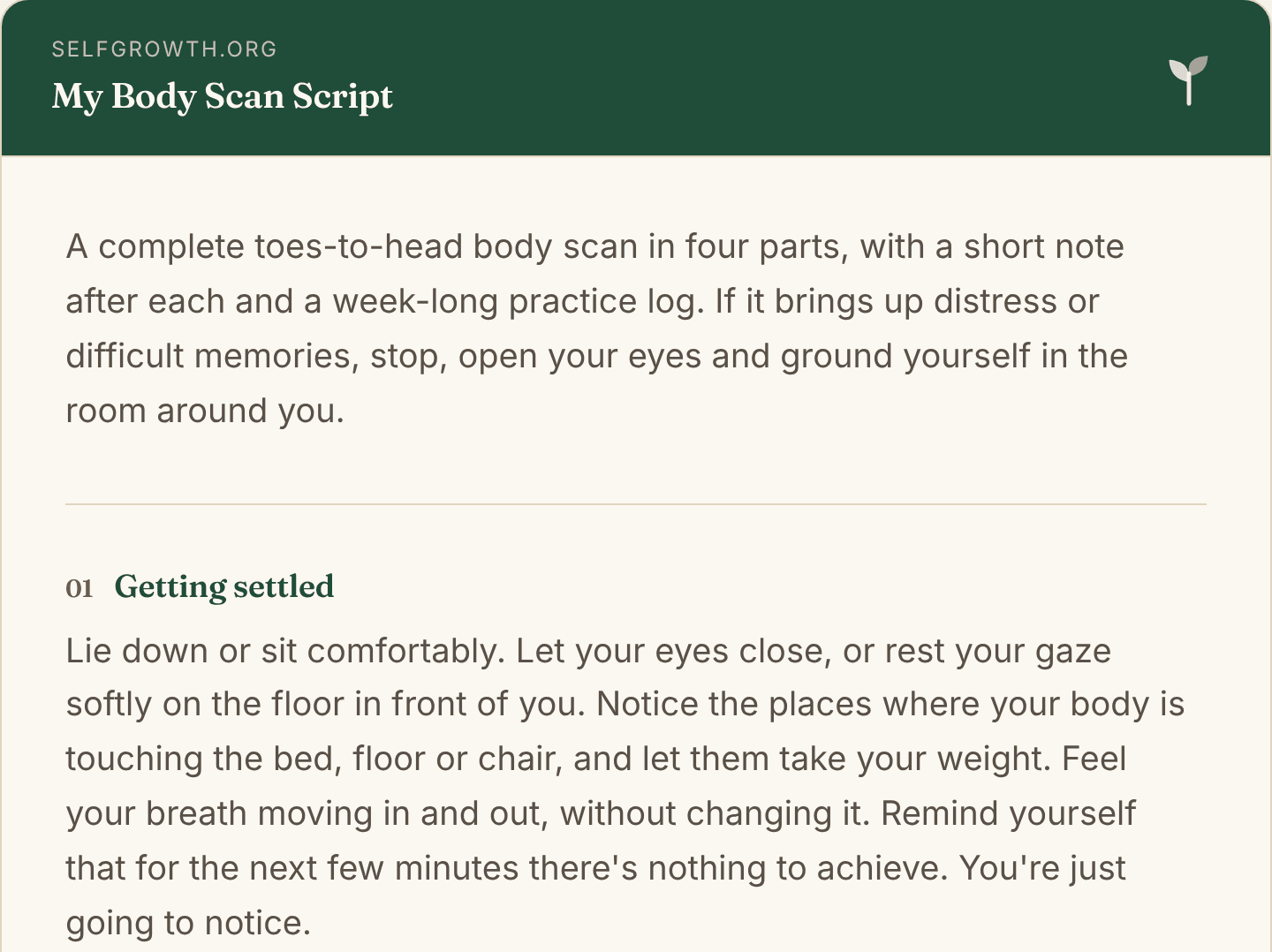
Body Scan Script
A free body scan meditation script in plain English: move your attention slowly from toes to head, noticing without changing, with reflection prompts and a log.
Open worksheetNew worksheets, straight to your inbox
An occasional new worksheet or tool, sent only when there's something genuinely worth your time. No spam, no pressure, unsubscribe any time.