
Feelings and calm
Where do I feel it? A free worksheet to find feelings in your body
Updated 23 October 2026 · 6 min read · Free to print
To find where you feel an emotion in your body, notice which areas are tight, hot, heavy, buzzing, numb, empty or fluttery, then ask which feeling might fit that pattern. This free worksheet lets you tick body areas and sensations, name the likely feeling, rate it and note what your body is asking for.
Drawn from body-based emotion awareness · Part of feelings and calm
Fill it in here (it saves in this browser, but not in a private window), print it, or download the PDF. Free, no sign-up.
Feelings are not only thoughts. A knot in your stomach, a heavy chest, hot hands or a tight throat can tell you something is going on before you have a word for it. If you struggle to say what you feel, starting with the body can be an easier way in.
This worksheet asks you to pick one feeling moment, tick where you notice it and what it feels like, make a best guess at the feeling, rate how strong it is, and write what your body seems to be asking for. It is a way to notice, not a way to decode. Your guess is only a guess.
Body sensations can also come from physical illness. This sheet is for everyday emotional moments, not for working out what a symptom means. Please read the safety note at the top of the worksheet before you start. It is not therapy.
How to use this worksheet
- 1Pick a recent moment that was uncomfortable but manageable, or a moment that felt good. Avoid your hardest memory.
- 2Tick as many areas and sensations as fit. There are no wrong ticks, and you can leave the rest blank.
- 3Treat the feeling you name as a best guess. If two fit, write both.
- 4Come back to the log over a few days to see what your own body tends to do.
The worksheet
selfgrowth.org
My where-do-I-feel-it worksheet
Pick one moment, tick where and how you feel it, name the likely feeling, rate it, and note what your body is asking for. Notice, don't diagnose.
01Check first: is this physical?
Body sensations can be signs of physical illness. Do not try to read them as emotions if any of these apply. Chest pain, trouble breathing, fainting, or sudden severe symptoms need urgent medical care: call 999 (UK) or 911 (US), or NHS 111 if you are unsure. This worksheet cannot tell the difference and does not diagnose anything.
02The moment
Pick one moment and describe it briefly.
What was happening, or what was I thinking about?
03Where I feel it
Tick every area where you notice something. Take a moment to scan, from the top of your head down.
Anywhere else, or more detail:
04What it feels like
Tick every sensation that fits. You can match them to the areas above in your notes.
In my own words, it feels like:
05My best guess
Look at the pattern you ticked and make a guess at the feeling. If you want words, the feelings wheel on this site has a long list. A guess can be wrong, and that is fine.
The feeling this might be (one or two words):
How strong is it right now?
Does the guess feel right, partly right or off? What would I change?
06What my body is asking for
Sometimes there is a small, kind thing the body seems to want: water, air, a stretch, rest, a hug, company, a break from screens. Write what comes up, then try one thing and re-rate.
My body seems to be asking for:
One small thing I will try:
After trying it, how strong is the feeling now?
07Body and feeling log
A short log shows your own patterns over time. Note each moment, where you felt it, and the feeling you guessed.
Entry 1
Entry 2
Entry 3
Entry 4
Entry 5
When you're done, a moment to reflect
- Which part of your body tends to speak up first when something is bothering you?
- Is there a sensation you usually ignore or push through?
- Did naming the feeling change how strong it was, even a little?
- What small thing does your body seem to ask for most, and when did you last give it?
- If a sensation keeps coming back and worries you, who could you ask about it, such as a GP?
Done for now?
Save today's answers as a dated entry. You can come back, fill it in again and compare the two side by side.
What research says about feelings and the body
Feelings often show up in the body. In one 2014 study, volunteers from Europe and East Asia coloured in body outlines to show where they felt feelings. Different feelings gave different patterns.
That study was self-report from volunteers. It describes a link between feelings and sensations. It does not show that a given sensation means a given feeling in you, and it does not test whether filling in a worksheet helps. That is why this sheet asks for your guess and your own words, not a lookup table.
The ratings and the log are there so you can judge what helps you. If a sensation worries you, a doctor is the right person to ask.
These are educational self-reflection tools, not therapy.
If you want to go deeper
- Nummenmaa, L., Glerean, E., Hari, R. & Hietanen, J. K. (2014). Bodily maps of emotions. Proceedings of the National Academy of Sciences, 111(2), 646-651.
Your questions, answered
- What does it mean to feel emotions in your body?
- Feelings can come with body changes you can notice, such as a tight throat, a heavy chest or a fluttery stomach. Noticing them can help you name what you feel. This worksheet asks you to tick where and how you feel it, then make a best guess at the feeling. It is a way to notice, not to diagnose.
- Where do you feel different emotions in the body?
- Your own sensations matter more than any chart. In one 2014 study, volunteers from Europe and East Asia coloured in body outlines to show where they felt feelings. Different feelings gave different patterns. That is self-report, and it does not tell you what your own sensations mean.
- How do I know if a sensation is a feeling or something physical?
- You cannot tell from a worksheet. Chest pain, trouble breathing, fainting or sudden severe symptoms need urgent medical care: call 999 (UK) or 911 (US), or NHS 111 if you are unsure. If a sensation is new, getting worse or worrying you, ask a doctor rather than assuming it is an emotion.
- What if I can't feel anything, or everything at once?
- Both happen. Numb or empty counts as a sensation you can tick. If everything is too much, slow down, tick one area only, or stop and use a grounding exercise first. If feeling numb or overwhelmed lasts a long time or gets in the way of daily life, talk to your GP.
- Does noticing body sensations help with emotions?
- No study tests this worksheet on its own. Treat it as a way to pay attention, not a treatment. Your before and after ratings let you see whether it helps you.
- Is there a where do I feel it worksheet PDF?
- Yes. Use the Download PDF button for a clean, print-ready copy, or Print to print straight from the page. It is completely free, with no payment and no email needed. You can also fill it in on screen, and your answers save in your browser.
- Is this worksheet a substitute for therapy?
- No. It is a self-help tool for noticing feelings, not therapy or medical advice. If low mood, anxiety or physical sensations are part of daily life, a GP can point you towards help. If you ever feel unsafe or think about harming yourself, thoughts like these are serious: call Samaritans on 116 123 (UK and Ireland), call or text 988 (US), find a line at findahelpline.com, or see selfgrowth.org/help.
Keep going, related worksheets
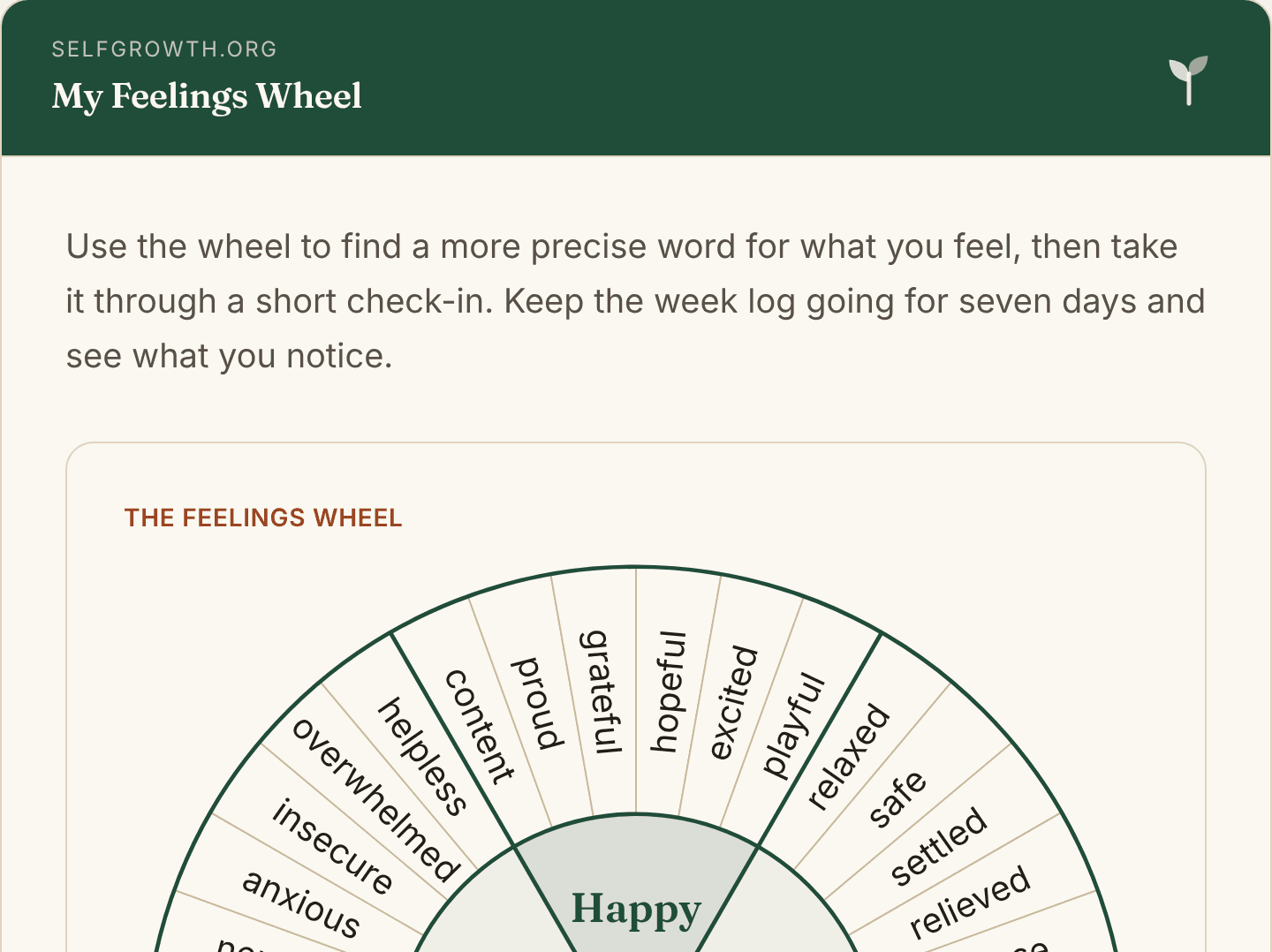
Feelings Wheel
A free printable feelings wheel (emotion wheel) PDF: six core feelings and 36 more precise words, with a daily check-in and a week log to name what you feel.
Open worksheet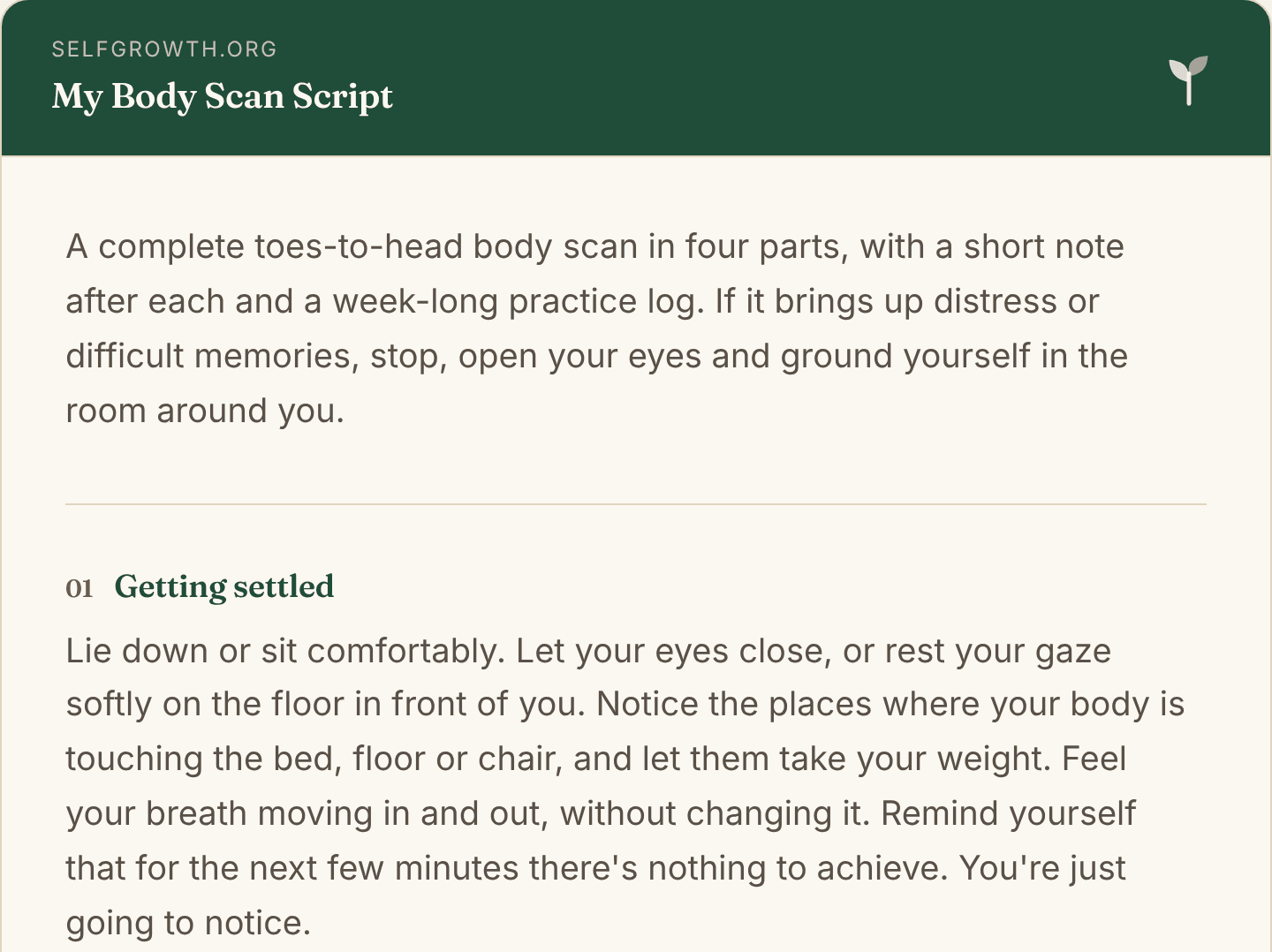
Body Scan Script
A free body scan meditation script in plain English: move your attention slowly from toes to head, noticing without changing, with reflection prompts and a log.
Open worksheet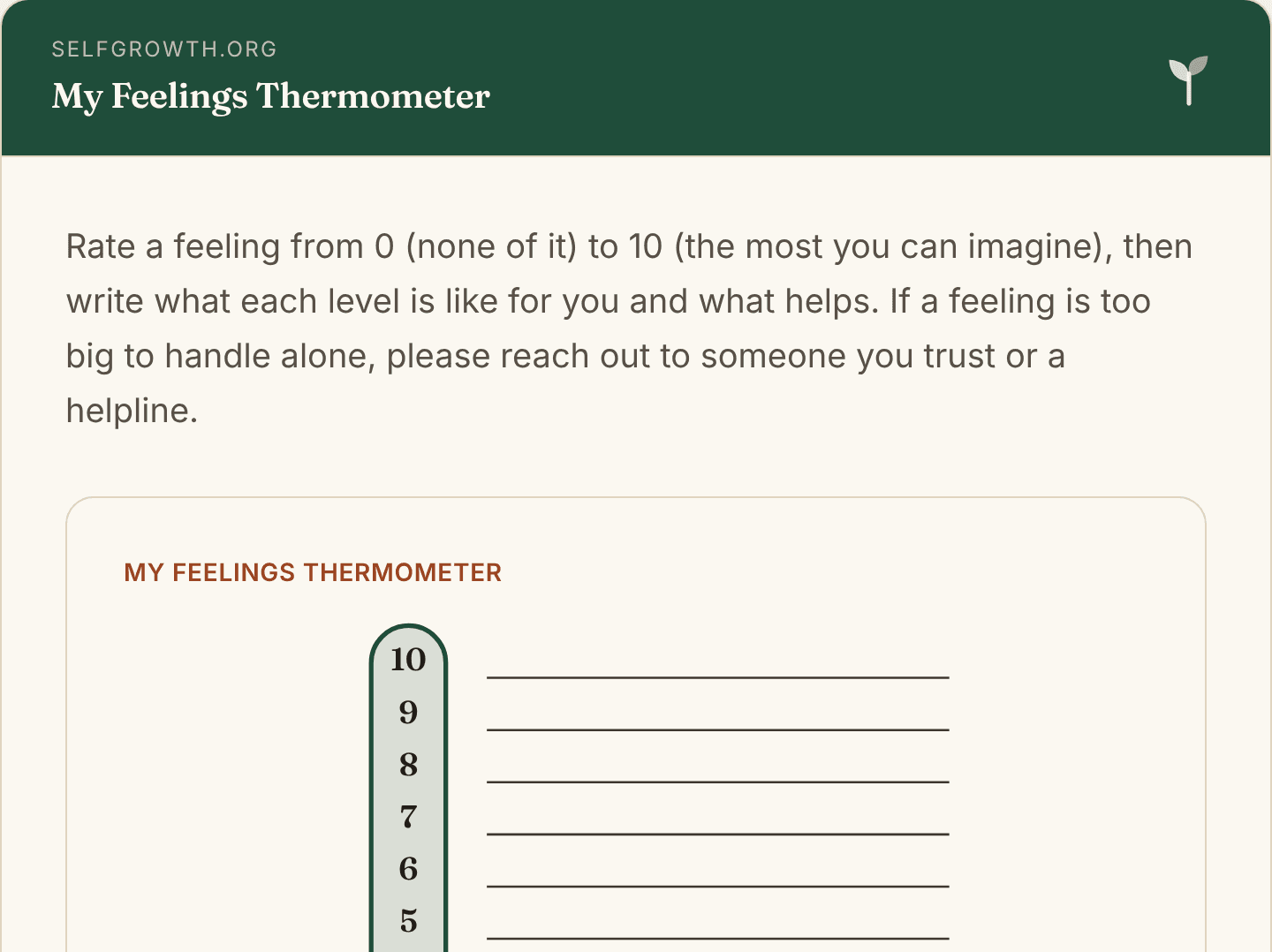
Feelings Thermometer
A free feelings thermometer: rate any feeling from 0 to 10, write what each level is like for you, and plan what helps. Works for adults and older kids. Free PDF.
Open worksheetNew worksheets, straight to your inbox
An occasional new worksheet or tool, sent only when there's something genuinely worth your time. No spam, no pressure, unsubscribe any time.