
Journaling
Self improvement journal: a free printable daily, weekly and monthly page
Updated 25 October 2026 · 7 min read · Free to print
A self improvement journal is a set of short, repeating pages where you write what you focused on, what you learned and what you would change. This free printable has a five-minute daily page, a weekly page and a monthly look back. Use it to see how you are growing over time.
A simple day, week and month reflection format · Part of self-discovery
Fill it in here (it saves in this browser, but not in a private window), print it, or download the PDF. Free, no sign-up.
A journal is easier to keep when you know what to write. This one gives you three fixed pages: a daily page, a weekly page and a monthly look back. Each asks the same few questions every time, so you can see change over weeks, not just feelings on one day.
It is different from the self-growth journal prompts, which is a long list of questions grouped by theme to pick from. Here there is nothing to choose. You print a page, answer a few short questions, and you are done. If you have never kept a journal, the how to start journaling guide covers the basics.
Aim for five minutes a day. Skip days without guilt, because a missed day is not a failed journal. It is a self-help tool, not therapy.
How to use this worksheet
- 1Print several copies of the daily page, or fill it in on screen. One page for each day you write.
- 2Write for about five minutes. Short answers are fine. A line is enough.
- 3Once a week, fill in the weekly page. Look back over your daily pages first.
- 4Once a month, do the monthly look back. Then pick one thing to drop and one to keep.
- 5If you miss a day, or a week, just carry on at the next page. Do not go back and fill it in.
The worksheet
selfgrowth.org
My Self-Improvement Journal
A daily page (5 minutes), a weekly page and a monthly look back. Print as many copies of each as you need. Skip days without guilt.
01Daily page
Fill this in at the end of the day, or at any time that suits you. Keep it short. Copy or print this page for each day you write.
Today's date:
Today's one focus (the one thing that matters most to me today):
One thing I learned today:
One thing I would do differently:
One small win, however small:
My energy and how I feel about myself today:
02Weekly page
Once a week, take ten minutes. Read your daily pages first, then answer. You are looking for what you did, not for a mark out of ten.
The week starting:
My growth goal at the moment (one, in plain words):
Progress on that goal this week, however small:
What helped:
What got in the way:
Next week's one step (small enough to do on a bad day):
How I feel about my week:
03Monthly look back
At the end of the month, read over your weekly pages. Notice what repeats. You are looking for patterns, so read first and write after.
The month of:
What changed this month, in me or in my days:
What I'm proud of:
What I learned that I want to remember:
What to drop (a habit, a goal, a way of doing things that is not working):
What to keep doing:
My one focus for next month:
04If writing starts to feel heavy
A journal should leave you a little clearer, not stuck in a loop. If you notice you are writing the same worry again and again, or feeling worse after each entry, stop for a while and talk to someone. If low mood or stress is what is really in the way, see your GP.
If this gets heavy, the person I will talk to is:
Something that helps me reset (a walk, music, a shower, a call):
When you're done, a moment to reflect
- Which page did you find easiest to keep up, and which did you skip?
- What keeps appearing in your 'what got in the way' answers?
- What is one thing you do now that you did not do a month ago?
- What would you like to write in the 'proud of' box next month?
Done for now?
Save today's answers as a dated entry. You can come back, fill it in again and compare the two side by side.
How the journal is set out
The day, week and month rhythm is one simple way to review your own progress. A short daily page captures small things before you forget them. The weekly page asks what helped and what got in the way. The monthly page is for spotting patterns and deciding what to drop.
No study has tested this exact layout, so it is a format to try, not a method with proven results. If a question does not suit you, change it. If a page feels like a chore, cut back to the weekly page only.
For more on getting started, see the how to start journaling guide. For a longer list of questions to pick from, use the self-growth journal prompts.
These are educational self-reflection tools, not therapy.
Your questions, answered
- What is a self improvement journal?
- It is a notebook or printed pages where you regularly write what you are working on, what you learned and what you would change. Short, repeating pages make it easy to keep up and let you look back and see what has changed.
- What do you write in a self improvement journal?
- Write short answers to the same few questions each time. This journal asks for each day's one focus, one thing you learned, one thing you would do differently and one small win. Each week it asks about progress, what helped and what got in the way. Each month it asks what changed and what to drop.
- How often should I write in a personal growth journal?
- There is no proven best schedule. Choose one you will keep. Five minutes most days works for some people. Others prefer a weekly page only. A missed day is not a failure, so carry on at the next page without going back.
- What is the difference between a personal development journal and a diary?
- A diary records what happened. A personal development journal asks what you learned and what you want to do next. Because the questions repeat, you can compare weeks and months and see where you are moving.
- How is this different from self-growth journal prompts?
- The prompts page is a long list of questions in themes, to pick from. This is a set of fixed pages for the day, the week and the month, with the same few questions each time, so you can track change over time.
- Is there a self improvement journal PDF?
- Yes. Use the Download PDF button for a clean, print-ready copy, or Print to print straight from the page. It is completely free, with no payment and no email needed. You can also fill it in on screen, and your answers save in your browser.
- Is this a substitute for therapy?
- No. It is a self-help tool, not therapy. If low mood or stress is what is really getting in the way, talk to your GP. If you ever feel unsafe or have thoughts of harming yourself, call Samaritans on 116 123 (UK and Ireland), 988 (US), or find a line at findahelpline.com.
Keep going, related worksheets
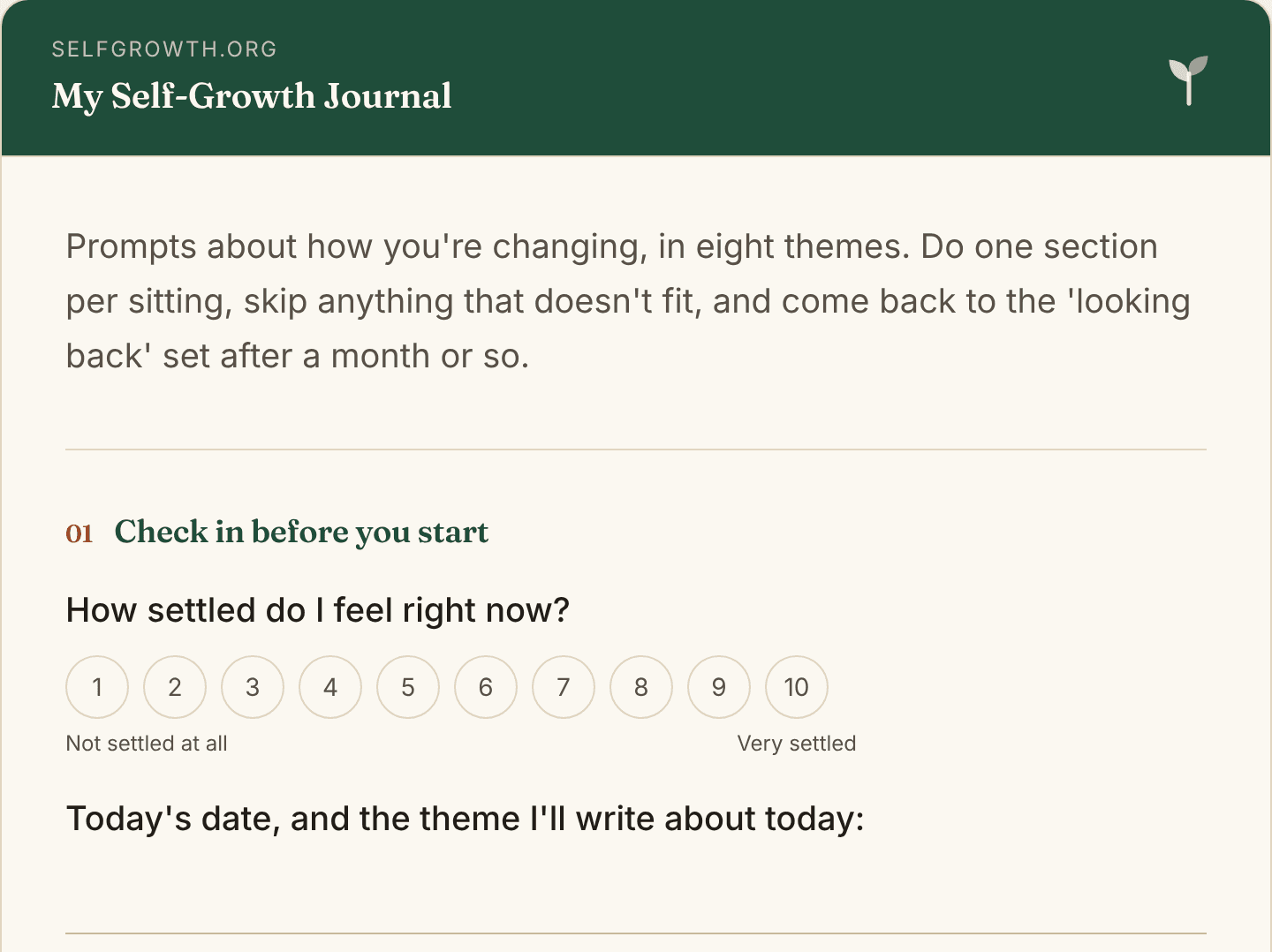
Self-Growth Journal Prompts
58 free, printable journal prompts for self growth, in themes from habits and setbacks to values and a look back, with honest tips on how often to write.
Open worksheet
Self-Discovery Journal Prompts
Free journal prompts for self discovery: questions on your values, your energy and the stories you tell yourself, with space to write. No sign-up.
Open worksheet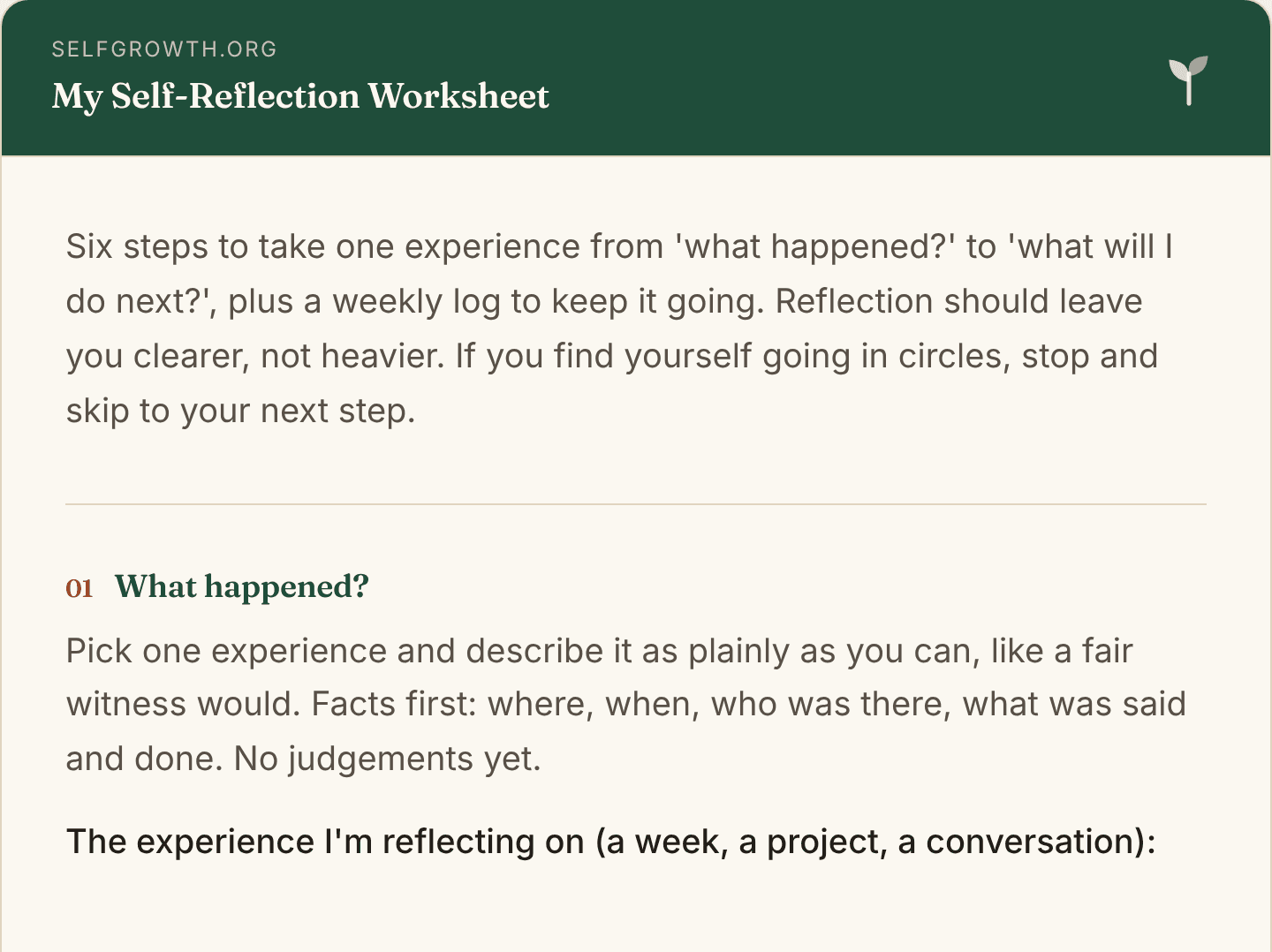
Self-Reflection Worksheet
A free, printable self-reflection worksheet: take one experience through Gibbs' reflective cycle, find your next step and keep a 10-minute weekly log.
Open worksheetNew worksheets, straight to your inbox
An occasional new worksheet or tool, sent only when there's something genuinely worth your time. No spam, no pressure, unsubscribe any time.