
Relaxation
Leaves on a stream worksheet: a free, printable script and rating sheet
Updated 23 October 2026 · 5 min read · Free to print
Leaves on a stream is a short guided visualisation from the Acceptance and Commitment Therapy (ACT) tradition. You picture a stream, place each thought on a passing leaf and watch it float away. This free, printable worksheet gives you the script to read slowly or record, plus a before and after rating and notes.
Drawn from Acceptance and Commitment Therapy (ACT) · Part of feelings and calm
Fill it in here (it saves in this browser, but not in a private window), print it, or download the PDF. Free, no sign-up.
Thoughts can feel like they have to be followed, fixed or fought. Leaves on a stream is a gentle way to practise something different: noticing a thought, setting it on a leaf, and watching it drift past without chasing it. You are not trying to empty your mind or make the thought go away.
This page is the guided exercise. Read the script slowly to yourself, or record it in your own voice and play it back. Before and after, you rate how much your thoughts are pulling at you, and you write down what you noticed. If you want a menu of other ways to step back from a thought, the cognitive defusion worksheet has one.
It's a self-help skill, not therapy. Please read the safety note before you start.
How to use this worksheet
- 1Find somewhere you won't be disturbed for about five to ten minutes. Sit comfortably. You can close your eyes, or keep them open and rest your gaze on a spot on the floor. If closing your eyes feels uncomfortable, keep them open.
- 2Read the script slowly, with pauses, or record it and play it back. Pause for a few breaths wherever you see '(pause)'.
- 3Your mind will wander and get hooked on thoughts. That is part of the exercise, not a failure. Each time you notice, gently go back to the stream.
- 4This exercise is not for ignoring real danger. If a thought is about harming yourself (thoughts like these are serious), or you are not safe, stop and use the support lines in the FAQ or at selfgrowth.org/help.
The worksheet
selfgrowth.org
My Leaves on a Stream Worksheet
Rate how you feel, read or play the script, then rate again and make notes.
01Before: how much are my thoughts pulling at me?
A quick check. There's no right answer, just an honest number.
How much are my thoughts pulling at me right now?
What's on my mind, in a few words? (optional)
Before I start:
02The script (read slowly, or record it)
Sit comfortably and take a slow breath in and out. (pause) Picture a gentle stream, in a place you like, a forest, a field or somewhere you make up. Watch the water move past. (pause) Notice that leaves are floating on the surface, drifting slowly downstream. (pause) Now, for the next few minutes, whenever a thought comes into your mind, place it on a leaf and let the leaf float away. It does not matter whether the thought is pleasant or unpleasant, big or small. If it is a word, put the word on the leaf. If it is a picture, put the picture on the leaf. (pause) You are not pushing the leaves along, and you are not trying to make the stream go faster or slower. Let each leaf move at its own pace. (pause) If the stream seems to run dry, or the leaves stop coming, just watch the water for a while. Thoughts will come again. (pause) If a feeling comes, such as boredom or worry, notice it, say to yourself 'here is a feeling of worry', and place that on a leaf too. (pause) At some point your mind will wander off, or you will find you have been following a leaf downstream. That is fine. Notice it, take a breath, and come back to the bank of the stream. (pause) Carry on for a few minutes in your own time. (pause) When you are ready, let the stream fade, notice the chair under you and the sounds in the room, and open your eyes.
Thoughts I noticed floating by (a word or two for each):
Fill this in after the exercise, from memory. Write them as 'a thought about...'.
03After: what did I notice?
Re-rate it. It doesn't need to go down. Write what actually happened.
How much are my thoughts pulling at me now?
What happened? Tick any that fit:
Notes: what was easy, what was hard, what I'd change next time:
04Adjust it to suit me
You might picture a stream, a river, a conveyor belt or clouds in the sky. Work out what suits you. If a thought stays heavy after trying this, or the exercise made you feel worse, that is a sign to stop and get support rather than push on.
A scene I'd rather picture (stream, river, clouds, a train passing):
Where and when I could try this again:
Someone I can reach out to if my thoughts feel too heavy (a friend, my GP, Samaritans 116 123, 988 in the US):
05My practice log
If you try it more than once, a short log shows you whether it helps you. Rate how much thoughts pull at you, 1 to 10.
Entry 1
Entry 2
Entry 3
Entry 4
Entry 5
When you're done, a moment to reflect
- Which kinds of thought were hardest to place on a leaf, and why?
- What did it feel like to watch a thought go by without answering it?
- Did I notice the moment I got caught up in a thought? What was that like?
- Did anything about this exercise not suit me, and what would I change?
- Is there a thought here that I should act on, or talk to someone about, rather than let float past?
Done for now?
Save today's answers as a dated entry. You can come back, fill it in again and compare the two side by side.
Does the leaves on a stream exercise work?
Leaves on a stream is taught as a cognitive defusion exercise within Acceptance and Commitment Therapy (ACT). ACT was developed by Steven C. Hayes and colleagues, and the core text is Hayes, Strosahl and Wilson's Acceptance and Commitment Therapy (1999, second edition 2012). No single author of the leaves on a stream script is agreed. Many versions are in circulation, and the wording here is our own.
Honestly, the evidence for this exact exercise is thin. No study tests it on its own. A 2012 review by Levin and colleagues of 66 laboratory studies found positive effects for defusion exercises in general compared with doing nothing, though the studies were short. The larger reviews of ACT, such as A-Tjak and colleagues (2015), look at the whole therapy given by a therapist, not at a single visualisation done at home.
That is why the sheet asks for a rating before and after. Your own experience is the best guide to whether this exercise belongs in your toolkit.
These are educational self-reflection tools, not therapy.
If you want to go deeper
- Hayes, S. C., Strosahl, K. D. & Wilson, K. G. (1999). Acceptance and Commitment Therapy: An Experiential Approach to Behavior Change. Guilford Press. (2nd ed., 2012, Acceptance and Commitment Therapy: The Process and Practice of Mindful Change.)
- Levin, M. E., Hildebrandt, M. J., Lillis, J. & Hayes, S. C. (2012). The impact of treatment components suggested by the psychological flexibility model: A meta-analysis of laboratory-based component studies. Behavior Therapy, 43, 741-756.
- A-Tjak, J. G. L., Davis, M. L., Morina, N., Powers, M. B., Smits, J. A. J. & Emmelkamp, P. M. G. (2015). A meta-analysis of the efficacy of acceptance and commitment therapy for clinically relevant mental and physical health problems. Psychotherapy and Psychosomatics, 84(1), 30-36.
Your questions, answered
- What is the leaves on a stream exercise?
- It's a short guided visualisation used in Acceptance and Commitment Therapy (ACT). You picture a stream with leaves floating on it, put each thought that comes up on a leaf, and watch it drift away. The aim is to practise noticing thoughts without following or fighting them, not to empty your mind.
- How do you do leaves on a stream?
- Sit comfortably and picture a stream. Whenever a thought comes, place it on a leaf and let it float downstream. When you get caught up in a thought, notice that, and gently return to the stream. Section 2 of this worksheet has a script you can read slowly or record yourself reading, with a rating before and after.
- Who created the leaves on a stream exercise?
- We don't know. It's taught as an ACT defusion exercise, and ACT was developed by Steven C. Hayes and colleagues, but no single author of this particular script is agreed. It is also taught in many slightly different versions.
- Does leaves on a stream work?
- The evidence for this exact exercise is thin. No study tests it on its own. Laboratory studies of ACT-style defusion exercises in general have shown positive effects compared with doing nothing, but they were short and are not about this script. Treat it as something to try and judge from your own ratings, and drop it if it doesn't help.
- What is the difference between leaves on a stream and a defusion worksheet?
- This page is one guided exercise, done sitting quietly with a script. The cognitive defusion worksheet is a menu of quicker techniques you can use on one thought, such as adding 'I'm having the thought that' or naming the story. Both aim at the same thing: seeing a thought as a thought.
- Is there a leaves on a stream worksheet PDF?
- Yes. Use the Download PDF button for a clean, print-ready copy, or Print to print straight from the page. It's completely free, with no payment and no email needed. You can also fill it in on screen, and your answers save in your browser.
- Is this worksheet a substitute for therapy?
- No. It's a self-help tool, not therapy or medical advice. If thoughts are taking over your days, a GP can point you towards talking therapies. If you ever feel unsafe or have thoughts of harming yourself, thoughts like these are serious: call Samaritans on 116 123 (UK and Ireland), 988 (US), or find a line at findahelpline.com.
Keep going, related worksheets
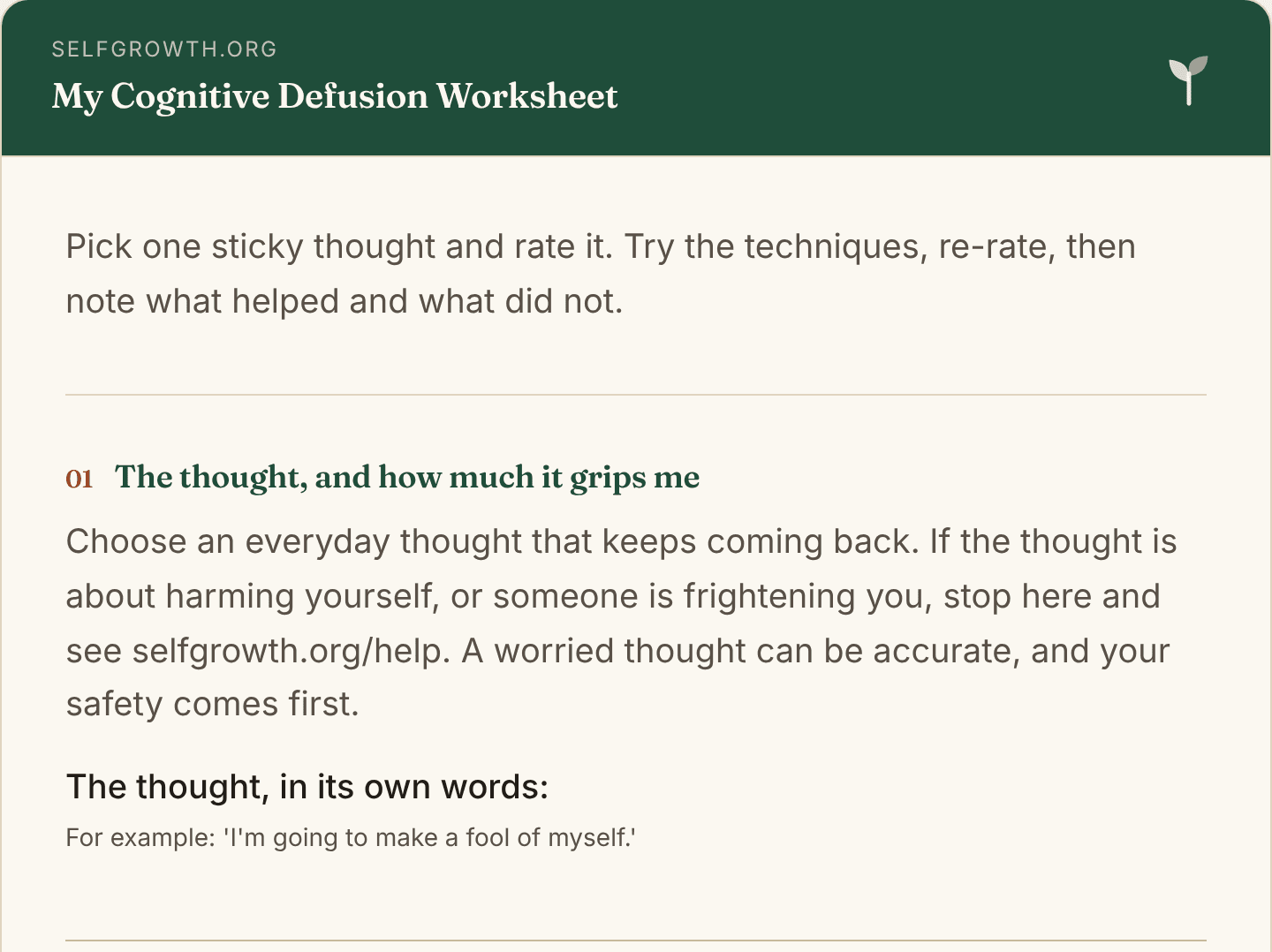
Cognitive Defusion Worksheet
A free, printable cognitive defusion worksheet: try ACT techniques like 'I'm having the thought that', rate how a thought grips you, see what helps.
Open worksheet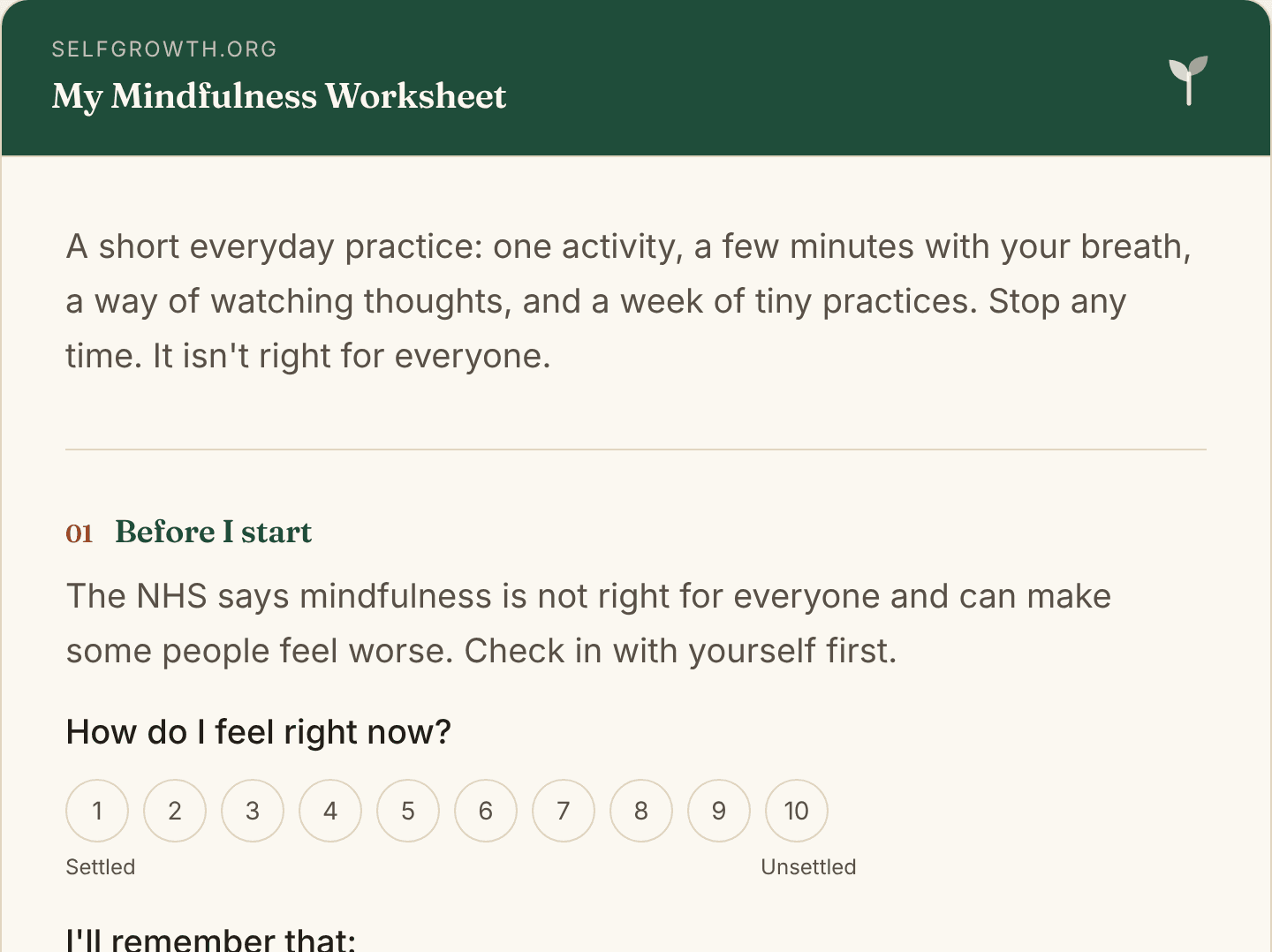
Mindfulness Worksheet
A free mindfulness worksheet: one everyday activity, a few minutes with your breath, a way to watch thoughts and a week of tiny practices. Not for everyone.
Open worksheet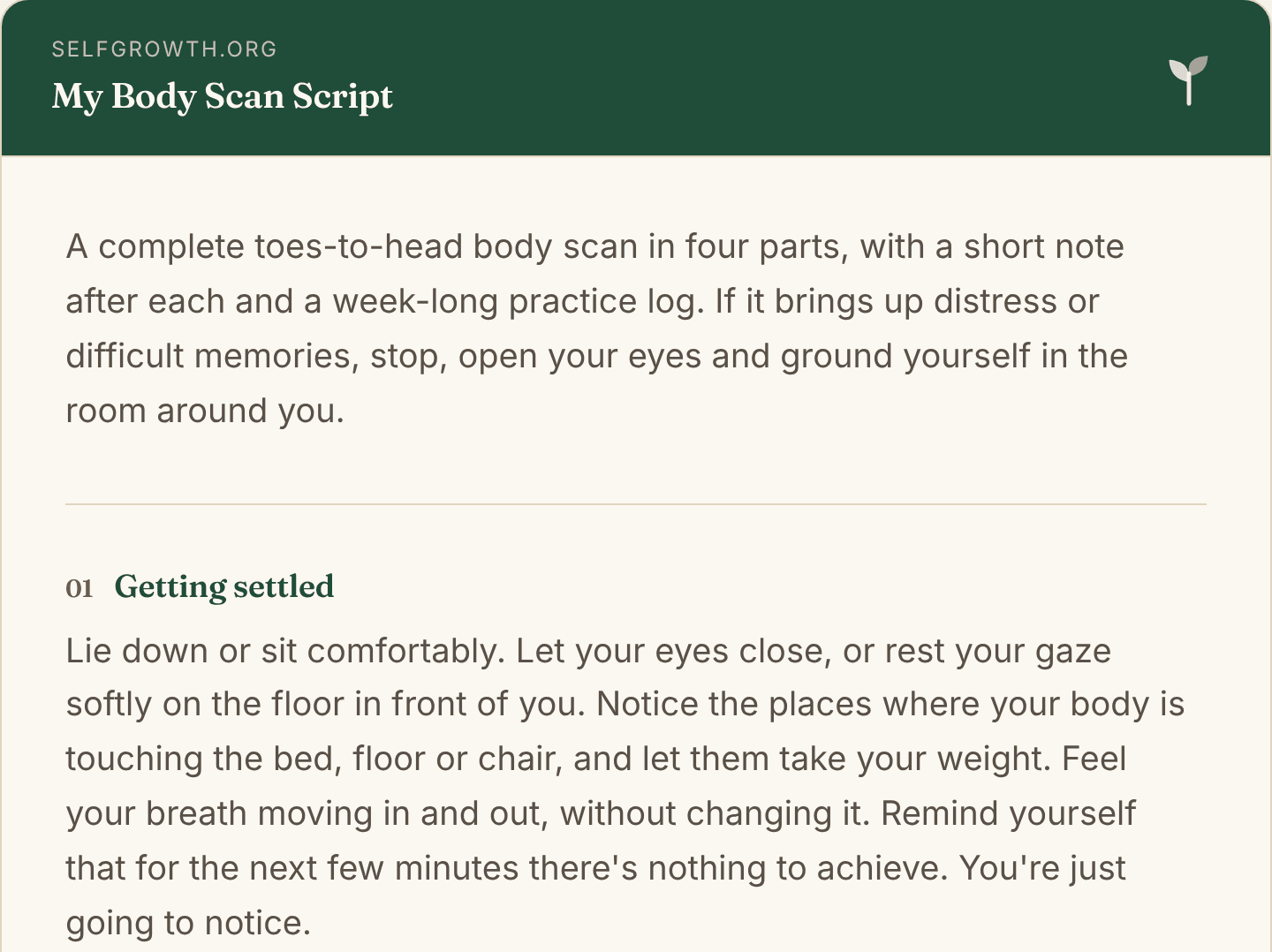
Body Scan Script
A free body scan meditation script in plain English: move your attention slowly from toes to head, noticing without changing, with reflection prompts and a log.
Open worksheetNew worksheets, straight to your inbox
An occasional new worksheet or tool, sent only when there's something genuinely worth your time. No spam, no pressure, unsubscribe any time.