
Emotions
Emotional regulation worksheet: a free printable to notice, rate and respond to a strong feeling
Updated 23 October 2026 · 7 min read · Free to print
Emotional regulation means influencing how strongly you feel something, how long it lasts and what you do with it. This free worksheet walks you through five steps: notice the feeling, name it, rate it, choose a response (change the situation, shift your attention, rethink it, or calm your body), then review what helped.
Drawn from the emotion regulation research literature · Part of feelings and calm
Fill it in here (it saves in this browser, but not in a private window), print it, or download the PDF. Free, no sign-up.
A strong feeling can take over before you've noticed it arriving. Emotional regulation is the skill of having more say in what happens next: not getting rid of the feeling, but choosing what to do with it.
This worksheet takes one real moment and works through it in order. You notice what happened, name the feeling, give it a number, then pick a way to respond from four kinds: change the situation, shift your attention, rethink it, or settle your body. At the end you rate it again and note what helped, so next time you have something to go on.
It is a skill-building page, not therapy, and it does not diagnose anything. Use it on an ordinary hard moment. If you are overwhelmed by feelings much of the time, or they are getting in the way of sleep, work or relationships, please talk to your GP.
Thoughts like these are serious: wanting to harm yourself, or feeling that others would be better off without you. If you are having them, do not work on this sheet. Put safety first. Call Samaritans on 116 123 (UK and Ireland), call or text 988 (US), or find a helpline at findahelpline.com. The page at selfgrowth.org/help lists more.
How to use this worksheet
- 1Pick a recent moment that was hard but manageable, rather than the worst thing that has happened to you.
- 2Fill in the first three steps while the feeling is still fresh, or as soon after as you can.
- 3Choose one response, not all of them. Try it, then come back and re-rate.
- 4Use a fresh copy each time. A few completed sheets show you which responses work for you.
The worksheet
selfgrowth.org
My emotional regulation worksheet
Work down the page in order: notice, name, rate, choose a response, review. Be honest and specific. There are no right answers.
01Notice
Start with the facts, as if you were describing the moment to someone who wasn't there. The feeling often shows up in your body before you have a word for it. If the feeling is in your body: chest pain, trouble breathing or fainting means call 999 (UK) or 911 (US), or NHS 111 if you're unsure. A new or worsening symptom means see a doctor.
What happened, and where was I? (just the facts)
What did I notice in my body?
What was I thinking, word for word?
Write the thought as it came, even if it sounds unfair.
02Name
Aim for the most exact word you can find, not just 'bad' or 'stressed'. A feelings wheel can help if you are stuck.
The main feeling was...
Underneath it, there might also be... (hurt, afraid, embarrassed, disappointed, tired)
What was this feeling trying to tell me, or protect?
03Rate
Give the feeling a number, where 1 is barely there and 10 is the strongest it could be. The number is only information.
How strong was the feeling at its peak?
How strong is it right now?
What do I feel an urge to do? (Be honest. You do not have to do it.)
If the urge is to harm yourself, stop here and use the crisis numbers on this page.
04Choose a response
You have more than one option. They fit different moments. The first two work on the situation itself, the third on how you see it, the fourth on your body. Tick what you could try, then circle one.
Change the situation
Use this when something in the moment is feeding the feeling and you can change it.
Shift my attention
Use this to get some breathing space. It does not make the problem go away, so come back to it.
Rethink it
Use this when a thought is making the feeling bigger. Check the thought. Do not argue yourself out of a feeling that is telling you something true.
Adjust my body's response
Use this when your body is running hot. Check with a GP before cold water or hard exercise if you have a heart condition or take heart medication.
The one response I will try now is...
Why I think it fits this moment:
05Review
After you have tried it, check what happened. Even a point or two lower is a real result, and a response that did not help is useful to know.
How strong is the feeling now?
What helped, and what got in the way?
Next time this feeling shows up, I will try...
Is something under this that is worth talking to someone about?
06Log of what worked
Over a few sheets, your log shows which responses suit which feelings.
Entry 1
Entry 2
Entry 3
Entry 4
Entry 5
When you're done, a moment to reflect
- Which feelings do you find easiest to handle, and which do you find hardest?
- Does your body tell you before your mind does? What are your first signs?
- Which kind of response suited you best: changing the situation, shifting your attention, rethinking, or calming your body?
- Is there a moment, person or place that keeps setting off the same feeling?
- Who could you talk to if a feeling keeps coming back or feels too big?
Done for now?
Save today's answers as a dated entry. You can come back, fill it in again and compare the two side by side.
Do emotional regulation worksheets work?
The structure follows ideas from psychologist James Gross, set out in a 1998 review of the field. He suggested you can step in at different points: before the feeling, while it builds, in how you see it, or in your body. This worksheet turns those into four plain options.
Gross's paper is a review that offers a model. It is not a trial of a worksheet, and no study tests this page on its own. Slow breathing, one of the body options, has more behind it: a 2018 systematic review by Andrea Zaccaro and colleagues of studies in healthy adults linked slower breathing with feeling more relaxed and less anxious.
The before and after ratings and the log are there so you can judge for yourself which responses help you.
These are educational self-reflection tools, not therapy.
If you want to go deeper
- Gross, J. J. (1998). The emerging field of emotion regulation: An integrative review. Review of General Psychology, 2(3), 271-299.
- Zaccaro, A., Piarulli, A., Laurino, M., Garbella, E., Menicucci, D., Neri, B. & Gemignani, A. (2018). How breath-control can change your life: A systematic review on psycho-physiological correlates of slow breathing. Frontiers in Human Neuroscience, 12, 353.
Your questions, answered
- What is emotional regulation?
- Emotional regulation is how you influence which feelings you have, how strong they get, how long they last and how you express them. It does not mean pushing feelings away or never getting upset. It means having more choice about what you do when a strong feeling arrives.
- How do you practise emotional regulation?
- Take one moment at a time. Notice what happened and what you felt in your body, name the feeling, give it a number, then pick one response: change the situation, shift your attention, rethink it, or settle your body. Afterwards, rate it again. This worksheet follows exactly that order.
- What are emotional regulation strategies?
- James Gross's 1998 review set out a model with five points where emotion can be influenced: choosing situations, changing situations, directing attention, changing how you think about it, and changing your body's response. This worksheet groups those into four plain choices. They are a way of organising ideas, not a tested treatment plan.
- Do emotional regulation worksheets work?
- No study tests this worksheet on its own. Slow breathing, which is one body-based option here, has a systematic review behind it in healthy adults, linking it with feeling more relaxed and less anxious. For the rest, treat the sheet as a way to practise and to see what works for you, using your own before and after ratings.
- What is the difference between this and a feelings wheel or thermometer?
- A feelings wheel helps you find the word for a feeling, and a feelings thermometer helps you rate how strong it is. This worksheet uses both ideas as its name and rate sections, then goes further: it helps you choose what to do and check whether it worked.
- Is there an emotional regulation worksheet PDF?
- Yes. Use the Download PDF button for a clean, print-ready copy, or Print to print straight from the page. It is free, with no payment and no email needed. You can also fill it in on screen, and your answers save in your browser.
- Is this a substitute for therapy?
- No. It is a self-help tool, not therapy, medical advice or a diagnosis. If strong feelings are overwhelming, constant or getting in the way of daily life, please see your GP, who can point you to talking therapies. If you ever feel unsafe or have thoughts of harming yourself, call Samaritans on 116 123 (UK and Ireland), 988 (US), or find a line at findahelpline.com.
Keep going, related worksheets
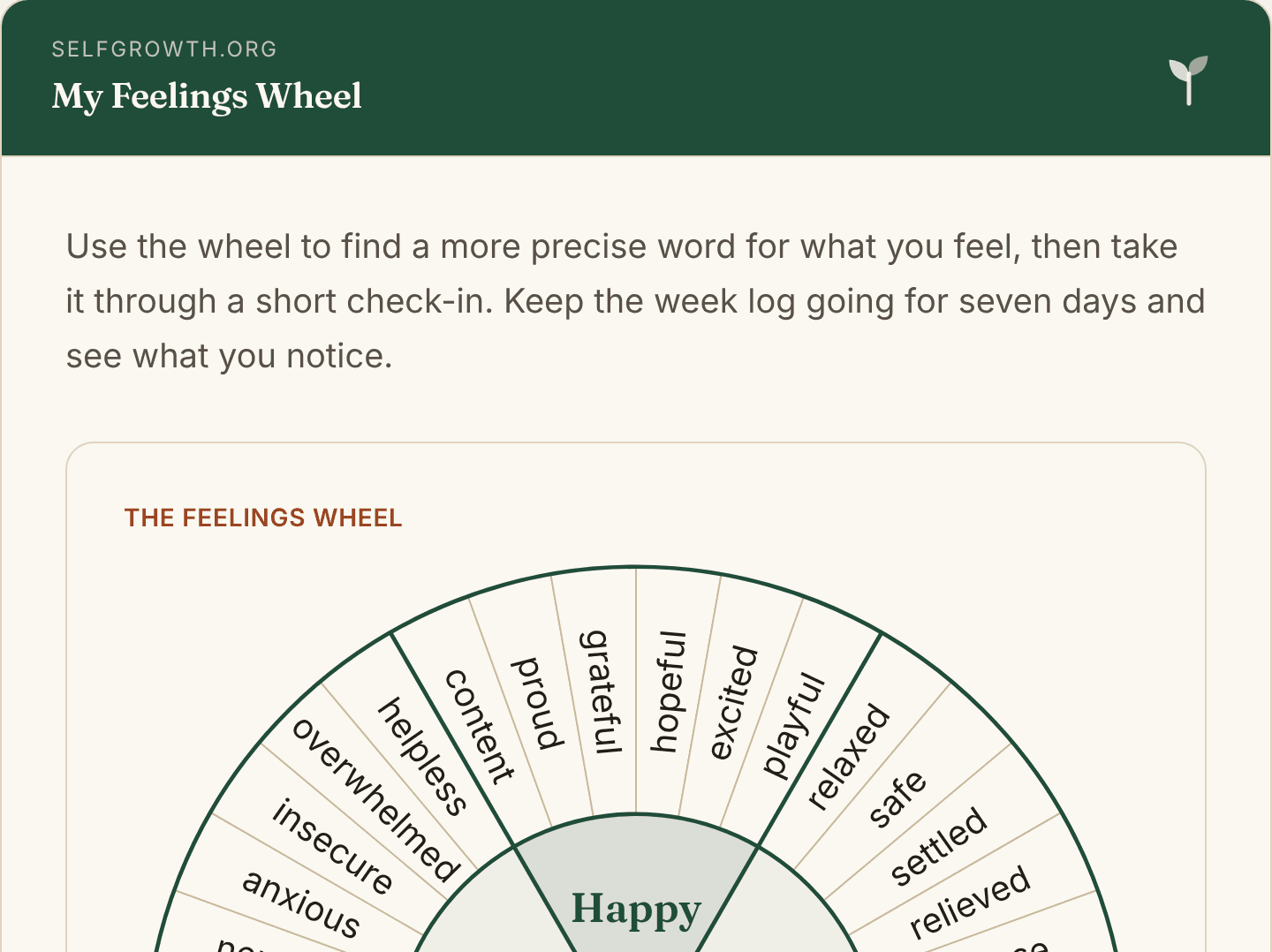
Feelings Wheel
A free printable feelings wheel (emotion wheel) PDF: six core feelings and 36 more precise words, with a daily check-in and a week log to name what you feel.
Open worksheet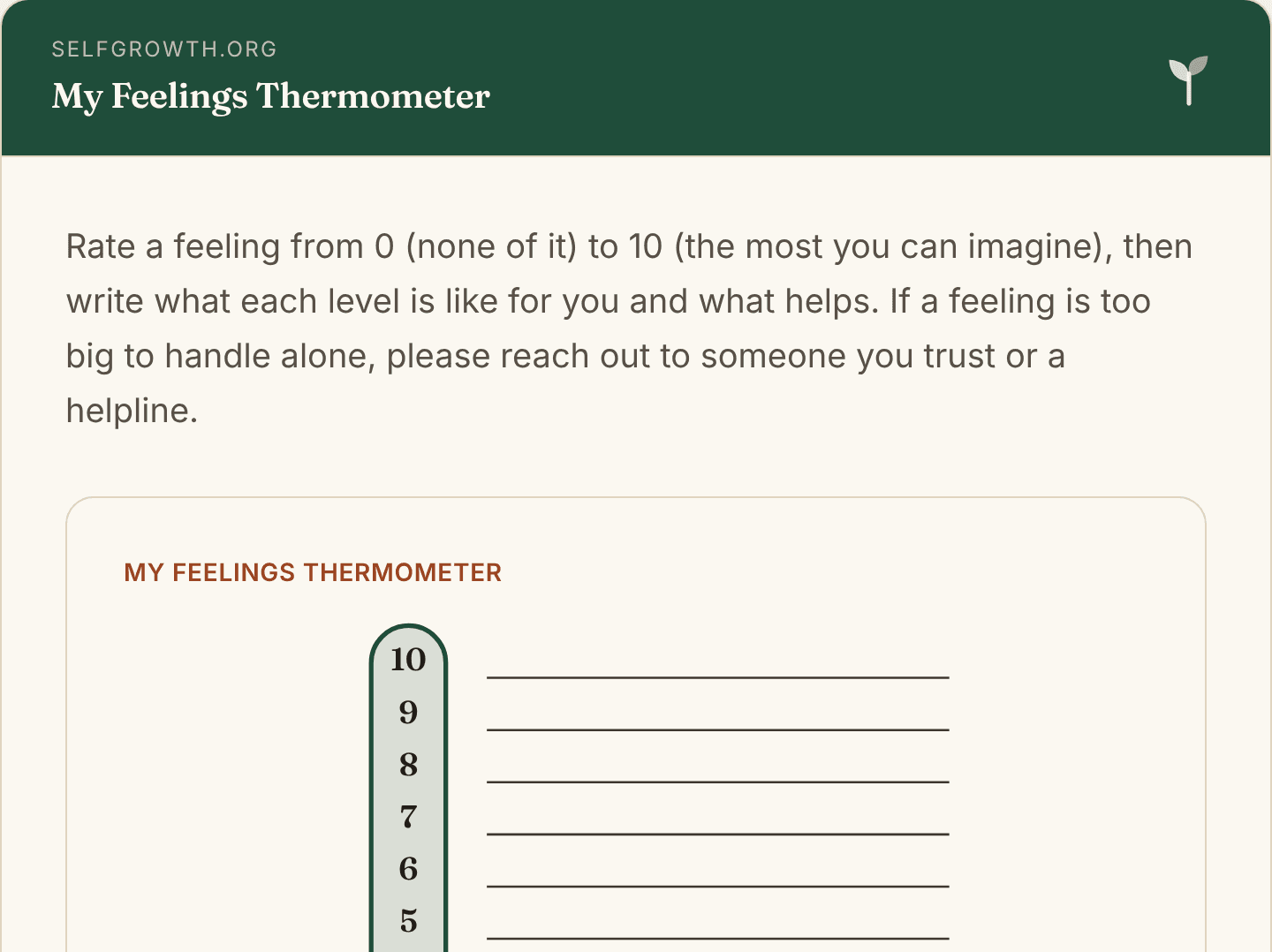
Feelings Thermometer
A free feelings thermometer: rate any feeling from 0 to 10, write what each level is like for you, and plan what helps. Works for adults and older kids. Free PDF.
Open worksheet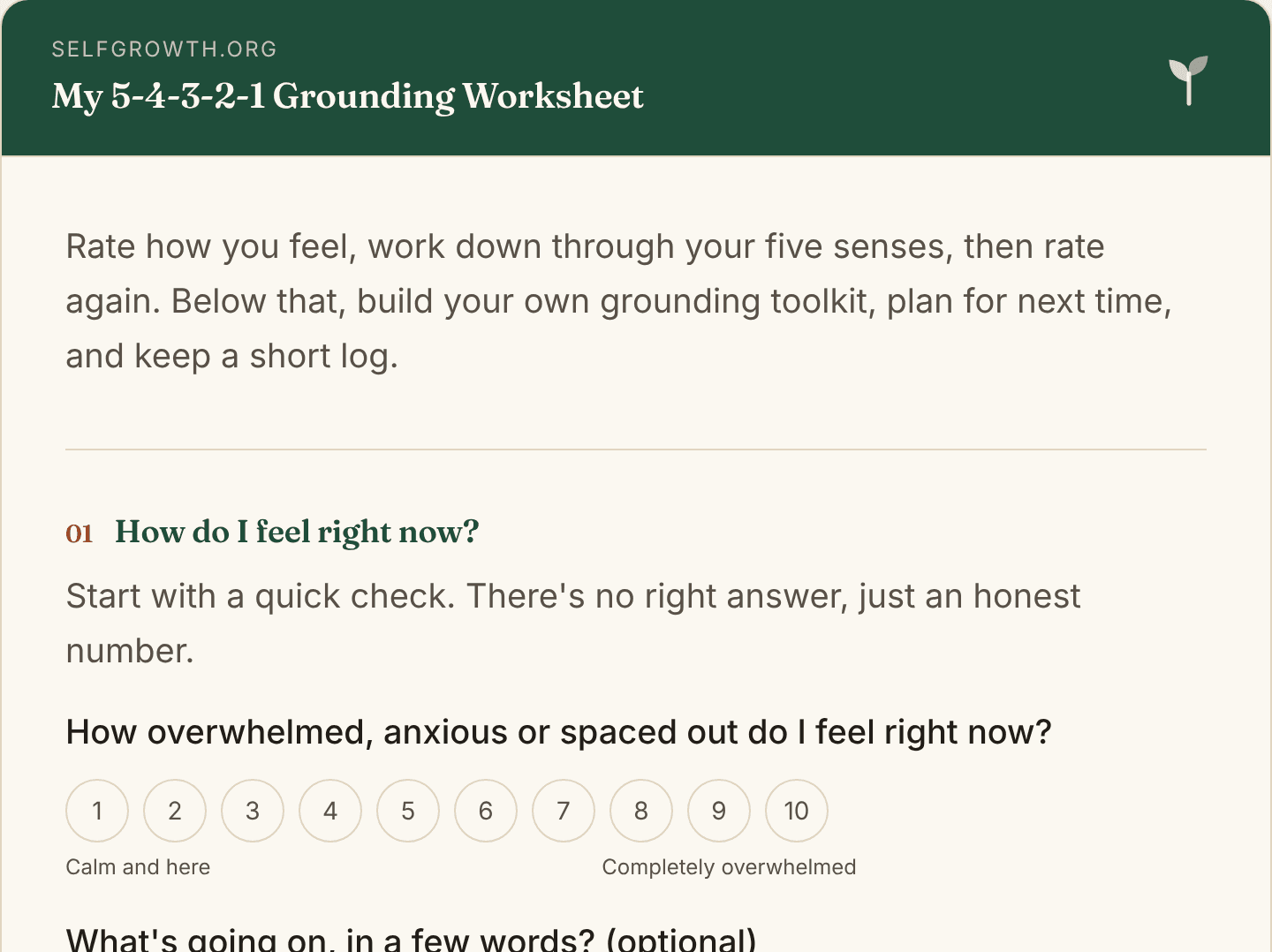
5-4-3-2-1 Grounding Worksheet
A free, printable 5-4-3-2-1 grounding worksheet: rate how you feel, work through your five senses, re-rate, then build your own toolkit and plan for next time.
Open worksheetNew worksheets, straight to your inbox
An occasional new worksheet or tool, sent only when there's something genuinely worth your time. No spam, no pressure, unsubscribe any time.