
Anxious moments
Coping skills for anxiety worksheet: a free printable to build your own toolkit
Updated 23 October 2026 · 7 min read · Free to print
Coping skills for anxiety are small things you do to ease everyday worry: slow breathing, a walk, writing the worry down, setting a worry time, or talking to someone. This free printable worksheet lets you rate your worry, try skills from the body, mind and people groups, and keep the ones that help you.
Drawn from NHS self-help advice for anxiety · Part of feelings and calm
Fill it in here (it saves in this browser, but not in a private window), print it, or download the PDF. Free, no sign-up.
Everyday worry is a normal part of life, and it helps to have more than one thing to reach for. Slow breathing might suit you in a queue. Writing a worry down might suit you at 2am. A walk or a call to a friend might suit a Sunday evening. This worksheet helps you find out which of them work for you.
You rate how worried you feel, try skills from the body, mind, and people and places groups, then build a short personal list and an if-then plan. A small log at the end shows you what helped. These are ideas the NHS suggests for everyday worry, and slow breathing has a review behind it (see the section "Do these coping skills actually work?" below for what it does and does not show).
This is a self-help sheet for everyday worry. It is not therapy, it does not tell you whether you have an anxiety problem, and it will not replace help if worry is taking over. Read the next paragraph before you start.
Please read this first. See a GP if your anxiety is constant, if it stops you doing things you need to do, or if it comes as panic attacks. In England you can also refer yourself to NHS talking therapies. If you have chest pain, or trouble breathing, get urgent medical care: call 999 (UK) or 911 (US); use NHS 111 if you are unsure. Thoughts like these are serious, so if you have thoughts of harming yourself, call Samaritans on 116 123 (UK and Ireland), call or text 988 (US), or find a line at findahelpline.com. More support is listed at selfgrowth.org/help.
How to use this worksheet
- 1Start with the rating, then try one or two skills from a group and re-rate. Come back to the other groups another day.
- 2Be honest rather than positive. A skill that did nothing is useful information, so write it down.
- 3Choose a few skills for your short list. A short list you will use beats a long one you will not.
- 4Fill in the if-then plan on a calmer day, and keep the sheet where you will see it.
The worksheet
selfgrowth.org
My coping skills for anxiety
Rate your worry, try skills from the body, mind and people groups, then build a short list and a plan. For everyday worry, not a diagnosis. If anxiety is constant, stops you doing things you need to do, or comes as panic attacks, see a GP.
01Before I start
This sheet is for everyday worry. If any of these is true, set the sheet aside and get help first.
Get help first if:
The person or line I will turn to first if I need to:
02How worried do I feel right now?
A quick, honest check. There is no right number.
How worried or anxious do I feel right now?
What is on my mind, in a few words?
Where do I feel it in my body?
For example a tight chest, a knot in the stomach, tense shoulders, restlessness.
03Body skills
These work on how your body feels. Try one for a few minutes, then see how the rating moves.
Tick the ones I tried or want to try:
Body skill I tried, and what happened:
04Mind skills
These work on the worry itself. They will not make worry vanish, but they can give it less room.
Tick the ones I tried or want to try:
My worry time (when and where), if I want to try one:
One small next step for something I can act on:
05People and places
Some skills are about who and where you are. You do not have to explain everything to anyone.
Tick the ones I tried or want to try:
Someone I could text or call, and a place that helps:
06How worried do I feel now?
Re-rate. It does not need to reach zero. Lower is a real result, and so is 'no change': it tells you that skill is not for you today.
How worried or anxious do I feel now?
What helped most, and what did nothing?
07My short list and my plan
Pick the skills that helped most, then decide now, while you are calmer, what you will do next time.
My short list of coping skills
A few is plenty.
- 1.
- 2.
- 3.
- 4.
If-then plan
Entry 1
Entry 2
Entry 3
08When I used a skill
A short log shows you what works for you. Rate before and after, 1 to 10.
Entry 1
Entry 2
Entry 3
Entry 4
Entry 5
When you're done, a moment to reflect
- Which group of skills (body, mind, or people and places) helped you most today?
- When does worry tend to be loudest for you, and which skill could you use there?
- Is there something you have been avoiding because of worry, and could one small step toward it be possible?
- What would you say to a friend who felt the way you do right now?
- If worry has been taking up a lot of your days, who could you talk to about it?
Done for now?
Save today's answers as a dated entry. You can come back, fill it in again and compare the two side by side.
Do these coping skills actually work?
These are ideas the NHS suggests for everyday worry. The NHS suggests calming breathing exercises, regular exercise, enough sleep, talking about your feelings and cutting back on caffeine. Its Every Mind Matters pages add keeping a diary of what you are doing and how you feel, and a daily worry time. The same pages advise against avoiding situations that make you anxious, and against using alcohol, cigarettes, gambling or drugs to relieve anxiety.
Here is what the evidence does and does not show. A 2018 systematic review (a study that gathers all the research on a question) by Andrea Zaccaro and colleagues looked at slow breathing in healthy people. It linked slow breathing with more relaxation and comfort and less anxiety, depression, anger and confusion. It did not study people with anxiety problems. No study tests this worksheet, a set worry time, or cold water on their own as used here. The NHS pages are advice, and this sheet is a way to try that advice and keep a record.
The ratings and the log let you judge for yourself. Your own results are the best guide to which skills belong on your short list.
These are educational self-reflection tools, not therapy.
If you want to go deeper
- NHS. Generalised anxiety disorder in adults: self-help. nhs.uk/mental-health/conditions/generalised-anxiety-disorder/self-help/
- NHS Every Mind Matters. Anxiety: tips on managing anxiety. nhs.uk/every-mind-matters/mental-health-issues/anxiety/
- NHS. Heart attack: symptoms. nhs.uk/conditions/heart-attack/symptoms/
- Zaccaro, A., Piarulli, A., Laurino, M., Garbella, E., Menicucci, D., Neri, B. & Gemignani, A. (2018). How breath-control can change your life: A systematic review on psycho-physiological correlates of slow breathing. Frontiers in Human Neuroscience, 12, 353.
Your questions, answered
- What are coping skills for anxiety?
- They are small, practical things you do to ease worry when it shows up: calming your body, handling your thoughts, or leaning on people and places that help. They are not a cure. They help you get through a moment, and the ones that work for you are worth keeping.
- What are some coping tools for anxiety?
- NHS self-help advice for anxiety includes calming breathing exercises, regular exercise, enough sleep, talking about your feelings, cutting back on caffeine, and not avoiding situations that make you anxious. Its Every Mind Matters pages add keeping a diary and setting a daily worry time. This worksheet groups skills like these into body, mind, and people and places.
- Does slow breathing help anxiety?
- A 2018 review of studies in healthy people linked slow breathing with more relaxation and comfort and less anxiety. It looked at healthy people, not people with anxiety problems, so it does not prove slow breathing treats anxiety. It is low risk to try, and the rating on this sheet shows whether it helps you.
- How do I know which coping skill is right for me?
- You test them. Rate your worry, try a skill for a few minutes, and rate again. The log at the end of this worksheet builds a record, so you can see which skills help and which do nothing. Different skills suit different moments.
- What is the difference between coping skills and treatment?
- Coping skills help you through a moment. Treatment, such as talking therapies, works on the problem more deeply and is offered through the NHS or other services. If anxiety is constant, stops you doing things you need to do, or comes as panic attacks, see a GP. In England you can also refer yourself to NHS talking therapies.
- Is there a coping skills for anxiety worksheet PDF?
- Yes. Use the Download PDF button for a clean, print-ready copy, or Print to print straight from the page. It is free, with no payment and no email needed. You can also fill it in on screen, and your answers save in your browser.
- Is this worksheet a substitute for therapy?
- No. It is a self-help tool for everyday worry, not therapy or medical advice, and it cannot tell you whether you have an anxiety problem. If anxiety is part of daily life, see a GP. For chest pain or trouble breathing, get urgent medical care: call 999 (UK) or 911 (US); use NHS 111 if you are unsure. If you think about harming yourself, thoughts like these are serious: call Samaritans on 116 123 (UK and Ireland), 988 (US), or find a line at findahelpline.com.
Keep going, related worksheets
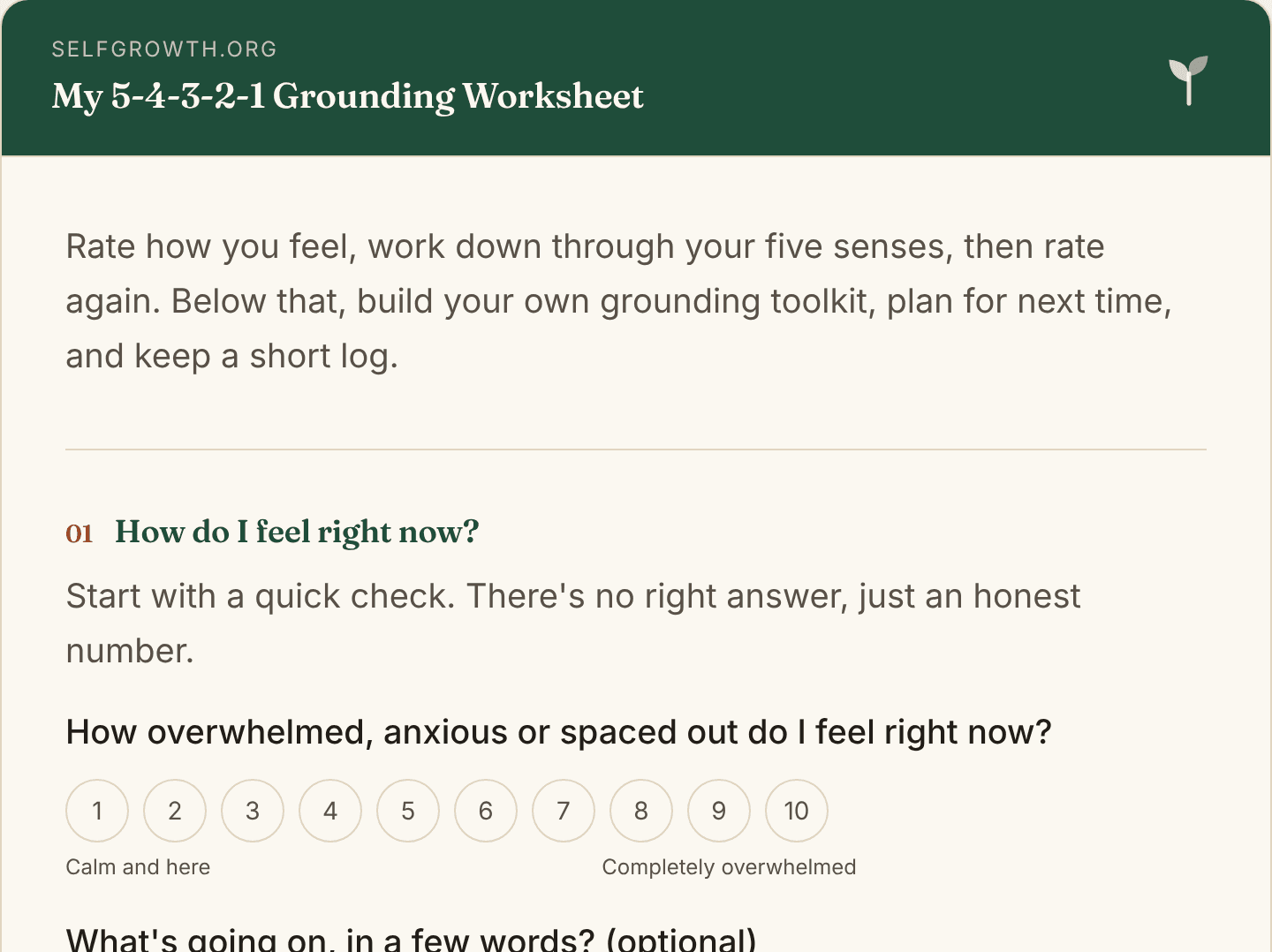
5-4-3-2-1 Grounding Worksheet
A free, printable 5-4-3-2-1 grounding worksheet: rate how you feel, work through your five senses, re-rate, then build your own toolkit and plan for next time.
Open worksheet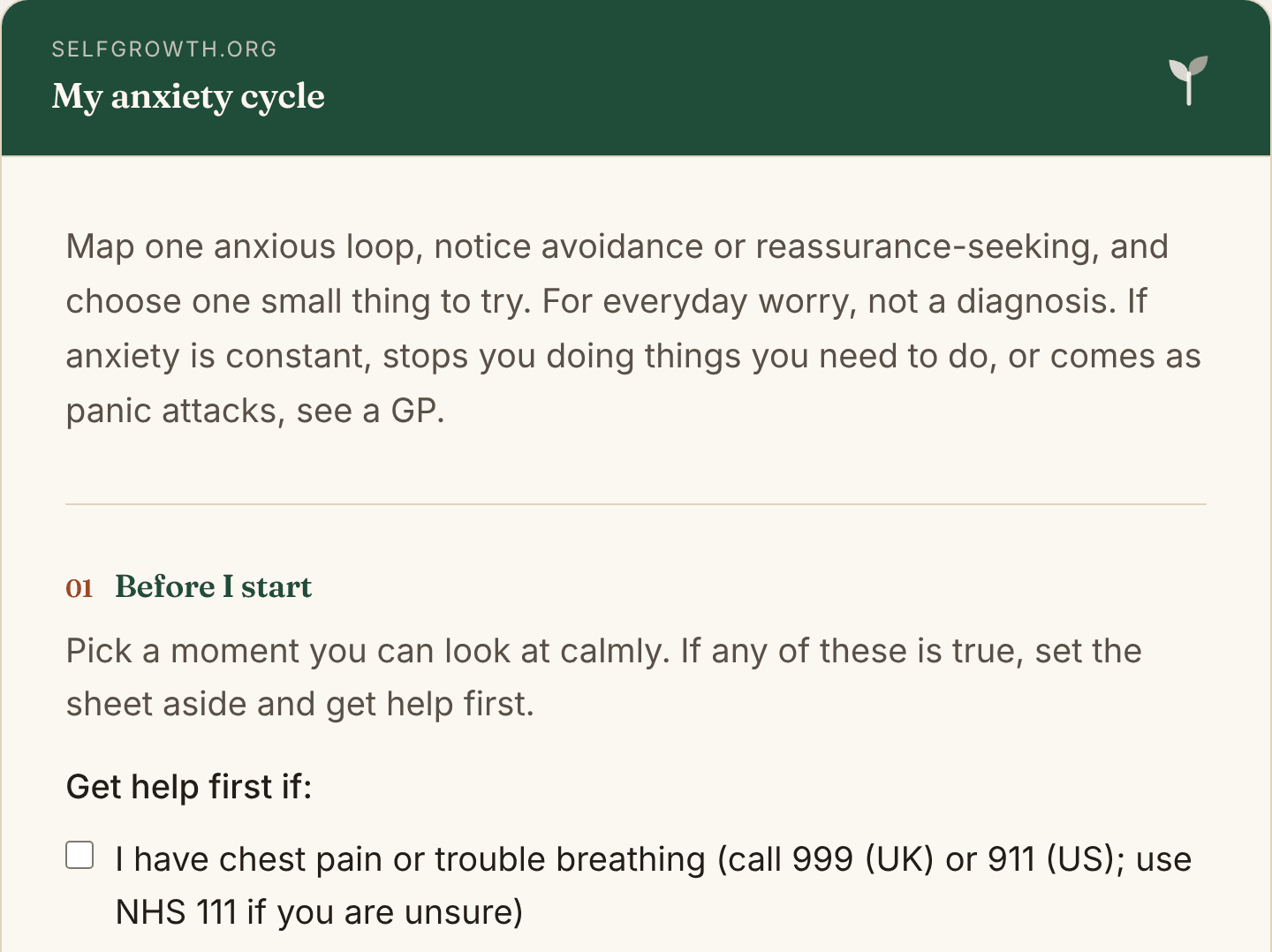
Anxiety Cycle Worksheet
Free anxiety cycle worksheet: map one anxious loop from trigger to relief, see how avoidance and reassurance keep it going, and pick one small change.
Open worksheet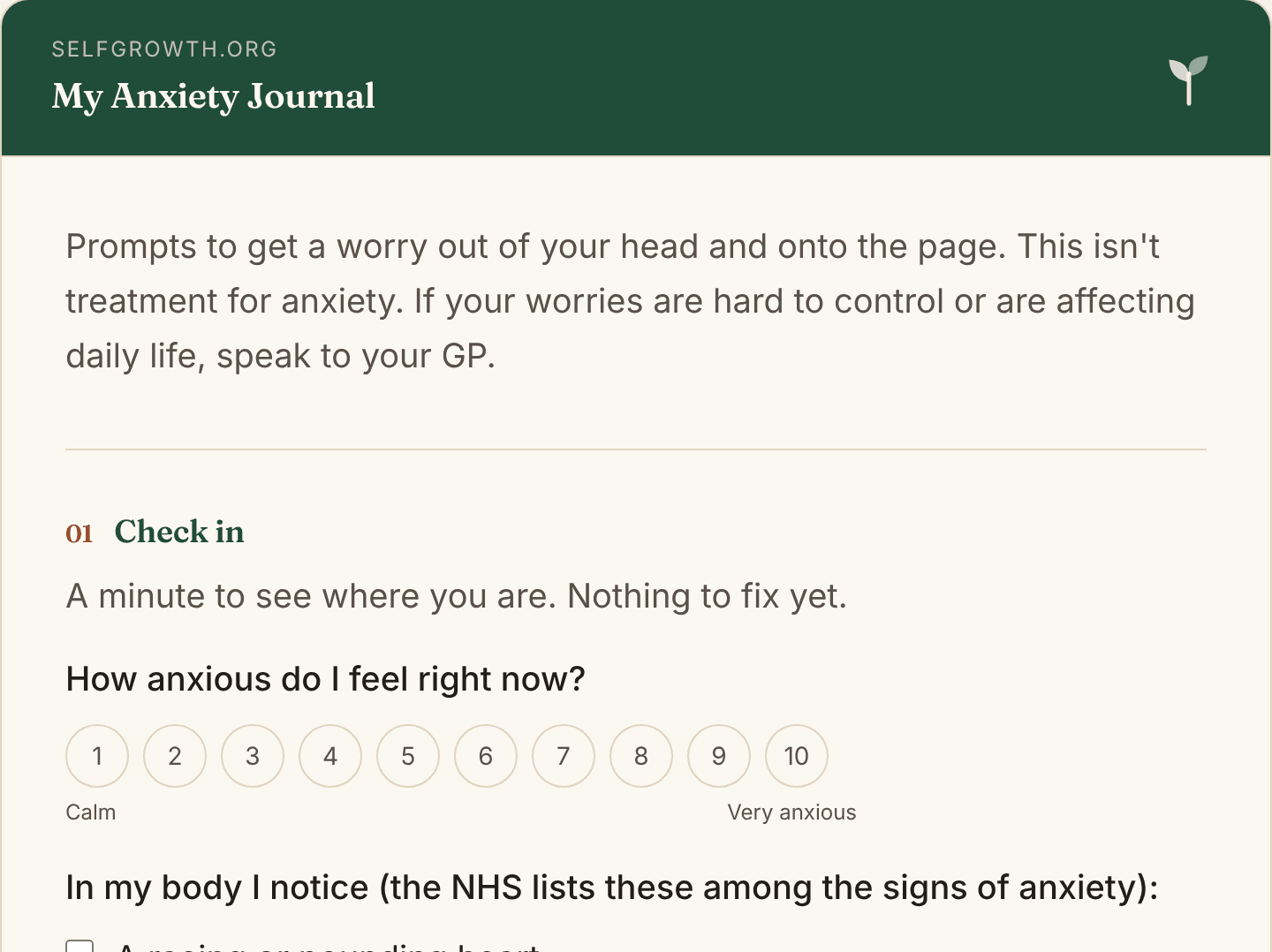
Anxiety Journal Prompts
Free anxiety journal prompts: name the worry, sort what you can influence, note what helped before and pick one small step. Not treatment. Free printable PDF.
Open worksheetNew worksheets, straight to your inbox
An occasional new worksheet or tool, sent only when there's something genuinely worth your time. No spam, no pressure, unsubscribe any time.