
Low mood
Behavioural activation activity list: a free printable menu of small things to try
Updated 23 October 2026 · 7 min read · Free to print
A behavioural activation activity list is a menu of small, pleasant activities you can tick, grouped by type: body, people, outside, creative, small wins, routine and values. Pick three, give each a time and place, then rate your mood afterwards. It is a self-help way to plan on low days, not therapy.
Drawn from behavioural activation and activity scheduling · Part of rest and self-care
Fill it in here (it saves in this browser, but not in a private window), print it, or download the PDF. Free, no sign-up.
When your mood is low, it can be hard to think of anything to do, let alone want to do it. This is a menu, so you do not have to come up with ideas from scratch. Read down the lists, tick what you could imagine doing, even a little, and ignore the rest. Nothing here is a test or something you should be doing.
The ideas come from the same planning approach as behavioural activation: choosing small activities on purpose, rather than waiting to feel like it, and noticing what they do for your mood. In research, a related method called activity scheduling has been used as part of therapy, where you track your mood and daily activities and plan more of the pleasant ones. The list mixes things you might enjoy with small things that give a sense of achievement, because low mood often dulls enjoyment first, and finishing something small can still count. To choose, pick one tiny activity that takes five minutes, one that involves another person, and one get-it-done task you have been putting off.
It is not therapy, and a list of activities cannot treat low mood. If your mood has been low for two weeks or more, or it is getting in the way of daily life, please see your GP. If you are thinking about ending your life or harming yourself, thoughts like these are serious: call Samaritans on 116 123 (UK and Ireland), call or text 988 (US), or find a line at findahelpline.com. More helplines: selfgrowth.org/help.
How to use this worksheet
- 1Tick anything that you have enjoyed before, or that you think might be a little bit nice or worth doing. Do not tick things only because you think you should.
- 2Pick three, with at least one tiny one. Give each a day, a time and a place.
- 3Do them, then rate how you felt before and after. If a step is too hard, shrink it. If it did not help, that is information, not failure.
- 4If you want to log a whole day first and think about your values, use the behavioural activation worksheet. This page is the menu.
The worksheet
selfgrowth.org
My Activity List
Tick the small activities you could try, add your own, pick three to schedule, then rate them afterwards. Self-help, not therapy. If you are thinking about harming yourself, stop and see selfgrowth.org/help.
01Before I start
A quick check. If any of the first three are true, use the support lines first and come back to this later.
If I ticked any of the first three, the person or line I will contact first (my GP, a friend, Samaritans 116 123, 988 in the US) is:
02Body, people, outside and creative
Tick anything you could do. Small is fine: a few minutes counts.
Body
People
Outside
Creative
03Small wins, routine and values
These are about getting something done and feeling a little more in charge of your day, as well as enjoyment.
Small wins
Routine and chores
Values and things that matter
Other things I could do that are not on the list:
- 1.
- 2.
- 3.
- 4.
04Pick three and schedule them
Choose three from everything you ticked: one tiny, one with another person or outside, one that gets something done. Give each a day, a time and a place. Plans with a when and a where are easier to start than 'at some point'.
Entry 1
Entry 2
Entry 3
How likely am I to do all three? (If it is under 7, shrink the steps.)
05Rate it afterwards
After each one, fill in a row. Rate your mood before and after from 1 to 10, plus how much you got a sense of achievement and how much you enjoyed it. If you did not do it, write that down without blame.
Entry 1
Entry 2
Entry 3
Entry 4
Entry 5
06Keep, shrink or swap
Look at your ratings. A small change, or none, is still information. Some things pay off in achievement rather than enjoyment.
Which one was worth repeating, and why?
Which one did I shrink, drop or swap, and what could I try instead?
My three for the next few days:
When you're done, a moment to reflect
- Which activities did you tick quickly, and which did you skip? What does that tell you?
- Which group on the list (body, people, outside, creative, small wins, routine, values) feels furthest from you right now?
- What got in the way when you did not do something?
- Which tiny step could you still manage on a hard day?
- Who could you tell about your three, so it is easier to follow through?
Done for now?
Save today's answers as a dated entry. You can come back, fill it in again and compare the two side by side.
Does scheduling pleasant activities help low mood?
Choosing small activities on purpose and checking their effect on your mood is the core of behavioural activation and of a related method called activity scheduling. In the second, according to a 2007 meta-analysis by Pim Cuijpers and colleagues, you track your mood and activities and plan more of the pleasant ones. The activity ideas in this list are our own list of everyday suggestions, not copied from any published checklist, and no single origin of pleasant activities lists is agreed.
The research behind these methods is on therapy. The 2007 review combined 16 studies and found no significant difference between activity scheduling and other psychological treatments. In a 2006 trial of 241 adults with major depressive disorder, Sona Dimidjian and colleagues found behavioural activation about as good as antidepressant medication among the more severely depressed. Trained people delivered the treatment in those studies, and the people taking part were being treated for depression.
We found no study showing that ticking items off a list gives the same results. The before and after ratings are there so that you can judge for yourself what helps. If your mood does not lift, or it gets worse, talk to your GP.
These are educational self-reflection tools, not therapy.
If you want to go deeper
- Cuijpers, P., van Straten, A. & Warmerdam, L. (2007). Behavioral activation treatments of depression: a meta-analysis. Clinical Psychology Review, 27(3), 318-326.
- Dimidjian, S., Hollon, S. D., Dobson, K. S., Schmaling, K. B., Kohlenberg, R. J., Addis, M. E., et al. (2006). Randomized trial of behavioral activation, cognitive therapy, and antidepressant medication in the acute treatment of adults with major depression. Journal of Consulting and Clinical Psychology, 74(4), 658-670.
Your questions, answered
- What is a behavioral activation activity list?
- It is a menu of small activities you can tick and choose from, used in behavioural activation to plan more of what gives you something back. This one is grouped into body, people, outside, creative, small wins, routine and chores, and values. You choose three, schedule them and rate how you feel afterwards.
- What is a pleasant activities list?
- A pleasant activities list is a set of ideas for things that might feel nice or worthwhile, used to plan your days when your mood is low. A good list includes both pleasant activities and small tasks that give a sense of achievement, since both can matter.
- How do I choose from the activity list?
- Tick anything you could imagine doing, even a little. Then choose three: one tiny, one with another person or outside, one that gets something done. Make each one small and give it a day, a time and a place. If you do not do it, make it smaller next time.
- Does scheduling activities help low mood?
- It might. A 2007 review of 16 studies by Pim Cuijpers and colleagues looked at activity scheduling, a method where you track your mood and activities and plan more pleasant ones, and found no significant difference from other psychological treatments in the studies it covered. Those were treatments given by trained people, not a checklist, so this page is something to try, not a guarantee. The ratings let you check what works for you.
- What if nothing on the list feels appealing?
- That can happen when your mood is low. Pick the smallest thing you can bear, or one that gives you a sense of achievement rather than fun, like making the bed or clearing a surface. Rate it afterwards anyway. If nothing feels appealing for two weeks or more, or you feel hopeless, please talk to your GP.
- Is there a behavioral activation activity list PDF?
- Yes. Use the Download PDF button for a clean, print-ready copy, or Print to print straight from the page. It is free, with no payment and no email needed. You can also tick it on screen, and your answers save in your browser.
- Is this activity list a substitute for therapy?
- No. It is a self-help tool, not therapy or medical advice, and it cannot tell you why your mood is low. If your low mood has lasted two weeks or more, see your GP. If you have thoughts of ending your life, call Samaritans on 116 123 (UK and Ireland), 988 (US), or find a line at findahelpline.com.
Keep going, related worksheets
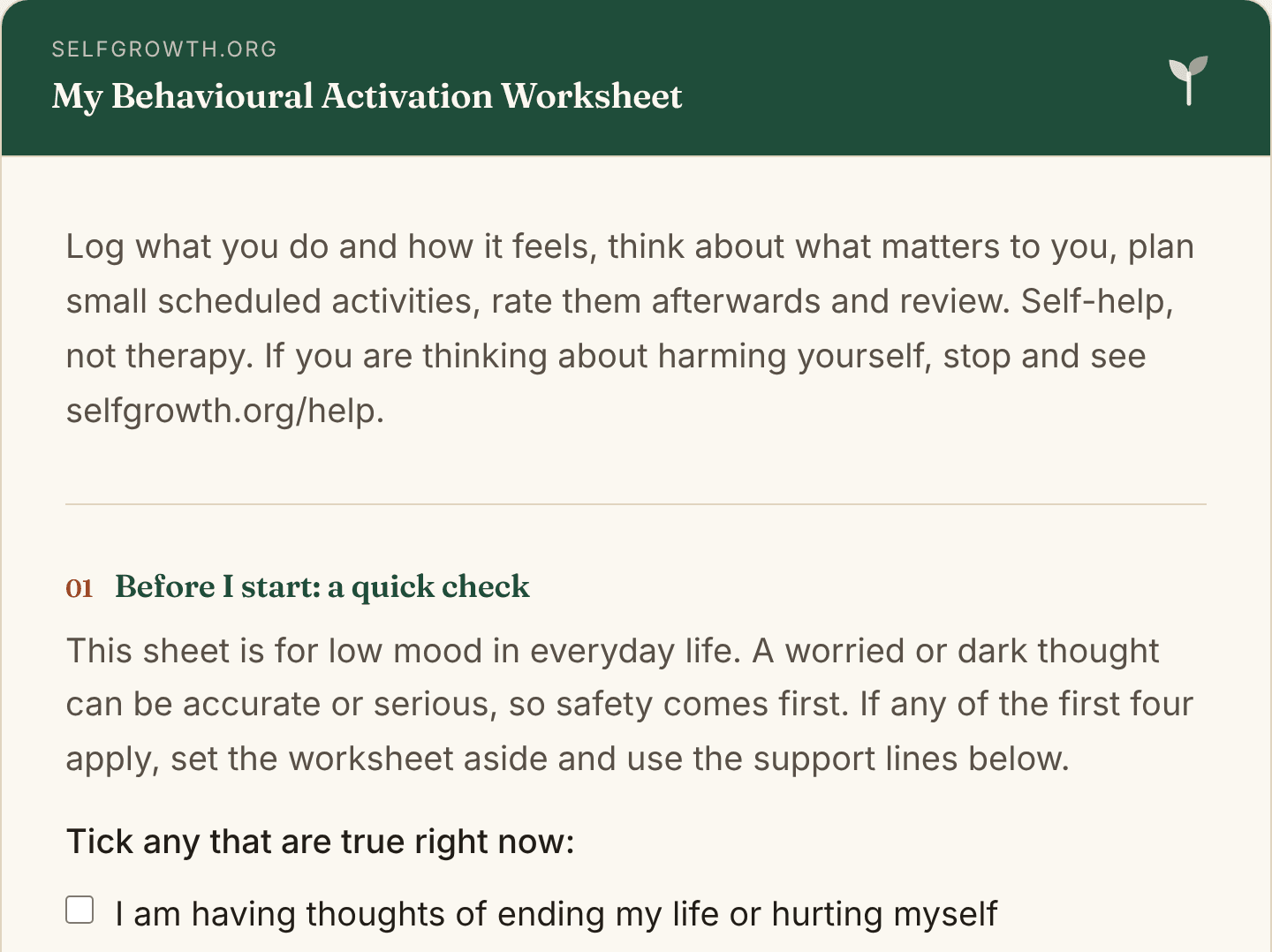
Behavioural Activation Worksheet
Free behavioral activation worksheet: log what you do and how it feels, pick small activities, schedule them and review. Self-help, not therapy.
Open worksheet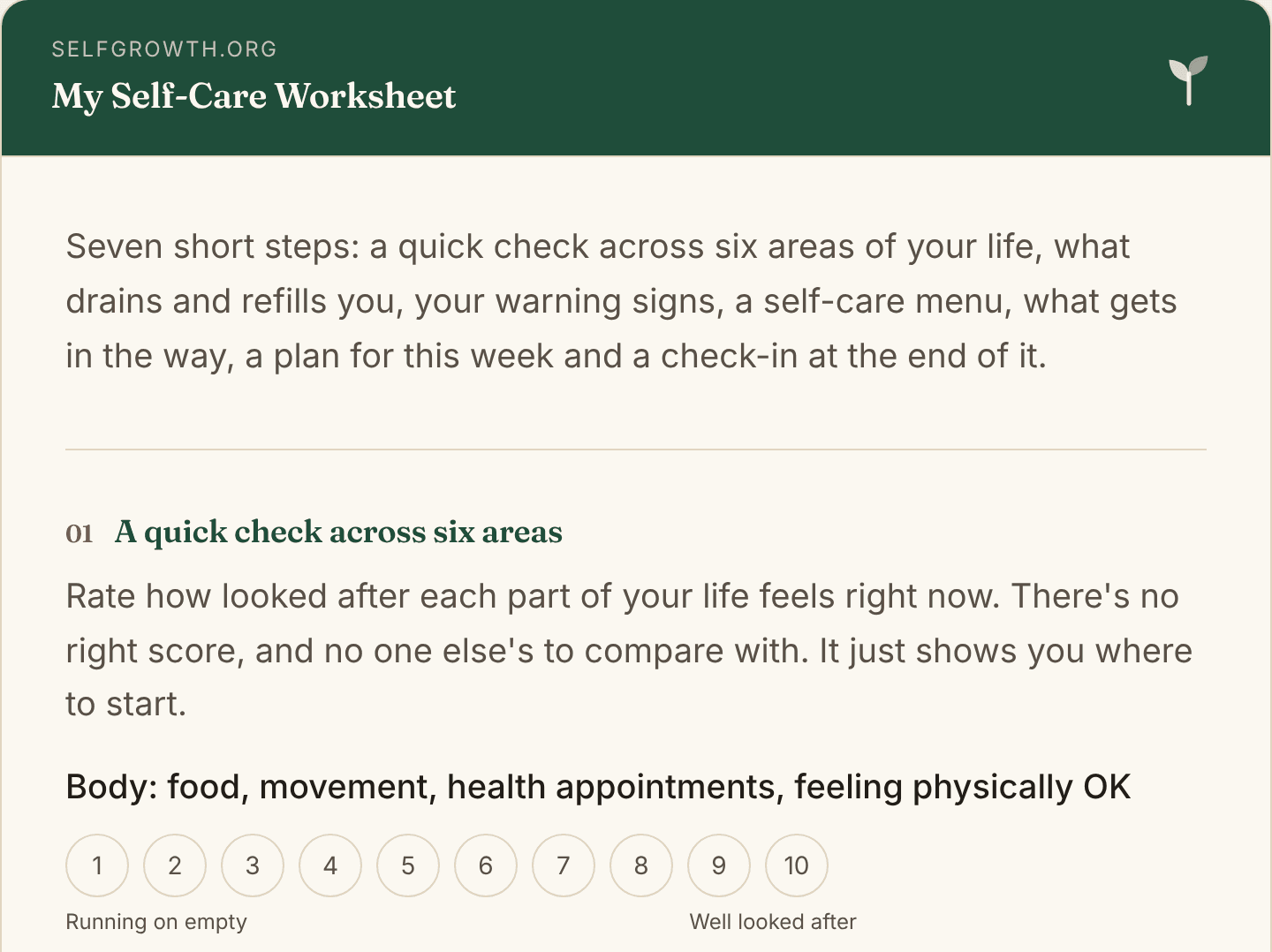
Self-Care Worksheet
A free, printable self-care worksheet for adults: check six areas of your life, see what drains and refills you, and make a self-care plan that costs nothing.
Open worksheet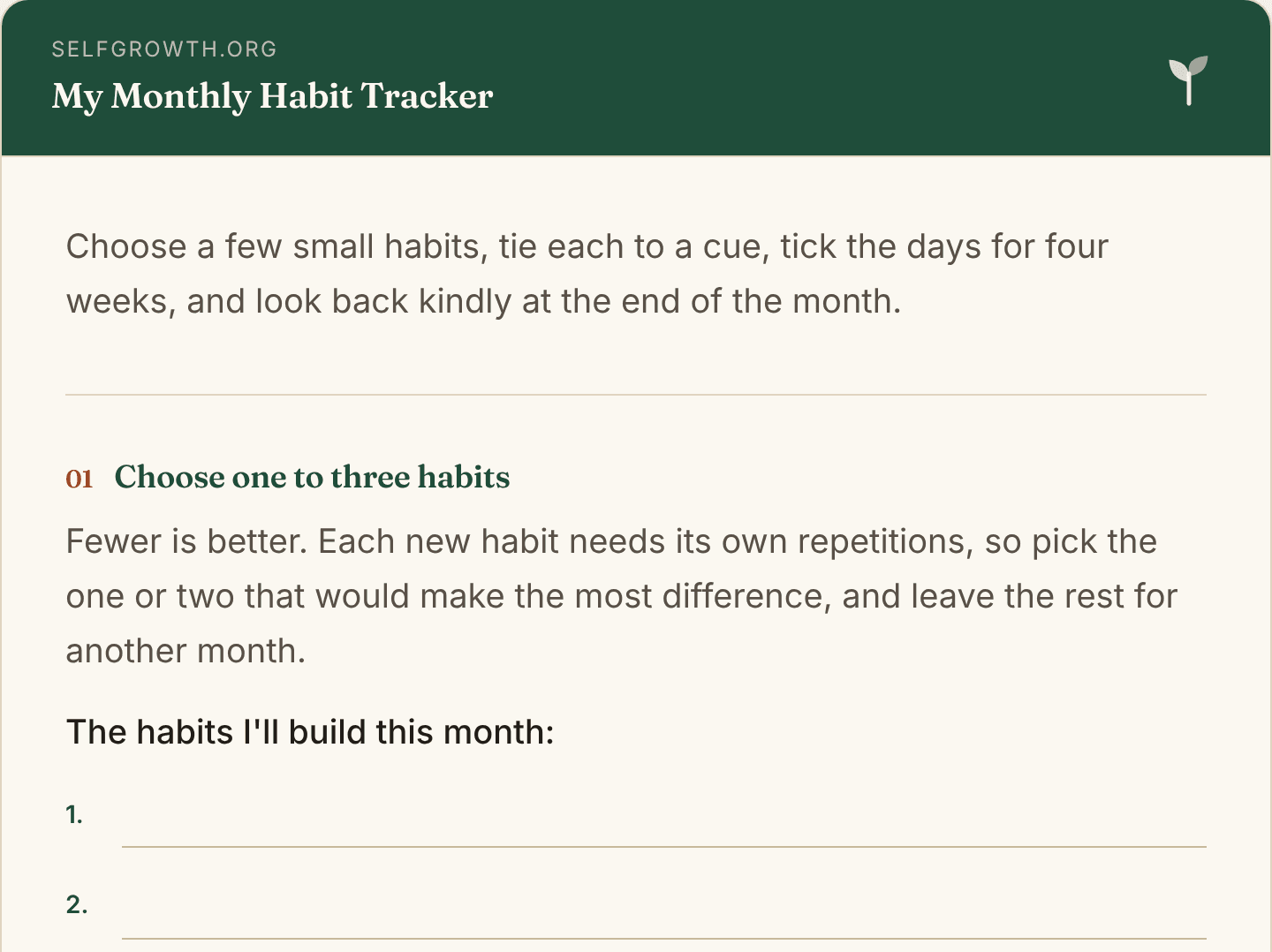
Habit Tracker Printable
A free printable habit tracker for one month: choose one to three small habits, tie each to a cue, tick the days, and review what helped. Print or fill it in.
Open worksheetNew worksheets, straight to your inbox
An occasional new worksheet or tool, sent only when there's something genuinely worth your time. No spam, no pressure, unsubscribe any time.