
Guide
How to cope with grief: practical ways through the first weeks and beyond
Updated 23 October 2026 · 10 min read
To cope with grief, look after the basics first: eat, sleep when you can, and keep the day small. Tell a few people what you need, and use rituals or memories if they help. There is no timetable. If grief feels overwhelming, or you have thoughts of ending your life, talk to a GP or a helpline.
Drawn from cognitive behavioural therapy & self-compassion research · Part of feelings and calm
If someone has died, or you have lost something that mattered, you may not be asking what grief is. You may be asking how to get through today.
This guide is practical, and it is self-help, not therapy. For the stage models, see the stages of grief guide.
What can grief feel like?
Grief is not only sadness. The NHS describes feelings such as shock and numbness, overwhelming sadness, anger and guilt, and says they can come and go and appear unexpectedly. Here are some ways it can show up. You may notice a few, many or none.
- In your body: tiredness, a heavy chest, a tight throat, trouble sleeping, changes in appetite, feeling in a daze.
- In your mind: poor concentration, forgetting things, going over what happened, 'if only' thoughts, a sense that it is not real.
- In your feelings: sadness, anger, guilt, relief, anxiety, numbness, longing for the person, and sometimes laughter that catches you off guard.
- In what you do: withdrawing from people, staying busy, avoiding places that remind you, looking for the person in a crowd, struggling to start tasks.
None of this means you are grieving wrongly. If you want help naming what you feel, the feelings wheel and the list of emotions can help.
Grief can also affect your body. If you have chest pain, trouble breathing or fainting, call 999 (UK) or 911 (US) or your local emergency number; use NHS 111 if you are unsure.
How do you get through the first weeks?
In the early days, the aim is not to feel better. It is to get through the day and keep yourself steady. These steps are suggestions, not rules.
- 1Cover the basics. Drink water, eat something at regular times even if it is small, and rest when you can. The NHS lists regular meals and some exercise among the things that may help.
- 2Make the day small. Pick one or two tasks and let the rest wait. Write a short list so you do not have to hold it in your head.
- 3Choose who to tell. Pick one or two people and say what would help, for example 'Could you ring me on Sunday?' or 'Could you do the shopping this week?'. Specific asks are easier for people to say yes to.
- 4Hand over tasks if you can. Admin after a death can be heavy. If someone offers help with forms or calls, you can say yes.
- 5Make room for ritual and memory. A funeral or memorial, lighting a candle, a photo on the shelf, a favourite meal or a walk somewhere you shared can give grief somewhere to go.
- 6Plan for hard days. Birthdays, anniversaries and holidays can bring it back. Decide in advance who you want near you, what you will do and what you will skip, and give yourself permission to change the plan.
- 7Go easy on alcohol and other numbing habits. The NHS says alcohol, cigarettes, gambling and drugs can make mental health worse.
If you feel overwhelmed, grounding can steady you for a few minutes. The body scan script and the self-care worksheet are gentle places to start.
What helps over time?
Once the first weeks pass, these things can help. None is guaranteed, and you can leave out any that do not suit you.
- Talking. The NHS suggests talking to a friend, family member, healthcare professional or counsellor, and peer support where people share experiences.
- Writing. A grief journal gives feelings somewhere to land without having to explain them. The grief journal prompts and the grief worksheet can get you started.
- Routine. Regular meals, a short walk and a steady bedtime give the days some shape.
- Going back to things gradually. Return to work, friends or hobbies in small steps. You can stop and try again later.
- Taking breaks from grief. Stroebe and Schut's dual process model describes moving between facing the loss and dealing with life's tasks. On that view, a film or a coffee with a friend is not a betrayal.
Some journal prompts to try: 'One thing I miss most is...'; 'A moment today that was a little easier was...'; 'What I wish I could say is...'. Write for a few minutes and stop when you want to. If writing brings up thoughts of harming yourself or ending your life, stop and reach out now: Samaritans on 116 123 (UK and Ireland), 988 (US), findahelpline.com; more routes at selfgrowth.org/help.
If you are also carrying something unresolved that happened before the loss, the letting go of the past worksheet may help.
Open the Grief Journal PromptsWhat should you not expect from grief?
Grief does not run to a timetable. You do not have to be 'over it' by a certain date, to have a certain feeling or to cry in front of anyone. The NHS says grief might feel chaotic and out of control, but the feelings will eventually become less intense over time.
- Do not expect a straight line. Some days will feel lighter and the next may not.
- Do not expect the same as someone else. Two people who lost the same person can grieve differently.
- Do not expect it to stay in the past. A smell, a song or a date can bring it back later.
- Do not expect to follow a fixed order of feelings. The stages of grief guide explains why.
What if other people do not understand?
People can say unhelpful things, or say nothing at all. Some expect you to be back to normal quickly. Others avoid the subject because they are afraid of upsetting you.
- 1Say what you need in a sentence. 'I do not need advice. I would like you to listen.'
- 2Give people a way to help. 'It would help if you said their name.'
- 3Limit time with people who make it harder, and see them on your terms.
- 4Look for people who have been through something similar, such as a bereavement group. Cruse and your GP can point you to one.
- 5Be as kind to yourself as you would be to a friend in your position.
If being hard on yourself is part of it, the self-compassion guide may help.
When to get more support
Grief is not an illness, but you do not have to cope alone. The NHS advises seeing a GP if you are struggling to cope, if low mood has lasted more than 2 weeks, if self-help is not working or if you would prefer a referral. The NHS says adults can also self-refer to NHS Talking Therapies. A GP can listen, check how you are and suggest support. You do not need to wait until it is bad enough. It is also worth seeing your GP if your grief is not easing as the months go by.
In the UK, Cruse Bereavement Support has a helpline on 0808 808 1677, free from UK landlines and mobiles, run by trained volunteers. In the US, your doctor, a local hospice or your faith community can point you to bereavement support nearby. The helplines page lists crisis lines and ways to find a therapist.
If a child or young person is grieving, Child Bereavement UK runs a helpline on 0800 02 888 40 for bereaved children, young people and parents bereaved of a baby or child.
If someone close to you died by suicide, you can be at higher risk yourself, so please reach out for support sooner rather than later. In the US, the American Foundation for Suicide Prevention (afsp.org) offers Healing Conversations, one-to-one support from volunteers who have lost someone to suicide. If you are struggling, call Samaritans on 116 123 (UK and Ireland), 988 (US), or find a line at findahelpline.com; more routes at selfgrowth.org/help.
If grief ever makes you think of ending your life, please call Samaritans on 116 123 (UK and Ireland), call or text 988 (US), or find a line at findahelpline.com. More routes: selfgrowth.org/help. If you are in immediate danger, call 999 (UK) or 911 (US) or your local emergency number.
Sources and further reading
This is an educational self-reflection resource, not therapy or medical advice.
If you want to go deeper
- NHS. Grief, bereavement and loss. nhs.uk/mental-health/feelings-symptoms-behaviours/feelings-and-symptoms/grief-bereavement-loss/
- Cruse Bereavement Support. Helpline. cruse.org.uk/get-help/helpline/
- Child Bereavement UK. Get support. childbereavementuk.org/get-support
- American Foundation for Suicide Prevention. I've lost someone. afsp.org/ive-lost-someone
- Stroebe, M. & Schut, H. (1999). The dual process model of coping with bereavement: Rationale and description. Death Studies, 23(3), 197-224.
Your questions, answered
- How do you cope with grief?
- Start with the basics: eat, rest when you can and keep the day small. Tell one or two people what would help, use rituals or memories if they feel right, and plan for hard days. There is no timetable. If it feels overwhelming, talk to a GP.
- What does grief feel like?
- It can feel like shock, numbness, sadness, anger, guilt, anxiety or longing, and it can show up as tiredness, poor sleep, trouble concentrating or withdrawing from people. The NHS says these feelings can come and go and appear unexpectedly.
- How long does grief last?
- There is no set time. The NHS says grief might feel chaotic and out of control, but the feelings will eventually become less intense over time. It can return around anniversaries or reminders. If it is getting worse or stopping you looking after yourself, see a GP.
- What should I do on the anniversary of a death?
- Plan ahead if you can. Decide who you want near you, what you will do and what you will skip, and allow yourself to change it on the day. Some people visit a place, light a candle, write a letter or cook a favourite meal. There is no right way.
- What is the difference between this and the stages of grief?
- The stages of grief describe feelings, sometimes presented as steps. This guide is practical: what to do in the first weeks and over time. The stages of grief guide covers the models. Neither gives a timetable.
- When should I see a doctor about grief?
- The NHS advises seeing a GP if you are struggling to cope, low mood has lasted more than 2 weeks, or self-help is not working, and also if grief is not easing as the months go by. In the UK, Cruse Bereavement Support has a free helpline on 0808 808 1677. You do not need to wait until it is bad enough.
- Is this therapy, and is it a substitute for it?
- No. It is a free self-help guide, not therapy or medical advice, and it cannot tell you what your grief means. For personal support, speak to a GP or a bereavement service. If grief ever makes you think of ending your life, please call Samaritans on 116 123 (UK and Ireland), call or text 988 (US), or find a line at findahelpline.com. More routes: selfgrowth.org/help. For chest pain, trouble breathing or fainting, call 999 (UK) or 911 (US) or your local emergency number; use NHS 111 if you are unsure.
Worksheets to do the work
Free to fill in online or print. No email needed.
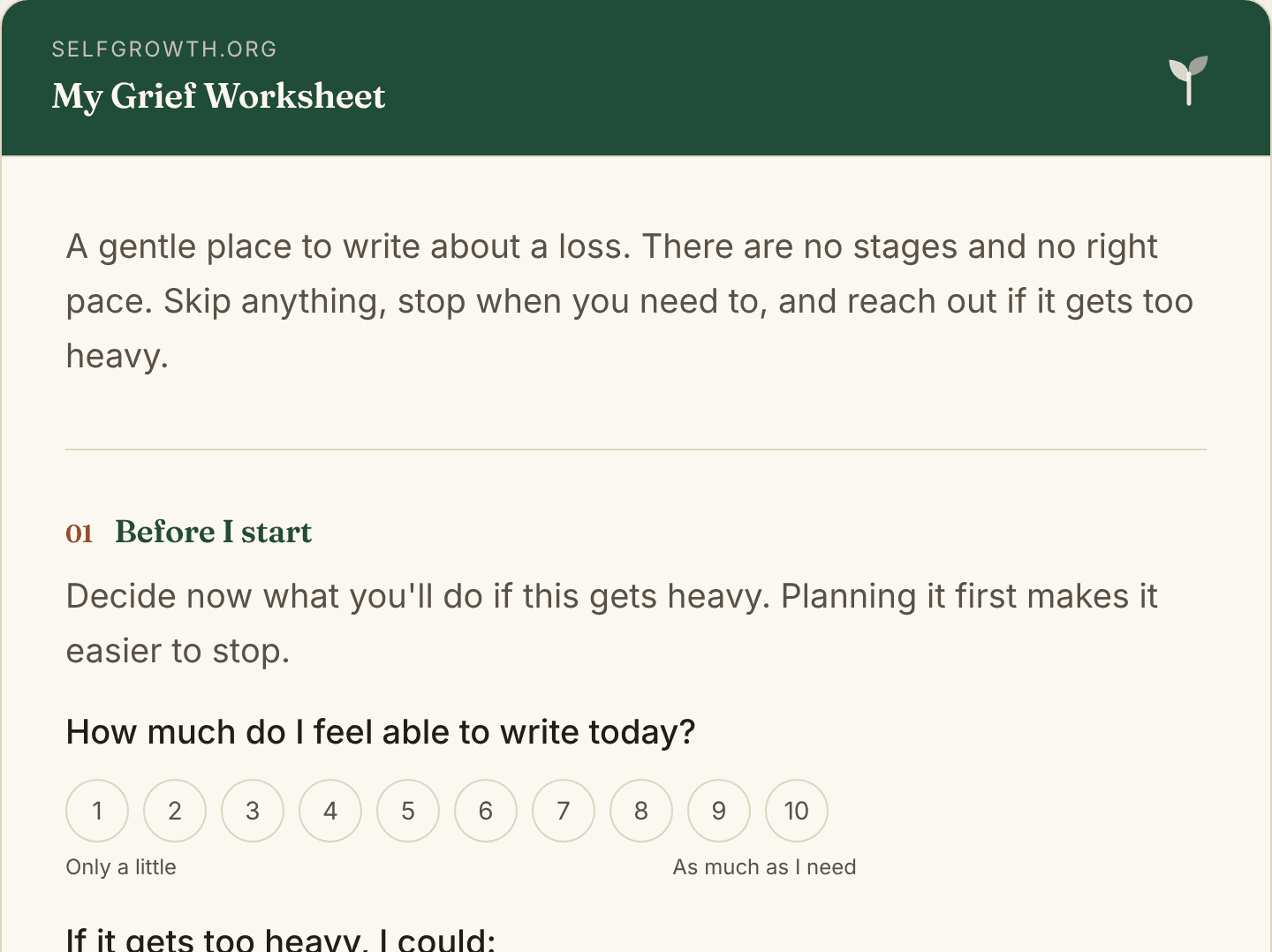
Grief Worksheet
A free, gentle grief worksheet for after a bereavement: write about who you miss, what you feel and what helps today. No stages, no timetable. Free PDF.
Open worksheet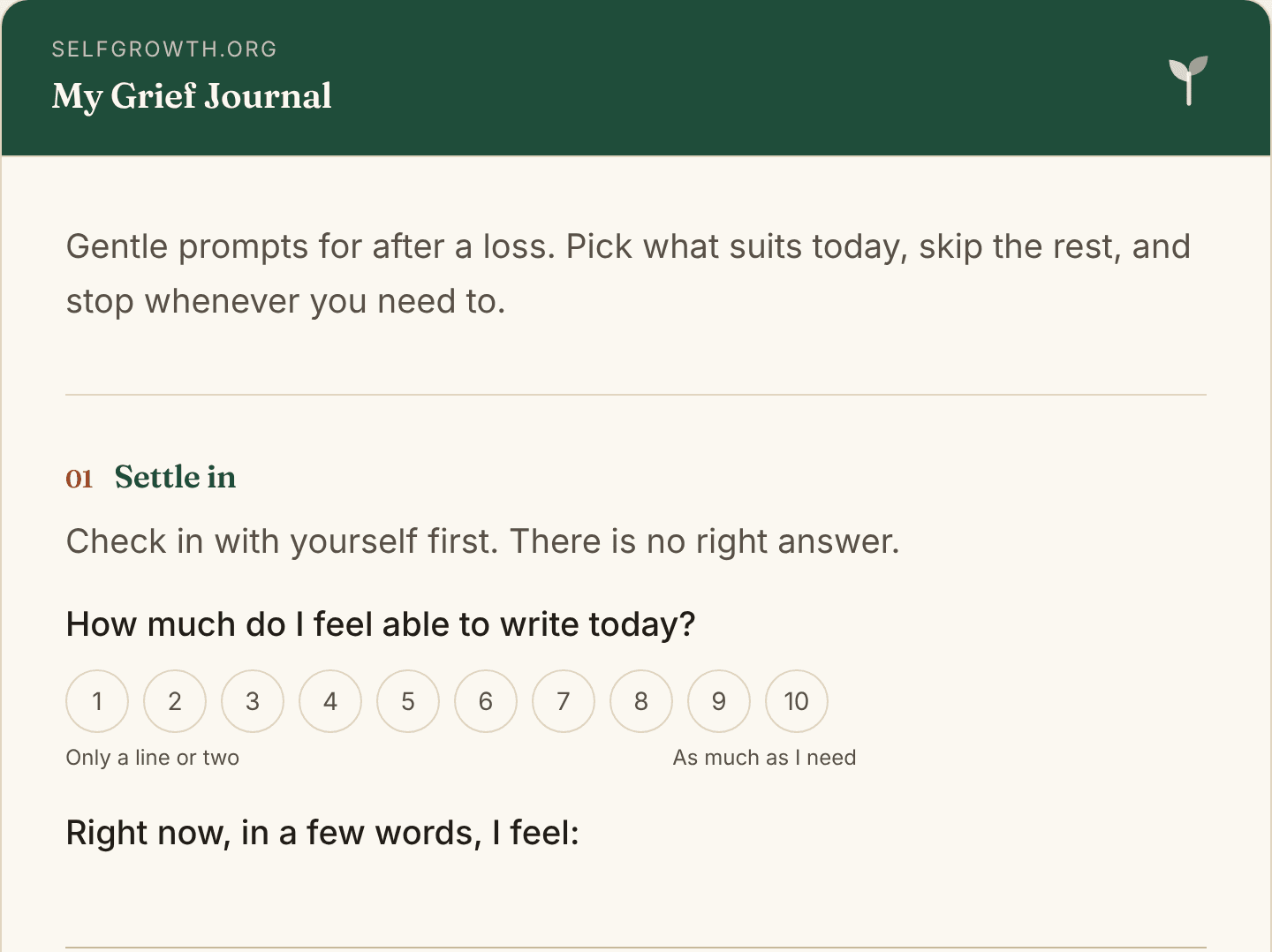
Grief Journal Prompts
Free, gentle grief journal prompts for after a bereavement: who you miss, what you feel, what you wish you'd said. Skip any prompt. No stages. Free PDF.
Open worksheet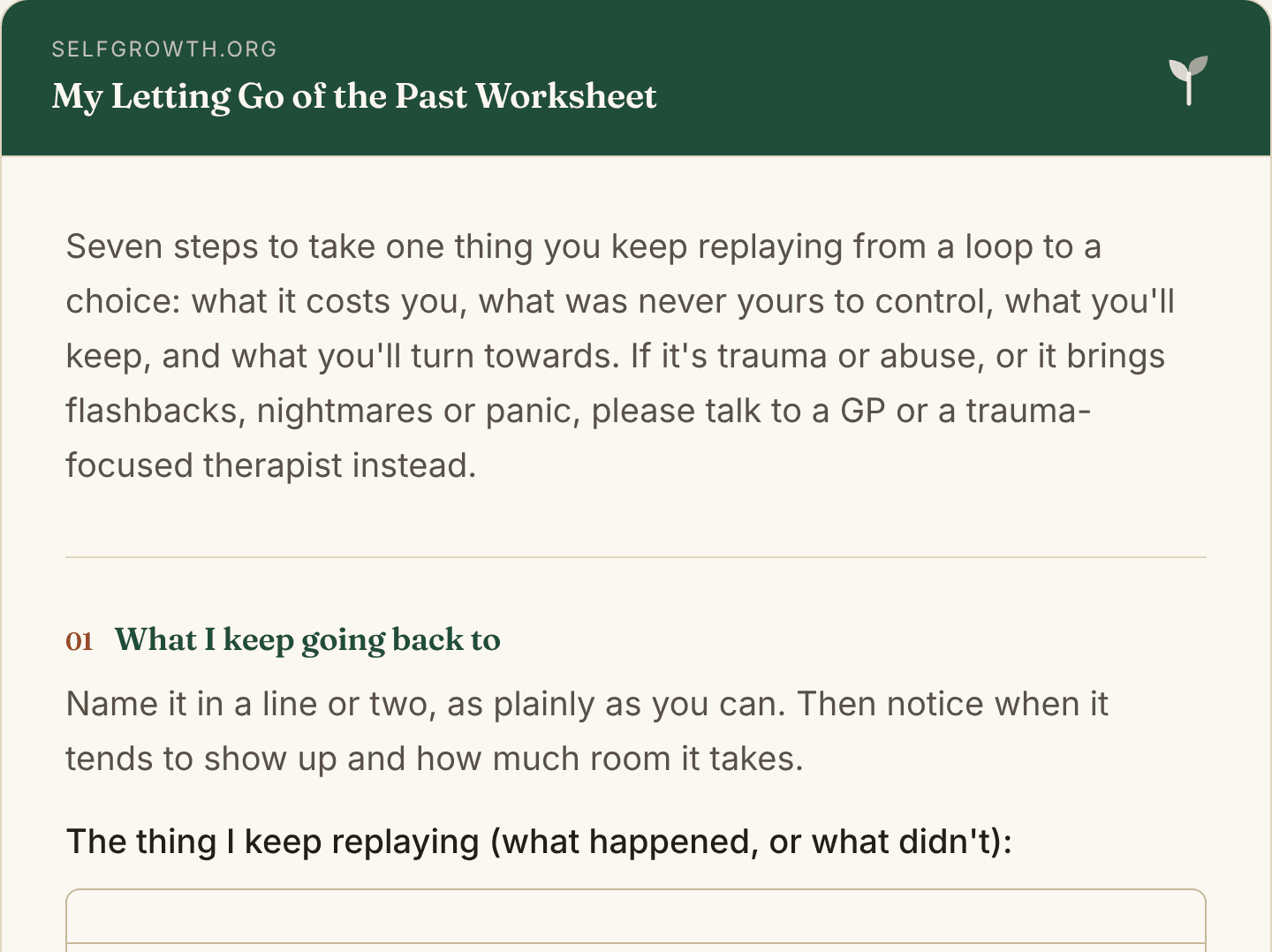
Letting Go of the Past Worksheet
A free printable letting go worksheet: see what replaying the past costs you, sort what was in your control, write an unsent letter, plan for when it returns.
Open worksheet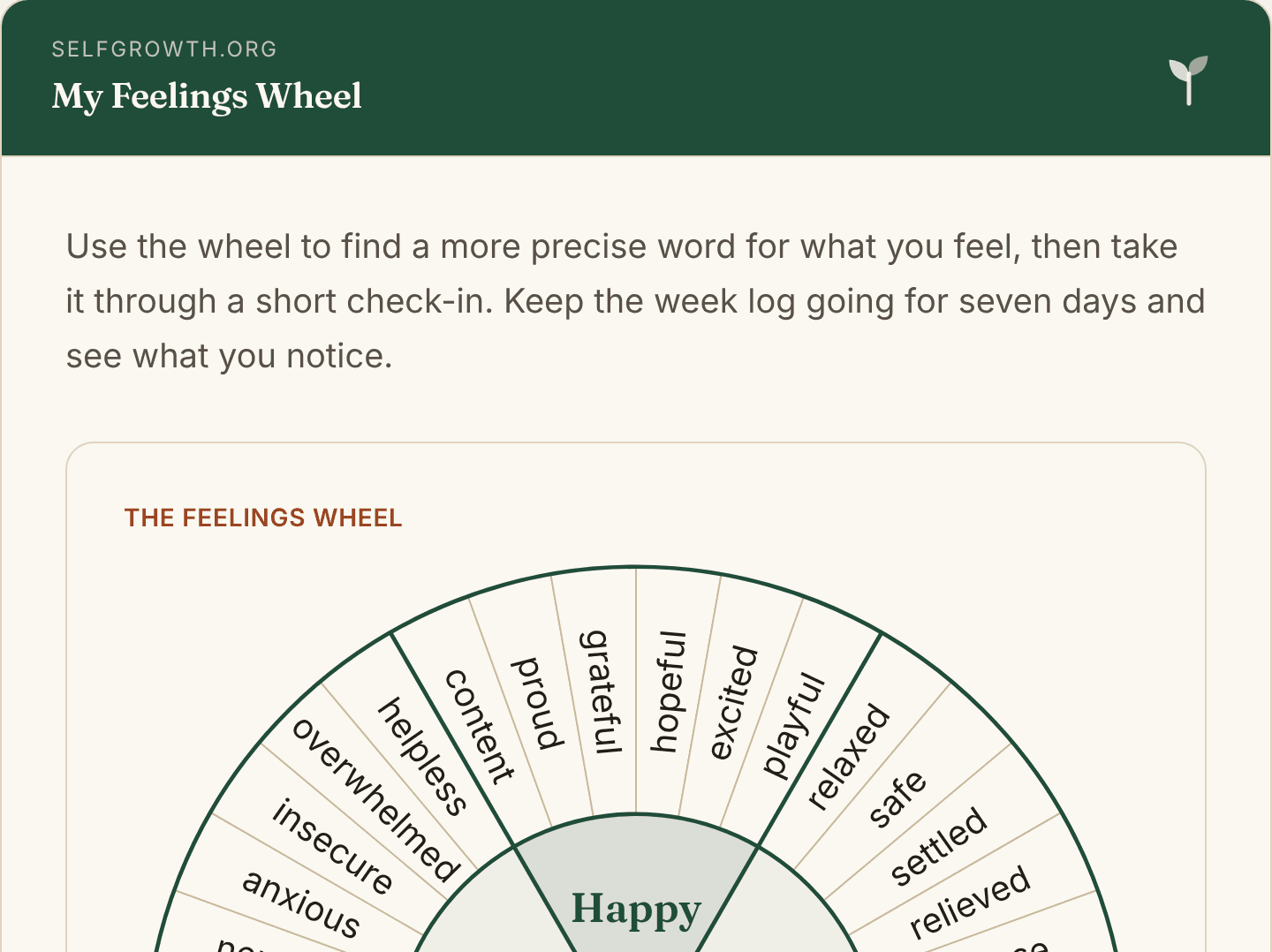
Feelings Wheel
A free printable feelings wheel (emotion wheel) PDF: six core feelings and 36 more precise words, with a daily check-in and a week log to name what you feel.
Open worksheet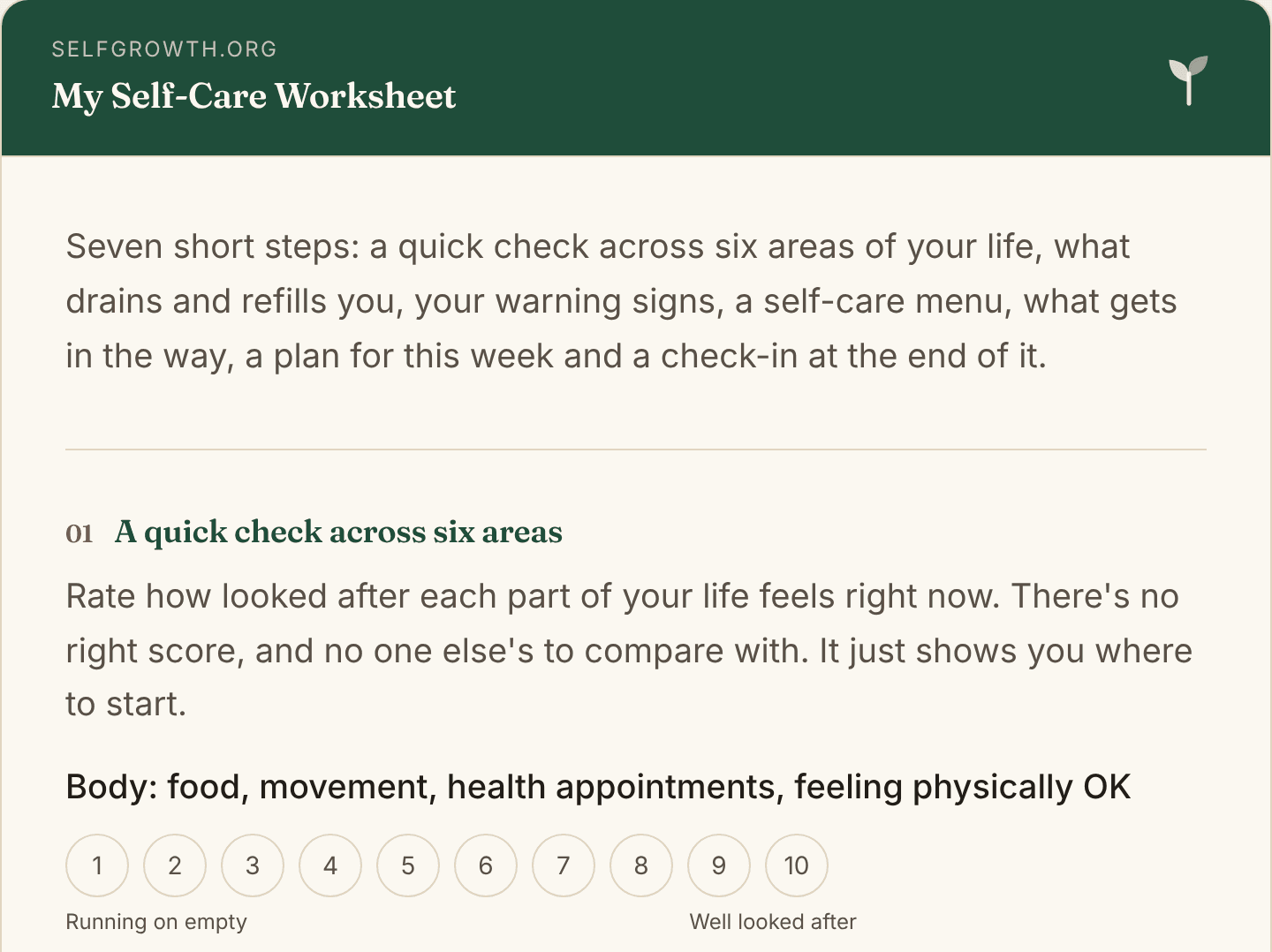
Self-Care Worksheet
A free, printable self-care worksheet for adults: check six areas of your life, see what drains and refills you, and make a self-care plan that costs nothing.
Open worksheet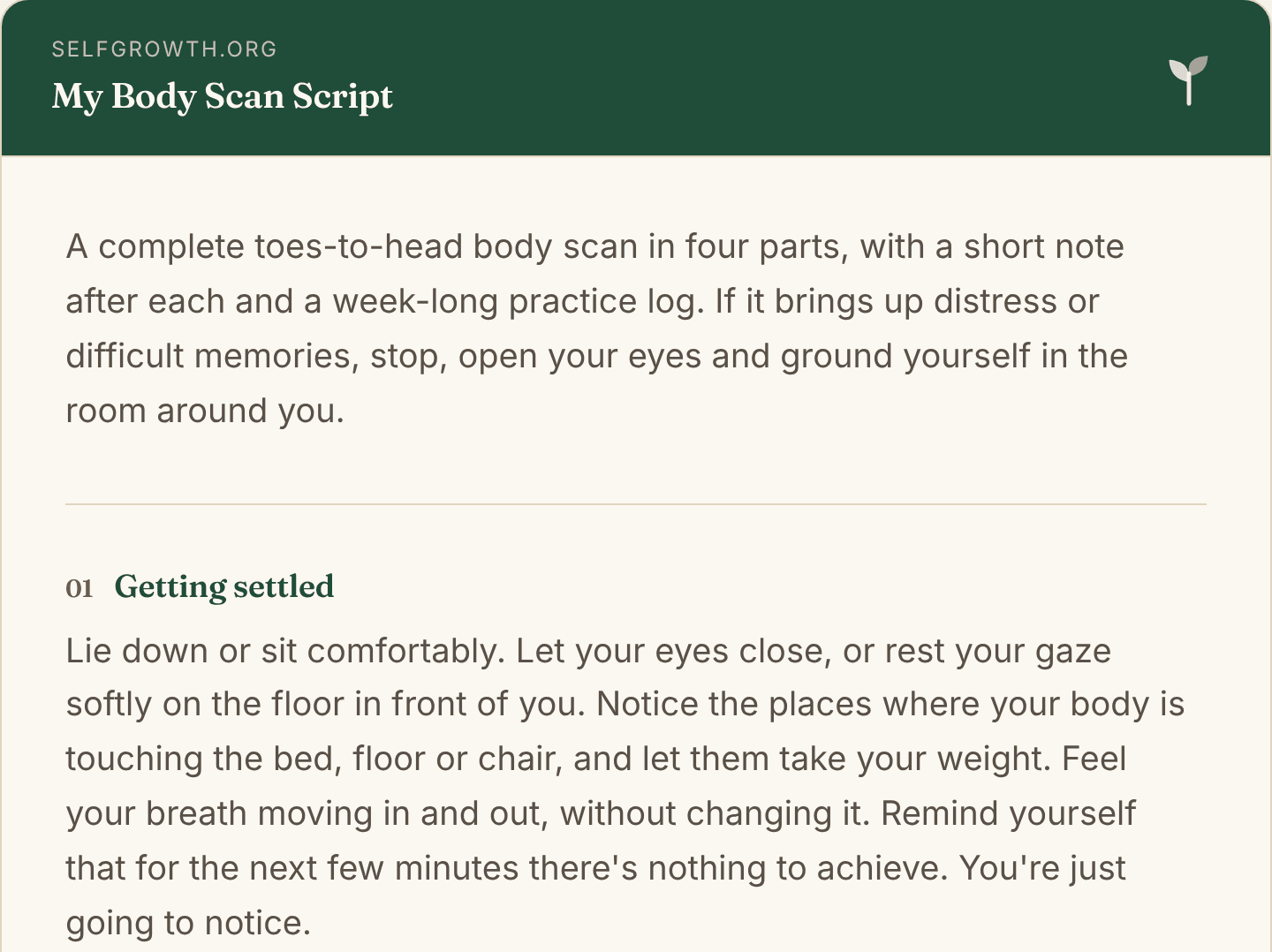
Body Scan Script
A free body scan meditation script in plain English: move your attention slowly from toes to head, noticing without changing, with reflection prompts and a log.
Open worksheetRelated guides
New worksheets, straight to your inbox
An occasional new worksheet or tool, sent only when there's something genuinely worth your time. No spam, no pressure, unsubscribe any time.