
Guide
Cognitive restructuring: what it is and how to do it
Updated 23 October 2026 · 9 min read
Cognitive restructuring means looking hard at a distressing thought and asking whether it holds up. You catch the thought, weigh the evidence for and against it, write a fairer version you could believe, and then test it in real life. It is a skill from CBT, and it works best on thoughts that go beyond the facts.
A four-step way to check a thought, from cognitive behavioural therapy · Part of self-talk and the inner critic
A thought lands: 'I'm going to fail this.' It arrives as if it were a fact, and your body reacts as if it were true. Cognitive restructuring is the habit of stopping for a moment and asking whether the thought holds up.
It is not positive thinking, and it is not arguing yourself into feeling fine. It is closer to checking a claim before you act on it. This guide explains what it is, how to try it on an everyday thought, and where it can go wrong. It is self-help, not therapy.
What is cognitive restructuring?
Cognitive restructuring is a way of examining a thought instead of simply accepting it. 'Cognitive' means to do with thinking. 'Restructuring' means building the thought again, a little more carefully. You do not replace a bad thought with a cheerful one. You look at what you actually know, and you let the thought change to fit it.
It comes from cognitive behavioural therapy (CBT, a talking therapy). The Beck Institute says CBT is based on Dr Aaron T. Beck's cognitive model, which holds that how you perceive an event shapes your reaction more than the event itself. In CBT, a therapist helps you notice distressing thoughts and test them, and you learn to do that yourself and practise outside sessions.
The aim is a fairer thought, not a happier one.
How does cognitive restructuring work, step by step?
This is a short self-help version of the idea. Use it on an everyday thought that feels manageable, such as a worry about a message, a meeting or a mistake. If the thought is about harming yourself, or is tied to something painful that happened to you, set this page aside and see 'When to get more support' below.
- 1Catch the thought. Write it down as it sounds in your head, in one sentence: 'I'm going to mess up the presentation.' Note the situation and how strongly you feel it, from 0 to 100.
- 2Check the evidence, for and against. Write what supports the thought and what does not. Stick to facts you could point to, such as what happened, what was said and what you have done before. Guesses and feelings go in a separate list.
- 3Find a fairer thought. Write a version that fits all the evidence, not only the bad half. It does not need to be cheerful. It needs to be something you could believe: 'I'm nervous, and I've given talks that went fine.'
- 4Test it. Treat the fairer thought as a guess to try out, not a rule. Act on it in a small way, see what happens, and re-rate how strongly you feel the original thought.
If the thought does not shift, that is allowed. Leave it written down, and come back to it. The point is to look at the thought, not to win. The thought record worksheet gives you columns for exactly these steps, and the Socratic questioning worksheet gives you a list of questions for the evidence step.
Open the Thought Record WorksheetWhat does a worked example look like?
Say a colleague walks past without saying hello. Here is how the four steps might look on paper.
- Thought: 'She ignored me. She must be annoyed with me.' Strength: 70.
- Evidence for: she did not say hello, and she looked serious.
- Evidence against: she was carrying a laptop and a phone and was looking at the screen. She was friendly yesterday. I do not know what she was thinking. I have not done anything to upset her that I can think of.
- Fairer thought: 'I don't know why she didn't say hello. She might have been distracted.'
- Test: say hello next time we meet and see how she responds. Strength of the first thought afterwards: 30.
Notice what the example does not do. It does not conclude that she is definitely not annoyed. It swaps a certain-sounding claim for an honest 'I don't know', and then it checks. The cognitive distortions guide names common thinking traps, such as mind reading, that can make a first thought sound more certain than it is.
When does cognitive restructuring help?
It is a good fit when a thought goes further than the facts do. Typical cases are a worry about how others see you, a harsh verdict on yourself after a mistake, or a catastrophe you have predicted. Writing it out slows the thought down and puts the evidence in front of you.
It also suits thoughts you can test. 'Nobody will talk to me at the party' is a prediction you can try out. It is less suited to thoughts that are about values, grief or things that are simply sad. For those, a fairer thought may not be what you need.
If your thoughts loop without stopping, other tools may be a better start. The guide to stopping overthinking covers worry time, noticing the loop and getting out of your head, and the cognitive defusion worksheet offers a different route that does not argue with the thought at all.
When can cognitive restructuring backfire?
- When the danger is real. A worried thought can be accurate. If you are unsafe, afraid of someone, or facing a real threat to your safety, call your local emergency number. The next step is safety, not a fairer sentence. In England, the National Domestic Abuse Helpline is free on 0808 2000 247, 24 hours; in Scotland, call 0800 027 1234; in Wales, 0808 80 10 800; in Northern Ireland, 0808 802 1414; in the US, call 1-800-799-7233. The helplines page lists more.
- When you argue with facts. If the evidence is clear, such as a bill you cannot pay or a diagnosis you have been given, rewriting the thought into something nicer does not help. A fairer thought has to fit the facts, including the hard ones.
- When you force it. Telling yourself 'this is silly' can add shame on top of worry. If the fairer thought sounds false, it is not fair yet. Make it smaller or more honest until you could believe it.
- When it turns into more rumination. Going over the same thought again and again on paper is not restructuring. Set a time limit, and stop when you have a fairer thought or have decided you cannot yet.
- When it is tied to trauma. If a thought comes from something frightening or painful that happened to you, working through it alone with a worksheet may stir things up. A trained therapist can help you go at a safe pace.
A low or worried mood can also colour how convincing a thought feels, which is one reason to write it down and check it. It is also why a thought that stays very heavy is worth sharing with a person, not only a page.
Does cognitive restructuring work?
A 2012 review of earlier research summaries found the strongest support for CBT as a whole in anxiety disorders, somatoform disorders, bulimia, anger control problems and general stress. It did not test restructuring on its own.
What that does not show is that restructuring is the part that helps. CBT combines thought work with acting differently and other skills, and the review did not pull them apart. It also did not test self-help sheets like the ones here. So the sensible way to use this is as a skill to try, with your own before-and-after ratings as the test.
When to get more support
- The same distressing thoughts come back most days and a worksheet does not move them.
- Worry, low mood or fear is getting in the way of sleep, work, study or seeing people.
- A thought is tied to something painful or frightening that happened to you.
- You feel hopeless, or you are thinking that things will never improve.
This guide is for everyday thoughts. It is not therapy and it cannot tell you what is behind how you feel. A GP can talk it through with you. In England you can also refer yourself to NHS talking therapies, which include CBT.
Thoughts like these are serious: thoughts of harming yourself or ending your life. Please get help now. Call Samaritans free on 116 123 (UK and Ireland), or call or text 988 (US). Elsewhere, findahelpline.com lists free, confidential lines by country, and selfgrowth.org/help has more. If you might act on a thought, or you are in immediate danger, call your local emergency number. A thought like this is a sign to reach out to a person, not to test it on paper.
Sources and further reading
This is an educational self-reflection resource, not therapy or medical advice.
If you want to go deeper
- Hofmann, S. G., Asnaani, A., Vonk, I. J. J., Sawyer, A. T. & Fang, A. (2012). The efficacy of cognitive behavioral therapy: A review of meta-analyses. Cognitive Therapy and Research, 36(5), 427-440.
- Beck Institute. Understanding CBT. beckinstitute.org/about/understanding-cbt/
Your questions, answered
- What is cognitive restructuring in simple terms?
- It is checking a distressing thought instead of taking it as fact. You write the thought down, weigh the evidence for and against, and build a fairer version that fits what you actually know. It comes from cognitive behavioural therapy (CBT), a talking therapy.
- What are the steps of cognitive restructuring?
- Catch the thought, check the evidence for and against, find a fairer thought you could believe, and test it in real life. Rating how strongly you believe the thought before and after shows whether anything shifted. The thought record worksheet lays these steps out on one page.
- What is an example of cognitive restructuring?
- A colleague walks past without saying hello and you think 'she must be annoyed with me'. You write down what supports that and what does not, notice she was carrying things and looking at her screen, and settle on 'I don't know why she didn't say hello'. Then you say hello next time and see.
- Is cognitive restructuring the same as positive thinking?
- No. Positive thinking aims for a cheerful thought. Cognitive restructuring aims for a fairer one that fits all the evidence, including the hard parts. A fairer thought can still be serious or sad.
- Does cognitive restructuring work?
- A 2012 review of research summaries found the strongest support for CBT as a whole in anxiety disorders, somatoform disorders, bulimia, anger control problems and general stress. It did not test restructuring on its own or worksheets. Treat this as a skill to try and judge it by your own before-and-after ratings.
- Can I do cognitive restructuring on my own?
- You can try the steps on everyday thoughts with a worksheet, and typed answers save in your browser and, if you are signed in, also to your account. For thoughts that stay heavy, are tied to trauma, or feel unsafe, a GP or a trained therapist is a better route.
- Is this guide a substitute for therapy?
- No. It is a self-help guide, not therapy or medical advice. If you are struggling most days, see a GP. If you think about harming yourself or ending your life, thoughts like these are serious: call Samaritans on 116 123 (UK and Ireland), 988 (US), or find a line at findahelpline.com. More support is at selfgrowth.org/help. The worksheets are free, with no email needed.
Worksheets to do the work
Free to fill in online or print. No email needed.
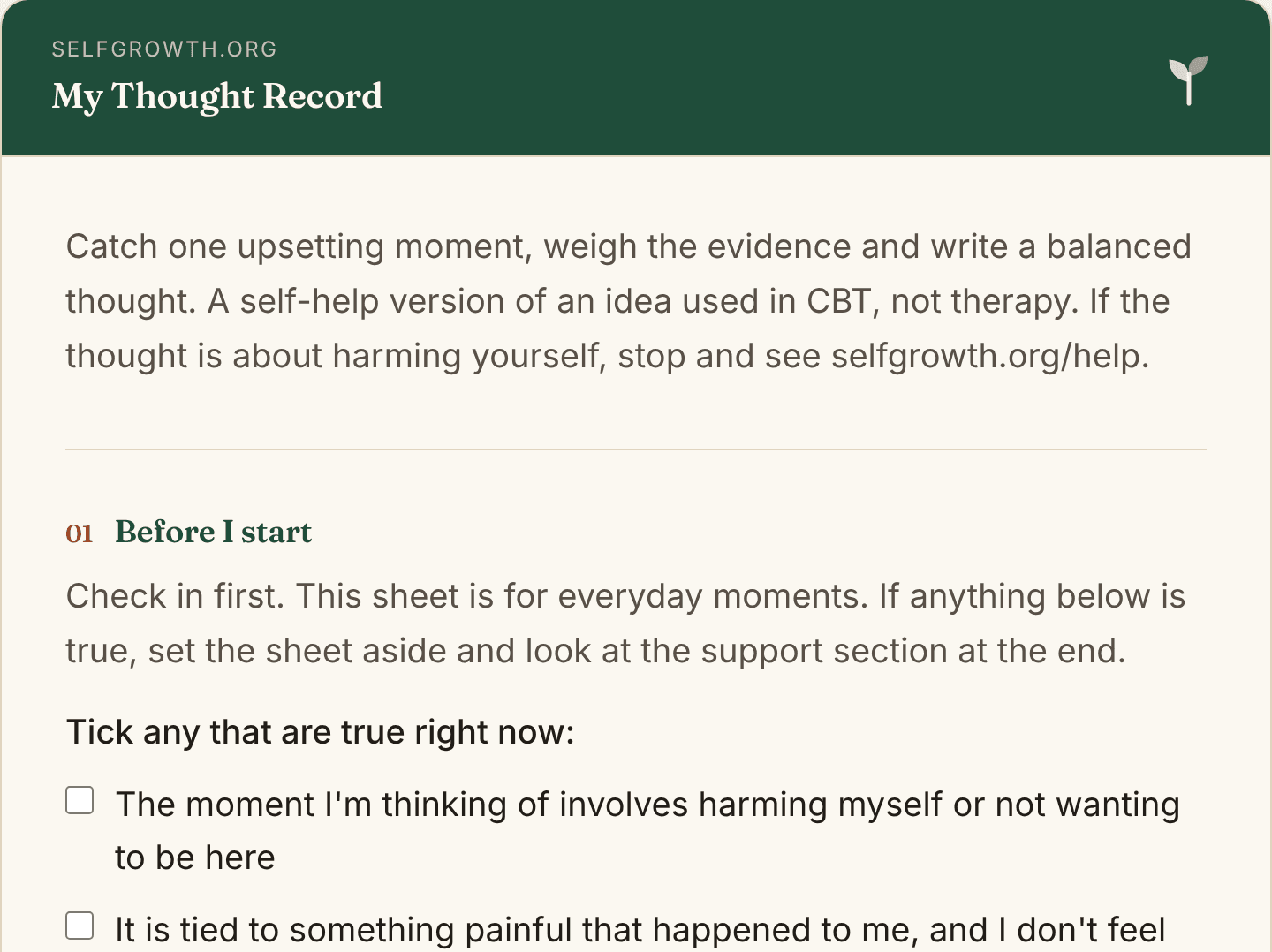
Thought Record Worksheet
Free thought record worksheet: note the situation, feeling and thought, weigh the evidence and write a balanced thought. Self-help, not therapy. Free PDF.
Open worksheet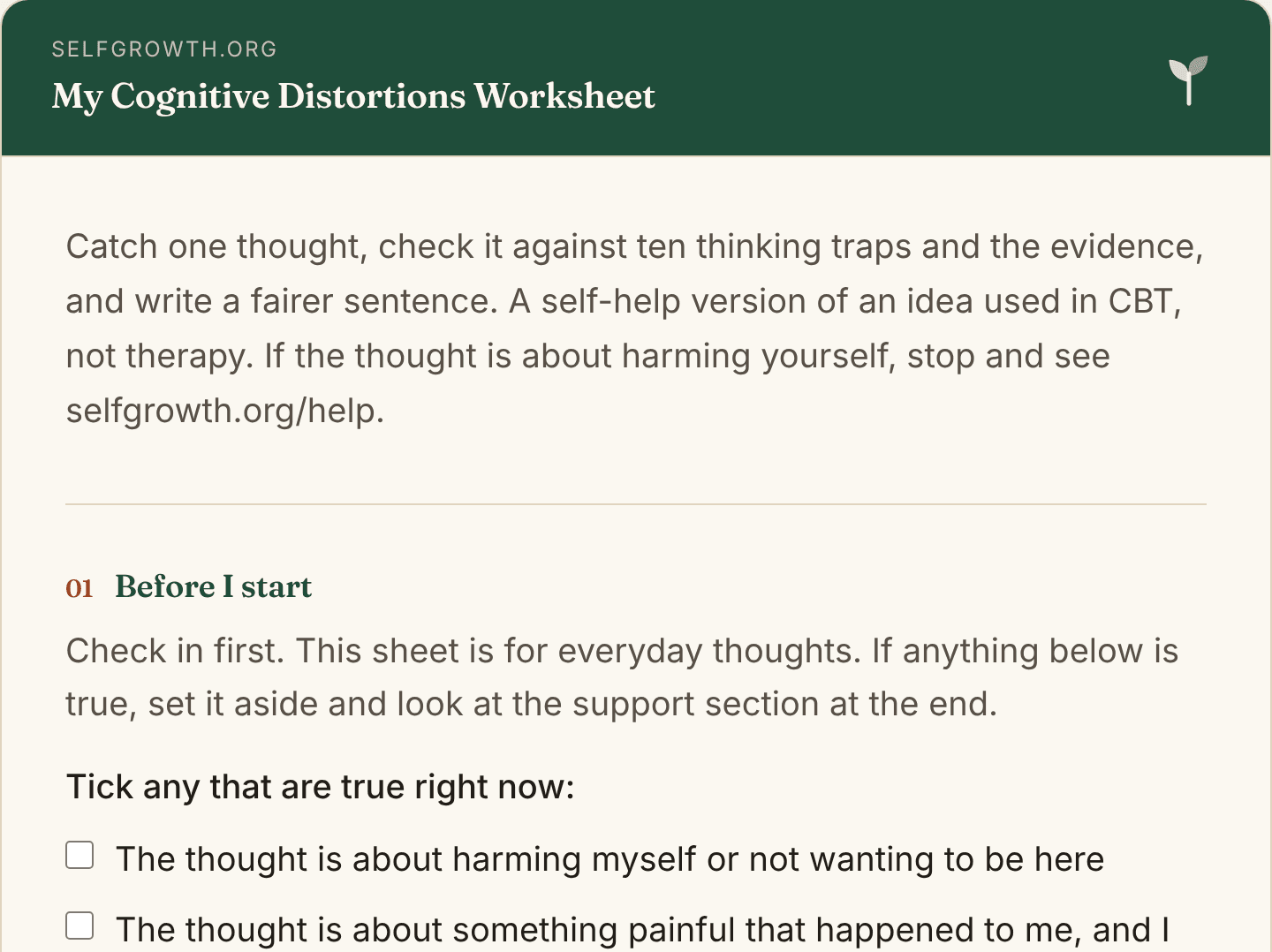
Cognitive Distortions Worksheet
Free cognitive distortions worksheet: check one thought against ten thinking traps, test the evidence and write a fairer sentence. Not therapy. Free PDF.
Open worksheet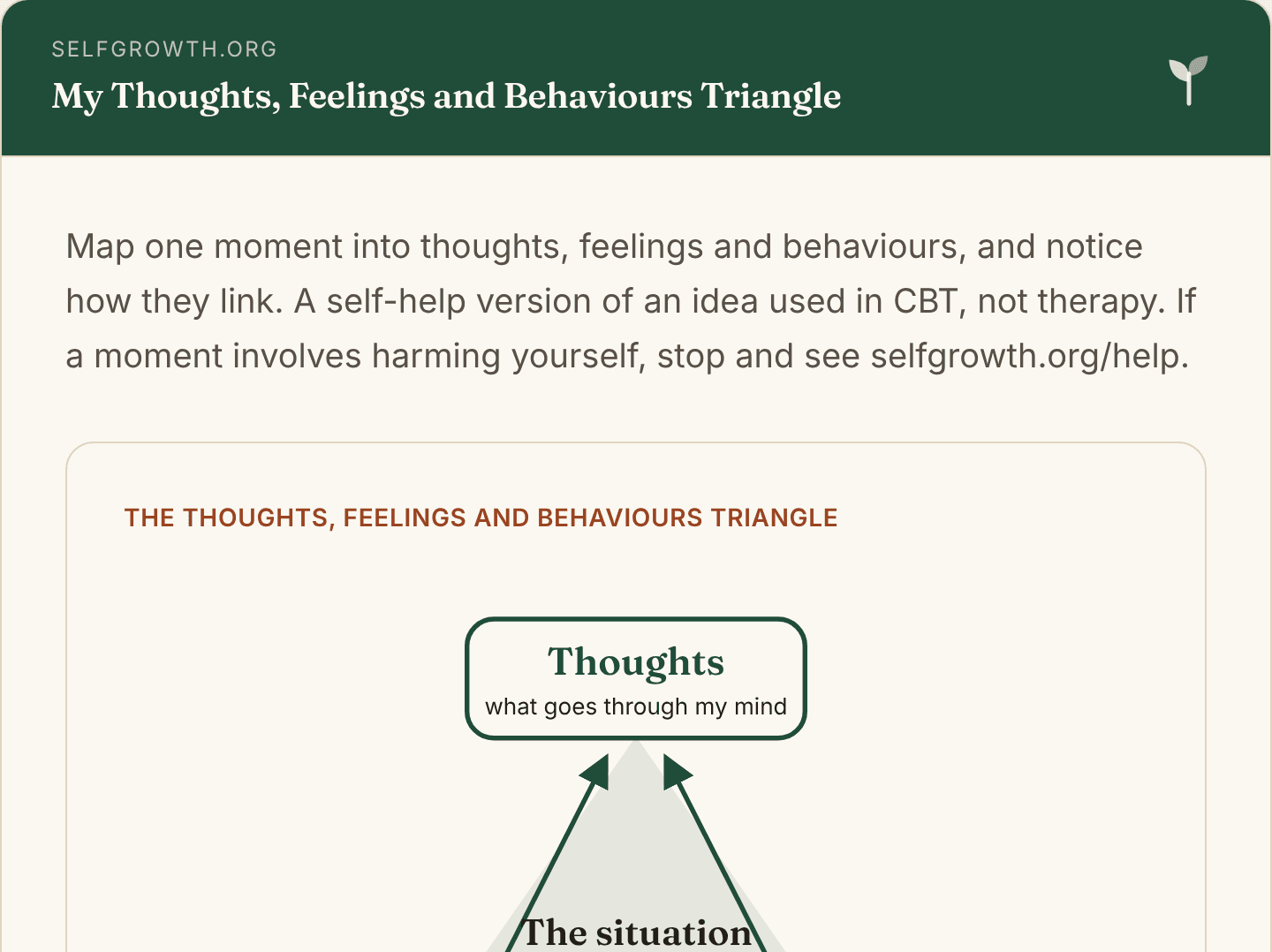
CBT Triangle Worksheet
Free CBT triangle worksheet: map one moment into thoughts, feelings and behaviours and see how they link. Self-help, not therapy. Free printable PDF.
Open worksheet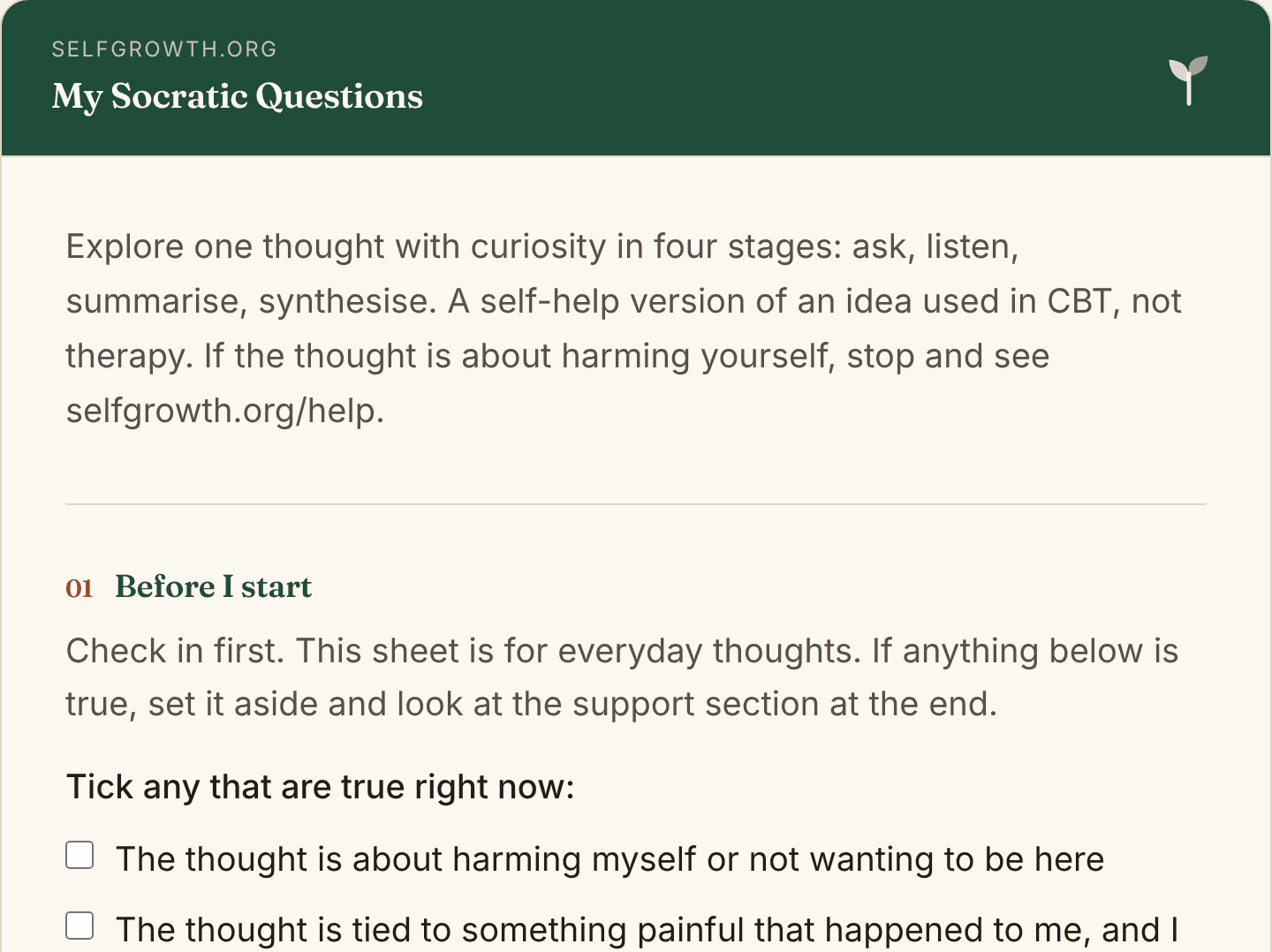
Socratic Questioning Worksheet
Free Socratic questioning worksheet: questions to explore one worrying thought in four steps, from Christine Padesky's guided discovery. Not therapy. Free PDF.
Open worksheet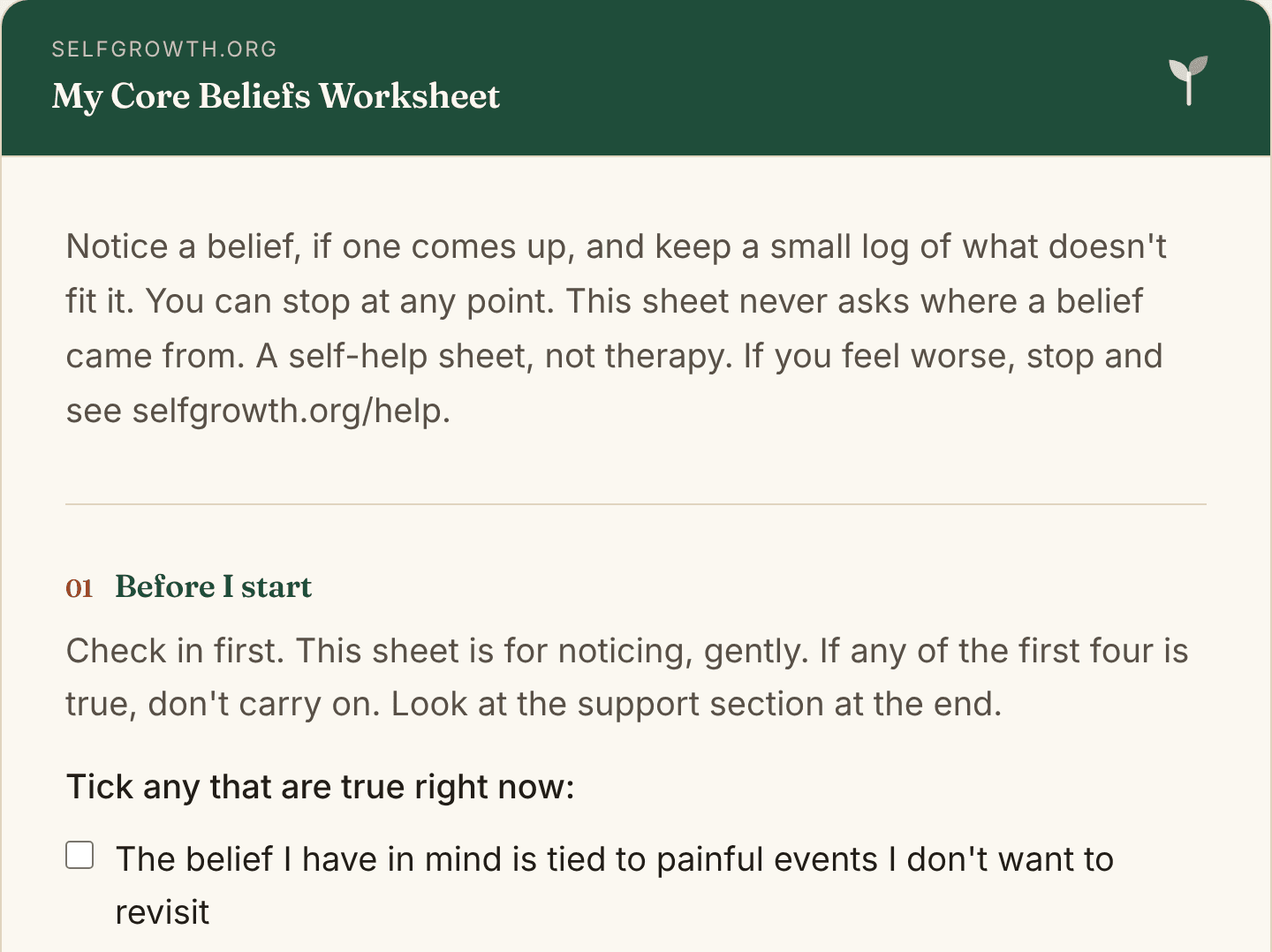
Core Beliefs Worksheet
A gentle, free core beliefs worksheet: notice one belief about yourself, keep a small log of what doesn't fit it, and know when to stop. Not therapy. Free PDF.
Open worksheet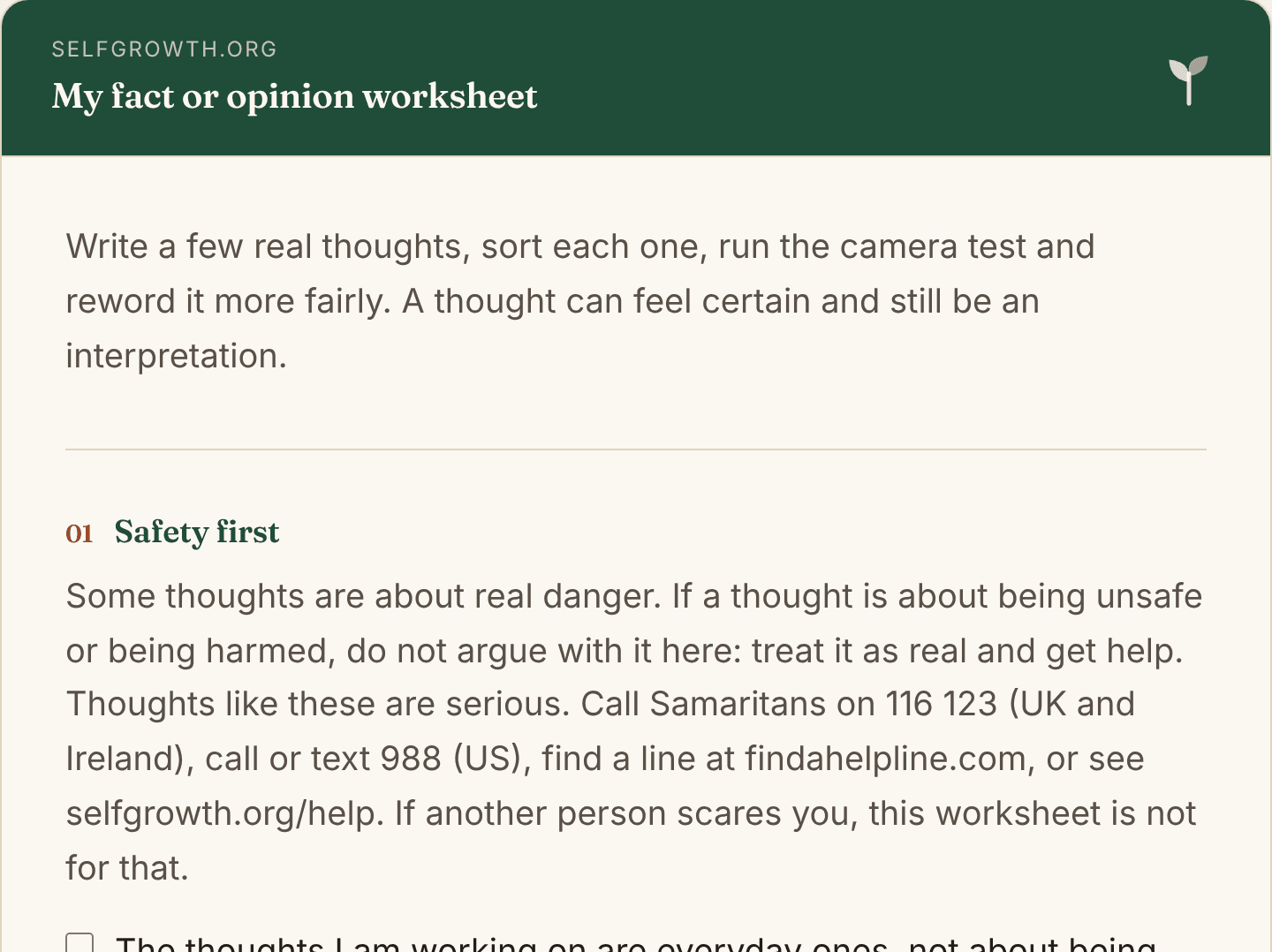
Fact or Opinion Worksheet
Free printable fact or opinion worksheet: sort real thoughts into fact, interpretation, prediction or feeling, use the camera test, reword fairly.
Open worksheetRelated guides
New worksheets, straight to your inbox
An occasional new worksheet or tool, sent only when there's something genuinely worth your time. No spam, no pressure, unsubscribe any time.