
Guide
Anger management techniques: how to control your anger
Updated 23 October 2026 · 11 min read
Anger management techniques work best when you start early. Notice your warning signs, pause and step away, slow your breathing with a longer out-breath, cool down, and name what is under the anger, such as hurt or worry. Say what you need once you are calm. Calming activities help; hitting things does not.
Drawn from NHS anger advice and research on anger · Part of feelings and calm
Anger is a normal feeling. The trouble starts when it flares before you have had a chance to think, and you say or do something you wish you had not. This guide is about the gap between the first spark and the blow-up, and what you can do in it.
It is self-help, not therapy.
One thing first. If your anger has led to hurting someone, or anyone is afraid of you, or you are afraid of someone, this guide is not the right tool. Please read the section called 'When to get more support' now, and use the phone numbers there.
Why do I get so angry?
Anger is a signal. It tells you something matters: a line has been crossed, something feels unfair, or you are being blocked from something you need. The NHS says most people feel angry sometimes, and lists being treated unfairly and feeling powerless to do anything about it among the common triggers.
So the aim is not to stop feeling angry. The aim is to feel it without letting it make your decisions. A signal can be useful and still be too loud.
Anger can hide other feelings. Hurt, fear, shame, tiredness and feeling ignored can all sit underneath it. You will see why that matters in the techniques below, and the anger iceberg worksheet is built around exactly this.
Anger is the part that shows. Look underneath for what else is there, then tick what fits on the sheet below.
What are the early warning signs of anger?
Every technique in this guide works better the earlier you start it. Anger shows up in your body, your thoughts and what you do, and you can often catch it before you say a word. The NHS lists a faster heartbeat among the warning signs. You might also notice:
- In your body: a hot face, a clenched jaw or fists, tight shoulders, a pounding heart, shallow breathing.
- In your thoughts: 'how dare they', 'this is so unfair', replaying what was said, mentally rehearsing a reply.
- In what you do: pacing, a sharper tone, getting louder, interrupting, slamming things down, going very quiet.
Your own signs will be a bit different from this list. A useful exercise is to think of the last time you lost your temper and rewind it. What was the very first thing you noticed, before the shouting? That is your earliest cue, and it is where your technique needs to start. The anger management worksheet has a 1 to 10 anger thermometer for writing your own signs at each level.
How do you control anger in the moment?
These are techniques for when you notice the signs. Try them when you are calm first, so they feel familiar when you need them. You do not need all of them; find the one or two that work for you.
- 1Pause and leave. Give yourself time to think before you react. Say something short, like 'I need a few minutes, I will come back to this', then step away to another room or outside. A pause is not the silent treatment: say that you are coming back, and then come back. The NHS suggests counting to ten before you react.
- 2Slow your out-breath. Breathe in gently through your nose, then out slowly through your mouth for longer than the in-breath. Keep it small and slow rather than gulping air. Breathe like this for a minute or two, and unclench your jaw, hands and shoulders as you go.
- 3Cool down. Run cold water over your hands or wrists, hold something cold, or step outside for fresh air. Walk slowly rather than hard: the aim is to bring your body's alarm down, not wind it up. Cold on the hands is a gentle place to start. If you have a heart condition, take medicine that affects your heart rate or feel faint, skip it and check with a doctor.
- 4Name what is under it. Ask yourself, in plain words: what am I feeling besides angry? Hurt, worried, embarrassed, worn out, ignored? Naming it, even silently, gives you something more useful to act on than the anger. A word list can help if you are stuck.
- 5Use an I-statement, once you are calm enough. Say what happened, how it affects you and what you would like, without blaming: 'I felt dismissed when my idea was talked over. I would like to finish my point.' If you cannot say it calmly yet, wait. It can be said after the pause.
A note on timing. The pause comes first. Words come after, not before. Trying to explain yourself at the top of your anger is hard, and a pause protects the other person and the relationship as well as you. If you need words for feelings, try the list of emotions.
If you have a few minutes free and the anger has dropped, the anger management worksheet turns these into a written plan, including a time-out you can agree in advance with the people you live or work with.
Open the Anger Management WorksheetDoes letting it out or hitting something help?
It is a common idea that anger builds up and you have to get it out, by shouting, punching a pillow or hitting a punching bag. The research does not back this up.
In an experiment published by Brad Bushman in 2002, angry participants hit a punching bag. Those who thought about the person who had angered them while they did it felt angrier afterwards and were more aggressive than the others. The author's conclusion was that doing nothing at all was more effective than venting anger. That was one experiment, so it is a pointer, not a final answer.
A 2024 review by Kjaervik and Bushman gathered studies of things people do to manage anger. Activities that calm the body, such as deep breathing, mindfulness and meditation, lowered anger and aggression. Activities that wind your body up, such as hitting a bag, jogging or cycling, did not help overall. The authors concluded that venting, or going for a run, is not supported as a way to manage anger.
This is why the techniques above are about turning the heat down, not burning it off. Venting by punching things did not help in that study. Regular walking, swimming or yoga is a different thing, and the NHS lists them as ways to relax and reduce stress; the review was about using high-energy activity as an in-the-moment anger fix.
What should you do after you have lost your temper?
Sometimes you will miss the early signs and it will blow up anyway. That does not mean the work failed. What you do next matters a lot.
- 1Calm down first. Use the pause, the slow out-breath or cold water. Do not try to sort it out while you are still flooded.
- 2Check whether anyone is hurt or frightened. If you shouted at, threatened or hurt someone, their safety and feelings come before your explanation. If you hurt someone, read the section called 'When to get more support'.
- 3Own your part, plainly. 'I raised my voice and I should not have' is enough. Skip 'but you made me', which turns an apology into an argument.
- 4Work out what was underneath. What were you feeling before the anger? What did you need, and could you ask for it next time?
- 5Say what you need, using an I-statement, when you are both calm.
- 6Note the trigger and the first warning sign, so you can catch it earlier next time. A line in a notebook is enough.
Be fair to yourself while you do this. Going over it again and again will not help. One honest look, one repair and one thing you will try differently is plenty. The anger iceberg worksheet walks you through the after-the-event steps in writing.
Open the Anger Iceberg WorksheetWhat helps with anger over the longer term?
- Learn your patterns. Keep a short note each time anger flares: what happened, how high it got, what you did. After a few weeks, look for the same people, places, times of day or topics.
- Watch sleep, food and stress. This guide does not claim a rule here, but your own log may show that angry days follow short nights, skipped meals or a packed week. If so, that is something you can change.
- Move your body regularly. The NHS lists running, walking, swimming and yoga as ways to relax and reduce stress. Think of this as general upkeep, separate from using a hard workout to burn off a particular burst of anger.
- Be careful with alcohol and other substances. The NHS advises trying not to use alcohol, cigarettes, gambling or drugs to relieve anger, because they can all contribute to poor mental health. Your log will show whether alcohol is part of your pattern.
- Sort what you can change from what you cannot. Some anger comes from things outside your control. The circle of control worksheet helps you pick one action where you have power and let go of the rest.
- Talk to someone who is not involved, such as a friend or your GP. The NHS suggests this too.
If much of your anger shows up when you cannot say what you need, the guide to assertive communication goes deeper on saying it clearly and calmly, and the I-statements worksheet lets you plan the words for one real conversation. If anger is tangled up with a loop of replaying and rehearsing, how to stop overthinking may help too.
Which anger worksheet should you start with?
- You want a plan for the whole thing (triggers, warning signs, time-out, calming skills): the anger management worksheet.
- You keep wondering why you got so angry about something small: the anger iceberg worksheet.
- You know what you want to say but blurt it out as an attack: the I-statements worksheet.
- You are angry about things you cannot change: the circle of control worksheet.
When to get more support
If your anger has led to hurting someone, threatening them or controlling them, or anyone is afraid of you, this guide is not the right tool, and a worksheet on its own is not enough. In the UK, the Respect Phoneline on 0808 8024040 is free and confidential for people worried about their own behaviour. Calling is a sign you want to change it.
If someone is hurting you, or you are afraid of someone, your anger makes sense and it is not yours to manage away. Do not try to use techniques or ground rules with them. Call the National Domestic Abuse Helpline on 0808 2000 247 (England; Scotland 0800 027 1234, Wales 0808 80 10 800, Northern Ireland 0808 802 1414) or 1-800-799-7233 (US). In the UK, the Men's Advice Line on 0808 801 0327 is for men experiencing domestic abuse. If you are in immediate danger, call 999 (UK) or 911 (US).
Please see a GP if anger is hard to cope with, self-help is not working, or it is affecting your work, health or relationships. The NHS says to see a GP if you are acting in an abusive or violent way. A GP can talk through options such as an anger management course or counselling.
Thoughts like these are serious: thoughts of harming yourself, or of harming someone else. Please get help now. Call Samaritans free on 116 123 (UK and Ireland), or call or text 988 (US). Elsewhere, findahelpline.com lists free, confidential lines by country, and selfgrowth.org/help has more. If anyone is in immediate danger, call your local emergency number.
Sources and further reading
This is an educational self-reflection resource, not therapy or medical advice.
If you want to go deeper
- Kjærvik, S. L. & Bushman, B. J. (2024). A meta-analytic review of anger management activities that increase or decrease arousal: What fuels or douses rage? Clinical Psychology Review, 109, 102414.
- Bushman, B. J. (2002). Does venting anger feed or extinguish the flame? Catharsis, rumination, distraction, anger, and aggressive responding. Personality and Social Psychology Bulletin, 28(6).
- NHS (n.d.). Anger. nhs.uk, Mental health: feelings, symptoms and behaviours.
- Respect Phoneline (UK 0808 8024040); National Domestic Abuse Helpline (England 0808 2000 247; Scotland 0800 027 1234, Wales 0808 80 10 800, Northern Ireland 0808 802 1414); National Domestic Violence Hotline (US 1-800-799-7233).
Your questions, answered
- What are the best anger management techniques?
- Start early. Notice your warning signs, pause and step away, breathe out slowly for longer than you breathe in, cool down with cold water on your hands or fresh air, and name what is under the anger. Say what you need afterwards with an I-statement. Reviews of anger activities point to calming ones, such as deep breathing and mindfulness, over ones that raise your energy.
- How do I control my anger in the moment?
- Pause before you react. Say you need a few minutes, step away and slow your breathing, with the out-breath longer than the in-breath. The NHS suggests counting to ten and doing calming breathing exercises. Come back to the conversation once the feeling has dropped, and say what you need in an I-statement.
- Does punching a pillow or a punching bag help anger?
- Research points the other way. In a 2002 experiment, people who hit a punching bag while thinking about the person who angered them felt angrier and were more aggressive, and doing nothing worked better than venting. A larger 2024 review found activities that wind your body up did not reduce anger overall, while calming ones did. Venting by punching things did not help in those studies.
- Why do I get so angry over small things?
- Anger can sit on top of other feelings, such as hurt, worry, tiredness or feeling ignored, and a small event can be the last straw on a heavy day. Tracking your triggers and the feeling underneath helps. The anger iceberg worksheet is built for this. If it keeps happening or is hard to cope with, see a GP.
- Is anger management therapy?
- No. This guide is self-help, not therapy or medical advice. Anger management courses and counselling are delivered by trained people, and a GP can talk through options. The NHS says to see a GP if you are struggling to cope with anger, if self-help is not working, or if you are acting in an abusive or violent way.
- What if my anger has led to hurting someone?
- This guide is not the right tool. In the UK, the Respect Phoneline on 0808 8024040 is free and confidential for people worried about their own behaviour. See a GP too. If you are afraid of someone, call the National Domestic Abuse Helpline on 0808 2000 247 (England; Scotland 0800 027 1234, Wales 0808 80 10 800, Northern Ireland 0808 802 1414) or 1-800-799-7233 (US). In immediate danger, call 999 (UK) or 911 (US).
- Are the anger worksheets free, and is there a PDF?
- Yes. They are free, with no payment and no email needed. Use the Download PDF button on each worksheet for a print-ready copy, or fill it in on screen.
Worksheets to do the work
Free to fill in online or print. No email needed.
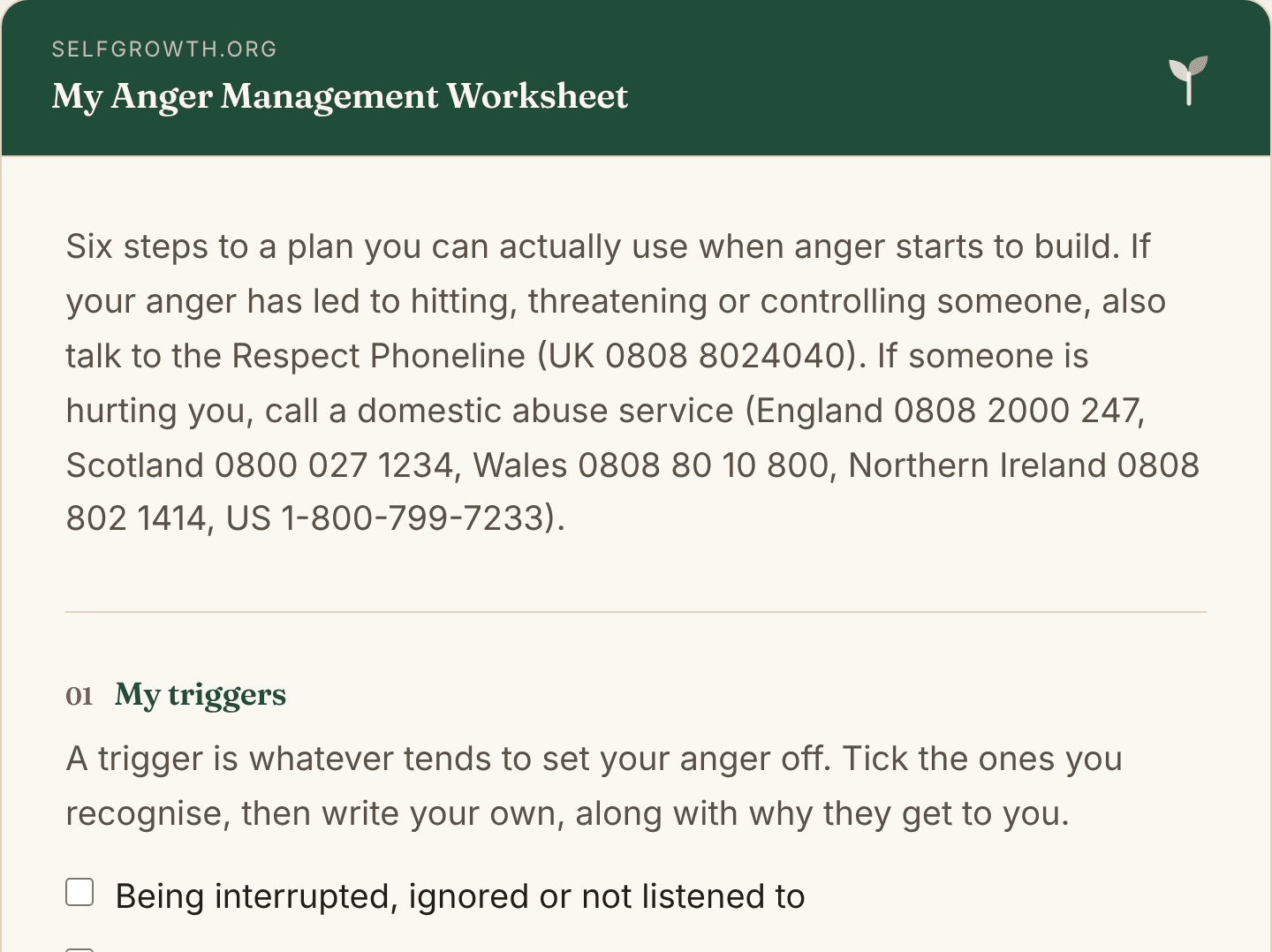
Anger Management Worksheet
A free anger management worksheet for adults: your triggers, an anger thermometer with your own warning signs, a time-out plan and calming skills. Free PDF.
Open worksheet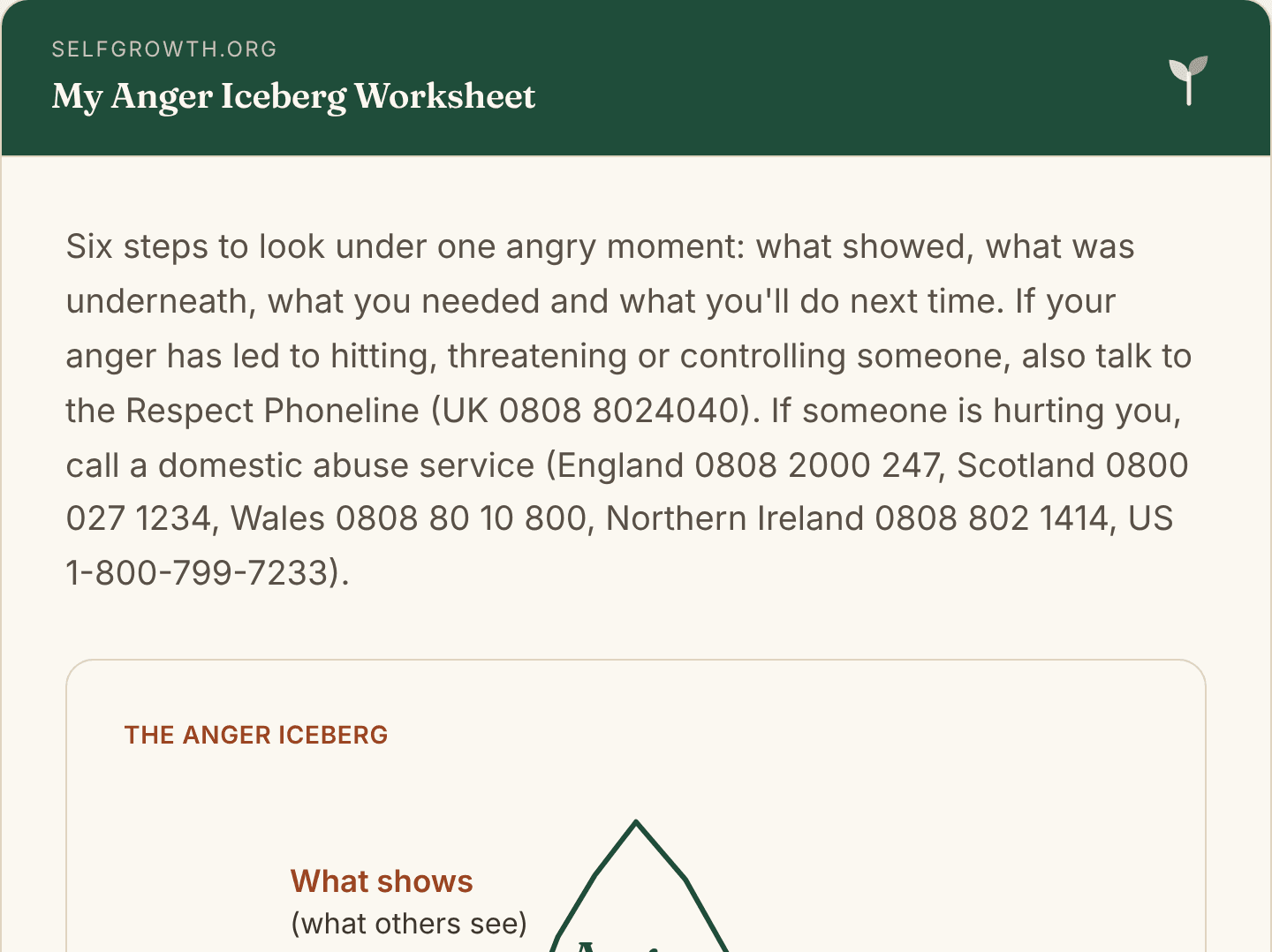
Anger Iceberg Worksheet
A free anger iceberg worksheet and PDF: see what showed on the surface, find the hurt, fear or shame underneath, name what you needed and plan a repair.
Open worksheet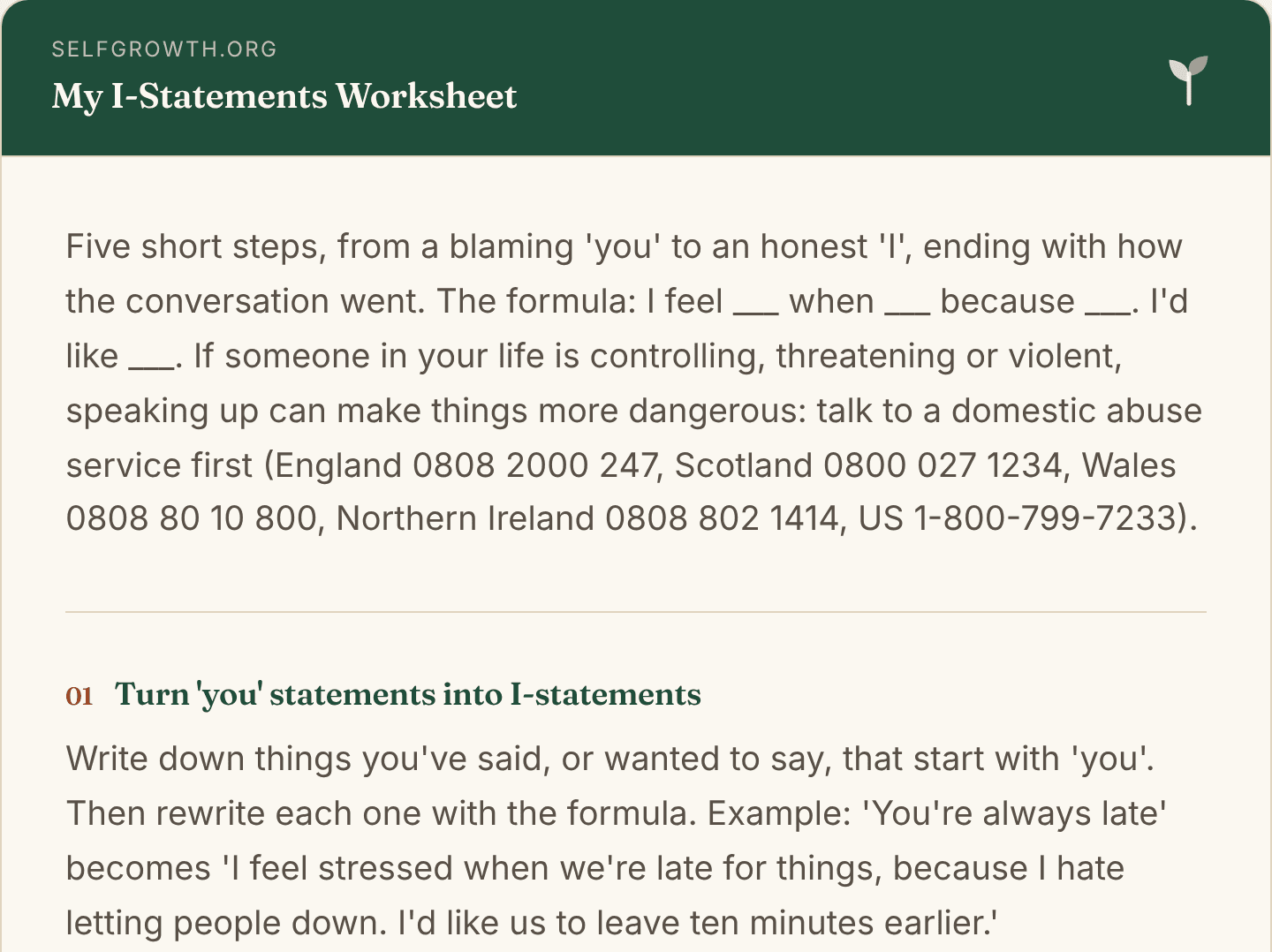
I-Statements Worksheet
A free, printable I-statements worksheet with I statement examples, the 'I feel... when... because...' formula, and space to plan one real conversation.
Open worksheet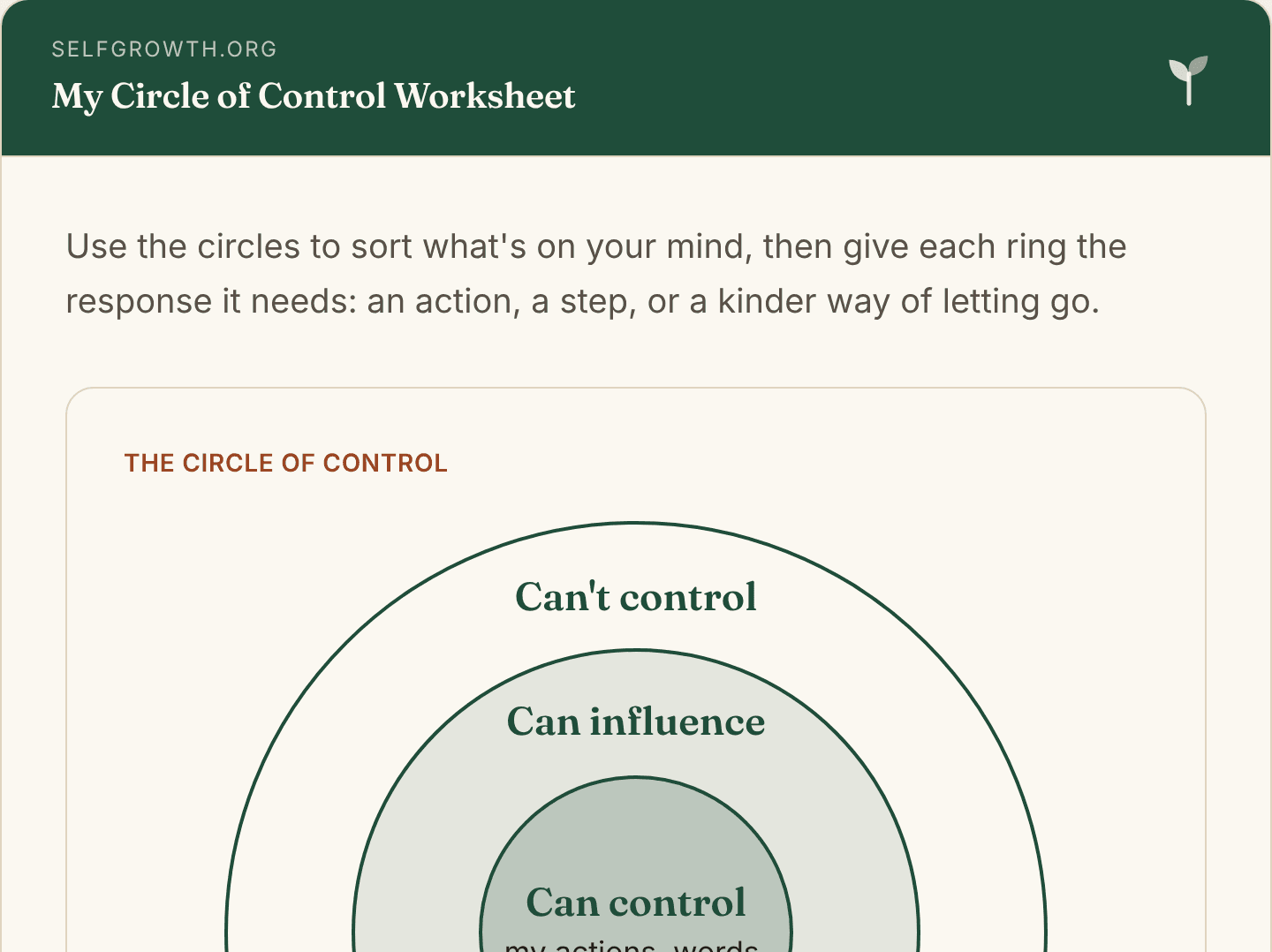
Circle of Control Worksheet
A free circle of control worksheet: sort your worries into what you can control, influence and can't control, then choose one step for each. Free PDF.
Open worksheetRelated guides
New worksheets, straight to your inbox
An occasional new worksheet or tool, sent only when there's something genuinely worth your time. No spam, no pressure, unsubscribe any time.